

Home / Crane lighting / Mobile tower crane
First unfolding the boom in the dark, then hoisting for hours above a construction site. That requires two different luminaires, and that is precisely why there is so often one too few hanging.
The setup requires a narrow beam to illuminate a sixty-meter boom from the platform. The work thereafter requires an even light distribution across the construction site beneath the boom, in compliance with EN 12464-2:2024, without shining into the surrounding area. We deliver both as a single set, powered by a single driver box, tailored to your crane type and boom length.
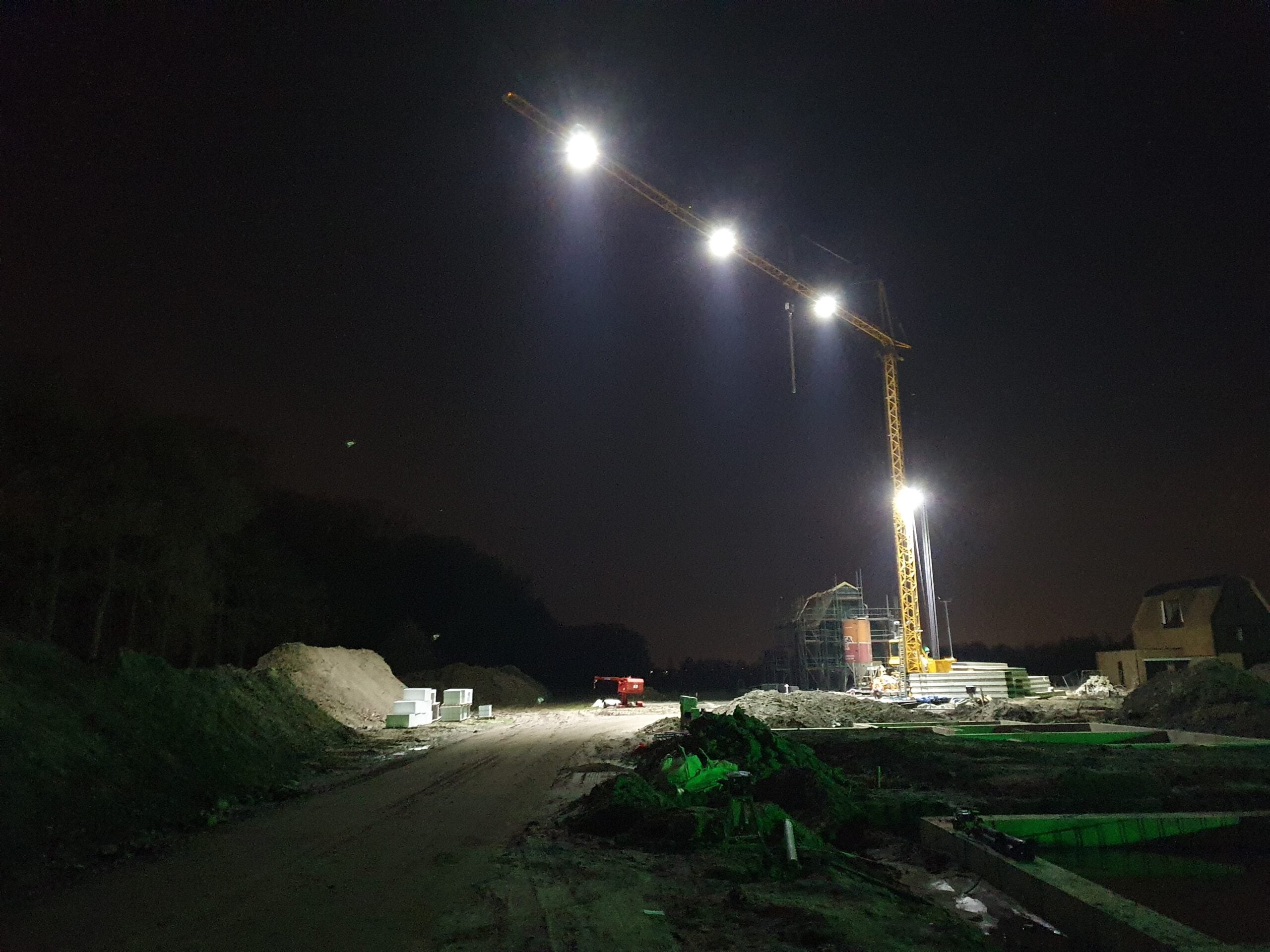
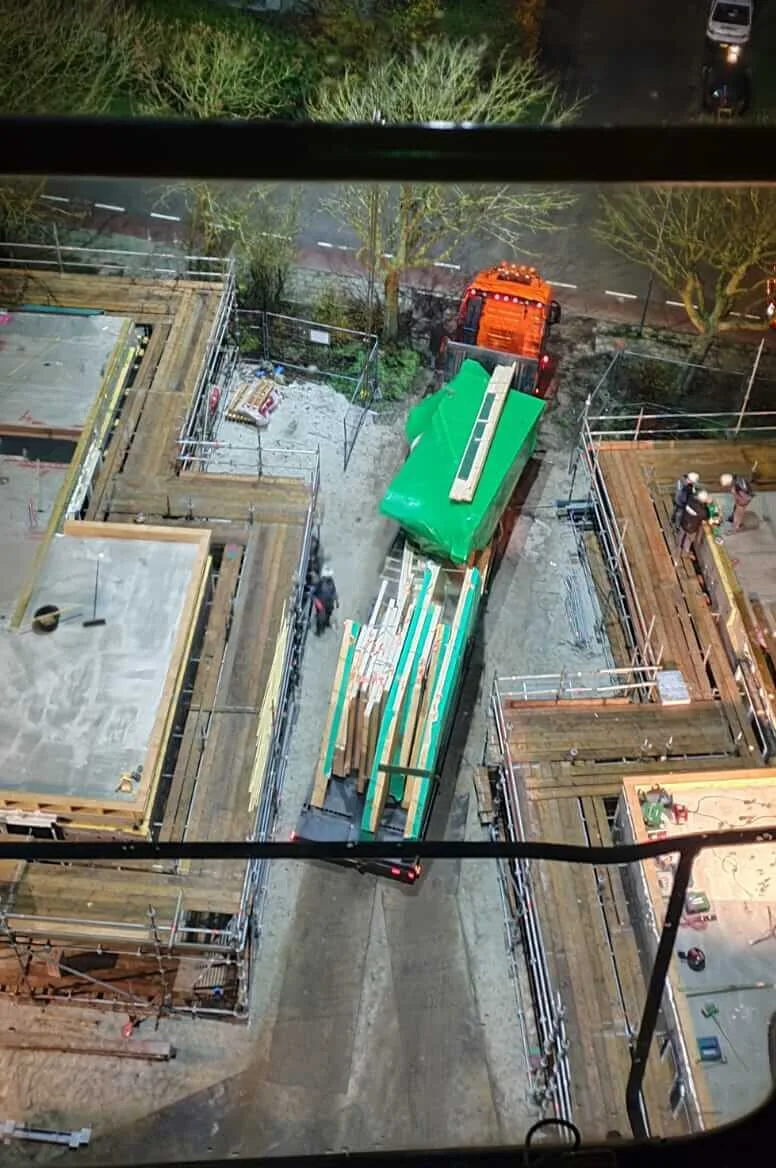
A quickly erecting crane from Liebherr, Spierings, or Potain can be set up in an hour. In winter, that hour almost always falls in the dark, and it is precisely then that sixty meters of boom unfolds above a site where no one has a good view. Whatever gets damaged there, you only see the next morning.
They are in the same set and run on the same driver box, but they do not do the same work. A set with only boom lighting leaves you in the dark while rigging; a set with only a build spotlight does not give construction site work light.

Two to five luminaires along the boom, directed at the work surface below, supplied as a Dual, Triple, Quattro, or Five set. The lens angle is chosen based on the mounting height: the higher the boom, the narrower the beam, so that the light stays on the construction site and not in the surrounding homes.
| Luminous flux per luminaire | 31,000 lm |
| Set of two to five | 62,000 to 155,000 lm |
| Power | 180 to 900 W |
| Efficiency | 172 lm/W |
| Beam angles | 30°, 60°, or 90° |
| Dimensions and weight | 320 × 210 × 190 mm, 3.1 kg |
| Applied to | 40 m installation height |
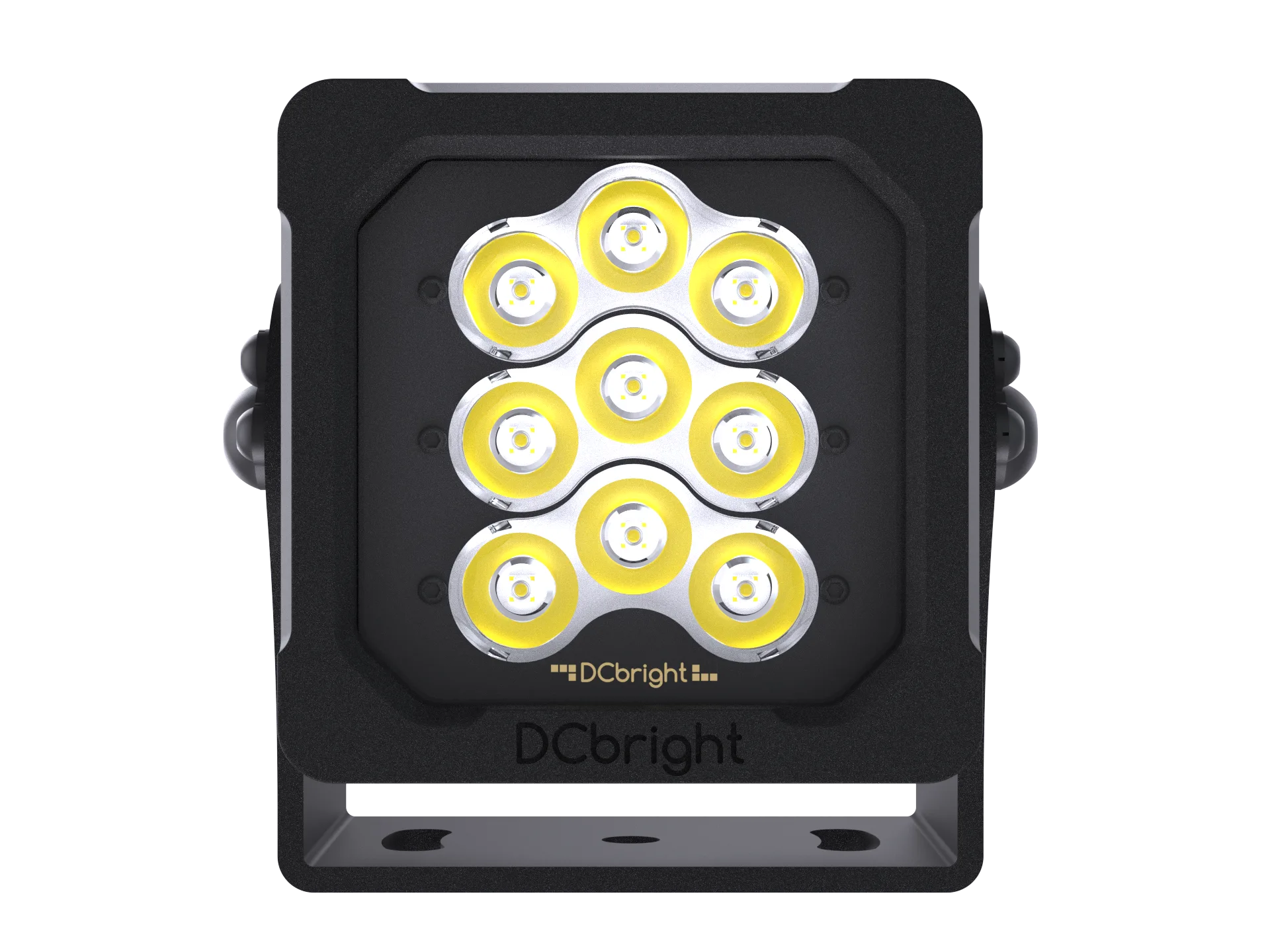
One luminaire on the table, with a 14-degree beam illuminating the entire boom during assembly. Where a xenon lamp first needs to warm up, the LED turns on instantly, which makes all the difference during a one-hour assembly process.
| Luminous flux | 8,400 lm |
| Power | 70 W |
| Beam angles | 14° of 14° × 46° |
| Scope | jib up to 60 m |
| Protection | IP69K and IK10 |
| Warm-up time | none, direct full power |
| Applied to | Spierings AT6 and similar |
A single external driver box powers the entire set, directly at 230 VAC or 400 VAC. No separate power supply per luminaire, and the same set fits any crane type in your fleet.
6500K, 4000K or 2700K. If the construction site borders residences or nature, a warmer color is usually the better choice; we advise on this during the composition.
Aluminum with C5 coating, 360,000 hours expected lifetime according to L90B05, and a five-year industrial usage warranty on the entire set, even with daily setup and teardown.

With a quick-mounting crane, the boom folds up, leaving virtually no mounting height. This makes the luminaire’s external dimensions more important than its luminous flux: anything that protrudes will be damaged during the initial installation. The Snapper measures 320 by 210 by 190 mm and weighs 3.1 kg, keeping it within the boom’s silhouette. The complete drilling pattern is listed in the datasheet.
The boom lighting is supplied as a complete set. All four sets share the same Snapper SNAC, the same 172 lm/W, and the same driver box; what differs is the number of fixtures along the boom and therefore the luminous flux, power, and weight. Which set belongs to your crane follows from the boom length and mounting height, and we calculate that for you.
| Specification | Dual | Triple | Four | Five |
|---|---|---|---|---|
| Snapper luminaires along the boom | 2 | 3 | 4 | 5 |
| Total luminous flux | 62,000 lm | 93,000 lm | 124,000 lm | 155,000 lm |
| Luminous flux per luminaire | 31,000 lm | 31,000 lm | 31,000 lm | 31,000 lm |
| Power consumption | 360 W | 540 W | 720 W | 900 W |
| Efficiency | 172 lm/W | 172 lm/W | 172 lm/W | 172 lm/W |
| Current draw at 230 VAC | approx. 1.6 A | approx. 2.3 A | approx. 3.1 A | approx. 3.9 A |
| Current consumption at 400 VAC | approx. 0.9 A | approx. 1.4 A | approx. 1.8 A | approx. 2.3 A |
| Total weight of luminaires | 6.2 kg | 9.3 kg | 12.4 kg | 15.5 kg |
| Driverbox | 1 external | 1 external | 1 external | 1 external |
| Beam angles per luminaire | 30°, 60°, or 90° | 30°, 60°, or 90° | 30°, 60°, or 90° | 30°, 60°, or 90° |
| Color temperatures | 6500K, 4000K, 2700K | 6500K, 4000K, 2700K | 6500K, 4000K, 2700K | 6500K, 4000K, 2700K |
| Protection | IP69K | IP69K | IP69K | IP69K |
| Warranty | 5 years | 5 years | 5 years | 5 years |
Current draw is calculated as power divided by voltage; the weight is that of the luminaires combined, excluding the driver box and cabling. All sets operate on a single external driver box that can be connected directly to 230 VAC or 400 VAC.
The Piranha PI-9 isn’t included in these numbers. It’s mounted on the table and serves a different purpose: illuminating the boom as it unfolds. So plan on one set of boom lights plus one Piranha, both connected to the same driver box. If you’d prefer just boom lights or just surface-mounted lights, that’s also possible; please specify this in your request.
More luminaires do not automatically mean better light. What matters is the spacing: five luminaires on a short jib cause overlap and glare, two on a long jib leave dark patches between the beams. Give us the make, the type and the jib length and we will determine the set and the beam angle for each position against EN 12464-2:2024.
Following the test crane, the entire fleet followed. In 2019, Jos Blom equipped four cranes and decided to convert all remaining cranes in 2022. Herms in Epe did the same with its Spierings and Liebherr cranes after several tests, replacing both the superstructure and boom lighting.
At Manitowoc, the first IGO T130 cranes in the Netherlands left the factory with our lighting on them, because the luminaires fit within the boom silhouette.
See also the projects, the photo gallery and in the case of the Van der Spek tower crane fleet.
Equipped four cranes with our lighting in 2019 and decided in 2022 to convert all remaining cranes to LED.
Converts its existing Spierings and Liebherr cranes after several successful trials. Both the superstructure lighting and the boom lighting have been replaced.
The first IGO T130 models in the Netherlands were delivered with our lighting, because the luminaires fit within the boom silhouette.


This is the European standard for lighting at outdoor workplaces. It sets requirements for illuminance, uniformity, and color rendering per task. On a construction site, that is not a mere formality: in the event of an accident caused by insufficient lighting, you as the employer are liable, and then the question is what you can prove.
We calculate your crane and boom length and provide the documentation to prove it: illuminance under the boom, uniformity across the work area, and the amount of light spilling outside the site. Free of charge, even if you buy the set elsewhere.
If you are building in an inner-city area or next to residential properties, the lighting calculation must also include an assessment against the NSVV guideline for light nuisance. That report prevents delays in the procedure and discussions with local residents afterwards.
More about how we calculate can be found at lighting advice and lighting calculation. If you illuminate more than one type of crane, the crane lighting hub the overview per machine.
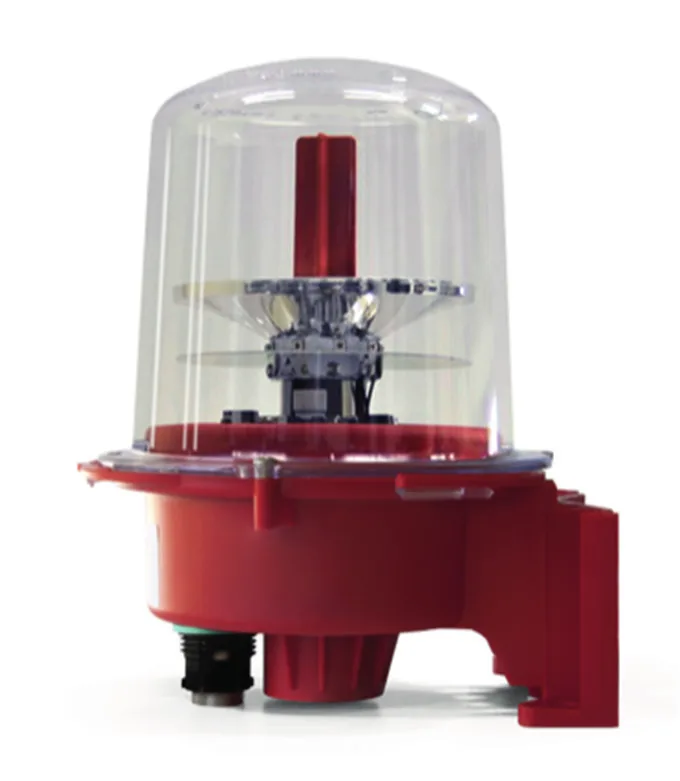
Cranes of 100 metres and higher must be reported to the aviation authority; around airports and low-flying routes lower limits apply. We supply the red obstruction lights, the Lantern L32 of 32 cd and the Lantern M2K of 2,000 cd, with photocell and controller as a complete set from stock, and advise which light belongs at which height.
Can't find your question? Call us with the crane type and boom length at hand, and you'll know what is needed within five minutes.
Because they are two different tasks. The setup requires a narrow 14-degree beam that illuminates a sixty-meter boom from the table; the work after that requires broad, even light on the construction site beneath the boom. A single luminaire that does both does not exist: a beam that reaches far does not illuminate the area directly beneath it evenly.
Probably yes. We supply for Liebherr, Spierings, Potain and other self-erecting cranes, and put together the set for your brand, type and jib length. The Snapper is 320 by 210 by 190 mm and 3.1 kg, small enough to stay within the boom envelope when folded.
This is determined by the boom length and mounting height, not by a lumen target. The four sets range from two to five Snapper luminaires, or 62,000 to 155,000 lumens at 360 to 900 watts. What matters is the spacing between luminaires: five luminaires on a short boom cause overlap and glare, while two on a long boom result in dark areas in between. Provide the brand, model, and boom length, and we’ll determine the set and the lens angle for each position in accordance with EN 12464-2:2024.
No. The Piranha PI-9 is mounted on the table and serves a different purpose: illuminating the boom as it unfolds. So plan on one set of boom lights plus one Piranha, both connected to the same driver box. If you want only boom lights or only surface-mounted lights, that’s also possible.
That depends on the mounting height and how sensitive the surrounding area is. As a rule of thumb: higher up on the boom requires a narrower beam, so that the light stays on the construction site. We determine the angle for each position in the lighting calculation; 30, 60, and 90 degrees are available.
On both. The external driver box can be powered directly with 230 VAC and 400 VAC, without modification. That was done intentionally: in a mixed fleet, you do not want to have to keep two types of sets on the shelf.
The luminaires are designed for the vibration and shock loads of machine use, featuring IP69K against dust and high-pressure cleaning and IK10 against impact during Piranha. A mobile tower crane is assembled and disassembled more often than a fixed crane, and that is the load for which the anchorage is chosen.
Yes, that is the most common assignment. Herms and Jos Blom have converted their entire fleet, usually after a trial setup on a single crane. We look at the existing mounting points and the available cabling, so that the conversion fits within a regular maintenance schedule.
Yes, on one crane in your fleet. That is also the sensible order during a retrofit process: first let one crane run for a season, only then the rest. Your mechanics will immediately see how the assembly works out in practice.
The set is explained accordingly. EN 12464-2:2024 sets requirements for illuminance, uniformity, and color rendering at outdoor workstations; we calculate your crane and boom length and supply the evidence with which you can demonstrate that. That calculation is free of charge.
That is exactly what the lens choice is for. By tuning the beam angle to the mounting height, the light stays on the construction site. If you are building in an inner-city location, we also supply the assessment for the NSVV guideline on light nuisance, so that you can substantiate this to the municipality and local residents.
6500K, 4000K, or 2700K. Cool white provides the sharpest contrast on the work surface; if the construction site borders residential areas or a nature reserve, a warmer color is usually better because it is perceived as less annoying.
Five-year industrial warranty on the entire set. This applies to heavy use on the construction site, including daily assembly and disassembly and road transport.
Looking for individual LED work lights for the cab, the boom or the superstructure, without a lighting plan or installation? The same Goby and Piranha work lights we fit on cranes can be ordered directly from our web shop, Industrial Light Store. For 12 and 24 V, IP69K, with a 5-year warranty on the luminaire. In stock and ordered before 15:00, shipped the same working day.

A mobile tower crane is not the same as a fixed tower crane or a mobile lattice boom crane: the mounting points, the vibration load, and the assembly method differ. If you illuminate multiple types, we will coordinate the sets so that your technicians work with a single system.
Lighting for the mobile tower crane belongs to the sector mobile machines and equipment, and at the construction site near construction and infrastructure.
Lighting from the jib of a self-erecting crane, using the DarkLicht crane frame for fully shielded light.
The Crane Light Director for telescopic cranes, where the light must tilt with the boom.
The Crane Light Stabilizer keeps the beam in place while the boom moves.
Lighting for crane runways and bulk handling, where salt, wind and continuous operation determine the requirements.
Red aviation lights to ICAO Annex 14 for the top and the jib ends, with control and power supply.
Light distribution, on-board power and mounting per crane type, on one overview page.
Brand, type and boom length are enough to get started. We determine the number of luminaires, the lens angles, the mounting points and the driver configuration, and calculate the light level under the boom according to EN 12464-2:2024.
Your request is being reviewed by an engineer. We will respond within 1 business day.