

What your field needs is in the standard, what it costs is in your budget. We calculate both: for each sport, the lighting levels and uniformity from NEN-EN 12193, as well as the power capacity, consumption, and the corresponding subsidy.
We illuminate a sports field to 200 lux with eight poles and one luminaire per pole. That means fewer mounting points, less cabling, and less maintenance at height compared to a traditional setup with three to six floodlights per pole. Because our optics are full cut-off, the light stays on the field and not in the neighbors' gardens.

Whether your association has a permanent in-house installer, or a municipality must tender the work, that does not have to be a reason to look elsewhere. We work both ways: with our own VCA-certified technicians, or as a supplier to the party carrying out the work.
Lighting design, supply, installation, and commissioning by our own VCA-certified technicians. A single point of contact, a single warranty, a single invoice. Subsequent maintenance as well, either under contract or on demand.
Do you have an in-house installer, or has the work been contracted out? Then we supply the luminaires, the lighting plan and the installation material, and we support your installer with specifications and installation instructions.
Lux levels, uniformity, and pole configuration vary by sport, and the difference is greater than most quotes show. A training-level hockey field requires almost three times as much light as a football field at that same level. Below is what is required per sport and what is different.
The most common field, and the field with the most errors: too little light in the corners and too much spill over the property boundary. Our configuration is 4 × 1,200 W plus 4 × 1,800 W on a field of 100 × 64 m, and 8 × 1,800 W on 105 × 69 m.
Hockey has its own, stricter table. A Class III hockey pitch requires 200 lux at U2 0.70, whereas a football pitch at that same level suffices with 75 lux at U2 0.50: almost three times as much light and a much tighter distribution. The ball is small, low, and fast, so uniformity carries more weight here than in football. Anyone who quotes for a hockey pitch with a football configuration falls short of the standard.
The korfball post stands in the middle of the playing field and not on the edge. As a result, the shadow effect of the mast structure carries more weight: a player under the basket is not allowed to stand in their own shadow. Therefore, we deliberately do not place the masts symmetrically on the long side only.
At the storage area, a player looks straight up, so glare is the determining design point here. We therefore prefer to place higher than usual: at 12 to 15 meters, the light enters at a smaller angle and a player does not look into the beam. In padel, the glass walls reflect the light back onto the court. For padel, the standard prescribes a clear safety zone to be maintained at both entrances: 2 m wide, 4 m high, and 4 m from the center to both sides. No mast or luminaire is allowed to be located there.
Rugby uses the same goalposts as soccer, but the pitch, at 144 × 69 m including the in-goal areas, is considerably larger. Anyone who adopts a soccer lighting setup will fall slightly short in the in-goal areas, precisely where the ball most often goes high.
The infield and outfield require two different light levels in a single installation: for baseball class III, 300 lux inside and 200 lux outside; for softball, 200 and 100 lux. The infield is 27.5 × 27.5 m (softball 20 × 20 m), and the outfield is 120 × 120 m (softball 90 × 90 m). The transition between both zones must be smooth, otherwise a high ball will disappear into the dark section.
An outdoor handball field is small and is often located close to buildings or other fields. That makes light pollution here more of a problem than the lux levels: with four light points at a limited height, a sharp cut-off is the difference between receiving complaints or not.
In discus throw, javelin, and hammer throw, the object can rise above the light beam and be invisible during part of its flight. That is a safety issue and not a comfort issue: the beam must extend high enough, or the throwing area must be illuminated separately.
Three things deviate: there is dust in the air, animals are startled by flickering, and the arena is small relative to the desired mast height. Flicker-free drivers are therefore not an extra but a requirement, and the shielding must prevent a horse from looking directly into a light source from the arena.
Bocce, beach volleyball, golf, a training field behind the clubhouse, or a multi-sport field for two sports: the calculations are the same. NEN-EN 12193 has a separate table for each sport, and we test your field against it, along with the requirements of your sports association. Provide the dimensions and usage, and we will tell you which class applies.
We focus on outdoor sports at the club and field level up to and including regional competition. For stadiums with grandstand capacity, television requirements, and camera angles, and for indoor sports in sports halls and gymnasiums, another party is a better fit. We prefer to say this now rather than after three meetings.
A light calculation is an image with numbers; what a field actually looks like can only be seen in a photo taken from the sidelines and from outside the fence. In every image, pay attention to what does not emit light: the sky above the mast, the facades behind the field, and the gardens along the property boundary.


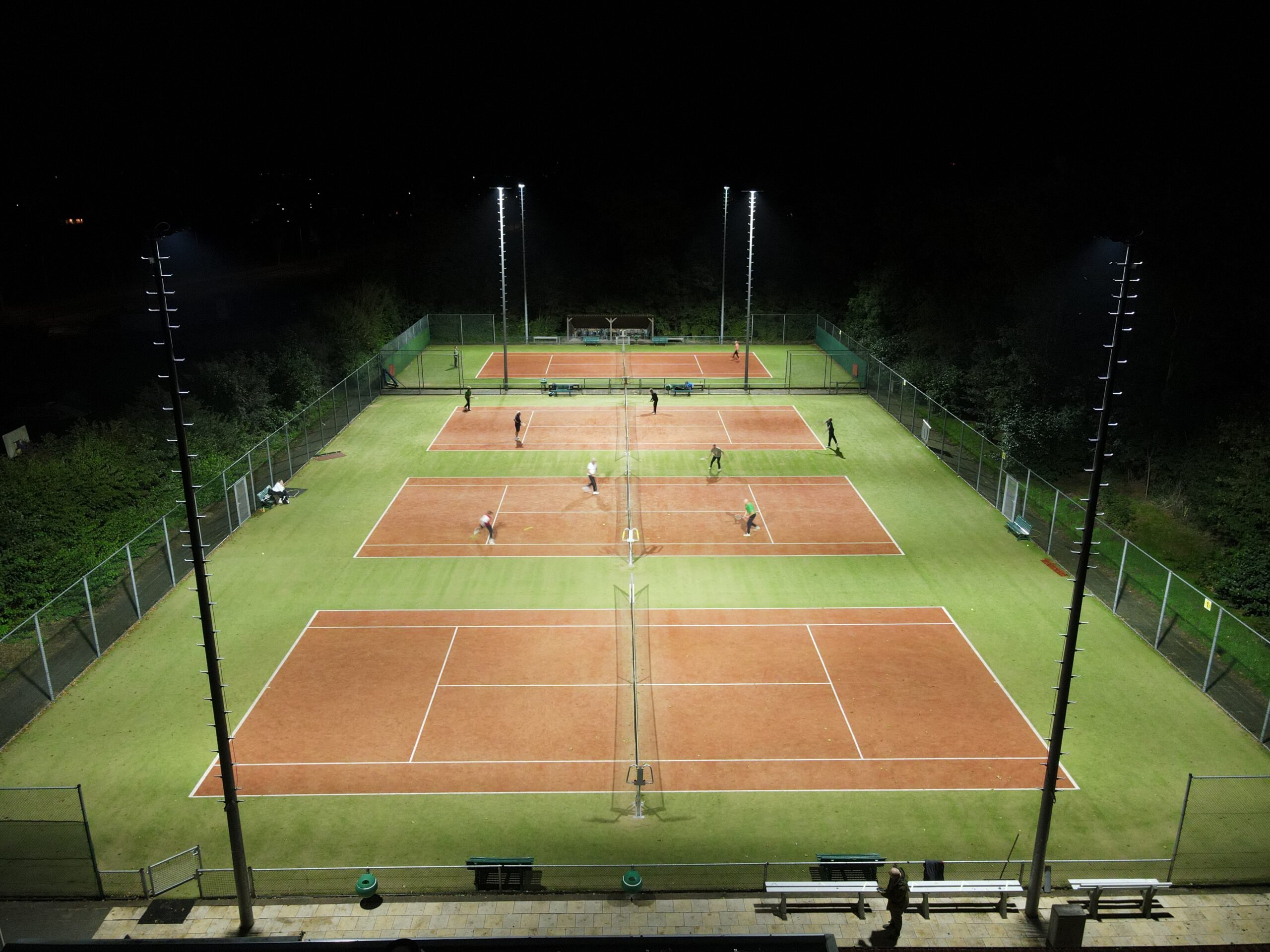


Would you like to see it at your own club before anything is decided? We will hang a test luminaire on your own pole, on a training evening, and measure what ends up on the field and across the property boundary.
For every project, we provide the lighting calculation, the measurement report after completion, and photos of the new situation. The latter also serve as the evidence you can present to the municipality or the neighborhood.
See also lighting advice and lighting calculation, or masts on which these installations are located.
NEN-EN 12193:2018 is the European standard for sports lighting. It divides sports into three classes and specifies an illuminance level, uniformity, and colour rendering index for each sport. We hold a license for the standard and test every lighting plan against it.
Training, recreation, school sports, and small club competitions without spectators. This is what most Dutch amateur fields need, and what most clubs end up with.
Club and regional level competition, with short to medium-distance spectators. The configuration we are calculating as an example, eight masts at 200 lux, belongs to this category.
National and international matches, large audience capacity, and long viewing distances. This is stadium work; we are not the right party for that.
The standard is the starting point. Unions and competition regulations can set additional or deviating requirements, for example regarding the level for promotion classes, the measurement procedure, or the reporting during inspections. We test your field against both and state in the lighting plan which requirement comes from where.
Horizontal illuminance, maintained average, in lux. U2 is the uniformity (minimum divided by average), Ra is the color rendering index.
Class III with 75 lux at U2 0.50 is the level at which most amateur fields train. Class II at 200 lux is the level of our calculation examples.
Field hockey has its own, stricter table: U2 0.70 in all three classes, and at class III 200 lux compared to 75 for football. Anyone quoting a hockey field with a football configuration is below the standard.
In padel, the standard prescribes a clear safety zone to be maintained at both entrances: 2 m wide, 4 m high, and 4 m from the center to both sides. No pole or luminaire may be located there.
Two light levels in one installation. The transition between the indoor and outdoor field must be smooth, otherwise a high ball will disappear into the dark part.
Softball is at Class III lower than baseball: 200 lux indoors and 100 lux outdoors. If your club plays both, we rely on the heavier of the two.
For running events in class III, the level may be reduced to 50 lux. For throwing events, the reverse is true: there, in addition to the lux on the ground, the height of the beam also counts.
A field with an average of 200 lux can drop to 60 lux in the corners and reach 400 under the mast. It is impossible to play on that: a goalkeeper looks from dark to light and the ball disappears in the transition. That is why every lux value is accompanied by a U2, the ratio between minimum and average. U1, the ratio between minimum and maximum, must be at least half of U2. We provide the calculation with both values, per measurement point.
The numbers in the standard apply at the end of the maintenance cycle. Anyone who designs based on new value delivers a field that falls below the standard after a few years and fails an inspection. The standard therefore prescribes that the maintenance factor must be agreed upon in advance with the client. We put that factor in the lighting plan, along with the assumption. The values apply to the main playing field; where the standard also mentions a total area, this must be at least 75% of both the illuminance and the uniformity.
For class III and II, Ra 60 is sufficient, for class I the standard requires Ra 70. If filming takes place, even if it is only the club camera behind the goal, the flicker-free nature of the driver also counts: in slow motion, a pulsating luminous flux creates bands in the image. Please state in your request whether cameras will be installed, so that we can take this into account when choosing the driver. For spectator areas, an average of at least 10 lux applies when seated and 20 lux on stairs and inclined surfaces, and the standard requires that the lighting can be stopped safely in the event of a malfunction; continuing a match requires at least the class III level.
In three steps: first the energy bill with our own configuration, then the subsidy, and then the payback period based on your own figures. We calculate with €0.30 per kWh including VAT and 500 operating hours per year. Both are visible here so you can replace them with your own numbers.
We illuminate a sports field at 200 lux, class II, with eight poles and one luminaire per pole. Where a traditional installation has three to six floodlights per pole, there is only one here: fewer mounting points, less cabling, fewer maintenance visits at height, less wind load on the pole, and a calmer silhouette at the sports park.
Based on 500 operating hours per year and €0.30 per kWh including VAT. An amateur association is generally not subject to VAT, so this is the amount you actually pay. If you run them seven evenings a week, calculate with your own operating hours.
The clubs that switched to us saw their energy bills drop by 68 to 80%. That has been measured at those clubs.
Of all the light produced by our luminaires, approximately 60% reaches the field. In a traditional installation, that figure is 40 to 55%. The difference is lost there in the air, against the building facades, and beyond the property line: you pay for it, and the neighborhood suffers the consequences.
That’s not just a bonus from our lighting system,that’s what it was built for. For a 100 × 64 m field, 1,280,000 lumens are required on the playing surface to achieve 200 lux; the eight luminaires, at 171 lm/W, deliver a gross output of 2,052,000 lumens. That’s 62% efficiency on the field, and 59% on the larger field. Verifiable, and that’s perfectly fine.
Since 2026, LED field lighting has been covered by DUMAVA, RVO’s subsidy program for sustainable social real estate. Amateur sports clubs and sports facilities are explicitly eligible for this program, and LED sports field lighting is explicitly listed as an eligible measure. Individual measures: 20% of the project costs, with a minimum subsidy of €2,500 and a maximum of €1.5 million. An integrated project: 30%, and up to 40% for high energy performance.
We guide the application and provide the substantiation requested by RVO: lighting plan, power statement, calculated savings, and specifications. See subsidy process and guidance.
As of 2026, the BOSA program has been scaled back, and sustainability measures have been removed. The base rate was reduced from 30 to 20%, the increased rate from 40 to 30%, and that increased rate now applies only to accessibility, circularity, and climate adaptation. Energy savings and LED lighting were covered under the 40% category through 2025 and are no longer funded through BOSA. The annual budget decreased from approximately €80 million to €46.5 million.
BOSA remains the second track for the non-energy part of a project: construction, maintenance, and the modifications that do fall under it. See BOSA and DUMAVA 2026.
What works best for your pitch depends on your masts, your current luminaires, and your operating hours. An average from a brochure doesn't tell you anything about that. Calculate it yourself with our calculator (number of luminaires, type, wattage, operating hours, and electricity price), or let us do it based on your latest annual statement.
The DUMAVA application window is open from June 1 through October 16, 2026. The budget is €405 million; as of August 3, 2026, approximately 70% of that amount remained available, or about €283.5 million. An application requires a well-documented lighting plan, so be sure to start working on it well in advance.
Sports complexes are increasingly bordering new developments or protected areas. The standard therefore limits the light that spills into the surroundings, per environmental zone. That is no minor detail: it is the most common reason for a lighting plan to be rejected or for a club to still have to dim its lights after completion.
By definition, a full cut-off luminaire emits nothing above the horizontal, so the upward luminous flux is 0%. That is the only value permitted in zone E1. A sports complex next to a nature reserve or in a rural area is in practice E1 or E2, and a large portion of the luminaires on the market are unsuitable for that.
We assess every plan against the NSVV Light Nuisance Guideline and are affiliated with the NSVV code of conduct for light calculations. If your municipality requests a light nuisance substantiation for the environmental permit, we provide it: calculations with facade points, upward light ratio, and the zone in which the sports park is located.
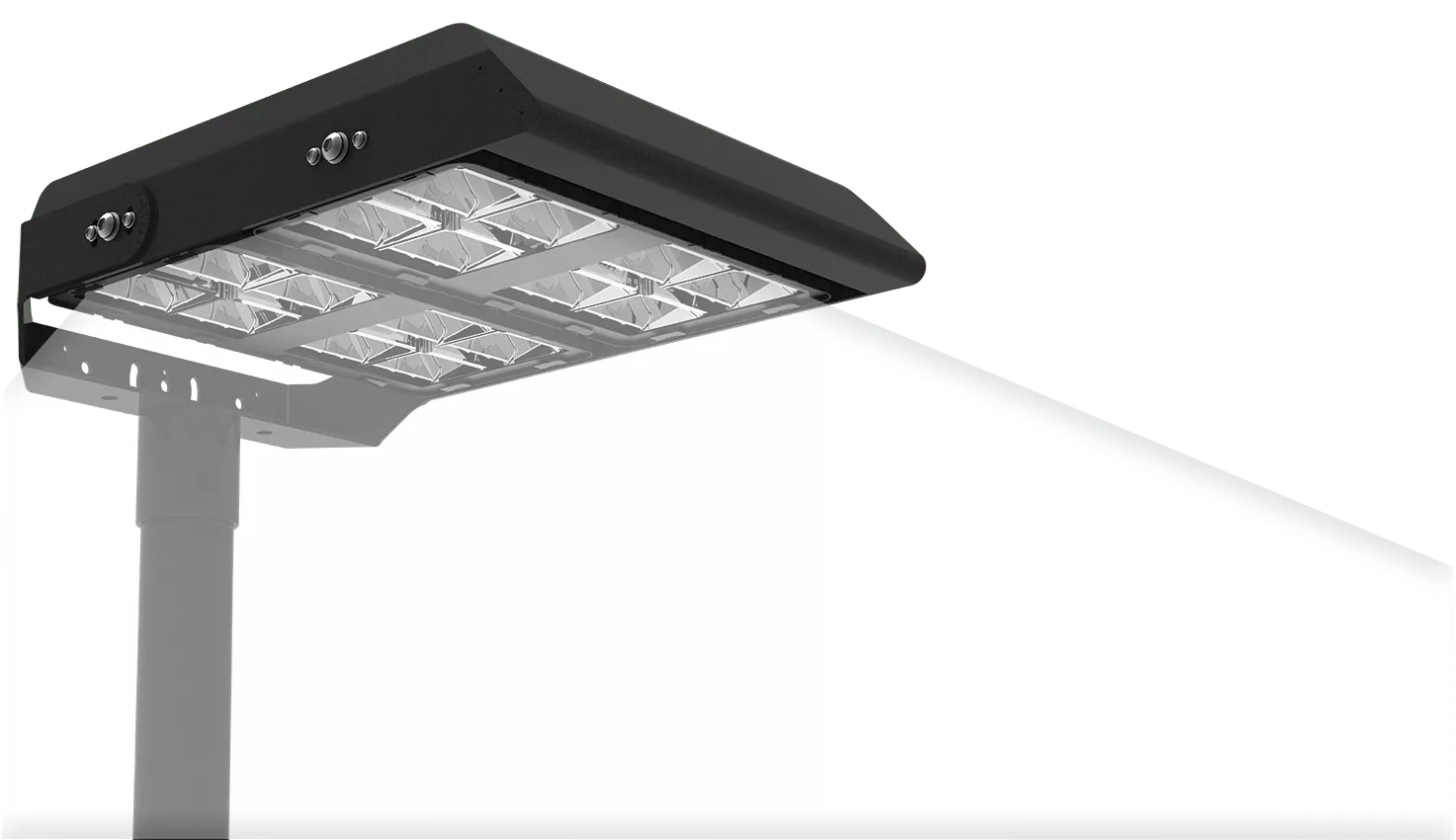
The DarkLicht features a modular reflector optic where the light source is hidden behind the shielding. The luminaire is flush-mounted. Anyone standing by the field will therefore not see any light source, and nothing escapes above the horizontal.
At many sports parks, the lights are left on because the last coach forgot to turn them off, or they are not on because the key holder wasn't there. That is a management problem, not a lighting problem, and it can be solved with control systems. We supply dimmable and switchable lighting, and tailor the schedule to how your park operates.
Important regarding light pollution: a curfew,the time after which stricter limit values apply,can only be met if the installation complies with it. A dimming profile that switches to a lower setting at 11:00 PM is often the difference between receiving a complaint and not receiving one.
The basics: on at a set light level or time, off at a fixed time. No key needed, and no pitch that stays on all night because the last coach forgot.
On and off per pitch or per half pitch, with a permission structure so not everyone can switch everything. Handy for sports clubs with multiple teams on the same evening.
Switching by reservation or occupancy detection: the light turns on when the pitch is in use and off when the last group has left. In practice, this delivers the greatest savings on top of the LED efficiency gains.
One installation, two levels: training on Class III and playing on Class II. That saves power on the evenings when there is no match, and a dimming profile for the late hours keeps you within curfew limits.
Often it is possible, but not just like that. New luminaires have a different weight and wind-catching surface than what was there, and your pole is calculated for the old situation. With one luminaire per pole instead of four, the load usually goes down, which works in your favor. We look at the pole certificates, the year of construction, the condition of the base and the doors, and the existing cabling. If there is no documentation, a visual inspection and sometimes a pole calculation is necessary; the costs thereof are a fraction of a new pole.
Should replacement prove necessary, we will supply the masts. See lighting poles and high mast lighting for the categories, the foundation and the regime: up to 20 meters AND 40, above that a project-specific assessment according to the Eurocode.
Mounting on a light pole is working at height: this requires VCA**, the right aerial work platform or climbing equipment, and a task risk analysis per location. Our installers are certified for this. If your own installer performs the work, we provide the installation instructions, tightening torques, and connection diagram, and that responsibility remains with them. See installation and maintenance.
Indicative, and always the result of the lighting calculation. In case of doubt, we prefer to go higher: the higher the luminaire is mounted, the smaller the angle at which the light falls onto the field. As a result, the light stays on the playing surface instead of spilling past it, eliminating the need to tilt the luminaires. It is precisely that tilting which causes discomfort and glare. Therefore, a taller pole is not a more intrusive measure, but rather a calmer lighting image.

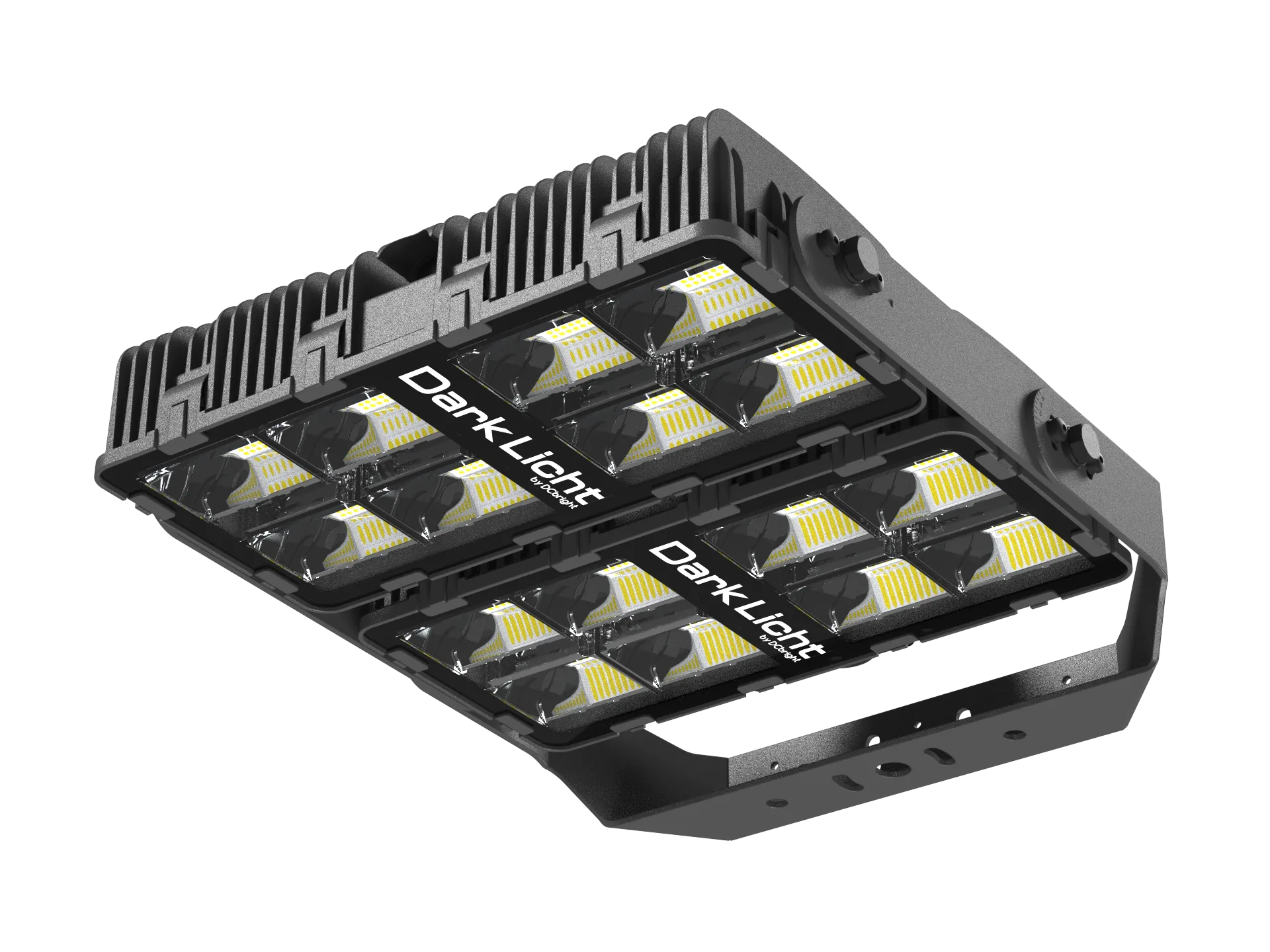
On sports fields, we use the DarkLicht floodlights: full cut-off, low-hanging, with modular reflector optics that direct the light so precisely that virtually none of it falls outside the field. The light source is concealed behind the reflector, so nearby residents are not exposed to a direct light source.
One luminaire per pole, eight poles, 200 lux across the entire field. That is the configuration, and it has been recalculated.
On a sports field, it is all about the larger versions: DarkLicht One, Two, and Three, from 320 to 1,800 W. Which of these applies to your field follows from the field size and mast height; for smaller pitches and lower masts DarkLicht D the more compact choice. Request a trial luminaire to see it on your own field.
About quality and warranty: Product quality and our quality labels.
Five years on the complete luminaire. As long as a maintenance contract is in place with us or with a party designated by us, we extend the warranty on the housing to ten years. Without an active maintenance contract, the standard period of five years applies.
No quotes, but what was there, what is there now, and what the bill did. The percentages come from the clubs themselves, from their own annual statements.

The fields at RKAV Volendam were equipped with conventional floodlights with a high tilt angle, causing light to spill over the property line. They are now equipped with DarkLicht floodlights, mounted flush on the existing poles. The club maintains the same level of competition while paying 74% less for electricity for the field lighting.

soccer
Replacement of the existing field lighting on the playing fields, while retaining the poles. The goal was to reduce both the energy bill and complaints from the neighborhood: thanks to the flush mounting and the sharp cutoff, virtually no light now escapes beyond the field. Measured reduction in energy costs: 72%.

Tennis courts with low mounting heights, where glare during the serve was the key consideration. The courts have been converted to DarkLicht with shielded optics. This represents the greatest savings among our five sports projects: 80% lower energy costs, with improved lighting on the court.

Retrofit of the field lighting at the soccer club, while retaining the existing light pole locations. Of the five case studies, this one shows the lowest savings, and there’s a reason for that: some of the lighting here was already newer. Even so, the savings still amount to 68%, which indicates the savings achieved by the optics alone.
A korfball field where the pole is located in the center of the field, so shading has a significant impact. The pole configuration was adjusted accordingly, and the luminaires were replaced with DarkLicht models. Energy costs for the field lighting decreased by 78%.
We will visit with a test luminaire and hang it on your own pole, so you can see the light distribution before making a decision. We provide the lighting calculation free of charge, even without an order.
Whether you carry out the work yourself or write specifications for a municipality, you are our customer, not our competitor. Below are the six questions we get asked most often in practice, complete with answers instead of a list of collaboration benefits.
DIALux calculation with measurement points, IES files of the applied luminaires, installation drawings, wiring diagrams, and datasheets. The datasheet is a direct download; IES and 3D are supplied by us upon request.
Yes. A five-year warranty on the complete luminaire applies regardless of who installs it, provided it is done according to our installation instructions. The extension to ten years on the housing does not depend on the installer, but on the maintenance: it applies as long as there is a maintenance contract with us or with a party designated by us. That is immediately a reason to sell the maintenance contract along with it.
Both are possible. If you supply the work as the main contractor, we will invoice you. If the association or municipality wants to buy directly and you only install, we will invoice them and you remain the contractor for the installation.
We handle the warranty claim and supply the replacement luminaire. We will agree in advance on who goes there: if you do it yourself, we will reimburse the luminaire and materials; if you do not have equipment for work at height, our technicians will come.
We ship standard DarkLicht models from stock or on short notice; for a full field installation, we’ll coordinate delivery with your installation schedule. Please specify your desired installation week in your request, and we’ll let you know if that’s feasible before you place your order.
We supply both. In the case of specifications based on functional requirements, we help write the text regarding lux, uniformity, upward light output, and maintenance factor. If a competing luminaire is specified, we provide an equivalence statement with the substantiation for each requirement. For municipalities and engineering firms, this is often the reason to call.
Is your question not listed? Call us with the field dimensions and the number of masts at hand, and you will have an indication within ten minutes.
For training and recreation, class III, NEN-EN 12193 requires 75 lux average maintained at a uniformity U2 of 0.50. For competition at club and regional level, class II, this is 200 lux at U2 0.60. Class I, national and international, requires 500 lux at U2 0.70. These are maintained values: they apply at the end of the maintenance cycle.
Hockey has its own, stricter table: 200 lux at U2 0.70 for class III, 300 lux at U2 0.70 for class II, and 500 lux at U2 0.70 for class I. At the training level, that is almost three times as much light as in football, with a much tighter distribution, because the ball is small, low, and fast.
Korfball follows the same table as football: 75 lux at U2 0.50 for class III, 200 lux at U2 0.60 for class II, and 500 lux at U2 0.70 for class I. The difference lies in the layout: the korfball pole is in the middle of the field, so shadow effects from the mast positions carry more weight.
For tennis and padel, 200 lux at U2 0.60 applies for class III, 300 lux at U2 0.70 for class II, and 500 lux at U2 0.70 for class I. For padel, a safety zone must remain clear at both entrances: 2 m wide, 4 m high, and 4 m from the center to both sides. No pole or luminaire may be located there.
Rugby follows the table for football: 75 lux for class III, 200 lux for class II and 500 lux for class I. However, at 144 × 69 m, the field is considerably larger, so more masts are needed and the in-goal zones require explicit attention in the calculation.
In baseball and softball, two levels apply within a single installation. Baseball class III: 300 lux on the infield at U2 0.50 and 200 lux on the outfield at U2 0.30; class II 500 and 300 lux. Softball class III: 200 lux infield and 100 lux outfield. The infield is 27.5 × 27.5 m in baseball and 20 × 20 m in softball.
Handball follows the football table: 75 lux for class III, 200 lux for class II, and 500 lux for class I, on a 40 × 20 m court. Because the court is small and often located close to buildings, the light nuisance aspect is usually more decisive here than the lux requirements.
For athletics and riding schools, 100 lux at U2 0.50 applies for class III, 200 lux at U2 0.50 for class II, and 500 lux at U2 0.70 for class I. For running events, the level may be lowered to 50 lux in class III. For throwing events, the height of the light beam also matters: discus and javelin can rise above it.
That depends on the level, the field size, whether your masts can remain in place, and whether we install or your own installer does. What we can state precisely is the operation: illuminating a competition field to 200 lux with eight masts and one luminaire per mast, 12.0 kW on a 100 × 64 m field. That is 6,000 kWh and approximately €1,800 in electricity per year at 500 operating hours and €0.30 per kWh including VAT.
For LED field lighting, the DUMAVA code has been 20% since 2026 for project costs associated with individual measures, 30% for an integrated project, and up to 40% for high energy performance, with a minimum subsidy of €2,500 and a maximum of €1.5 million. The application window is open through October 16, 2026. We provide the supporting documentation required by RVO and assist with the application process.
As of 2026, the BOSA program has been scaled back: the base rate was reduced from 30 to 20%, the increased rate from 40 to 30%, and that increased rate now applies only to accessibility, circularity, and climate adaptation. Energy savings and LED lighting were covered under the 40% category through 2025 and have been removed from it. The annual budget decreased from approximately €80 million to €46.5 million. LED sports field lighting is now explicitly listed in DUMAVA as an eligible measure.
We do not calculate that with a fabricated investment amount. The result depends on your masts, your current luminaires, and your operating hours. Fill in the calculator with your number of luminaires, type, wattage, operating hours, and electricity price, and you will receive a report, or send us your latest energy bill and we will calculate it for you.
Often yes. New luminaires have a different weight and wind-catching surface than what was hanging there, so the pole must be reassessed. But with one luminaire per pole instead of four, the load usually goes down. We look at the pole certificates, the year of construction, the condition of the base, and the cabling. Without documentation, an inspection and sometimes a pole calculation is required.
By designing for the surrounding area and not just for the field itself. The standard limits the light on facades and the upward luminous flux per zone: in E1, 0% is allowed upward; in E2, 5%. By definition, a full-cut-off luminaire emits no light above the horizontal plane and meets that 0% requirement. In addition, a dimming profile is helpful for late-night hours, and a calculation using facade points that you can show to the neighborhood.
For replacing luminaires on existing poles usually not; for new or taller poles often yes. The zoning plan or environmental regulation can also establish limit values for light pollution, especially next to a residential area or Natura 2000 area. We provide the light pollution substantiation with the application: calculation with facade points, upward light output ratio, and the zone in which the park falls.
Yes. That is possible by reservation or through occupancy detection: the light turns on when the pitch is in use and off when the last group leaves. In practice, that yields the greatest savings on top of the LED efficiency, because it tackles the operating hours instead of just the power consumption.
Yes, per field or per half-field, with a permission structure so that not everyone can control everything. We usually combine that with a time switch as a backup, so the lights also turn off if no one thinks of the app.
Yes. One installation can operate on two levels: training on Class III and playing on Class II. That saves power on nights without a match, and a dimming profile for the late hours keeps you within the stricter curfew limits.
The DarkLicht luminaires we use on sports fields have a lifespan of 103,500 hours, L90B05. At 500 operating hours per year, that’s a service life that no club will reach within a single generation. The AC drivers have a service life of more than 130,000 hours.
Five years on the complete luminaire. As long as there is a maintenance contract with us or with a party designated by us, we extend the warranty on the housing to ten years. Without an active maintenance contract, the standard period of five years applies. We prefer to call it that rather than “ten years warranty,” because the latter is a promise that is not true in all cases.
Yes, provided it is installed according to our installation instructions. The five-year period is not dependent on the installer. The extension to ten years on the housing depends on the maintenance contract, regardless of who did the installation.
Yes. That is one of the two routes on this page: we supply luminaires, a lighting plan, and installation materials, and your installer carries out the work. You will then also receive the installation instructions, connection diagrams, and IES files.
We do that regularly. For an association with a fixed in-house installer, or a municipality that has to tender and cannot award contracts directly, that is often the only workable route. We support your installer with specifications, installation instructions, and telephone consultations during execution.
Yes, both. In a functional specification, we include the requirements for lux, uniformity, color rendering, upward light output ratio, and maintenance factor. If a different luminaire is prescribed, we provide a declaration of equivalence with the justification for each requirement.
Then it will be replaced; with one luminaire per mast, a failure is immediately noticeable on that part of the field. Therefore, we keep the standard models in stock and agree upon a response time in the event of a maintenance contract. Without a contract, we handle it as a warranty claim, but in that case the availability of equipment for working at height determines the lead time.
For club cameras and streaming at the club and regional level, yes: then the color rendering (Ra 60 for class II and III, Ra 70 for class I) and the flicker-free nature of the driver determine the image. Please indicate when submitting your request whether filming will take place, and we will select the driver accordingly. For television productions with slow motion and high camera positions, stadium-grade work is required; we are not the appropriate party for that.
Usually, field lighting falls under the association's building or inventory insurance, but the mast and luminaire are not always automatically included. Provide your insurer with the investment sum, the number of masts, and the luminaire specification. We provide a statement with types, quantities, and values for that purpose.
A lighting plan is the technical justification: calculation in lux, U2 and U1 per measurement point, mast positions, luminaire types, maintenance factor, and testing against the standard and your sports federation's requirements. A quotation is the price for carrying out that work. We create the lighting plan free of charge, even if you do not award us the contract.
For an association, a municipality, a installer or a consultancy agency. We produce the lighting calculation free of charge, even without an order, and state which class applies and whether your poles can remain in place.
Your request is being reviewed by an engineer. We will respond within 1 business day.