

Home / Crane lighting / Tower crane
A tower crane hangs above everything. What you hang there shines not only on your work, but also into the surrounding bedrooms. With full cut-off luminaires in a custom crane frame, the light stays within the construction fences.
At the MORE construction site in Leiden, that resulted in 73 percent less energy consumption and the title of best-performing construction site in the Netherlands. Not because there was less light, but because nothing spilled over the edges anymore.
Download the tower crane brochure, pdf
Also in: Nederlands · English · Deutsch · Français · Español
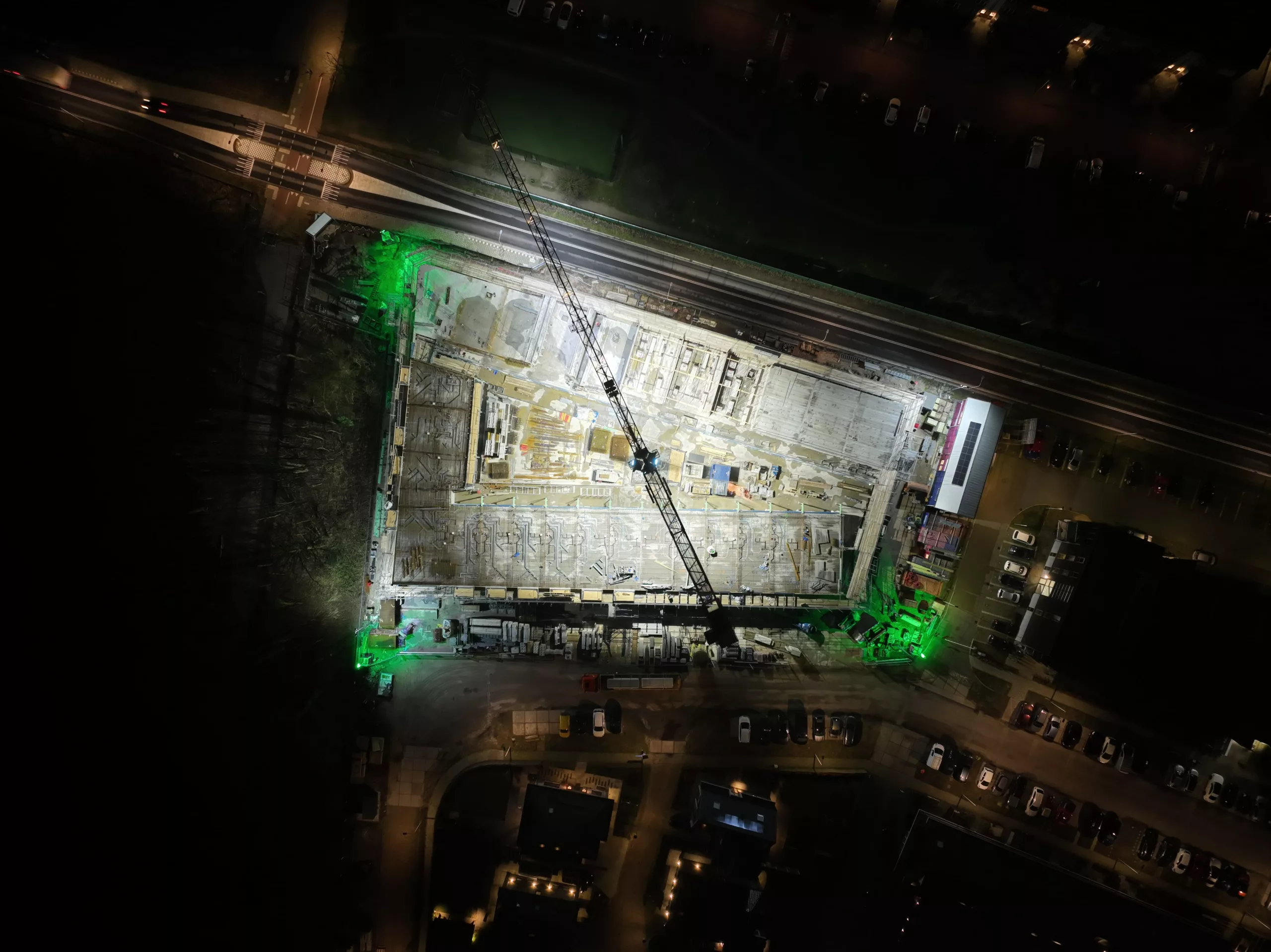
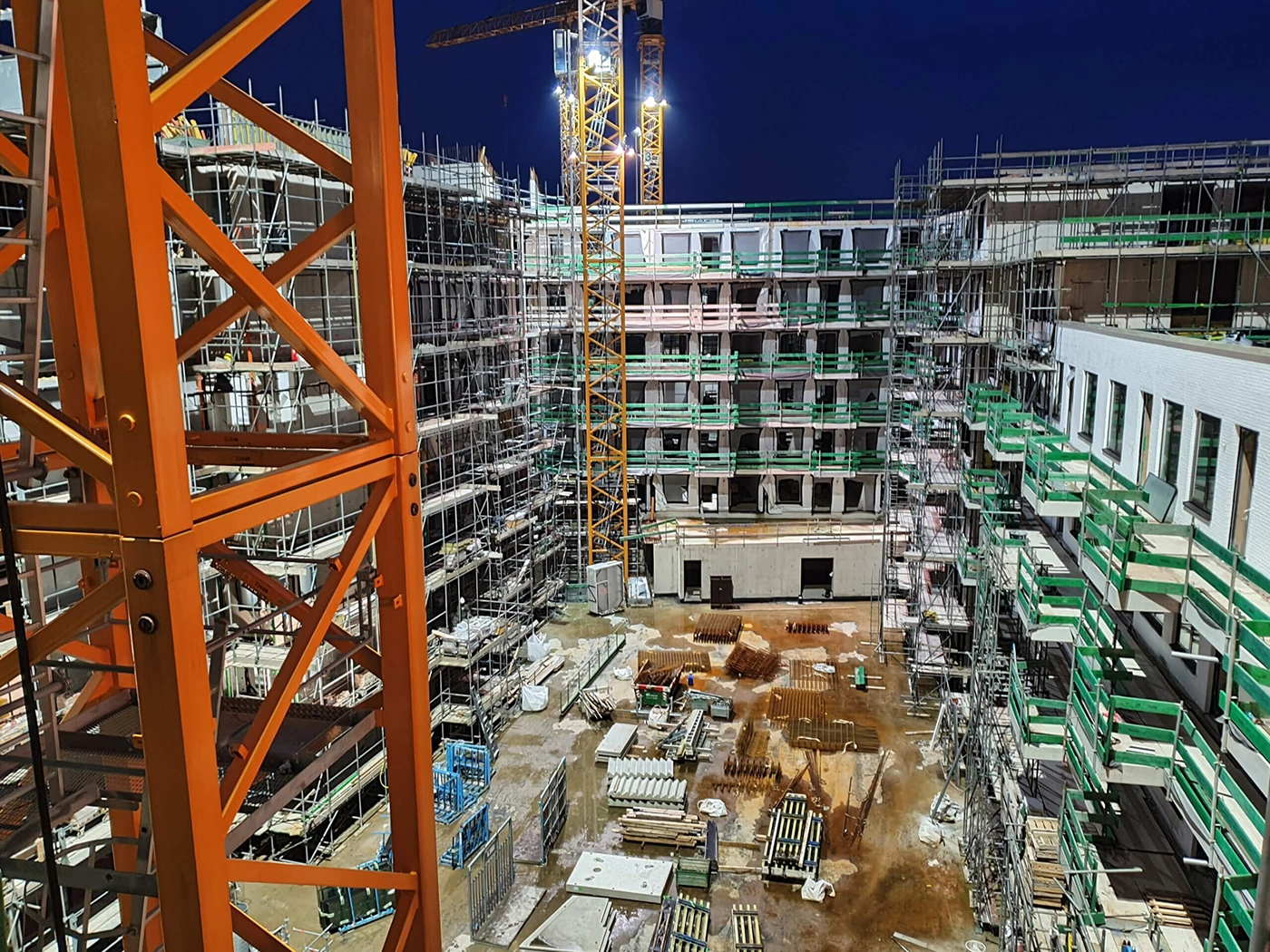
A lens floodlight distributes its light across the angle allowed by the lens, and on a 40-meter boom that means part goes down toward the work, part horizontally into the street, and part goes upward. That last part is generated, hoisted upward, and lands nowhere. The horizontal part is what residents a hundred meters away see in their bedrooms, and what more and more municipalities are limiting in their permits with a reference to the NSVV light nuisance guideline. One complaint costs an evening crew, and with it, scheduling.
The DarkLicht uses a parabolic reflector instead of a lens. The fixture is full cut-off: no light is emitted above the horizontal, and virtually none above the factory-set cut-off angle of 63 to 75 degrees. Whatever comes out below falls on the construction site. As a result, less power is needed for the same light level on the work floor; at MORE in Leiden, this meant 73 percent less consumption than the previous installation, with four fixtures per crane where there used to be three. With each set, we provide the lighting calculation: illuminance and uniformity under the crane, tested against the 50 lux that EN 12464-2:2024 maintains for this work, and the light ingress outside the site according to the NSVV guideline. That report can also be used for the permit application.
We do not supply separate luminaires for a tower crane. The difference on the construction site is not in the luminaire itself, but in what surrounds it: the frame, the distribution, and the way the entire assembly attaches to the jib. That is a single system, and it is deliberately designed so that a technician doesn't have to do anything to it at height.
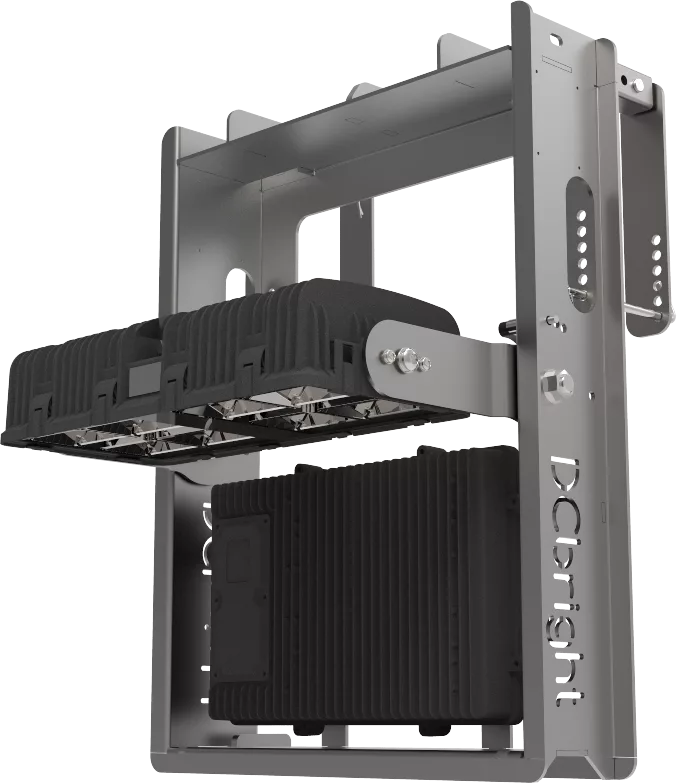

Each frame carries one luminaire and is completely assembled on the ground. Usually, four are hung per crane mast, at 0, 90, 180, and 270 degrees, so that the construction site is illuminated all around.
Frame, luminaire, connection unit, and the way the assembly attaches to the boom. Anyone who has seen it once immediately knows what needs to happen on the construction site and what does not.
Tower crane is not a single concept. A hammerhead with a horizontal jib illuminates the construction site from a fixed point; a luffing jib tilts, causing the beam to move with it and the light to move away from the spot where you want it. And on the jib itself, where the trolley travels and the load hangs, a directional floodlight is needed instead of a broad light beam.

The boom is horizontal and the luminaires face downward from a fixed point. This is where lighting control matters: full cut-off keeps everything within the construction fences. This is the standard setup and the set from this design.
| Luminaire | DarkLicht One |
| Luminous flux | 68,400 to 102,600 lm |

A luffing jib tilts, and a fixed-mounted luminaire tilts along with it. The beam then moves away from the work zone precisely when you need it. The Crane Light Stabilizer keeps the beam directed while the boom moves.
| Luminaire | Shark DC or Barracuda AC |
| Luminous flux | up to 50,000 lm |
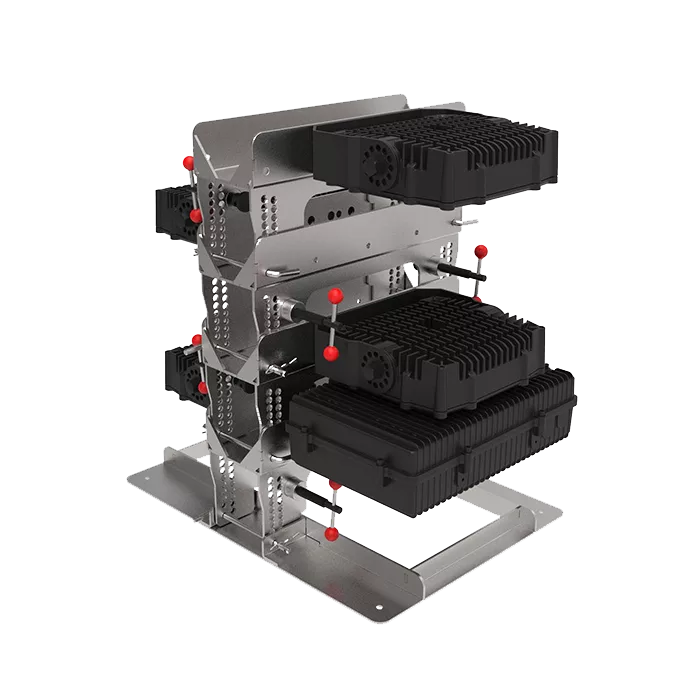
Inside the boom itself, where the trolley travels and the load hangs, a directional floodlight is needed rather than a wide light beam. With the special bracket, this light is easy to mount on the boom. If the boom itself moves, the Crane Light Stabilizer is the better choice.
| Luminaire | Barracuda AC or DC |
| Luminous flux | 32,600 to 44,100 lm |
The cut-off is the angle, measured from the vertical, above which the luminaire emits virtually no light; above the horizontal, the emission is zero, because the luminaire is full cut-off. For the DarkLicht, the cut-off is factory-set to one of five positions between 63 and 75 degrees. Which position is appropriate follows from the distance between the luminaire and the work floor and the distance to the construction site fences: with a fifty-meter crane, the viewing angle toward the edge of the site is flatter than with a twenty-five-meter crane, so a smaller angle belongs there. In the lighting calculation, we calculate with the measured light distribution from the LDT file, including the residual light just above the cut-off, and we test the light intrusion on the nearest facades against the NSVV limit values.
The reflector modules can also be rotated 90 degrees in both directions. This allows you to adjust the light distribution to the shape of the construction site instead of a circle.
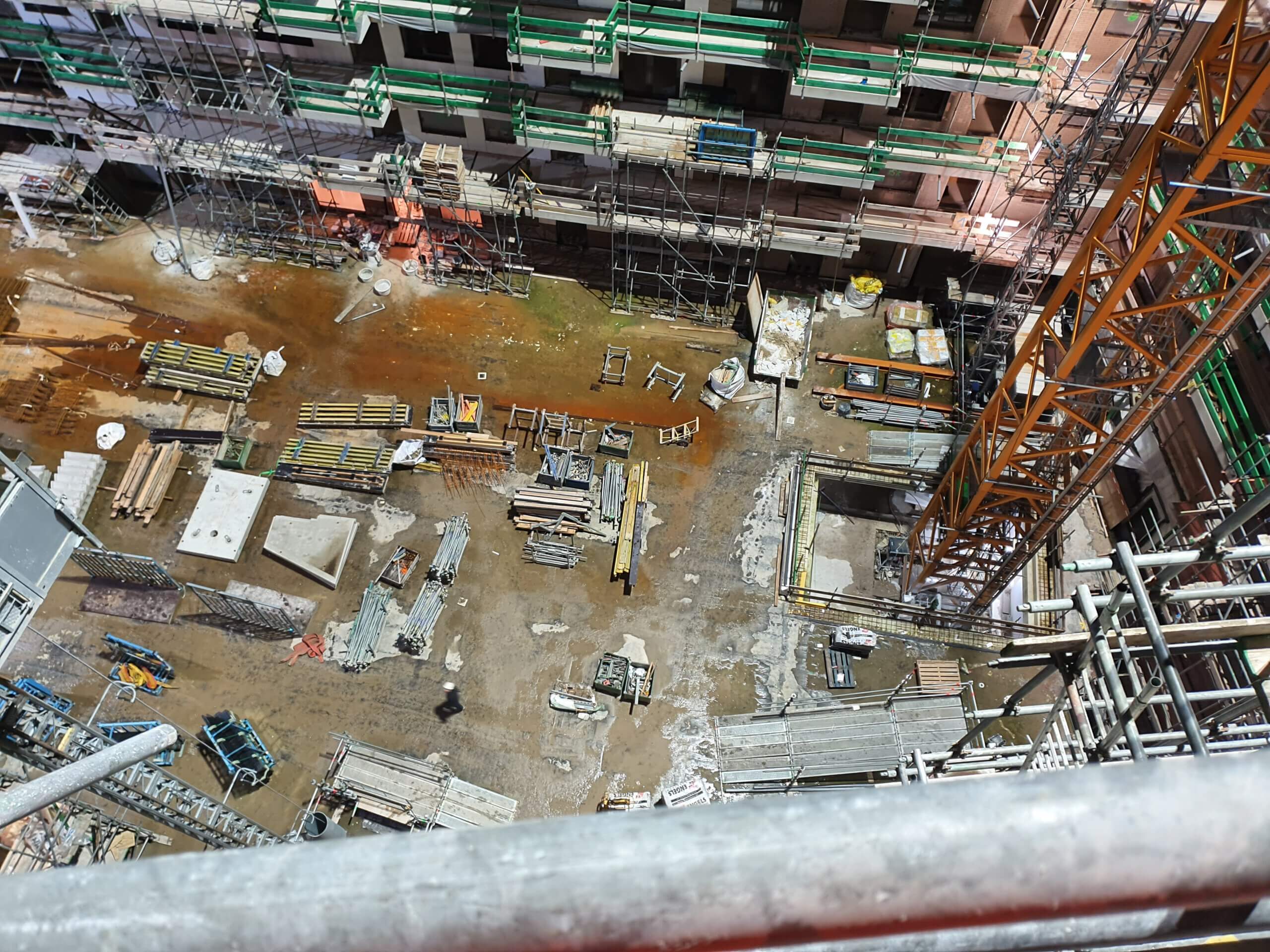
EN 12464-2:2024 sets the requirements for illuminance and uniformity at outdoor workplaces, with 50 lux as the guideline around the crane; in the event of an accident involving insufficient light, that is the document that will be requested. The NSVV light nuisance guideline sets the limit for what falls outside the site. We test against both and include the report free of charge, even if you purchase the set elsewhere. See lighting advice and lighting calculation.
Two projects in operation, recorded after completion. The footage shows what a calculation cannot convey: how sharp the light boundary is on the construction fences and how dark it remains outside them.
With Ballast Nedam Materieel and Heddes. Because the DarkLicht fixtures are more compact, four could fit per crane where previously three hung: more lighting on the construction site and yet 73 percent less consumption.
The SSB project in Alkmaar, filmed during work. Pay attention to the edge of the construction site: that is where the light stops, and that is precisely what the cut-off does.
See also the case of the MORE construction site in Leiden, the Van der Spek tower crane fleet and the photo gallery.
“We use JEL Products lighting on all our tower cranes. The visibility, product quality, and service have proven themselves in everyday use. Now that we’ve worked with this solution, we wouldn’t want to go back to anything else.”

Tower cranes are the application we have been involved with the longest and most extensively: from crane rental companies converting their entire fleet to manufacturers supplying our lighting factory-fitted.







More work is at the projects in and out photo gallery.
All specifications in one place, so you don't have to lay three pages side by side. Which capacity, which cut-off position, and how many luminaires belong to your crane follow from the lifting height and the dimensions of the construction site; we calculate that for you.
| Specification | DarkLicht crane frame | Barracuda boom light | Crane Light Stabilizer |
|---|---|---|---|
| What for | fixed boom, construction site lighting | geek, cat and burden | luffing jib and lattice boom |
| Type designation | DL-CCB-400+DIS and DL1-600CCB | BAAC01-65K | CLS |
| Luminaire | DarkLicht One | Barracuda AC or DC | Shark DC or Barracuda AC |
| Luminous flux per luminaire | 68,400 to 102,600 lm | 32,600 to 44,100 lm | up to 50,000 lm |
| Power consumption | 400 or 600 W | 240 or 320 W | 240 to 320 W |
| Efficiency | 171 lm/W | 138 lm/W at AC | 156 lm/W at Shark |
| Lighting control | full cut-off 63° to 75° | 14° spot, 38°, 69°, 14° × 46° | lens optics per working distance |
| Movement | fixed, modules rotatable by 90° | fixed frame, adjusted during assembly | stabilizer, beam remains focused |
| Voltage range | 230 or 400 VAC | 90-305 of 180-528 VAC, 20-35 VDC | 35 to 60 VDC or 90-305 VAC |
| Distribution | in-frame at 400 W, separate unit at 600 W | internal | per execution |
| Luminaires per frame | 1, usually 4 per mast | 1 per boom frame | 1 per stabilizer |
| Circuit | built-in time switch or twilight switch | on request | on request |
| IP and IK | IP67 / IK07 | IP69K / IK10 | IP69K / IK10 |
| Weight per luminaire | 14.0 to 15.0 kg | 10.1 kg | 9.2 to 10.1 kg |
| Frame weight | 29.2 kg, gross 44.1 kg at 400 W | 17.1 kg with fixture | on request |
| Color temperatures | 5700K to 1700K, standard 4000K | 6500K, 4000K, 2700K, amber 2200K | 6500K, 4000K, 2700K |
| Operating temperature | -45 to +50 °C | -45 to +50 °C | -45 to +50 °C |
| LED lifespan | L90B05 103,500 hours | L90B05 360,000 hours | L90B05 360,000 hours |
| Warranty | 5 years | 5 years | 5 years |
Cranes of 100 metres and higher must be reported to the aviation authority; around airports and low-flying routes lower limits apply. We supply the red obstruction lights, the Lantern L32 of 32 cd and the Lantern M2K of 2,000 cd, with photocell and controller as a complete set from stock, and advise which light belongs at which height.
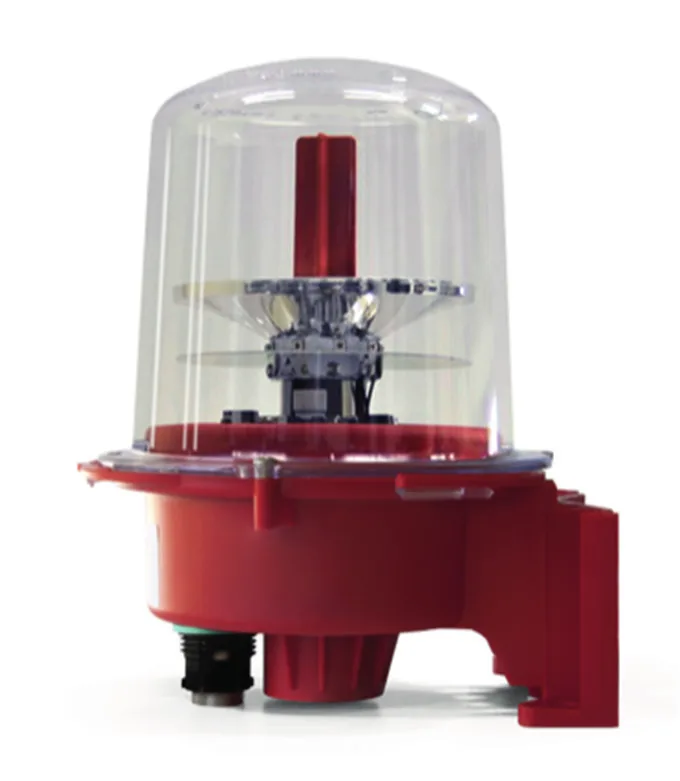
Can't find your question? Call us with the crane type and lifting height at hand, and you will know what is needed within five minutes.
The lighting control and the surrounding system. A classical spotlight works with a lens and always loses part of its light upwards and sideways. The DarkLicht uses a parabolic reflector where nothing comes out above the horizontal and virtually nothing above the set cut-off. In addition, the distribution is in the frame and the whole is assembled on the ground, so that there is no more connection work at height.
No, and that is the most common misconception. The 50 meters is the distance between the luminaire and the working floor, not the height of the crane. A luminaire at 90 meters is fine, provided the building is 40 meters high at that moment; the distance to where work is being done then remains within range. The 600 W version is used up to 50 meters above the working floor, the 400 W up to 35 meters, with 15 meters as the lower limit. For tall projects, it is therefore normal for the luminaires to be relocated during construction, along with the building height.
With high-rise buildings yes, and that is not a shortcoming but the only way to do it right. As the building goes up, the distance to the work floor decreases; if you leave the luminaires hanging, the construction site becomes overexposed and stray light to the surrounding area actually increases. Relocating them keeps the light level up and disturbance limited. In our lighting plan, we indicate at which construction height that is advisable.
Each frame carries one luminaire. Usually, four are hung per crane mast, at 0, 90, 180, and 270 degrees, so that the construction site is illuminated all around and no shaded side is created when the boom rotates. The frame is a standalone product and is often supplied as an accessory with the lighting.
The pin system is universal and fits all common brands of tower cranes. What we need is the brand, the model and the lifting height; with that, we determine the frame variant and the position on the jib. If in doubt, please include a photo of the mounting point.
Up to four per frame. At the MORE construction site in Leiden, four fit where three had previously been installed, because the DarkLicht luminaires are more compact. The exact number depends on the lifting height and the dimensions of the construction site, and we factor that into the lighting calculation.
That follows from the lifting height and the distance to the construction fences. As a rule of thumb: 75 degrees for a low boom or a narrow site, 72 degrees as standard, 69 degrees for maximum uniformity, 66 degrees above fifty meters, and 63 degrees under the strictest light pollution requirements. The setting is chosen upon ordering and factory-set, settings S1 to S5.
It limits them significantly, and whether it is enough depends on the distance to the façades and the chosen cut-off position and light color. No light comes out of the luminaire above the horizontal and virtually none above the set cut-off, so the light spill onto façades adjacent to the site drops to a fraction of what a floodlight with a lens produces; exactly how much is stated in the nuisance assessment that we provide with the lighting plan. At MORE in Leiden, the result, alongside a 73 percent saving, was the title of best-performing construction site in the Netherlands.
Yes, that is partly what it is intended for. We test against EN 12464-2:2024 for the lighting level on the construction site and against the NSVV light nuisance guideline for what falls outside the site, and we deliver reporting me. Please state in your request that it concerns a permit, and we will tailor the reporting accordingly.
Most of the work is done on the ground: the frame is completely assembled with luminaires, distribution, and the set cut-off position. At height, only attaching the frame and connecting a single power cable remain. That saves climbing time and, more importantly, it saves connection work at a position where a mistake costs a second climb.
The complete distribution box for the luminaires, delivered ready-to-use and tested prior to delivery. You connect a single supply cable to it, and the luminaires are already attached. We can build a timer or a twilight switch into the same unit, so the lighting automatically follows the construction working hours instead of requiring someone to remember it. A separate circuit per group of luminaires is also possible, for example, to keep only the orientation lighting on outside of working hours.
Yes, via the timer or twilight switch in the connection unit. On a construction site next to residential homes, that is often the difference between having complaints or not: the crane doesn't need to be lit when no one is working, and no one has to perform an action for that in the evening. For inner-city projects, such a switch is sometimes even a permit requirement.
Via a single power cable to the connection unit; the distribution to the luminaires is already integrated. How many luminaires fit on a single circuit depends on the wattage and the cable length along the pole; we calculate this upon request and provide it as a load table with the plan.
The luminaires are IP67 and IK07, and the frames are hot-dip galvanized steel. A tower crane moves continuously and stands outside for months; the mounting has been chosen accordingly. For a specific wind load calculation, we need the crane data.
Yes, that is the most common assignment. Construction companies and rental businesses usually convert their fleets step-by-step, after a trial setup on a single crane. We look at the existing mounting points and the available cabling so that the conversion fits within a regular maintenance service.
Yes, on one crane in your fleet. During a conversion project, that is also the sensible order: let one crane run for a season first, and only then the rest. Your mechanics will immediately see how the assembly works out in practice.
Cool white provides the sharpest contrast on the construction site, but is perceived as harsher by local residents. If the work borders on residential areas or a nature reserve, a warmer color is usually better; the range runs from 5700K to 1700K, with 4000K as the standard.
Five-year industrial warranty on the entire set, frame, and luminaires. This applies to heavy-duty use on the construction site, including repeated assembly and disassembly of the crane and transport between projects.
Looking for individual LED work lights for the cab, the boom or the superstructure, without a lighting plan or installation? The same Goby and Piranha work lights we fit on cranes can be ordered directly from our web shop, Industrial Light Store. For 12 and 24 V, IP69K, with a 5-year warranty on the luminaire. In stock and ordered before 15:00, shipped the same working day.

Above is what differs within the tower crane itself. In addition, a stationary erection crane is slightly different from a self-erecting mobile tower crane or a telescopic crane: the mounting points, the erection sequence, and the vibration load differ. If you illuminate multiple types, we coordinate the sets so that your technicians work with one system.
Tower crane lighting belongs to the sector mobile machines and equipment, and at the construction site near construction and infrastructure.
Four fixed sets, from Dual to Five, for the fast-erecting tower crane.
The Crane Light Director for telescopic cranes, where the light must tilt with the boom.
The Crane Light Stabilizer keeps the beam in place while the boom moves.
Lighting for crane runways and bulk handling, where salt, wind and continuous operation determine the requirements.
Red aviation lights to ICAO Annex 14 for the top and the jib ends, with control and power supply.
Light distribution, on-board power and mounting per crane type, on one overview page.
Make, type, lifting height, and site dimensions are enough to get started. We determine the number of luminaires, wattage, cut-off setting, and frame variant, and calculate the light level on the construction site against EN 12464-2:2024 including a light pollution assessment.
Your request is being reviewed by an engineer. We will respond within 1 business day.