

Short answer
Lighting has a direct impact on the safety of crane operators. Insufficient or incorrect lighting significantly increases the chances of errors, delays, and accidents,both for the operator themselves and for the people and objects in the work environment. The questions below provide a clear picture of what constitutes good crane lighting and when it's time to take action.
Pay attention to the distinction between indoor and outdoor: those are two different standards with different levels. The 200 and 300 lux further on in this article apply to indoor situations. At an outdoor terminal, the standard level for the work area is considerably lower, in the order of 50 lux, and there the focus is primarily on uniformity and glare limitation rather than a high lux value.
Which lighting errors cause the most accidents with cranes?
Many accidents during crane operations are not caused by a single error, but by a combination of factors. Consider an insufficient lighting level on the work floor, direct glare from poorly positioned luminaires, and blind spots due to uneven light distribution. This combination causes operators to misjudge loads, obstacles, or people too late or incorrectly.
An operator working from a high cabin is completely dependent on what they can visually perceive. If the lighting on the work floor is spotty, creates shadowy zones, or blinds the operator, they lose oversight. The most common problems:
- Insufficient lux on the factory floor: Too little light makes it difficult to correctly estimate depth and distance.
- Glare from direct light sources: Luminaires that shine directly into the operator's field of vision temporarily but significantly reduce visibility.
- Uneven light distribution Sharp transitions between light and dark areas force the eye to constantly readjust, which slows down reaction time.
- Outdated luminaires with color distortion: Poor color rendering (low CRI) makes it difficult to distinguish markings, obstacles, and people.
How many lux does a crane operator need for safe work?
As a general guideline, a minimum of 200 lux is required on the work floor and a minimum of 50 lux at height, in the cabin, or around the crane structure itself. For precise tasks or environments where people are present on foot,such as terminals or production halls,300 lux or more is recommended.
The type of operation largely determines how much light is actually needed. A crane operator stacking containers at a terminal works differently than someone installing steel structures in a production hall. In both cases, it's not just the absolute lux level that matters, but also the uniformity of the light. An average of 300 lux with large dark spots is less safe than an even distribution of 200 lux across the entire work area.
Additionally, the height of the luminaires plays an important role. The higher the mounting location, the more power is needed to achieve sufficient lux on the workplace. This is a technical consideration that must always be included in the lighting design.
What is the difference between glare and non-glare crane lighting?
Blinding lighting shines light directly into the operator's or workers' field of vision, causing temporary vision loss and reduced perception. Non-blinding lighting,also called full-cutoff or dark-sky-compliant lighting,directs light exclusively downward onto the work area, with no light spill to the sides or upward.
In practice, the difference is significant. An operator in a crane cabin looking down must never look directly into a light source. Glare only lasts a few seconds, but in a dynamic work environment with moving loads and people on the work floor, that's more than enough for a serious incident.
Non-glare optics are specially designed to direct the light beam via asymmetric reflectors or specialized lenses that deliver light precisely where it is needed. This is especially relevant for harbor cranes and other large-scale crane installations, where the operator works at a great height and the work area is wide and deep.

Blind test
We calculate the viewing angle from your crane cabin
Send the mast positions or crane type with the mounting height. You will receive back what the operator sees from the cabin, what the lux levels on the work floor are, and where the beam needs to be adjusted. Response within one business day, by an engineer.
No newsletter, no sales pitch.
How does poor lighting affect crane operator reaction time?
The visual processing process takes significantly more time with insufficient or uneven lighting. The eye needs longer to recognize objects, movements, and signals, leading to delays in decision-making and operation,precisely at moments when quick reactions are most needed.
Contrast, sharpness, and light intensity are the three pillars of good visual perception. With insufficient light, outlines become less distinct and it is harder to notice movement in the periphery. Glare causes temporary adaptation: the eye adjusts to the bright light, after which it takes several seconds for normal perception to return.
In an environment like a port or terminal, In areas where heavy machinery and people are active simultaneously, any delay in response time is an increased risk. Good lighting is not a comfort in such cases, but a safety feature.
What lighting standards apply to cranes in industry?
The most relevant standards for crane lighting are EN 12464-1 for indoor environments and EN 12464-2 for outdoor environments. These standards set requirements for illuminance level (lux), uniformity, and glare limitation (UGR value). Additionally, specific sectors have their own guidelines and sectoral requirements regarding the visibility of signals, colors, and markings,which justify the choice of luminaires with a high color rendering index (CRI).
The standards specify the minimum illuminance and uniformity applicable to different work zones. Stricter requirements apply to crane operations where people are present on the shop floor than to fully automated processes. The UGR (Unified Glare Rating) value is a measure of glare: the lower the value, the less glaring the installation. The main standards and guidelines at a glance:
| Standard or directive | What it applies to |
|---|---|
| EN 12464-1 | Standard for workplace lighting indoors, including production halls and workshops with crane operations. |
| EN 12464-2 | Standard for lighting of outdoor workplaces, relevant for terminals, construction sites and open industrial areas. |
| ATEX Guidelines | Applicable when cranes operate in potentially explosive atmospheres, such as in the chemical industry or offshore. |
| Sector-specific requirements | Harbors and terminals often handle additional requirements from port authorities or international standards. |
When is it time to replace or upgrade crane lighting?
There are several indications that the current lighting system is no longer adequate. This includes illumination levels that drop below normative minimum values, complaints from operators about glare or poor visibility, or a system that simply no longer complies with current safety standards. A high maintenance burden or significantly increased energy costs are also clear indicators for an upgrade.
Concrete indicators to look out for:
Is your crane lighting due for replacement?
Check what you recognize. Two or more points are sufficient reason to have the installation tested.
- Light sources that frequently fail or have significantly decreased in light output
- Complaints from operators about fatigue, headaches, or reduced vision during or after a shift
- An increased number of near misses or reports where visibility played a role
- Luminaires that cannot withstand the environmental conditions, such as humidity, vibrations, or extreme temperatures
- Installations older than ten to fifteen years that have never been reviewed based on current standards
An upgrade to modern LED work lights Industrial LED luminaires not only provide better light output, but also a longer lifespan, less maintenance, and lower energy consumption. Especially for cranes that operate 24/7, the payback period for an investment in quality LED lighting is typically short.
Fittings for faucet applications
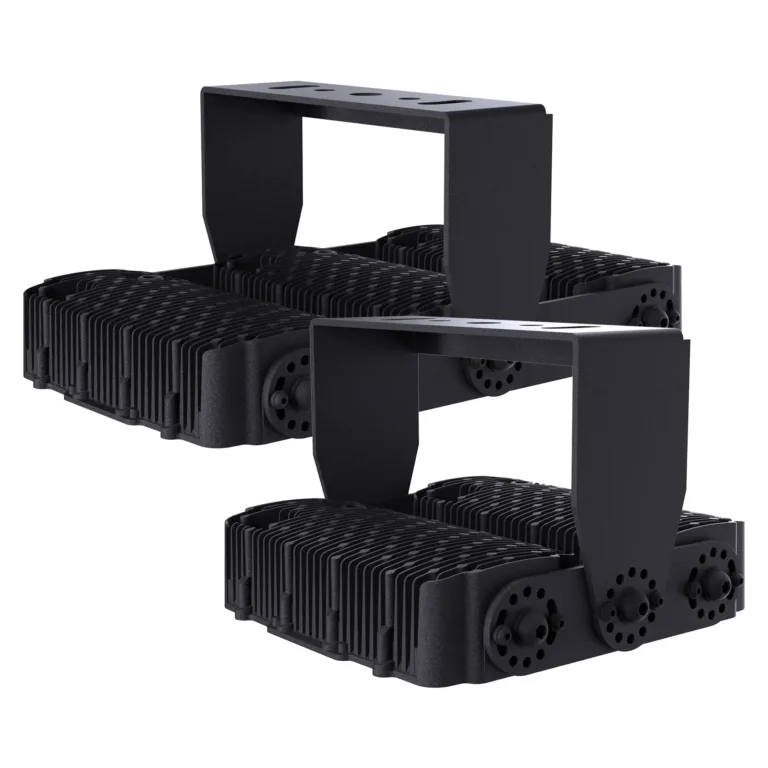 Snapper HCCrane lighting, vibration-resistant55,000 lm at 320 W
6 G vibration according to IEC 60068-2-6
IP68, C5 Industrial and MaritimeView Snapper HC
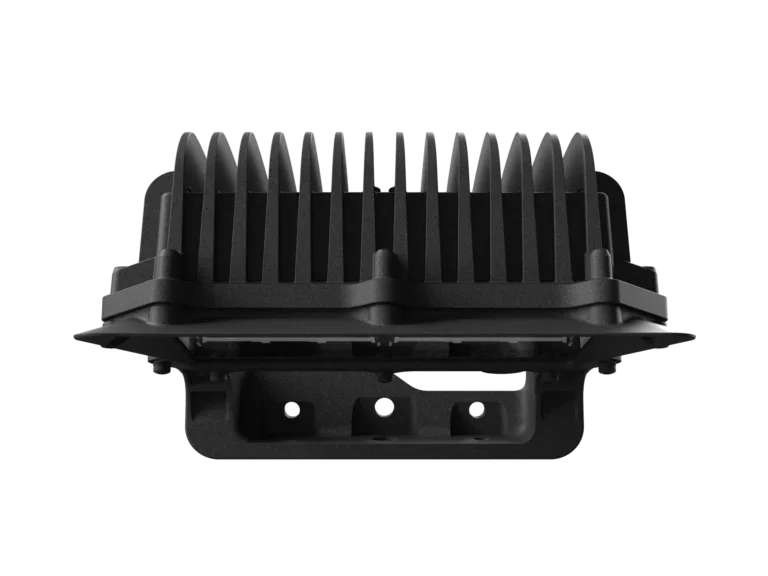 DarkLicht MFull cut-off against glare51,300 lm at 300 W
Cut-off 63 to 75 degrees
IP69K, IK08, C5-MView DarkLicht M
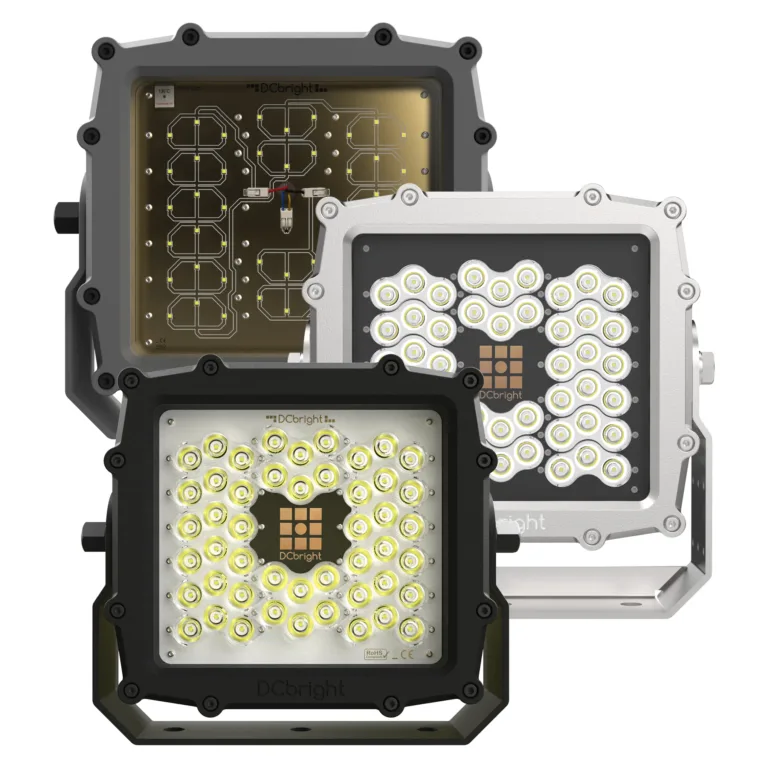 BarracudaHeat, vibrations and sea air44,100 lm at 320 W
HT execution up to +120 degrees
IP69K, IK10, 6 G vibrationView Barracuda
Real-world example: Van der Spek – Tower Crane Lighting
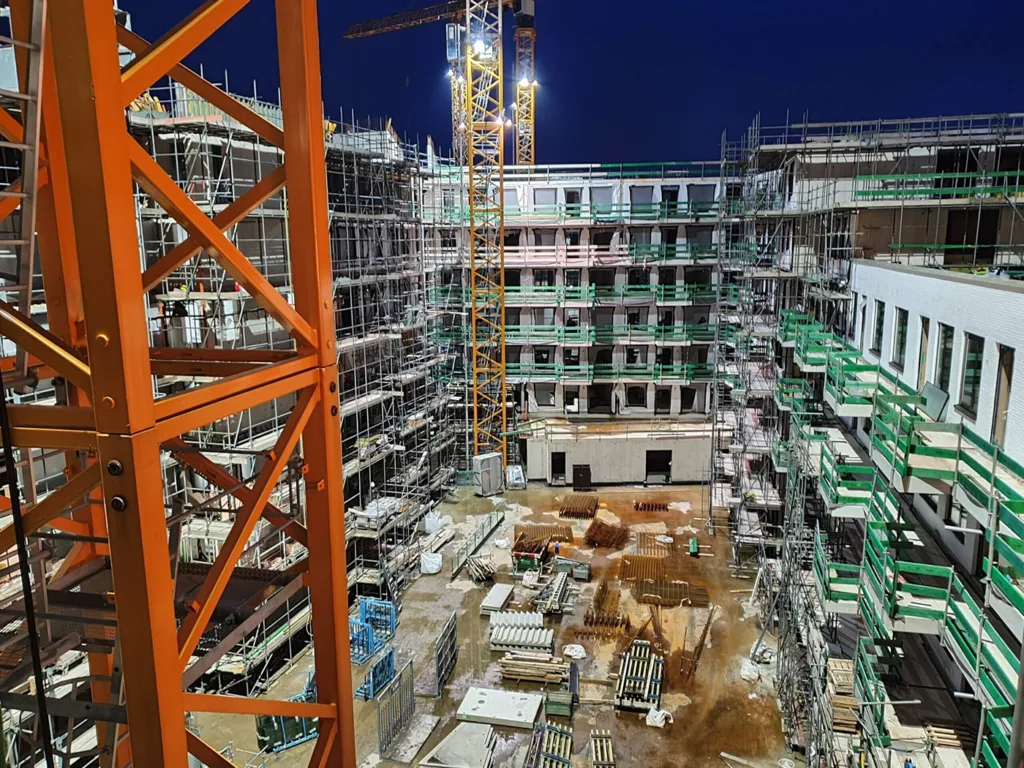
LED tower crane lighting for the Van der Spek fleet
A reusable frame concept that makes illuminating, storing, transporting, and assembling tower crane lighting easier.
A striking example of how lighting choices directly impact the safety of crane operators is the project at Van der Spek. It involved lighting for a fleet of tower cranes where the operator had to be able to work precisely from a great height, while glare for both the operator and ground personnel absolutely had to be prevented.
The technical challenge lay in the combination of multiple factors simultaneously: luminaires had to withstand the mechanical vibrations of the crane structure, function in fluctuating outdoor temperatures, and at the same time meet the full cutoff requirement to prevent direct light emission into the cabin. Standard industrial luminaires were therefore ruled out. The chosen solution utilized specially positioned luminaires with asymmetric light beams, which evenly illuminated the work area on the ground without the operator at height looking directly into the light source.
An important lesson from this project: the mounting angle and position of luminaires on a tower crane are at least as crucial as the power of the luminaire itself. Incorrect placement can neutralize even the best optics. Additionally, maintenance access proved to be a critical design criterion, high-altitude luminaires must be easily replaceable without the crane needing to be out of service for extended periods. This directly aligns with what was previously described in this article regarding the necessity of uniform light distribution and the importance of thoughtful lighting design. More practical examples can be found at Van der Spek Projects Page.
Continue reading: crane lighting, Tower crane lighting, light pollution and full cut-off and color rendering and CRI.
How JEL Products Helps Ensure Safe Crane Lighting
JEL Products develops and supplies lighting solutions specifically designed to meet the demands of crane operations in harsh industrial environments. Whether for harbor cranes, tower cranes, or mobile cranes in steel mills,the luminaires are built to perform under extreme conditions, from high temperatures and vibrations to corrosive environments and 24/7 operation.
What JEL Products specifically offers:
- Non-glare optics DarkLicht luminaires are designed with full-cutoff technology to ensure that operators working at heights never look directly into the light source.
- Extreme temperature resistance Luminaires such as the Orca and Barracuda are suitable for environments up to +120 °C, which is relevant for cranes in steel mills or foundries.
- Total solution From lighting design and light calculation to installation and commissioning, including guidance on certification and standards.
- ISO9001 and VCA** certified: Quality assurance at the product level and project execution level.
Would you like to know if your current crane lighting meets current standards, or do you have a specific lighting question? Get in touch Contact JEL Products for a no-obligation consultation.
Related Articles
- How do you save extra energy with smart lighting in a warehouse?
- What is UGR and why is it important in workplace lighting?
- How does poor lighting affect the continuity of port operations?
- Why is lighting an underestimated part of terminal security?
- What is the difference between linear LED lighting and LED high bays in a hall?