

We illuminate business parks, parking lots, distribution centers, quays, and recycling yards with 171 lm/W full cut-off luminaires. The light falls on the site, and not on adjacent facades, the property boundary, or the sky above.
What is needed on your site depends on the tasks that take place there: driving, shunting, loading, sorting, or just parking. Each of those tasks requires its own level, and those levels exist side by side on a single site. That is why we calculate per zone rather than using an average for the entire surface area.
DarkLicht Net Return
Upward luminous flux, also permitted in zone E1
Service Life L90B05
Do you work with a fixed electrical contractor or an engineering firm, or has the work been tendered? Then that does not have to be a reason to look elsewhere. We develop both routes, with the same calculation and the same luminaires.
Lighting design, delivery, installation, and commissioning by our own VCA**-certified technicians, including poles and foundations where necessary. One point of contact, one warranty, one invoice, and subsequent maintenance on a contract basis or on an as-needed basis.
Do you work with a fixed electrical installer, or has the project been tendered? In that case, we supply the fixtures, the lighting plan, and the installation materials, and we support the executing party with specifications and installation instructions.
Seven terrain types, with per type where the light should fall and where it should not, what level EN 12464-2:2024 gives as a guideline value, which pole height is usual, and which risk is at play. If your terrain is not listed, we will calculate it in the same way.
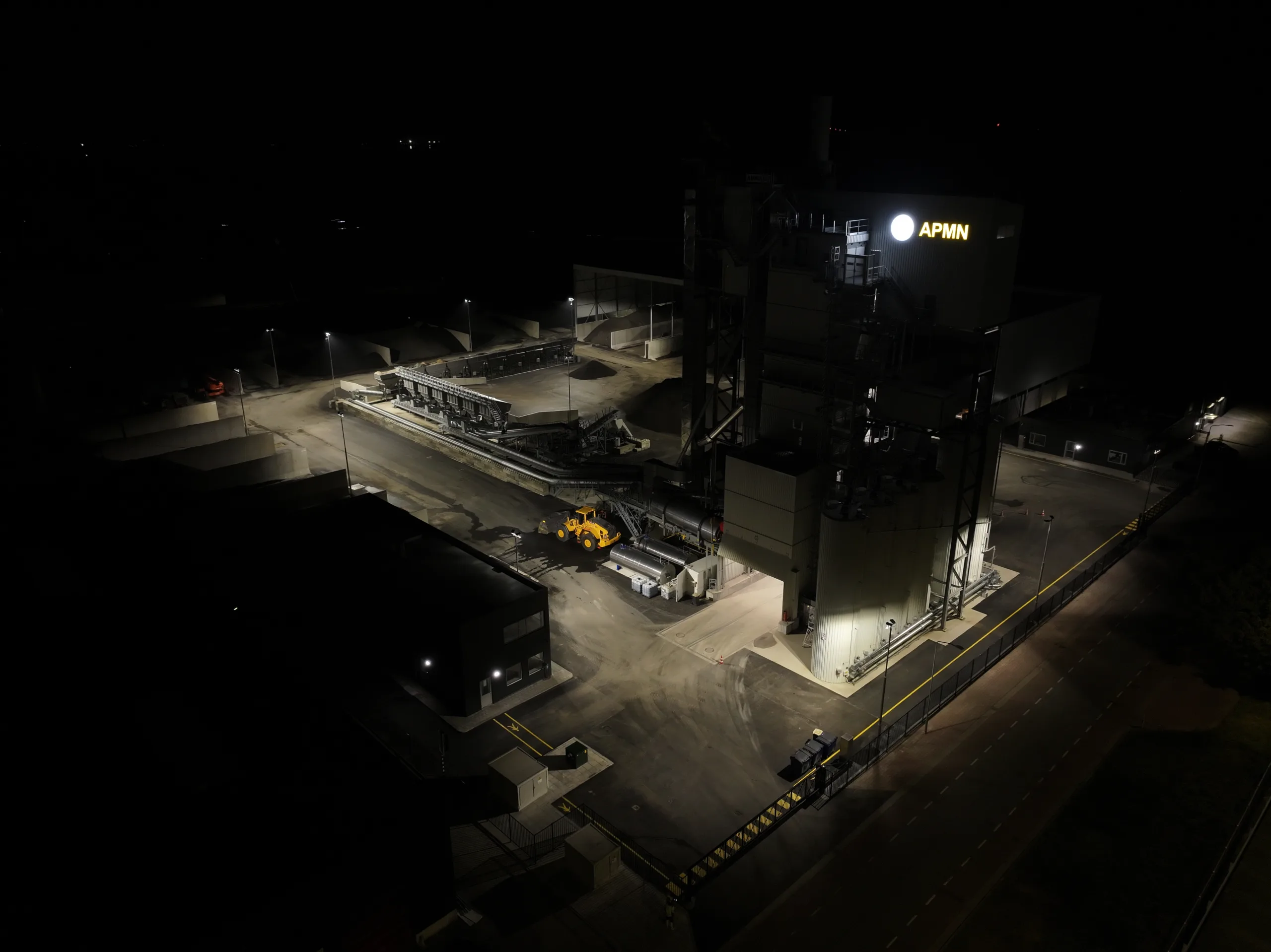
In an industrial park, lighting should be directed at the driving routes, loading zones, and walkways,and not at the property line, adjacent homes, or the sky. That sounds logical, but it’s exactly where site lighting installations usually go wrong: floodlights angled at the corners of the site end up illuminating the neighboring property as well, leaving the center in darkness.
We design based on traffic flow: where trucks drive, where staff walk, and where storage areas cast shadows. EN 12464-2:2024 specifies a guideline value of 20 lux for regular vehicle traffic, 10 lux for slow-moving internal transport, and 5 lux for walkways. Around a stationary loading and unloading area, this increases to 50 lux, and at the point where goods are handled and labels are read, it rises to 100 lux.
In outdoor storage, stack height is also a factor: pallets, containers, or bulk materials stacked four meters high cast a shadow that a low mast cannot illuminate. Often, a single taller mast with a single light luminaire is cheaper and more effective than three low ones.
| Driving routes | 20 lux |
| Internal Transportation | 10 lux |
| Looping | 5 lux |
| Mast height | 8 to 15 m |
| Luminaire | DarkLicht, full cut-off |
Forklift and truck traffic on the same route as personnel. Glare from a low spotlight is a safety risk here.
Company grounds with floodlights mounted on poles; the light remains within the grounds' boundaries
A parking lot is not lit to see cars, but to allow people to see and be seen. Social safety is the design goal here: faces that are recognizable from a few meters away, no dark corners between the rows, and no patches of light that make the rest of the lot appear even darker.
EN 12464-2:2024 specifies guideline values for parking areas that vary according to usage intensity: light use 5 lux, moderate use 10 lux, heavy use 20 lux, with walkways and the entrance and exit designated as separate zones. More important than the average is the uniformity of 0.25 required by the standard: a parking lot with an average of 20 lux but only 2 lux in the corners feels less safe than a parking lot with 10 lux that is uniform throughout.
The standard for charging plazas has been in place since 2024. For a charging point in a well-lit area, the requirement is 20 lux, plus an additional 50 lux vertically on the charging pole if the display does not light up on its own. We therefore install the luminaires on the roadway rather than above the charging bays, so that the pole is legible without the car next to it being bathed in light, and we dim the lights after the last vehicle has left.
| Heavy-duty use | 20 lux |
| Average use | 10 lux |
| Light use | 5 lux |
| Charging point | 20 lux, plus 50 lux vertical |
| Mast height | 6 to 10 m |
Social safety and liability. Dark corners between the rows are the most common complaint, and the first place an insurer looks.

Autonomous light mast on a site without power supply
At a distribution center, the focus is on the docks and the maneuvering space in front of them. Driving, shunting, scanning, and reading take place there, often in reverse and often in the rain. Therefore, the light must come from above and the side, rather than from the direction a driver is looking.
The standard divides the transshipment area into two zones: 50 lux on the traffic lanes and 100 lux where goods are actually handled, with a uniformity of 0.50 and a stricter glare rating of 45. Right at the gate to the indoor storage, this increases to 200 lux, because reading and scanning take place there; the thoroughfare across the site is set at 20 lux.
The tricky part is the transition. A driver going from 200 lux at the gate to 20 lux on the site is temporarily blinded. We build that transition with an intermediate zone instead of a hard boundary, and for 24-hour operations, we establish a dimming profile per zone, with the docks as an exception. What helps in this regard is that the standard allows a lower level in unoccupied zones, so the area outside peak hours can smoothly scale down without creating any dark corners.
| Material handling | 100 lux |
| transfer zone driving lane | 50 lux |
| Gate zone to indoor storage | 200 lux |
| Off-road routes | 20 lux |
| Mast height | 10 to 15 m |
Backing onto the dock, and the jump from 200 to 20 lux. Adaptation costs a driver seconds they do not have there.

Logistics area with lighting on gantries and masts
On a quay or container terminal, every mast is an obstacle. That is why higher placement with fewer positions works better here than a dense grid of low masts: more free space for driving, stacking, and crane operations. We install high masts up to 50 meters and mount luminaires on them that achieve 171 lm/W.
The standard covers the quay and the terminal separately: 10 lux for quays and berths, 30 lux for loading and unloading cargo, 50 lux for connecting hoses, pipes, and mooring lines and for the hazardous parts of walkways, and 100 lux for a container terminal with frequent traffic. What the standard does not mention, but practice shows: on a quay, glare for the crane operator and the skipper is just as important as the lux on the deck. A luminaire that is mounted low and hides its source behind the reflector does not shine into a wheelhouse.
Salt air is the second theme here. We supply versions in 316L that carry a twenty-year warranty on the housing, with five years on the remaining parts. That combination of height, cut-off, and corrosion class is operational at BUSS Terminal Eemshaven, DFDS Vlaardingen, and P&O Ferries Europoort.
| container terminal | 100 lux |
| Loading and unloading of cargo | 30 lux |
| Quays and berths | 10 lux |
| Mast height | up to 50 m, high mast |
| Performance in salty air | 316L |
Blinding for crane operator and skipper, and corrosion. Both are design choices and not a maintenance problem.
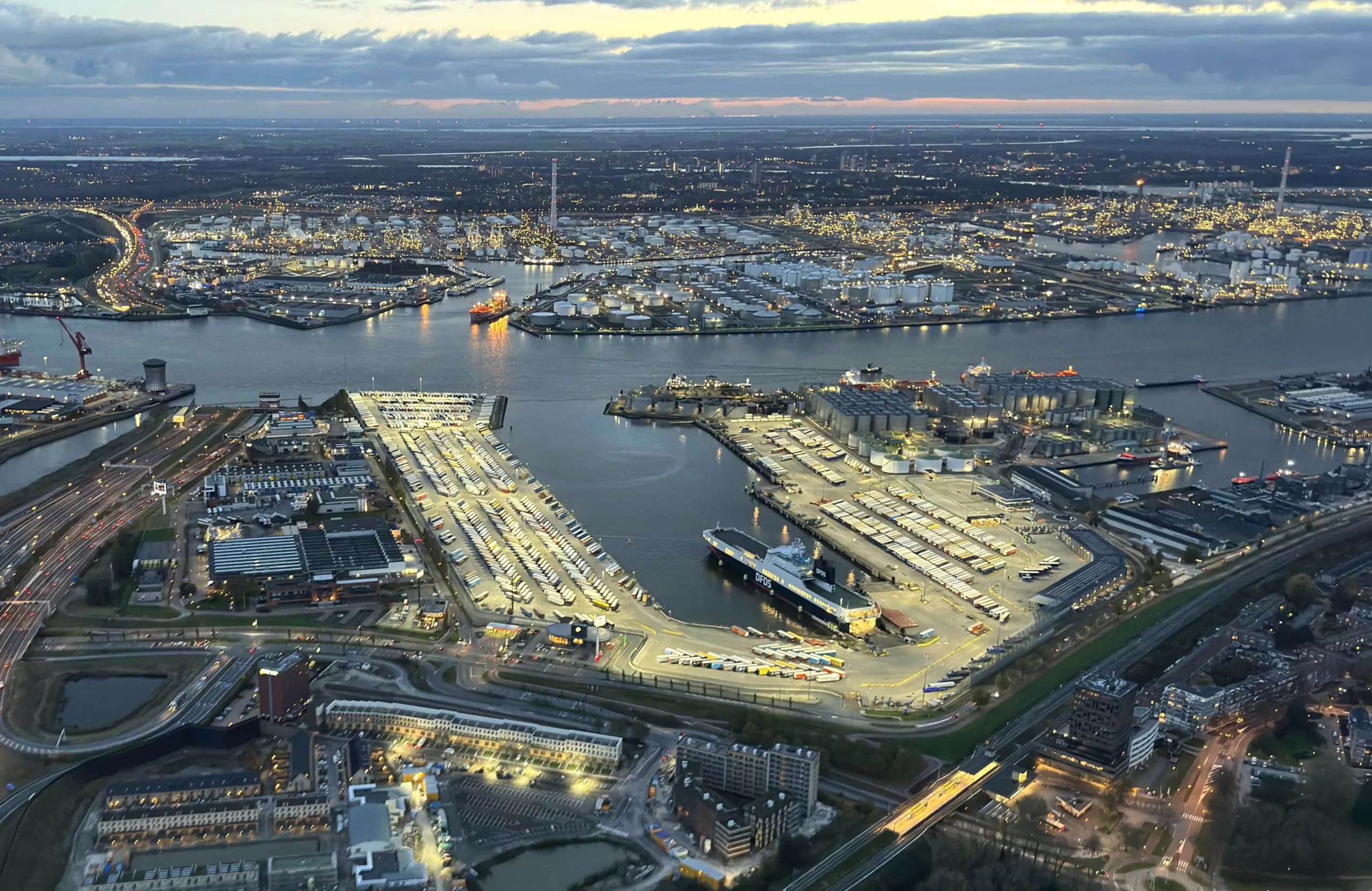
DFDS Vlaardingen: quay and terminal yard, lit without light spill into the surrounding area
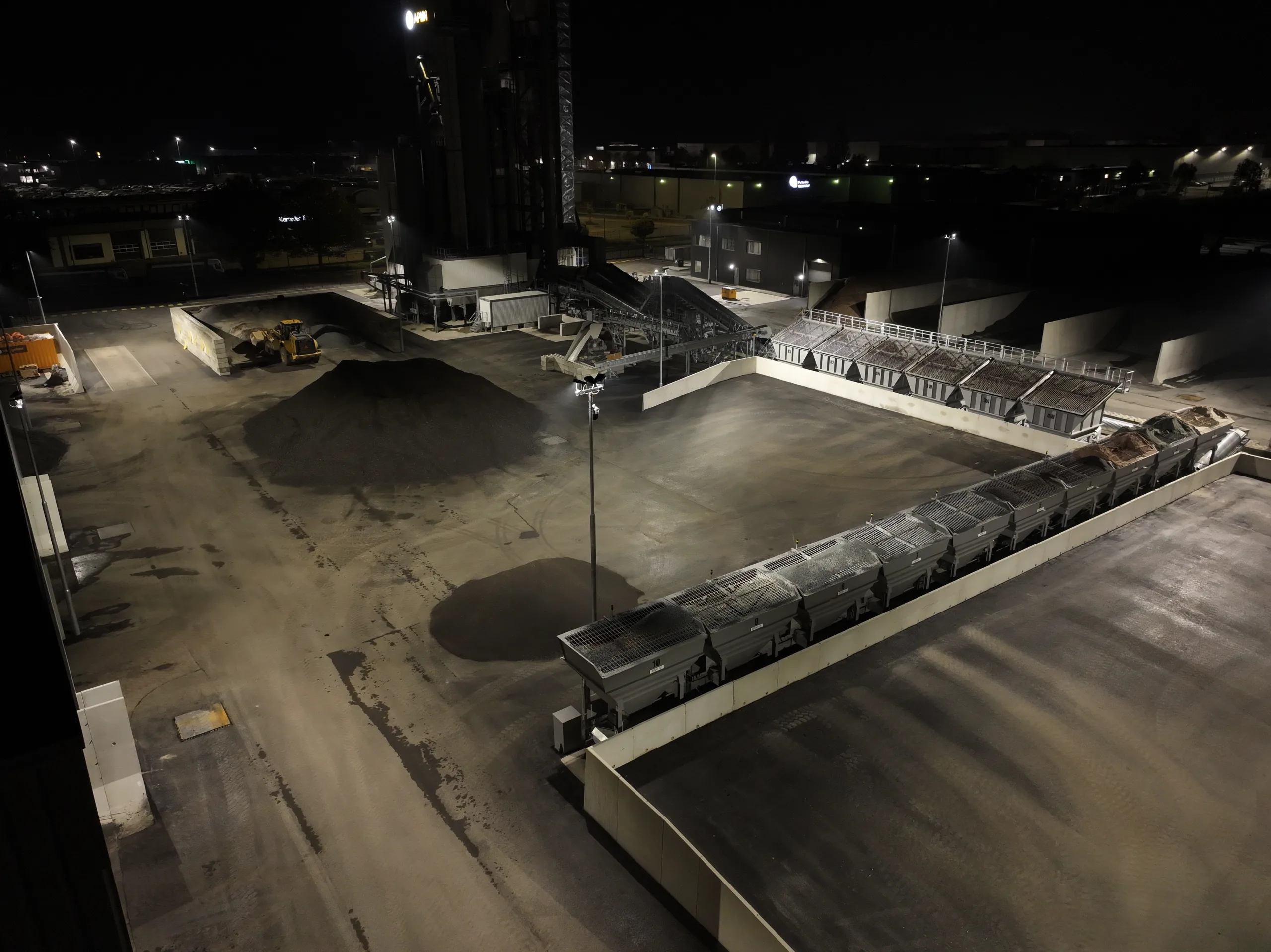
On a recycling or material yard, there is dust in the air and the layout is constantly changing: piles are growing, driving routes are shifting, a loader drives differently today than it did last week. A fixed lighting grid designed for the layout of three years ago is rarely accurate there anymore.
We therefore calculate such areas based on zones that can shift, with higher masts and wider beams instead of many local points. The standard lists the recycling area with containers and waste separation separately at 30 lux; for the surrounding handling, 20 lux applies for short-term work, 50 lux as soon as this is done continuously or work is performed with a crane, and 100 lux where addresses and labels are read. The latter is precisely the acceptance and weighbridge area.
Dust is the maintenance theme. A luminaire with a flat, smooth lens gets dirty slower than a ribbed cover, and one luminaire per pole means one cleaning session per position instead of four. That difference is not in the purchase price, but it is in the maintenance contract.
| Acceptance and weighbridge | 100 lux |
| Continue handling and crane work | 50 lux |
| Recycling site | 30 lux |
| Driving routes | 20 lux |
| Mast height | 12 to 20 m |
Dust accumulation on the optics and a layout that changes. Both require a safety margin in the lighting design so that no additional luminaires are needed afterwards.
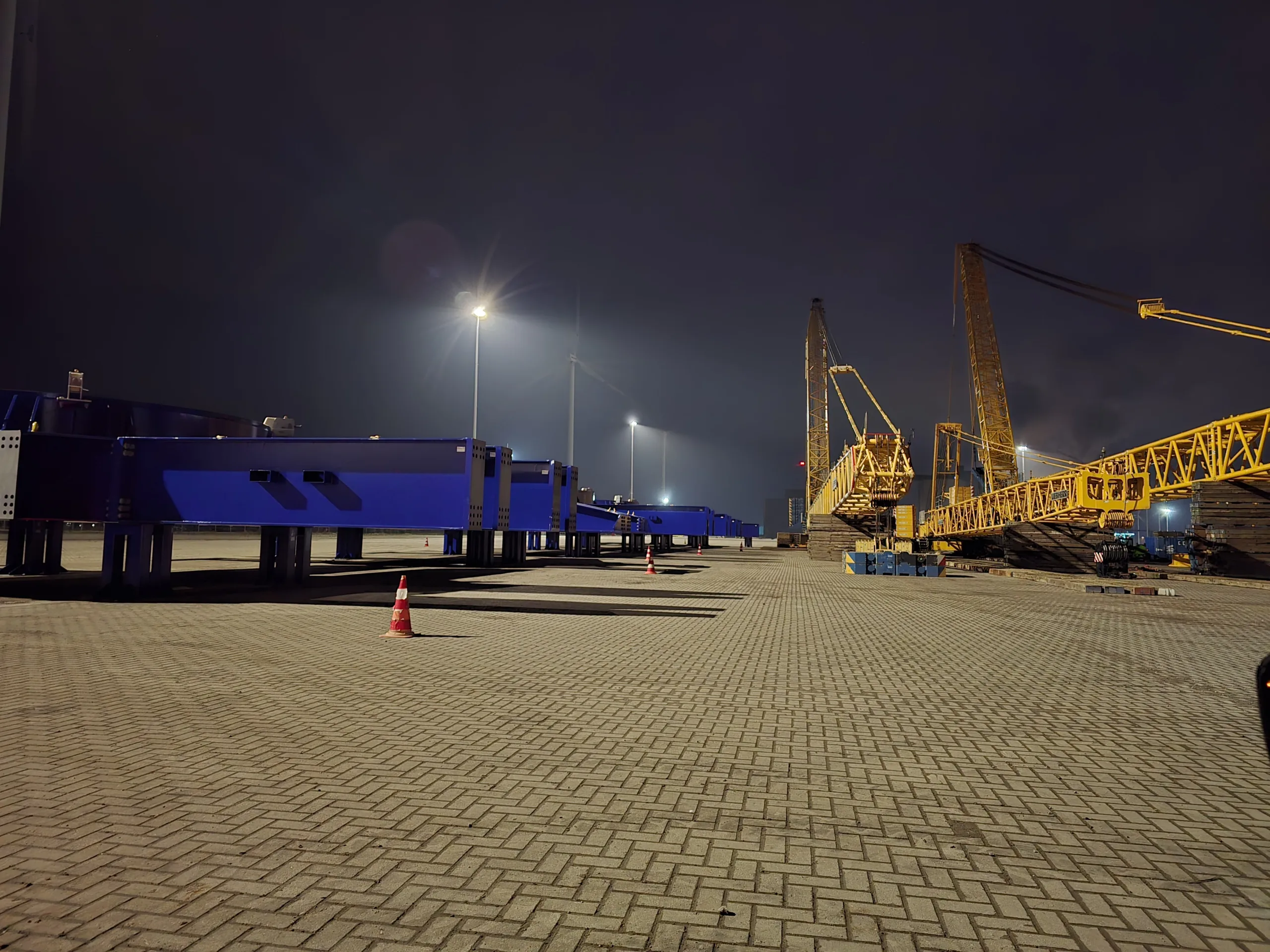
Transfer yard in operation, illuminated from high mast positions
A construction site changes every week and often has no power supply at first. That makes lighting a logistical challenge: how quickly is it set up, how quickly can it be moved, and what happens when the construction volume increases and last month's mast suddenly ends up in the crane's shadow.
For construction sites, the standard has its own series that adapts to the task: 20 lux for excavation, clearing, and loading; 50 lux for construction zones, transport, and storage work; 100 lux for positioning elements, reinforcement, and piping; and 200 lux for demanding assembly and connections. You will not achieve those two highest levels with area lighting alone; that requires local, movable lighting, and the standard itself states that.
We work here with mobile lighting towers and with autonomous solar-powered masts where there is no cable yet. Because a construction site is often right in the middle of a residential area, the cut-off is not a luxury here. At HSB in Hilversum, a construction site is illuminated according to DarkSky principles: working level on the spot, nothing upwards and nothing across the property boundary.
| Demanding assembly | 200 lux |
| Formwork, reinforcement, piping | 100 lux |
| Building zones and transport | 50 lux |
| Excavating, cleaning, loading | 20 lux |
| Lineup | movable or autonomous |
Complaints from the immediate vicinity, and a layout that changes weekly. Portability and cut-off weigh heavier here than the lowest price per luminaire.

Heijmans construction site Assendelft: working level on site, dark outside it
An agricultural farmstead is a work area with a dwelling on it and usually open countryside surrounding it. That makes the light pollution aspect the decisive factor here: in practice, the farmstead is located in environmental zone E1 or E2, where the standard permits 0 percent and 2.5 percent upward light output, respectively, and virtually no light on third-party facades after the curfew hour. The limit values per zone are fully detailed in light pollution and full cut-off.
On the farmyard itself, the three-tier standard applies: 20 lux on the yard and the driving route, 50 lux in an open equipment storage shed, and 50 lux where livestock is sorted, with 5 lux on the walkways. The uniformity on the farmyard is low at 0.10, which means that one well-placed pole with a wide cut-off beam is usually sufficient. Where livestock walks, the choice of driver matters: no visible flicker and no light point at eye level.
Autonomous versions are often practical here, because a light point on the edge of the yard or near a field shed rarely has a cable. A solar-powered mast with a cut-off luminaire provides light in the yard without the whole polder watching along.
| Open tool shed | 50 lux |
| Yard and route | 20 lux |
| Looping | 5 lux |
| Environmental zone | usually E1 or E2 |
| Upward light ratio | 0 to 2.5% |
Visual impact on the open countryside and on the private home. In addition, livestock react to flickering, so the choice of driver matters.

Outdoor area evenly lit from the perimeter
A campus, a marshalling yard, a temporary event site or a sports park: the calculation work does not change. We look at the tasks on the site, the zones in which they take place, the surrounding environment and the masts or buildings that are already there. A separate standard applies to sports fields; it is stated in sports field lighting.
A site drawing or a screenshot of the map, the desired tasks per zone, what is currently installed and how many, and whether residential homes or a nature reserve border the site. With those four things we will make a calculation; we will fill in the rest together.
EN 12464-2:2024 works with tasks and zones and does not have a fixed number per site type. On an average industrial site, three to five levels therefore exist side by side: 5 lux on walkways, 10 lux for slow internal transport, 20 lux on driving routes, and 100 lux at the location where goods are handled. An average over the entire surface means nothing: it conceals the dark corners and overlights what needs no light.
Besides the illuminance level, uniformity matters. A site with an average of 20 lux but 2 lux between the rows feels more unsafe than a site with 10 lux that is uniform throughout. Therefore, we calculate both the level and uniformity per zone, including the surrounding facade points, and deliver that calculation as a document.
| Walking paths and pedestrian routes | 5 lux |
| Slow-moving internal transport | 10 lux |
| Driving routes and regular vehicle traffic | 20 lux |
| Heavy-duty parking | 20 lux |
| Transshipment and container handling | 50 lux |
| Material handling and loading and unloading area | 100 lux |
Reference values from EN 12464-2:2024, per zone and per task. Where the standard allows an increased value, the level is higher: for example, 150 lux for a loading and unloading area. What applies to your site follows from the zone classification in the calculation.
The DarkLicht features a modular reflector optic in which the light source is concealed behind the shield. The luminaire hangs flat rather than at an angle, which means, by definition, that no light is emitted above the horizontal plane. That is the difference between an area that is illuminated and an area that illuminates the entire surrounding environment.
On construction sites, we use the larger models: DarkLicht One, Two, and Three ranging from 320 to 1,800 W on masts, DarkLicht M for lower mounting positions, and DarkLicht D where a compact design is required. The basic principle is one luminaire per pole: fewer mounting points, less cabling, less maintenance at height, and less wind load on the pole.
| Yield | 171 lm/W net |
| Service life | 103,500 hours, L90B05 |
| AC drivers | 130,000 hours |
| Upward light ratio | 0%, full cut-off |
| Ingress protection | IP67 / IK08 |
| Color temperature | 3000, 4000 of 5700 K; amber 2200 K |
| Mounting | flat, one luminaire per pole |
| Performance in salty air | 316L |
Warranty: five years on the complete luminaire. As long as a maintenance contract is in place with us or with a party designated by us, we extend the warranty on the housing to ten years. For fully 316L, twenty years applies to the housing and five years to the other components.
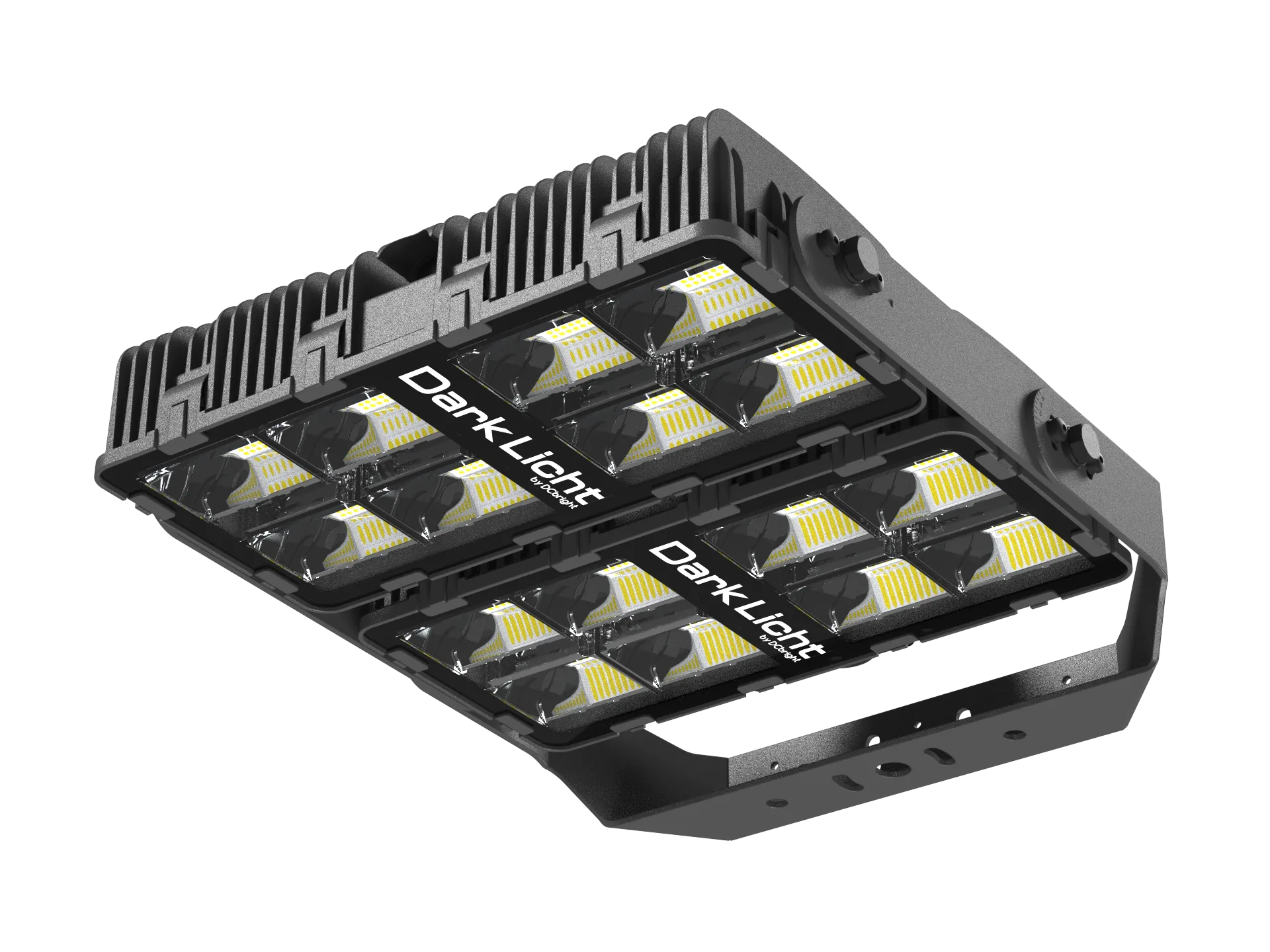
DarkLicht Two, EXT version with external driver
Area lighting is the most common source of light complaints regarding businesses, and the municipality has more instruments for this than most entrepreneurs think. Below is what can be stipulated, what is permitted per environmental zone, and which documents we include with an application.
For an industrial estate, E2 or E3 is customary. If the site borders a Natura 2000 area or open countryside, E1 applies, and 0 percent upward light ratio is the only permitted value.
| Zone | What it is | Facades before / after curfew | Up |
|---|---|---|---|
| E0 | Completely dark by nature: dark sky parks and observatories | 0 / 0 lux | 0% |
| E1 | Naturally dark: national parks, Natura 2000, protected areas | 2 / 0 lux | 0% |
| E2 | Rural residential or industrial area | 5 / 1 lux | 2,5% |
| E3 | Suburbs and industry | 10 / 2 lux | 5% |
| E4 | City centers and shopping areas | 25 / 5 lux | 15% |
Values from EN 12464-2:2024, Table 4. The curfew time is the moment when the municipality transitions the evening into the night; if there is no curfew regulation, the highest value applies as the limit and the lowest as the target value.
By definition, a full cut-off luminaire emits nothing above the horizontal, so the upward luminous flux is 0 percent. With a tilted floodlight, that is impossible: the beam will then extend above the horizontal, no matter how good the shielding is.
We adhere to the NSVV Code of Conduct for Lighting Calculations. Our calculations are therefore set up in a traceable manner, which is precisely what a municipality or consultancy firm wants to see during a review.
In a site, the second saving lies not in the luminaire, but in the regime. A distribution center that is idle between 1:00 AM and 5:00 AM does not need to be lit at working levels there, and a parking lot only needs to provide full light where someone is walking.
The basis, and the place where most facilities give away hours: switching based on light level instead of a fixed clock saves dozens of hours a year in spring and autumn.
Not the entire site has to follow the same regime. Docks, fencing, and parking spaces each have their own times; with zones, you keep the hours low without ending up in the dark anywhere.
In parking lots and back areas: 20 percent base level, full level when someone approaches. Visually, that is calmer than turning on and off, and it maintains social safety.
A site that is shut down between 1:00 AM and 5:00 AM can reduce its consumption to 30 to 50 percent during those hours. In the calculation example below, that is the difference between € 14,285 and approximately € 11,400 per year.
Where the environment or ecology requires it, we supply a 2200K amber version. Insects and bats react significantly less to this than to white light, and it is less noticeable in the landscape.
Anyone wanting to manage consumption needs to be able to see it. We deliver the installation in such a way that the power per group is measurable, so that a dimming profile can also be substantiated later.
We calculate on this page with € 0,248 per kWh excluding VAT and 4,000 operating hours per year at twilight switch. Both are visible so you can replace them with your own numbers.
| Terrain | approximately 2 hectares, mixed use |
| Masts | 12, one luminaire per pole |
| Power per luminaire | 1,200 W |
| Power consumption | 14.4 kW |
| Operating hours per year | 4,000, twilight switch |
| Annual consumption | 57,600 kWh |
| Annual energy costs at €0,248 excluding VAT | € 14,285 |
| With nighttime dimming to 50% between 1:00 a.m. and 5:00 a.m. | approximately €11,400 |
Example setup, with one luminaire per mast. If your site operates 24 hours a day, the operating hours will increase; with motion detection in the back areas, they will decrease. What it will be in your case depends on what is currently installed and your switching regime.
There is no subsidy specifically for area lighting, and it does not have its own EIA code on the 2026 Energy List. What remains is the generic route 310000, with a payback period between 5 and 25 years. Whether your project falls within that range depends on your current installation, your operating hours, and your tax position.
How that route works is stated on EIA and LED lighting, including the payback period formula. We do not promise any percentage on this page: that is up to RVO and your own advisor.
If your company is subject to the energy-saving obligation, it may also not be a choice but an obligation: area lighting is on the Recognized Measures List.
Where the savings are definitely to be found is in the consumption. That difference can be calculated, and the switching regime goes one step further.
The higher the luminaire is mounted, the smaller the angle at which the light strikes the area. As a result, the light stays on the surface instead of shining across it, eliminating the need for tilting. It is precisely that tilting which causes nuisance and glare. A higher pole with fewer positions is therefore often visually calmer and cheaper to maintain than a dense grid of low poles.
| Parking lot and P+R | 6 to 10 m |
| Industrial Park and Outdoor Storage | 8 to 15 m |
| Distribution center and docks | 10 to 15 m |
| Recycling and transshipment | 12 to 20 m |
| Port, quay and terminal | up to 50 m, high mast |
| Construction site and temporary site | mobile, 6 to 12 m |
Indicative, and always the result of the lighting calculation. For existing masts, we first assess whether they can support the new weight and wind-catching surface area.

In each image, pay attention to what does not emit light: the sky above the mast, the facades behind the site, and the plots along the property boundary. That is what an outdoor lighting installation is judged by.
Ferry terminal and quay
Terminal yard and quay illuminated with full cut-off flat floodlights on high masts, with no light spill into the surrounding area or the wheelhouse.
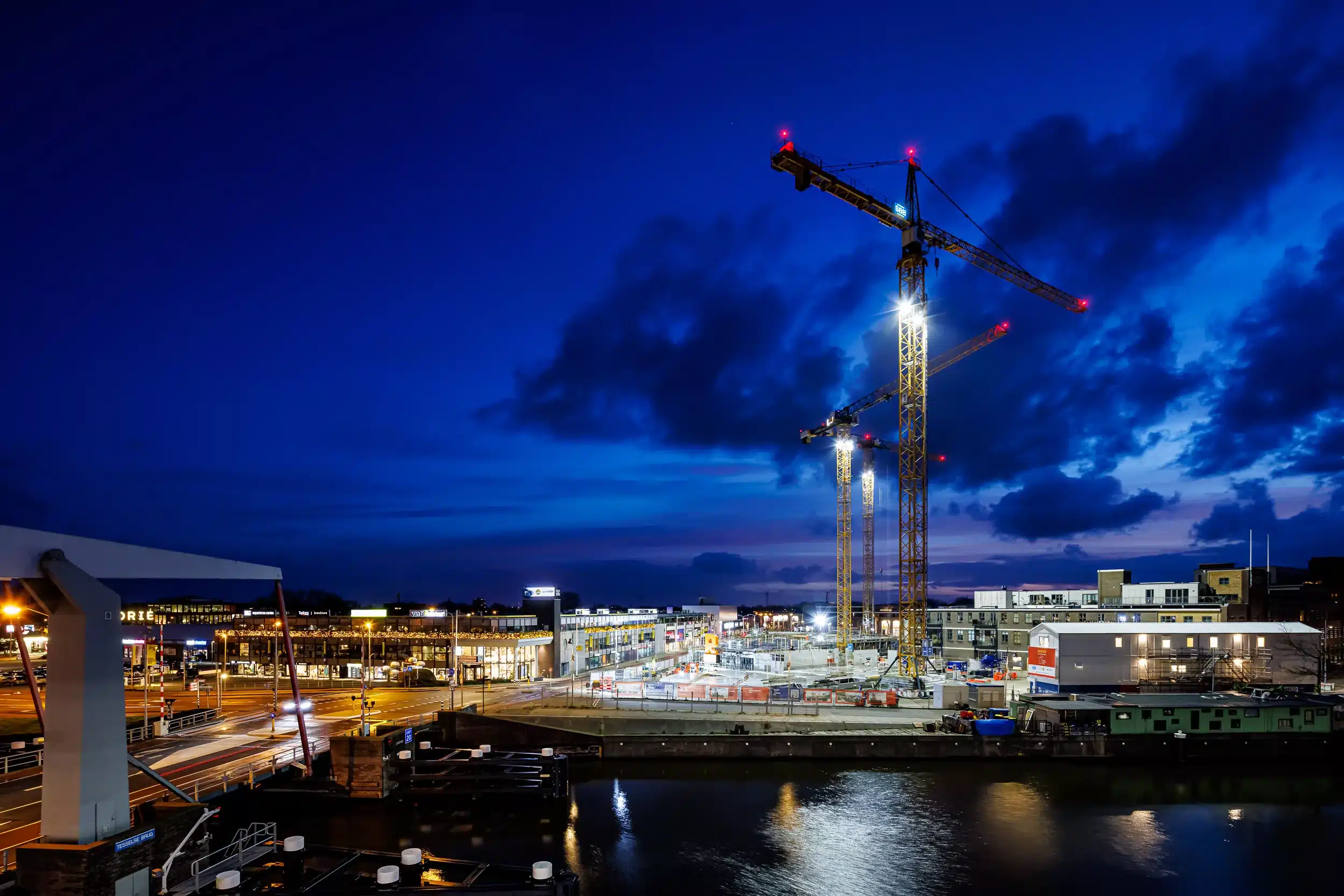
industrial site
Driving routes, loading zone, and walkways calculated per zone; the light stays within the property boundary of an inner-city site.
Construction site next to residences
Working level on-site, dark outside. Movable setup that moves along with the building volume.
Recycling and raw materials
High pole positions with wider beams, so the layout can shift without having to redo the lighting design.
Distribution and docks
100 lux for freight handling at the dock, with an intermediate zone leading to the site route so that a driver does not drive from light to dark.
Parking without power supply
Solar-powered light mast with cut-off luminaire, on a site where there was no cable and no excavation was possible.
Do you perform the work yourself, or do you write the specifications? Then these are the things you will want to know from us before you include us in a bid.
If your question is not listed, submit the situation via the form. An engineer will review it and respond within 1 business day.
That depends on the tasks per zone and not on the site type. EN 12464-2:2024 provides guideline values: 5 lux on walkways, 10 lux for slow internal transport, 20 lux on driving routes and for heavy parking use, 50 lux on the driving area of a transshipment zone, and 100 lux where goods are handled or labels are read. On a single site, those levels are adjacent to one another, so we calculate per zone.
That depends on the number of positions, the mast height, and whether masts and cabling are included. What we can indicate is the operational side: in our calculation example of twelve masts of 1,200 W at 4,000 burning hours, the consumption amounts to 57,600 kWh per year, or approximately €14,285 at €0.248 per kWh excluding VAT. With night dimming, that drops to approximately €11,400.
There is no specific subsidy for area lighting, and the 2026 Energy List also does not feature a dedicated EIA code for it. What remains is the generic route 310000, with a payback period between 5 and 25 years. How that works is explained on our page about the EIA; we do not promise a percentage in advance.
That the luminaire emits nothing above the horizontal. The light source is concealed behind the reflector and the luminaire hangs flat rather than tilted. The upward luminous flux is therefore 0 percent, which is the only value permitted in environmental zone E1.
Often yes. A new luminaire has a different weight and wind-catching surface than what was there before, so the pole is reassessed. With one luminaire per pole instead of four, the load usually goes down.
The higher the luminaire is hung, the smaller the angle at which the light strikes the site. As a result, the light stays on the surface instead of shining across it, and there is no need for it to be tilted. It is precisely that tilting that causes nuisance and glare.
For replacing luminaires on existing poles usually not; for new or taller poles often yes. First check the zoning or environmental plan for the maximum pole height and provisions regarding light emission, and take the general local ordinance (APV) into account.
By designing for the environmental zone and not just the site itself. We include the facade points of the surroundings in our calculations and keep the upward light output ratio at 0 percent. In the event of a complaint, that calculation is also your justification to the municipality or environmental agency.
That is advice from an energy advisor regarding the building or accommodation as a whole, and it is, for example, a requirement for DUMAVA. We provide the lighting figures that belong in it, but the advice itself comes from an energy advisor.
Yes, for site perimeters, field sheds, temporary setups, and unpowered parking lots. An autonomous mast with a cut-off luminaire prevents the need to excavate a cable route.
Yes on parking lots and back lots: 20 percent base level and full level upon movement. We do not do this on truck driving routes because a driver needs light before entering the zone.
For quays, terminals, and coastal locations, we supply versions in 316L. This comes with a twenty-year warranty on the housing and five years on the remaining parts. Corrosion class is a design choice and not a maintenance problem.
103,500 hours, L90B05: after that time, at least 95 percent of the luminaires still provide a minimum of 90 percent of the original light output. The AC drivers have a lifespan of more than 130,000 hours.
An engineer will respond to your request within 1 business day. The execution lead time depends on the delivery time of masts and luminaires and whether excavation is required; we will provide this per project.
Yes. Upon request, we will mount a luminaire on your own pole or facade so that you can see it on your own premises before anything is decided. For a site installation, that is more convincing than any brochure.
Yes. We supply and install in Flanders, at business parks, port locations and logistics sites. Our calculations take into account Flemish regulations regarding light pollution and any additional requirements from the port authority.
We provide the calculation free of charge, even without an order, and specify which level applies to each zone, what mast height corresponds to it, and what the environment permits. Your request will be evaluated by an engineer; we will respond within 1 business day.
Prefer direct contact?
We also deliver and install in Flanders, at business parks, port locations and logistics sites. Our calculations take into account Flemish regulations regarding light pollution and any additional requirements set by the port authority. You call the same number and get the same engineer.