

Home / Sectors / Ports and terminals / Terminal lighting
We illuminate container, ferry, bulk, and transshipment terminals with full cut-off flat floodlights of 171 lm/W net. The light falls on the site and the quay, and not into the pilothouse, onto the navigable channel, or into the residential area behind the fence.
At a terminal, zones with different functions are located side by side: traffic lanes, stacking yards, ro-ro ramps, docks, and waiting lines. Each requires its own level of work, and the entire operation must continue to function while work is being carried out. That is why we calculate requirements on a zone-by-zone basis and plan the installation around the ongoing operations.
Net luminaire efficiency
Highest mast we have installed, Eemshaven
Lower fuel consumption after conversion, P&O Ferries Europoort
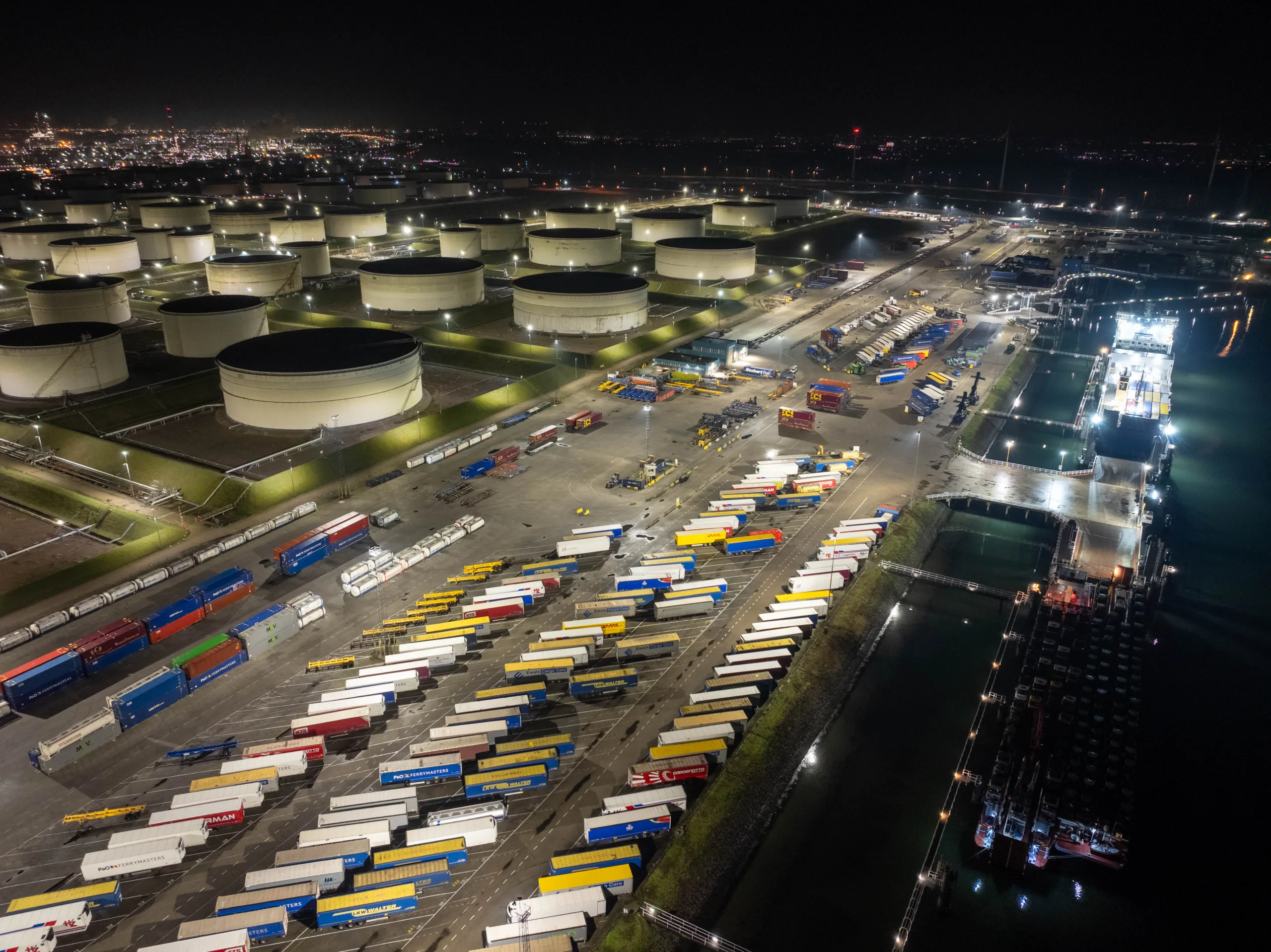
P&O Ferries Europoort: 30 new mast positions, lighting on the premises but not beyond
Almost every terminal we take on has the same setup: many masts, too low, with tilted floodlights shining diagonally across the site. That works in an empty field. As soon as there is cargo on it, it no longer works.
An angled beam hits the side of a container or a pile of bulk cargo, leaving a dark strip behind it. That same angled beam emerges at eye level on the other side of the site, so the machine operator and the skipper look into it. More power is then added, even though the problem isn’t the number of lumens but the angle at which the light hits the surface.
| What it says | How much it will cost you | What we change |
|---|---|---|
| Many poles, too low, with tilted floodlights | The bundle arrives at an angle. Behind every container, stack, or trailer, a dark strip remains that shifts along with the layout. | Fewer positions, but higher. In a completed project, the plan for 30 18-meter masts became an implementation of 6 50-meter masts, with a steeper angle of incidence that falls behind the objects. |
| Glare for the operator, the driver and the skipper | An oblique beam emerges on the opposite side at eye level. Anyone looking into it momentarily misses the rest of the field, and that is precisely where the work is being done. | Full cut-off, flush-mounted, and the inland positions. Hanging them higher makes tilting unnecessary, and thereby the source disappears from the field of view. |
| Add more coverage to conceal the dark spots | More wattage at the wrong angle mainly produces more stray light. Power consumption increases, the light beam does not improve. | First the angle and the beam, then the power. In a completed project, the design went from 30 × 3 × 400 W to 6 × 5 × 600 W: half the power, before a single mast was up. |
| Maintenance at height per pole position | Thirty locations mean thirty foundations, thirty cable runs, and thirty aerial work platforms used in the operation. That’s the amount not included in the luminaire price. | Fewer positions, one luminaire per position, and 103,500 hours L90B05. We do not make maintenance easier; we reduce the number of times it is needed. |
| The field must not be dark for a single night | A field that is shut down is a ship that is not being unloaded. Therefore, an installation that no longer meets requirements often lingers on for years longer. | We work field by field within the operational window, keeping the existing installation running until the new part is live. |
On a terminal we illuminated, there was a plan for thirty 18-meter masts. Nothing was there yet, so we were able to overhaul the design: six 50-meter masts. Fewer positions, higher up, with a steeper angle of incidence, so the light gets behind the objects and no one looks into it anymore. At the bottom of this page is what that did to the power consumption.
Light on the task, evenly distributed across the entire field, and 0% above the horizontal. Without dark strips behind the load and without complaints from outside the fence.
A lighting calculation per zone in advance, a test luminaire on your own mast, and a measurement report upon delivery. You do not have to take our word for it.
At P&O Ferries Europoort including 30 mast structures in two weeks, on a terminal that remained operational. Elsewhere in phases, field by field.
Foundation, mast, cable, luminaire, commissioning and measurement report from a single source. You provide the layout and shift times, we do the rest.
Six terminal types, with per type where the light should fall and where it should not, what level EN 12464-2:2024 gives as a guideline value, which pole height is usual, and which risk is at play. If your terminal is not listed, we will calculate it in the same way.
On a container terminal, the lighting image is determined by what is in the way. Stacks four or five high cast hard shadows that change by the day, and a reach stacker or straddle carrier drives right through them. Lighting from low positions at the edge therefore always results in dark strips, no matter how powerful the luminaire is.
That is why we work with a limited number of high positions, up to 50 meters, with a sharply defined beam per position. The higher the luminaire is mounted, the steeper the light incidence and the less the stacks obstruct it. For the driving routes between the blocks, we calculate a separate zone: these must be uniform, because that is where personnel cross paths with equipment.
When in doubt, choose height over count. Two 35-meter positions provide a more uniform field than six 15-meter ones, and require less cable, less foundation, and less maintenance at height.
| Handling and stacking field | 50 lux |
| Driving routes between the blocks | 20 lux |
| Mast height | 20 to 50 m |
| Luminaire | DarkLicht Two and Three |
| Corrosivity load | C5, ISO 12944 |
Cast shadow behind the stacks, and a layout that shifts every week. You accommodate both with margin in the lighting design, so no additional fixtures are needed afterwards.
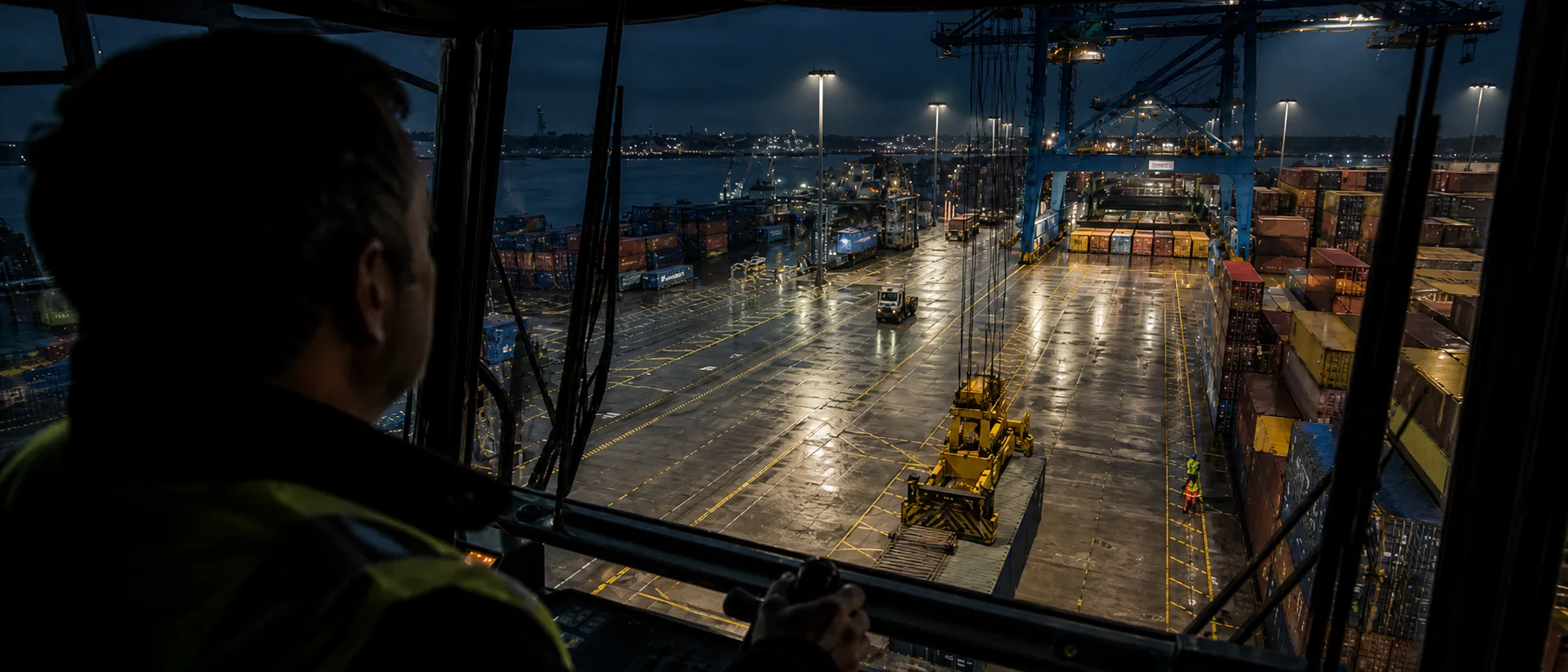
Transfer terminal in operation, illuminated from high mast positions
With dry bulk, dust is the deciding factor. A grab that handles coal, scrap metal, or raw materials coats every piece of optics within reach with a layer of dust, and on a flat lens that happens faster than on a downward-facing reflector. The output you measure after three years is therefore more a matter of construction than of the number of lumens on the datasheet.
That is why we are mounted high up, outside of the dust plume, and with a housing that can be cleaned with a pressure washer. In the lighting design, we take aging and dust accumulation over time into account, so that the required light level is still met at the end of the maintenance interval and not just on day one.
We calculate the transfer zone at 50 lux, and the driving routes at 20 lux. Where the layout of the bulk storage bays changes, we choose wider beams at fewer positions: this way, the setup can shift without requiring a new lighting plan.
| Rollover and gripper zone | 50 lux |
| Driving routes and internal roads | 20 lux |
| Mast height | 18 to 50 m |
| Luminaire | DarkLicht Two and Three |
| Cleaning | high-pressure permitted, IP67 |
Dust deposits on the optics and corrosion due to the combination of dust and salty air. Calculate with the maintenance factor so that the light level remains above the requirement even after years of soiling.

Quay and underlying area, calculated per zone
Heavy and irregular work is carried out at a supply base: pipe racks, sea fastening, crane work from the quay, and loads that are never the same twice. The work moves across the site, so a fixed lighting pattern for a single zone is not sufficient. What matters here is that the entire quay remains usable, even in the spot where nothing is located today.
We calculate the loading area at 150 lux and the quay zone at 50 lux, with an even ground level instead of hotspots. The luminaires on and near the quay are the same as elsewhere on the site: one maritime version, C5 and saltwater tested, with a five-year warranty and ten years on the housing with a maintenance contract.
Lighting on the crane itself does not belong in this lighting plan. That is a separate discipline, with its own vibration and mounting requirements; crane lighting exists for that purpose.
| Loading area and sea fastening | 150 lux |
| Quays and essay boxes | 50 lux |
| Mast height | 15 to 30 m |
| Version | maritime, C5 |
| ATEX | out of stock |
Salty air and a workstation that shifts by ship. Choose evenness across the entire surface over a high level in one spot.
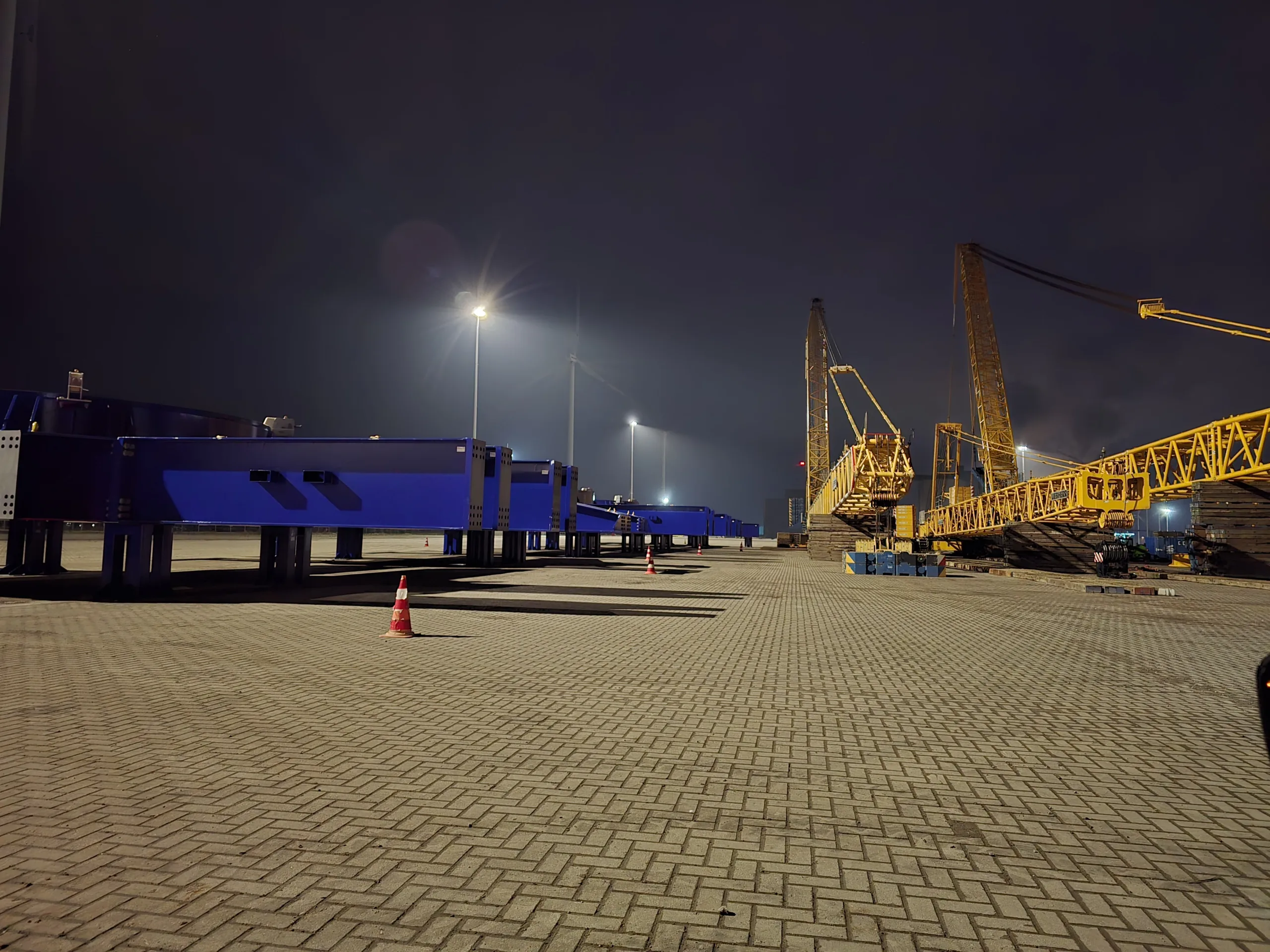
Quay zone evenly illuminated, without light spill over the water
On a logistics site, the sharpest transition of the entire terminal is located there: 150 lux at the dock, and twenty meters further onto the site route at 20 lux. A driver backing up looks from light to dark and back again, and adaptation takes seconds that he does not have there. We design that transition with an intermediate zone instead of a hard boundary.
We illuminate the docks from the building or from gantries, and the site routes and trailer park from masts of 12 to 30 meters. Uniformity is essential at the trailer park: otherwise, dark strips form between the parked trailers where no one can be seen.
Even when it’s the warehouse’s turn, we look at the big picture: inside with a Linear or Manta canopy, outside with DarkLicht,all with a single calculation and a single handover.
| Dock and loading and unloading area | 150 lux |
| Campground Trail and Trailer Park | 20 lux |
| Walking Routes | 5 lux |
| Mast height | 12 to 30 m |
| Luminaire | DarkLicht One, M and D |
The jump from 150 to 20 lux when reversing, and dark strips between the parked trailers.

Logistics area with lighting on gantries and masts
On the waterfront, the terminal’s boundary is not marked by a fence but by a line that no one can see. Light that falls beyond the boundary of the terminal area lands on the water, where it interferes with the work of helmsmen, pilots, and the bridge crew of a moored ship. Moreover, a reflective water surface makes scattered light twice as visible.
We therefore install the luminaires inland and do not aim them outward. Full cut-off is not an option here but a requirement: the luminaire emits no light above the horizontal, so no light shines into the eyes of anyone looking up from the water. We designate a separate zone around bollards, ladders, and the edge of the platform itself, as that is where personnel walk.
If the terminal is located on a waterway used by commercial vessels, we tailor the lighting plan to the requirements of the port authority or waterway management agency, and we provide the calculations in a format that can be easily verified.
| Curb and baseline | 20 to 50 lux |
| Walking routes along the edge | 5 lux |
| Upward light ratio | 0%, full cut-off |
| Mast height | 12 to 30 m |
| Version | maritime, C5 |
Blinding of skippers and pilots, and glare on the water. You control both with the beam and the mast position; dimming does not solve it.
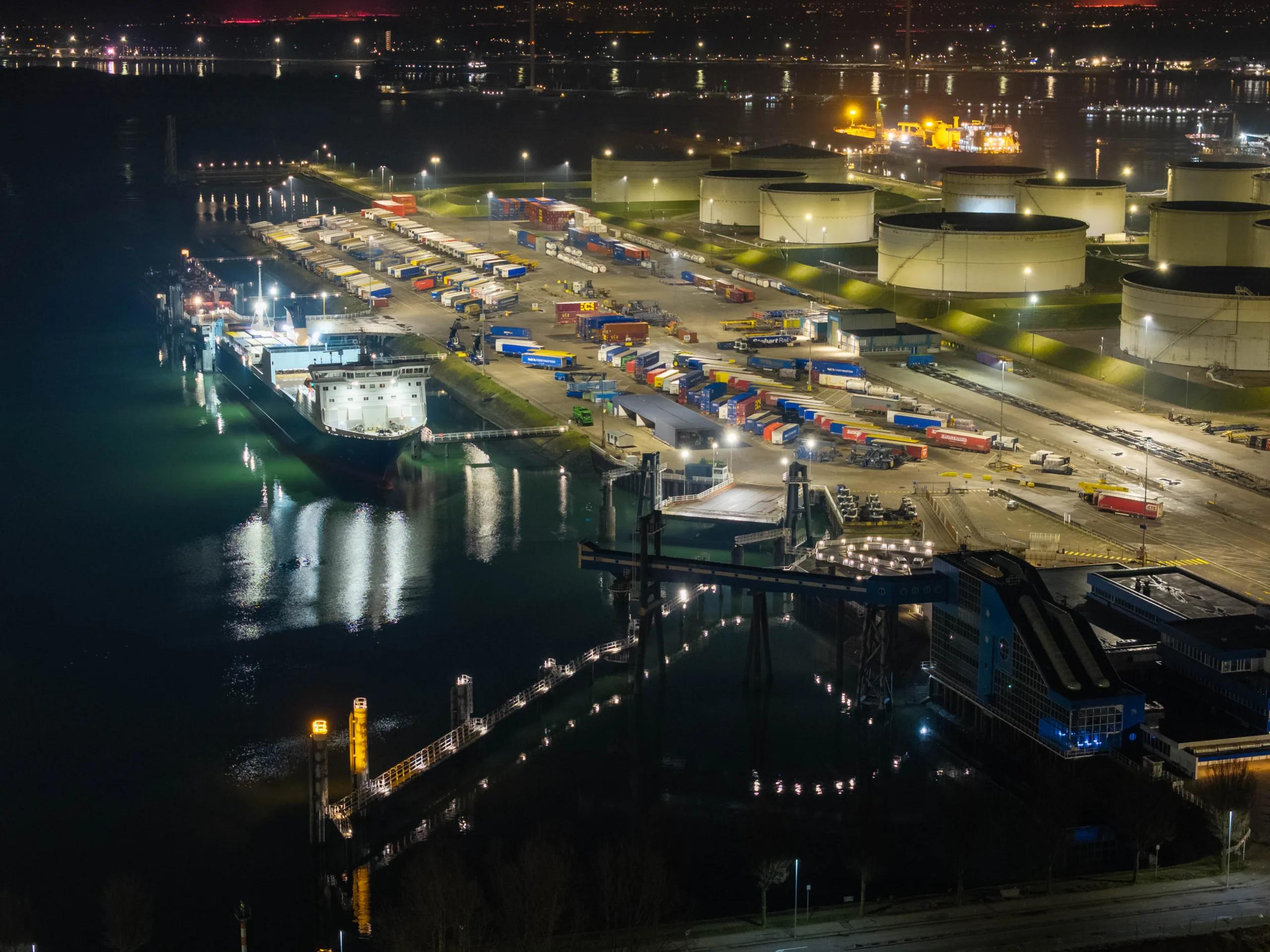
Quay illuminated from the land side, the water remains dark
The client in question, the location in question, and exactly what was done. All three remained operational during the project.
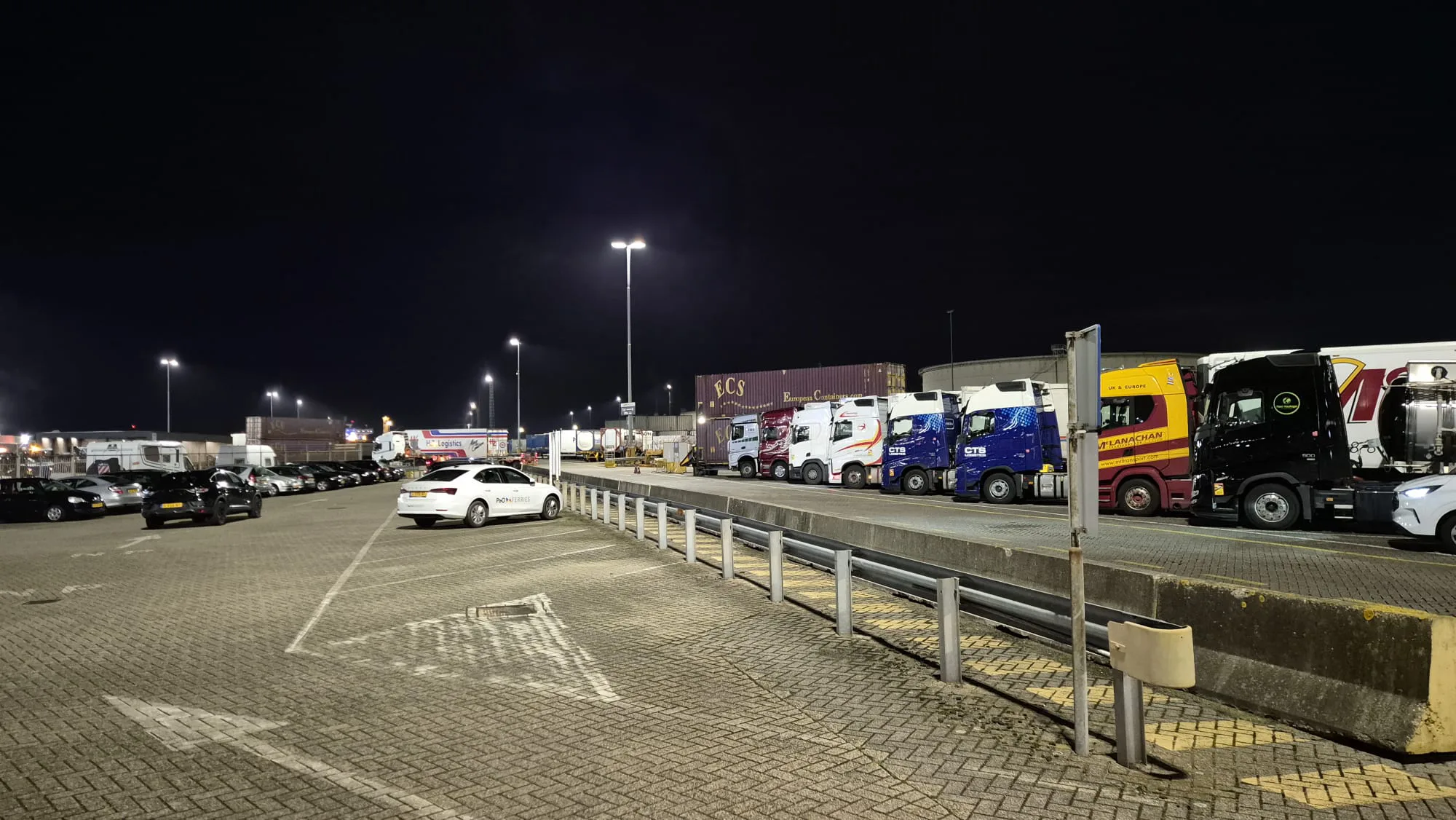
The previous LED installation with sports lighting luminaires was not adequate for the harbor. We designed and supplied a new system featuring highly focused DarkLicht luminaires mounted on 30 new mast structures. Thanks to better light concentration and reduced light spill, more usable light was provided to the site, with approximately 66% lower energy consumption. The project, including the mast structures, was completed in two weeks at a terminal that remained fully operational throughout.

In two phases: first, a new installation in 2021, followed by a complete LED upgrade in 2023. The terminal expanded during the project, so the work was carried out in phases without disrupting operations. Energy consumption fell by 53%, and visibility on the premises improved.
A complete lighting system for a large-scale transshipment yard: engineering, infrastructure, and installation, with masts up to 50 meters. Built for 24/7 operation in a port environment where wind, salt air, and heavy handling converge, from design to delivery by a single provider.
“We partnered with JEL Products on the outdoor lighting for DFDS. In our experience, JEL has a good understanding of the day-to-day operations of a terminal and is technically strong in developing appropriate solutions.”
Richard K., General Manager, DFDS Seaways
“The collaboration was excellent. In the end, we were able to implement a high-quality solution for our terminal. I would definitely recommend JEL Products to others in the industry.”
Jesse M., Project Manager, BUSS Terminal Eemshaven
“JEL Products has helped us achieve energy savings of 53%, while significantly improving visibility at the DFDS terminal in Vlaardingen.”
Leon C., Port Manager, DFDS Seaways
EN 12464-2:2024 works with tasks and zones and does not have a fixed number per site. At a terminal, those zones are close together, and it is precisely the transitions that determine whether someone sees well. We therefore calculate per zone and, in addition to the level, we also test the uniformity: 20 lux on average with 2 lux in the corners feels less safe than 10 lux that is uniform everywhere.
| Walking Routes and Pedestrian Zones | 5 lux |
| Queues and parking spaces | 10 lux |
| Slow-moving internal transport | 10 lux |
| Traffic Lanes and Regular Vehicle Traffic | 20 lux |
| Transshipment and container handling | 50 lux |
| Loading and unloading area, ro-ro ramp | 150 lux |
Guideline values per zone according to EN 12464-2:2024; there is no strict requirement per terminal. Which zone applies where, and the corresponding uniformity, are determined based on the survey and the calculation.
The standard also allows for adjusting the setting up or down by one step. We increase it where a mistake would be costly to correct, such as on a ferry gate, a ro-ro ramp, or under crane operations: in those cases, 150 lux goes up to 200 lux and 20 lux goes up to 30 lux. We lower the level during nighttime hours when only security patrols and surveillance are in effect.
A high mast at a transshipment yard, from the initial calculations to the final installation. See how the height determines the lighting pattern across the yard.
BUSS Terminal Eemshaven, high mast up to 50 meters. View the project

Lighting calculation per zone, with facade points and upward light output
The larger models are installed at terminals: DarkLicht One, Two, and Three, ranging from 320 to 1,800 W, with DarkLicht M and D for lower positions, facades, and canopies. The basic principle is one luminaire per mast position: fewer mounting points, less cabling, lower wind loads, and less maintenance at height.
The light output comes from a patented reflector technology instead of a lens. As a result, the beam remains sharply defined and the luminaire by definition emits nothing above the horizontal. That is precisely what a terminal needs: the light falls on the yard and the quay, not on the water, the wheelhouse, or the neighborhood behind it.
There is one version, and it is maritime. The housing has the same coating as all our industrial luminaires, tested for a saltwater environment and rated C5 according to ISO 12944-2:2017, the class for coastal and marine climates directly below CX for offshore. Therefore, the exact same luminaire is also fitted on the quay edge. A five-year warranty applies to the complete luminaire; as long as there is a maintenance contract with us or with a party designated by us, we extend the warranty on the housing to ten years.
| Implementations on terminals | DarkLicht One, Two, and Three |
| Power | 320 to 1,800 W |
| Net return | 171 lm/W |
| LED lifespan | 103,500 hours, L90B05 |
| AC Driver Service Life | more than 130,000 hours |
| Ingress protection | IP67 and IK08 |
| Corrosion class | C5 according to ISO 12944, tested on salt water |
| Upward light ratio | 0%, full cut-off |
| Dimming | 0 to 10V, DALI, time- or zone-controlled |
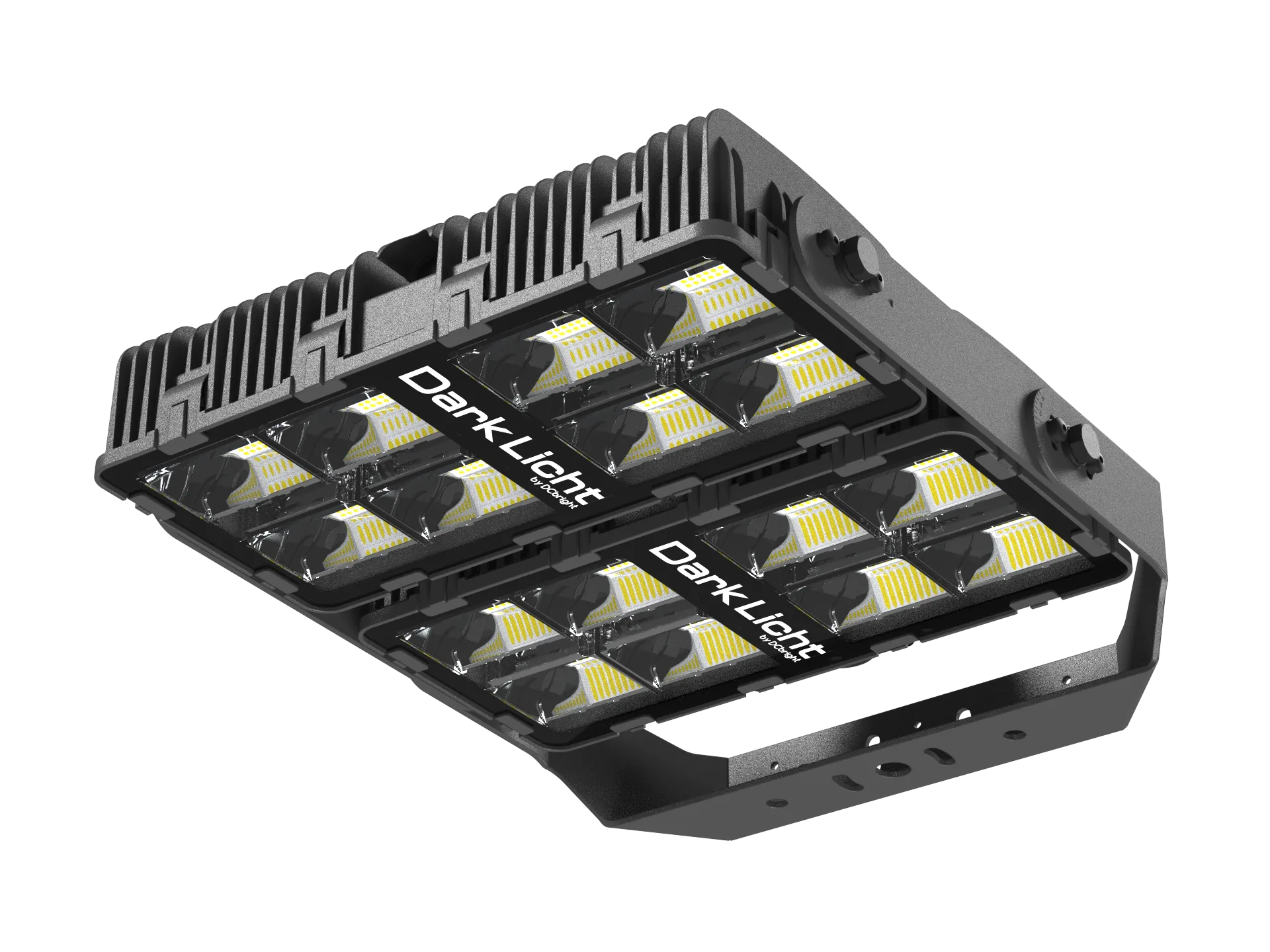
DarkLicht Two, EXT version with external driver
4000 K is the usual choice for terminals: good color differentiation on labels and markings, without the cold impression of 5700 K. Where the environment is sensitive, for example next to a Natura 2000 area, we supply amber 2200 K for the night hours.
Both are also possible. All versions are available with two switchable light colors, so that a single schedule runs throughout the day: 4000 K during the working hours of the evening and morning, and in the deep night a warmer or amber-colored setting for surveillance and patrols. That reduces light pollution for the surrounding area during hours when no work is taking place, without compromising the lighting during working hours.
A terminal rarely stands alone. On one side, water with shipping traffic; on the other side, often a residential area, a dike, or a protected zone. That makes stray light a design issue, not an afterthought.
| Zone | Environment | Upward light ratio |
|---|---|---|
| E1 | Nature reserve, remote rural area, Natura 2000 | 0% |
| E2 | Rural area, outskirts of a village, outside the dikes | up to 2.5% |
| E3 | Built-up area, mixed-use residential and commercial district | up to 5% |
| E4 | Industrial and port area, city center | up to 15% |
By definition, a full-cut-off luminaire emits no light above the horizontal plane, so the upward luminous flux is 0%. That is the only value permitted in zone E1, and it is impossible with a tilted floodlight. Tilting the luminaire to reach further is precisely the action that causes the glare; hanging it higher does not.
We adhere to the NSVV Code of Conduct for Lighting Calculations. As a result, our calculations are structured in a way that allows them to be verified, including by a third party reviewing them on behalf of the municipality or the port authority.
The higher the luminaire is suspended, the smaller the angle of incidence on the site becomes, and the less light is lost along the site. Furthermore, there is no need to tilt the luminaire, and it is precisely this tilting that causes interference. At terminals, this means fewer mast positions, spaced farther apart, with a heavier structure per position.
| Queue, Parking, and Office Area | 8 to 12 m |
| Ro-Ro ramp and loading and unloading area | 12 to 35 m |
| Stacking Area and Transshipment Zone | 20 to 35 m |
| Container terminal and large transshipment yard | up to 50 m, high mast |
| Temporary or movable setup | 6 to 12 m |
This is for reference only, and the results of the lighting calculation always take precedence. For existing poles, we first assess whether they can support the new luminaire and the wind load before placing any orders.
For high masts, we include the foundation: soil mechanics, wind zone, cable routing, and the voltage drop over the long distances that are typical for a terminal. We work with fixed mast configurations. This requires an aerial work platform or climbing equipment for maintenance, but it is a structure that stands after completion and does not need to be inspected annually. Instead of making maintenance easier, we reduce the number of times it is needed: fewer positions, one luminaire per position, and 103,500 hours of L90B05, so that within its lifespan there is hardly any need for work at height.
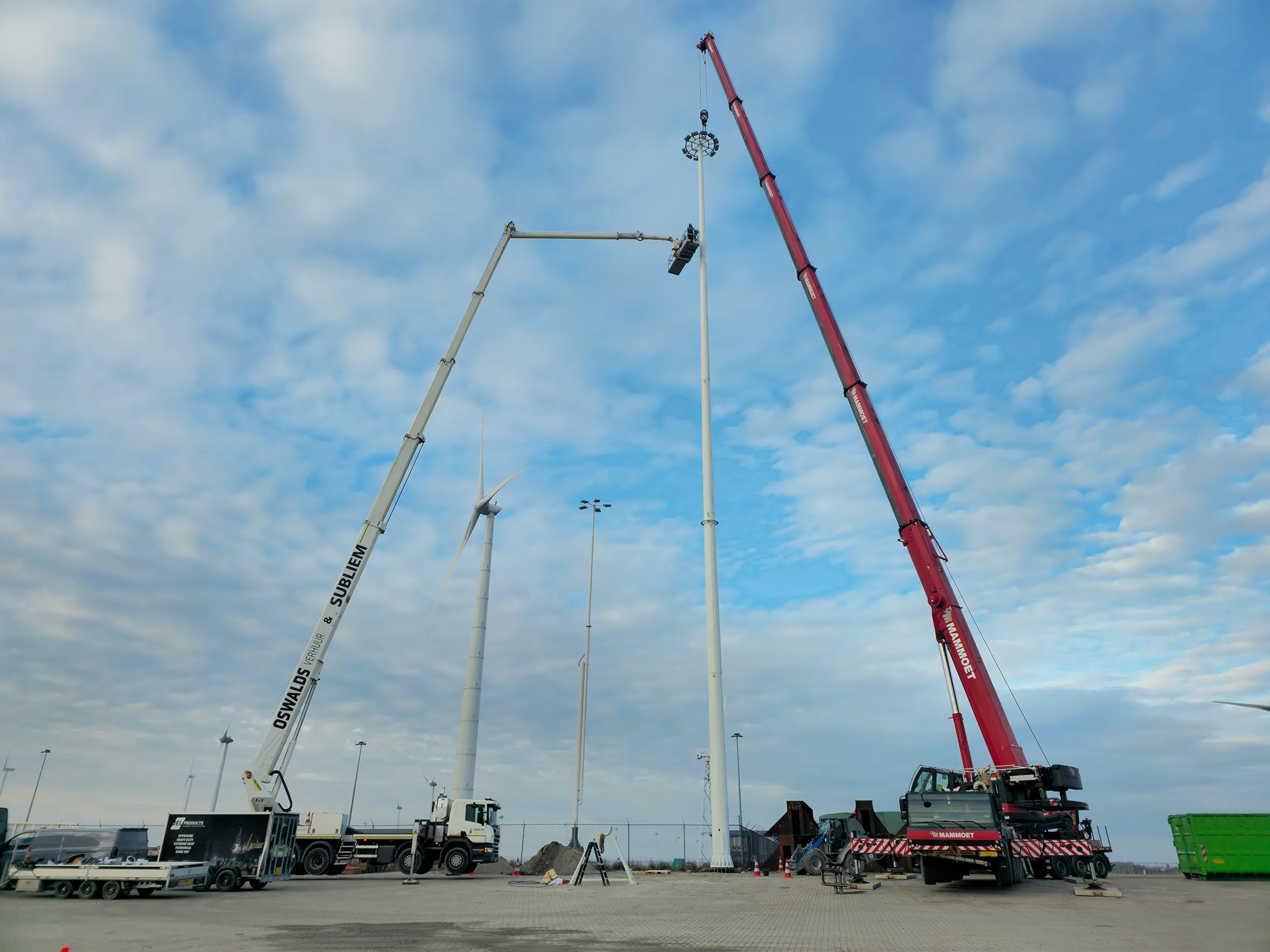
Assembly of the luminaires on a 50-meter mast, Eemshaven
This is the real project risk at a terminal. A field that is dark for a night means a ship that is not unloaded. We therefore plan the execution per field and per window, in consultation with operations.
We work field by field and keep the existing installation running until the new part is lit. An entire site is never taken out all at once.
The planning follows the arrival schedule of ships and the shift times. At DFDS Vlaardingen, the terminal expansion ran right through it, and that was resolved in phases.
Our technicians are VCA**-certified and work within your access and ISPS procedures, accompanied by the relevant guidance and work permits.
At P&O Ferries Europoort, the entire project, including 30 mast structures, was completed in two weeks on a continuously operational terminal.
We have deliberately opted for a fixed mast configuration: once installed, it remains in place and does not require annual inspection. We minimize the number of times someone needs to work at height by using fewer mounting points and ensuring a longer service life for each light luminaire.
If the schedule shifts per week or the work is temporary, then a mobile lighting tower more suitable than a fixed mast setup.
The actual level per zone is measured and recorded. That is what an occupational health and safety service, an insurer, or the port authority ultimately wants to see.
For a transshipment terminal, there was a design calling for 30 masts, each 18 meters tall, with three 400-watt luminaires per mast. Nothing had been built yet: we joined the project during the design phase and revised that plan to include 6 masts, each 50 meters tall, with five 600-watt luminaires. As a result, the light beam is more vertical, so it doesn’t shine over the cargo, and no one is blinded by it anymore. The total connected power ended up being half as much.
| Original design: 30 masts of 18 m, 3 × 400 W per mast | 36.0 kW |
| Annual consumption, original design | 144,000 kWh |
| Executed design: 6 masts of 50 m, 5 × 600 W per mast | 18.0 kW |
| Annual consumption, executed | 72,000 kWh |
| Difference per year | 72,000 kWh, approximately €13,000 |
| Mast positions that did not need to be built | 24 |
| With night dimming to 50% during off-peak hours | approximately €1,600 extra |
Assets from an actually executed project; the client is not named here. The energy amounts are derived from this using a fictitious rate of €0.18 per kWh excluding VAT and 4,000 operating hours per year with twilight switching. A terminal that runs 24/7 does not have lights on for 24 hours: the number of hours follows from the day length and the control per zone. For your terminal, we calculate using your own rate, positions, and operating hours.
This is not a saving on an existing installation, but on what would have been built. The 24 tower locations that disappeared from the plan are 24 foundations, cable routes, and maintenance points that were never created. That makes a difference in construction, and every year after that as well.
Besides energy, the savings lie in maintenance. A lamp replacement at 35 meters requires a aerial work platform, traffic control measures, and a disruption to operations. With 103,500 hours of L90B05 and drivers exceeding 130,000 hours, that moment shifts from annual to a one-time event within the installation's lifespan.
There is no subsidy specifically for terminal lighting, and the 2026 Energy List does not include a separate EIA code for it. What remains is the generic code 310000, with a payback period of between 5 and 25 years.
In addition, pay attention to the energy-saving obligation: exterior lighting is on the Recognized Measures List, and therefore replacement is an obligation rather than a choice.






Has the work been tendered, or do you work with a fixed electrical contractor? In that case, we supply the luminaires, the lighting calculation, the power specification, and the installation materials, and we support the executing party during installation. The warranty remains valid when installed by third parties, provided it is done in accordance with our installation instructions.
We supply terminals worldwide. In Flanders and the German North Sea ports, we typically handle the entire project, including installation, and take local light pollution regulations into account in our calculations. The farther away the project is, the more often we handle the engineering, delivery, and supervision, with a local installation contractor carrying out the installation under our engineering guidance. Turnkey installation is also possible outside of Europe; we determine this on a project-by-project basis.
Fifteen questions,click to expand and read. If your question isn't listed, please call an engineer. You'll speak directly with the person who will be doing the calculation.
+31 6 1054 4770, Lucas de Graaf, Technical Director
That depends on the task per zone. EN 12464-2:2024 gives as a guideline 5 lux on walking routes, 10 lux on queues, 20 lux on traffic lanes, 50 lux on transshipment and container handling, and 150 lux at the loading and unloading area. On a terminal, these zones lie next to each other, so we calculate them separately and also pay attention to uniformity.
Yes, that is the starting point at a terminal. We work field by field and keep the existing installation running until the new section is energized. The planning follows the arrival schedule of ships and the shift schedules. At DFDS Vlaardingen, the installation was carried out in phases while the terminal was growing; at P&O Ferries Europoort, it was done in two weeks on a continuously operational terminal.
From 12 meters at docks and trailer parks to 50 meters at a large transit yard, with 15 to 35 meters at ferry and roll-on/roll-off terminals and 20 to 35 meters as the usual range in stacking yards. Mounting higher provides a steeper angle of incidence, resulting in less light spilling past the site and no need for tilting. The height is always the result of the lighting calculation.
With the beam and the mast position; dimming doesn't solve it. Our luminaires are full cut-off: nothing shines above the horizontal, so someone looking up from the water or from a cabin does not look into the light source. In addition, we position them inland and do not aim outward. Angled floodlights do the exact opposite.
We supply one version, and it is maritime: the same coating as on all our industrial luminaires, tested in a saltwater environment and rated C5 according to ISO 12944-2:2017, the class for coastal and marine climates directly below CX for offshore. Therefore, the exact same luminaire is also installed at the quay edge, because that is where the stress is highest.
103,500 hours, L90B05: after that time, at least 95% of the luminaires will still provide at least 90% of their original light output. The AC drivers last more than 130,000 hours. We list LEDs and drivers separately because, in practice, the driver is the component that needs to be replaced first.
Five years on the complete luminaire. As long as a maintenance contract is in effect with us or with a party designated by us, we extend the warranty on the housing to ten years. We do not offer more than ten years for this application. Installation by your own installer does not limit the warranty, provided it is done in accordance with our installation instructions.
No. We do not have any ATEX-certified luminaires, nor do we supply them. If there is a zone designated as having an explosion hazard within your terminal,for example, near a tank pit or a gas installation,we will illuminate the surrounding area and refer you to a specialized supplier for the zone itself. We take that boundary into account in the lighting plan.
Rarely one-to-one, and that is usually a win. A modern floodlight focuses more sharply, so with fewer positions and less power, more usable light reaches the site. We calculate your existing setup and indicate which positions can be eliminated, which masts can be reused, and which cannot support the new wind load.
By definition, a full cut-off luminaire emits nothing above the horizontal, so the upward light ratio is 0%. That is the only value permitted for zone E1, the zone that applies adjacent to nature reserves and Natura 2000 areas. In our calculation, we also include the light on surrounding facades, before and after curfew. For sensitive environments, we supply amber 2200 K for the night hours, and all versions are available with two switchable light colors so that the night setting has a different color than the working hours.
There is no subsidy specifically for terminal lighting, and the 2026 Energy List does not include a separate EIA code for it. What remains is the generic code 310000, with a payback period of between 5 and 25 years. Also, be aware of the energy-saving requirement: outdoor lighting is on the List of Approved Measures, which means replacement is a requirement rather than an option.
We use a fictitious rate of €0.18 per kWh excluding VAT and 4,000 operating hours per year with twilight switching. In one executed project, a modified design reduced the connected load from 36 to 18 kW, which on that basis amounts to approximately €13,000 per year. How quickly that pays back depends on your current load, the number of positions, and whether poles and cables also need to be replaced. We will put that calculation on paper for your terminal, using your own rate and operating hours.
Yes, and that applies to all models in the lineup. The luminaire will then have two switchable light colors, for example, 4000 K for the active hours of the evening and morning, and a warmer or amber-colored setting for the late night. The switch is integrated into the dimming schedule for each zone, so you don’t have to do anything. This is particularly useful in areas where the surroundings are sensitive during nighttime hours and only security monitoring and patrols take place.
Yes. Upon request, we will hang a luminaire on your own pole so that you can see it on your own property before anything is decided. For a terminal project, that is the most reliable assessment there is: a demonstration at our facility tells you nothing about the conditions at your location.
Yes. Whether the work has been tendered or you work with a fixed electrical contractor, we supply the luminaires, the lighting calculation, the power specification and the installation material, and we support the executing party during installation. We can also supply turn-key, including foundation, masts, cabling and commissioning with a test report.
Terminal lighting is part of the sector Ports and terminals. It states what a port requires as an environment for the lighting design, from corrosion class to permit.
We provide the calculation free of charge, even without an order. You will receive information on which level applies to each zone, how many positions are needed, at what height, and what the consumption and savings will be.
| Response | within 1 working day, by an engineer |
| Lighting calculation | free of charge, per zone |
| Trial luminaire | on your own mast, on request |
| Warranty | 5 years full, 10 years on the housing with a maintenance contract |
Rather call directly: 033 785 9809