

Home / Crane lighting / Harbor crane lighting
A terminal runs day and night. A luminaire that fails at a height of fifty meters does not cost the price of a lamp, but crane downtime, an aerial work platform, and a crew standing idle. That is why, on a harbor crane, we choose for lifespan and corrosion resistance first, and only after that for lumens.
We supply LED floodlights and complete lighting sets for STS container cranes, RTG and RMG stacking cranes, gantry cranes and reach stackers, bulk and floating cranes, mobile harbour cranes, and material handlers. New build and retrofit, in AC and DC on the crane's on-board grid.

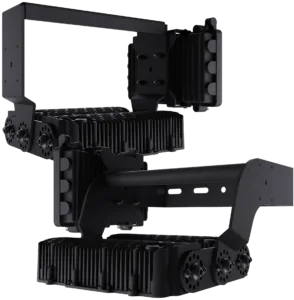
The luminaire
Up to 83,000 lumens per mounting point at 12.6 kg, composed of cast light modules.
A quay is not an industrial site with high masts. Everything is moving, everything is wet and salt, and the positions where the lighting needs to be hung are precisely the positions that are not easily accessible. Together, these five points determine which solution remains per crane type.
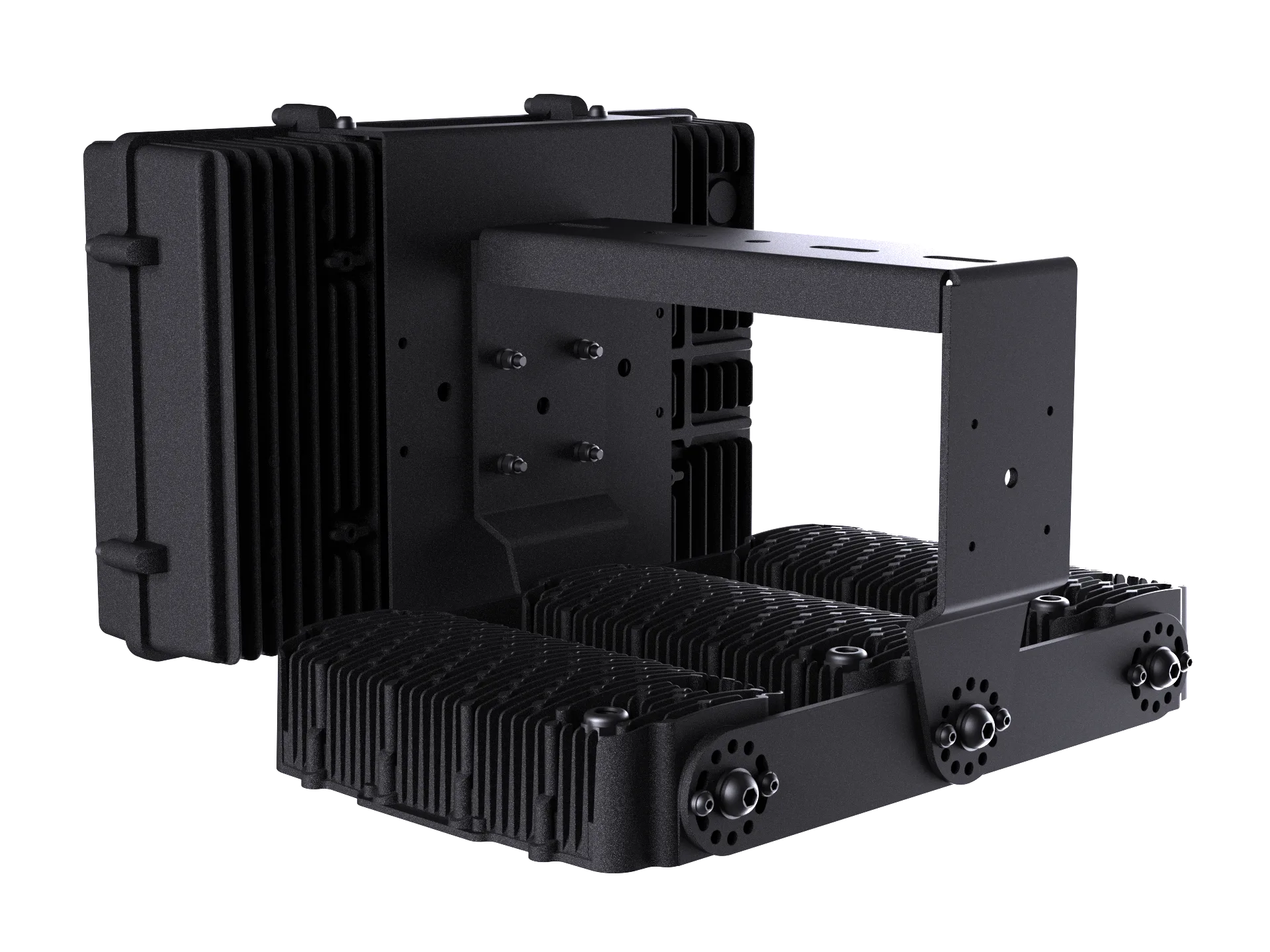
Most of our port projects involve the replacement of existing equipment: cranes with halogen or metal halide luminaires that provide insufficient light, fail too often, or only reach full power after the movement has already been made. Replacement is done position by position, without the crane having to be taken out of service for the entire set.
Crane type and brand, the available voltage on the crane, the mounting positions and the distance to the work area. With those four pieces of data, we make a lighting calculation before anything is ordered.
Haven crane is a collective term. A seventy-meter-high STS crane requires something different than a reachstacker driving among people. Below is a breakdown per type of what goes wrong, what we mount, and which luminaire we usually choose there.
The ship-to-shore crane illuminates three areas at the same time: the ship's hold and hatches, the trolley runway, and the quay beneath the portal. These three are tens of meters apart and each require a different beam angle. At a height of seventy meters, a wide-beam luminaire mainly illuminates the sky and blinds the lashing crew below.
In practice, this is almost exclusively the Snapper HC: High output per mounting point, which means fewer cables, fewer mounting points, and fewer times the crane needs to be taken out of service. We select the optics from the Snapper HC set, which includes 10-, 30-, 60-, and 90-degree options.
For the walkways, stairs, and the corridor along the machine house, we use the Linear. That is a linear luminaire without optics: it illuminates the walkway evenly over its entire length, and that is precisely what is needed there.
| Positions | boom, machinery house, gantry, catwalks |
| Power supply | 180 to 528 V AC, three-phase |
| Luminaires | Snapper HC on the crane, Linear on the walkway |
| Optics | 10° in the hold, 30 to 60° on the quay |
The stacking crane drives through the container stack and operates between walls of steel. The light must fall into the aisle between the stacks, not over them, and the container numbers must remain legible for the operator and for the camera. Driving on concrete tracks creates a continuous vibration load on the legs. A rail-mounted gantry crane along the quay is essentially the same challenge: a narrow, long track from a fixed portal.
On a diesel-powered RTG, the power consumption factors into the fuel consumption. With an e-RTG powered by a cable reel or rail system, the terminal more frequently requests dimming or switching per zone.
| Positions | legs, saddle, portal legs, spreader frame |
| Power supply | 400 V AC or 48 V DC on-board power supply |
| Luminaires | Snapper HC, Barracuda, or Shark as an alternative |
| Optics | 30 to 60° along the stack |
A reachstacker drives among people and continuously shifts its own light distribution. Glare is the main problem here: a wide-beam floodlight on the cab roof literally leaves the colleague on the ground in the dark. Toward people, we therefore mount full cut-off luminaires, so that nothing emits from the luminaire above the horizontal line.
Upwards, toward the load, the exact opposite is needed. As soon as the machine has a grip on a container, the top of that container and the spreader need to be in the light. For that we choose 69 degrees: spacious and close. Standard choices are the Goby and the Piranha on the 24 V electrical system, without an inverter.
| Positions | cab roof, boom, spreader |
| Power supply | 24 V DC, 20 to 35 V |
| Luminaires | Goby and Piranha, DarkLicht to people |
| Optics | 69° up to the load, full cut-off to people |
Grab cranes for coal, ore, scrap metal, and grain combine two things that destroy luminaires: the shock of a closing grab and dust settling on the lens. A dirty lens costs more light than the wrong optics, so cleanability is a specification here. IP69K means the luminaire will survive the high-pressure washer that will be used on it anyway.
On a floating crane or crane vessel, the ship's motion is added to the crane motion, and you often illuminate deep into the hold. We choose high output from a single housing there, such as the Orca, and where the class office or material policy requires it in 316L.
| Positions | jib, superstructure, compartment lighting |
| Power supply | 400 V AC or 24 V DC on board |
| Optics | 38° in the hold, 14° over the quay |
The mobile harbor crane drives along the quay and luffs its boom up and down. As a result, the light beam moves away from the work area precisely during the hook-up of the load. You cannot solve that with more lumen output, but with a mounting that maintains or adjusts the position.
Around the mast and the superstructure, we mount full cut-off, usually the DarkLicht One. This keeps the light on the quay and out of the sight of the lashing crew and passing vessels. The boom has an angle of 38 to 69 degrees, depending on the height at which the luminaire is suspended, with the Barracuda, the Shark, or the Orca.
If the bundle needs to move with the boom position, then comes the Crane Light Stabilizer Counter: a spring-loaded bracket that lets the luminaire hold its own position as the boom goes up and down.
| Positions | mast and superstructure, boom, cabin roof |
| Power supply | on-board generator, shore power or 24 V DC |
| Luminaires | DarkLicht One around the mast, Barracuda, Shark, or Orca on the boom |
| Optics | full cut-off around the mast, 38 to 69° in the boom |
Bridge cranes on the quay or on a pontoon, with grab, magnet or hook, rotate continuously with the superstructure. The lighting therefore rotates with it and must cover both the bin and the immediate surroundings of the machine. Dust, scrap metal and wet handling make the mounting just as important as the luminaire.
The same applies to the upper structure as to the mobile harbor crane: full cut-off to the surroundings, and 38 to 69 degrees on the grapple itself. For the smaller material handlers, the Goby and Barracuda are sufficient. These machines almost always have a 24 V electrical system, for which we supply a true DC version, without an inverter, installed in the hardest-to-reach spot on the machine.
| Positions | upper structure, boom, cab |
| Power supply | 24 V DC electrical system |
| Luminaires | Goby and Barracuda on smaller handlers |
| Optics | full cut-off random, 38 to 69° on the gripper |
Is your machine not listed, or is it a combination, for example a terminal with both STS and reach stackers? Then we will review it on a case-by-case basis. See also the hub crane lighting for mobile cranes, tower cranes and lattice boom cranes.
On the page terminal lighting you can read how we light the area around the crane, from mast height to zoning.
In a terminal, a luminaire rarely fails because of its LEDs. It fails because of its housing: copper-bearing aluminum that pits, a coating that peels off, a bracket that rusts solid, or moisture entering via a cable gland. That is why corrosion comes before lumens in our selection discussions.
C5 without ISO 12944 is a marketing term. C5 according to ISO 12944-2:2017, supported by 1,000 hours of salt spray testing according to ISO 9227, is proof.
More about our material selection and testing can be found at quality and warranty.
| Housing | aluminum, less than 0.08 % copper |
| Coating | conversion layer with two-layer titanium e-coating |
| Corrosion class | C5 according to ISO 12944 |
| Salt spray test | 1,000 hours in accordance with ISO 9227 |
| Bracket | high tensile strength 316L |
| All 316L | available, on material policy |
| Marine version | white painted, for ships and crane vessels |
| Protection | IP69K, IK10 |
| LED lifespan | TM-21 L90B05 > 360,000 hours |
What is not there, we also mention: there is no class approval from a classification society for these luminaires. If your shipyard or insurer asks for this, we will figure out together which document package will suffice.
Eight fixtures cover almost every position on a terminal. The choice is about mounting height, accessibility, and the weight the structure can support, and only after that about lumens. The Snapper HC is at the top because it delivers the most light per kilogram and per euro in crane positions.
| Image | Luminaire | Position on the terminal | Power | IP and IK | Weight |
|---|---|---|---|---|---|
 | Snapper HCup to 83,000 lm | The standard choice on STS, RTG, RMG and gantry cranes: maximum light per mounting point, custom optics set from 10 to 90 degrees | 270 to 500 W | IP67 / IK08 | 9.9 to 12.6 kg |
 | Orca111,300 lm | Bulk cranes, floating cranes, and mobile harbour crane booms: long-distance hold lighting from a single housing | 800 W | IP69K / IK10 | 22.7 kg |
 | Barracuda44,100 lm | Jib of mobile port and handling cranes, and on stacker cranes where mounting or weight requires a more compact luminaire | 240 to 320 W | IP69K / IK10 | 10.1 kg |
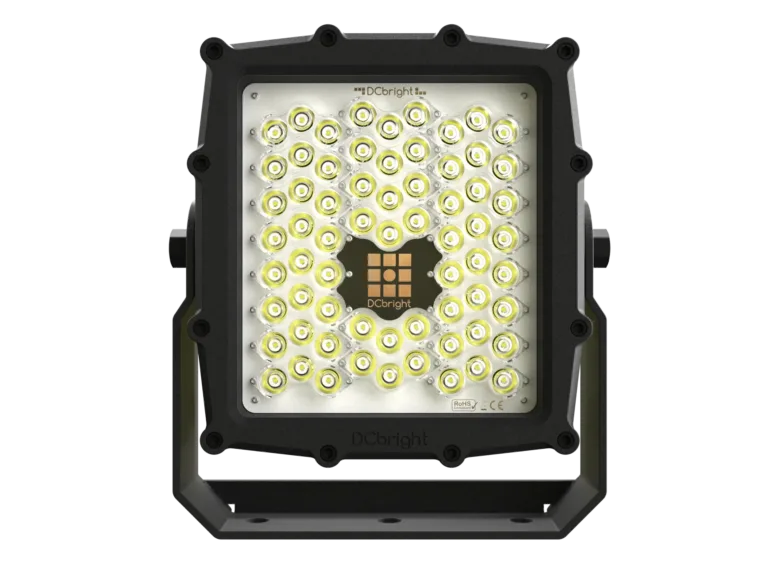 | Shark50,000 lm | Same task as the Barracuda, with more output at a lower weight per lumen | 320 W | IP69K / IK10 | 9.2 kg |
 | DarkLicht One51,200 to 102,600 lm | Full cut-off around the mast and the superstructure, and in every direction shining towards people, water, or residential areas | 320 to 600 W | IP69K / IK08 | 14.0 to 15.0 kg |
 | Piranha8,400 lm | Work light close to the load: slewing superstructure of material handlers, spreader, and cabin | 70 W | IP69K / IK10 | 3.1 kg |
 | Goby8,200 lm | Reachstackers, terminal tractors and smaller material handlers, directly on 24 V without converter | 65 W | IP69K / IK10 | 1.8 kg |
 | Linearup to 25,600 lm | Walkways, stairs and the corridor along the machine house: linear light without optics, in four lengths from 300 to 1,200 mm | 22 to 120 W | IP69K / IK08 | 2.8 to 7.6 kg |
All mentioned luminaires are available in AC voltage and the majority also in DC voltage for the ship's grid. Which version fits your crane depends on the available voltage and the existing cabling. If you are in doubt between two luminaires, we will calculate both in the lighting calculation and you see the difference in lux on the quay instead of in lumens on paper.
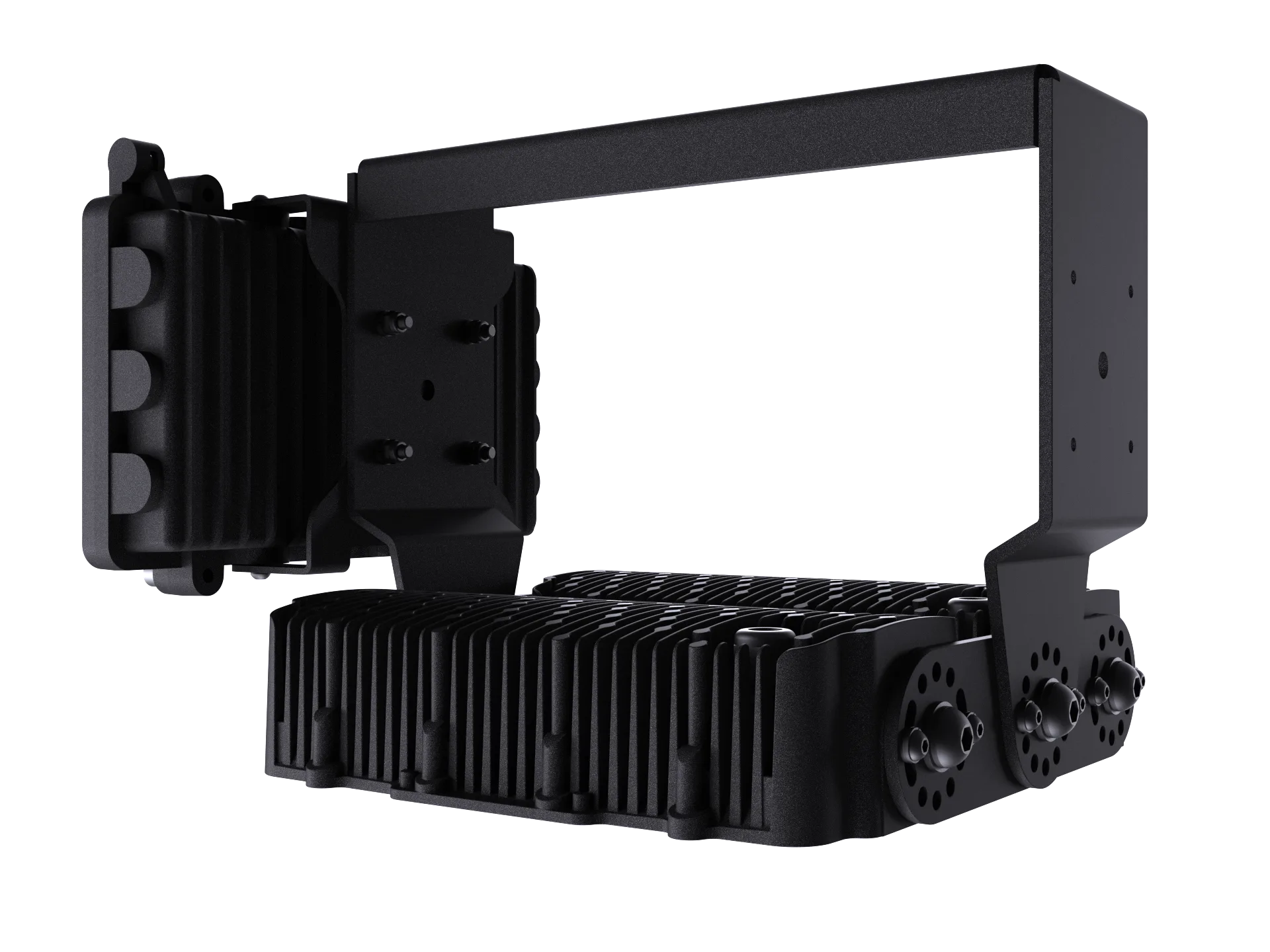


On a harbor crane, the mounting point is often forty to seventy meters above the working area. In that case, the beam angle is more important than the wattage: with narrow optics, the same floodlight delivers four times as much lux on the hatch, and at the same time less stray light toward the navigable waterway and the surrounding neighborhood.

From the boom of an STS crane, 50 to 300 m, and in front of the hold of a ship.

Mobile harbour crane and grab work, 30 to 100 m. The most commonly used optics.

Quay and container stack: spread wide to 150 m, where the area is wider than it is deep.

Reach stackers and handling cranes, 15 to 60 m around the machine.
These are the optics of the floodlights. The Snapper HC, the luminaire that is almost always the choice on STS, RTG, RMG, and portal cranes, has its own set of 10, 30, 60, and 90 degrees: 10 degrees for the hold and the deep positions, 30 to 60 degrees for the quay and the stack, 90 degrees for the immediate work area. The Linear on the catwalks has no optics; it illuminates the walkway over its full length.
Ports rarely stand alone. Stray light falling on the fairway hinders shipping; light falling across the terminal boundary ends up with local residents. We test the design against the NSVV light nuisance code of conduct and use full cut-off luminaires at the positions that radiate outward. The lighting calculation And we provide the report free of charge with the application.
Port cranes range from a 24 V on-board electrical system on a reach stacker to 400 V three-phase on an STS crane with its own distribution box. What we supply fits what is already there: no converter in a hard-to-reach location, and no welding work on a certified structure.
| Version | Reach | What for in the harbor |
|---|---|---|
| 24 V DC | 20 to 35 V | Reach stackers, terminal tractors, handling cranes |
| 48 V DC | 35 to 60 V | Heavier electric cranes and stacker cranes |
| AC single-phase | 90 to 305 V | Loose positions, crane cabins, shore power connection |
| Three-phase AC | 180 to 528 V | STS cranes, gantry cranes, fixed installations |
Our luminaires have a low inrush current, meaning that a relatively large number of luminaires can be fitted on a single circuit breaker compared to what is usual for comparable power ratings. Upon request, we calculate the load per circuit; the complete load table is available upon request.
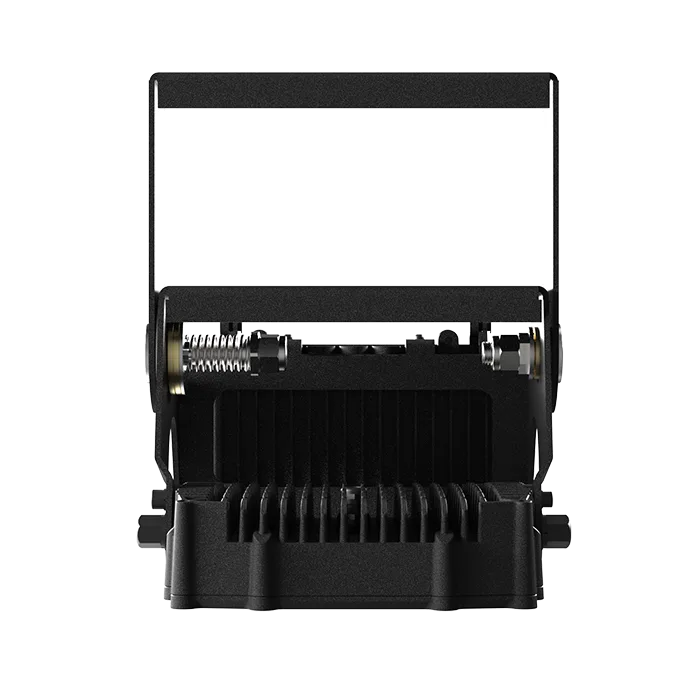
| Confirmation | existing holes or clamping system |
| Welding work | not necessary for the construction |
| Dimming | 0-10 V, PWM, and DALI-2 |
| Overvoltage | 6 kV line-to-line, 10 kV line-to-ground |
| Mounting | by us or by your own service |
We are scheduling the installation during the maintenance shutdowns that are already planned, so the crane does not need to be taken out of service additionally. See installation and maintenance.
Is your question not listed? Call Lucas de Graaf directly.
C5 according to ISO 12944-2:2017, the coastal and marine climate class directly below CX for offshore. Our standard version is aluminum with less than 0.08 percent copper, featuring a conversion layer and a two-layer titanium e-coating, backed by 1,000 hours of salt spray testing according to ISO 9227. Where the terminal's material policy mandates stainless steel, we supply the same fixtures in 316L.
No. There is no class approval from DNV, Lloyd's, or Bureau Veritas on these luminaires. For crane vessels and floating cranes, we do supply the complete document package: CE, EMC report, IP and IK test reports, and the salt spray test. If your shipyard or insurer explicitly asks for class approval, please state this upon request so we can figure out together what is needed.
Both. We supply a true DC version for 24 V (20 to 35 V) and 48 V (35 to 60 V), without an inverter, and AC versions from 90 to 305 V single-phase and 180 to 528 V three-phase. On an STS crane, three-phase is common, while on a reachstacker or handler crane, the 24 V onboard grid is used.
That depends on the version, voltage, and the type of circuit breaker. Our drivers have a low inrush current, which means that a relatively higher number of luminaires can be placed on a single circuit than is usual for comparable power ratings. Upon request, we calculate the load per circuit for your B16, B32, or C32; the full load table is available upon request.
The order code is the type plus the color temperature, for example ORAC01-65K for the Orca in 6500 K. The lens angle is deliberately omitted from the published article number: it is specified separately when ordering and follows from the lighting calculation. The complete overview per version can be found on the product page.
Standard 6 kV line-to-line and 10 kV line-to-ground. On terminals with high switching capacity or a long cable run along the quay, we also recommend protection in the distribution board; we assess this per installation.
Yes. The drivers operate flicker-free, ensuring that camera images and automatic container number recognition are not disrupted by banding. The luminaires achieve Ra 70 or higher with color consistency within MacAdam step 3, so colors and markings remain recognizable.
With optics selection, direction, and full cut-off in the positions radiating outward, so that the light level on the quay remains consistent. We test the design against the NSVV light nuisance code of conduct and provide the report with stray light values towards the water, site boundary, and residential buildings upon request.
Yes. Where mist and fog are structural factors, we supply luminaires with switchable light color, including 2200 K amber. That warmer light is reflected less by the droplets than cool white light, resulting in less glare for the operator. At a terminal, we usually combine this with a narrower optics on the positions that need to reach the furthest.
Yes, the luminaires with IP69K are tested for that. In bulk handling, cleaning is indeed necessary: dust on the lens costs more light than an incorrectly chosen optics. Include the cleaning of the lenses in the crane's regular maintenance schedule.
No. Our luminaires do not have ATEX certification. For locations within a certified dust or gas zone, we refer to an ATEX-certified luminaire from another supplier; outside the zone, we do supply.
The LEDs are rated at TM-21 L90B05 above 360,000 hours; the driver has its own, shorter lifespan and is the component that will need replacement first. The warranty is five years for industrial use, including continuous operation at a terminal.
No. We mount on existing attachment points or with a clamping system around the profile. Nothing changes to the certified construction of the boom, portal, or mast. We preferably schedule the installation during a maintenance shutdown that is already planned.
Looking for individual LED work lights for the cab, the boom or the superstructure, without a lighting plan or installation? The same Goby and Piranha work lights we fit on cranes can be ordered directly from our web shop, Industrial Light Store. For 12 and 24 V, IP69K, with a 5-year warranty on the luminaire. In stock and ordered before 15:00, shipped the same working day.

A terminal often has several crane types side by side. If you also light mobile or lattice boom cranes, we match the luminaires so your maintenance team works with one system.
Lighting on the port crane belongs to the sector Ports and terminals. It states what a port requires as the environment for the lighting design.
Lighting from the jib of a self-erecting crane, using the DarkLicht crane frame for fully shielded light.
Four fixed sets, from Dual to Five, for the fast-erecting tower crane.
The Crane Light Director for telescopic cranes, where the light must tilt with the boom.
The Crane Light Stabilizer keeps the beam in place while the boom moves.
Red aviation lights to ICAO Annex 14 for the top and the jib ends, with control and power supply.
Light distribution, on-board power and mounting per crane type, on one overview page.
Send us the crane type, the positions you want to illuminate, and the voltage available on the crane. You will receive a proposal per position: which luminaire, which optics, which bracket, and which connection. Upon request, including a lighting calculation, free of charge.
Your request will be evaluated for content by an engineer. We will respond within 1 business day.
| Response | within 1 working day, by an engineer |
| Lighting calculation | free of charge, in advance |
| Trial luminaire | possible, in one position |
| Warranty | 5 years of industrial use |
Call us and we will walk through your terminal in five minutes.