

Home / Products / Full cut-off floodlights / DarkLicht WP
16,000 lumens shining downwards and nowhere else. The power is adjustable starting from 10 watts, so a single type covers the entire facade.
By definition, a wallpack hangs at eye level for anyone walking beneath it and at facade level for anyone living next to it. A standard facade fixture scatters light into the street and the sky; this one does not. Above the chosen cut-off, the light emission is zero, so that the facade strip and the ground are illuminated and the surroundings are not. Surface-mounted directly to the facade using a mounting plate, with the driver housed within the fixture.
A response from an engineer within 1 business day. Free lighting calculation, in accordance with the NSVV code of conduct.
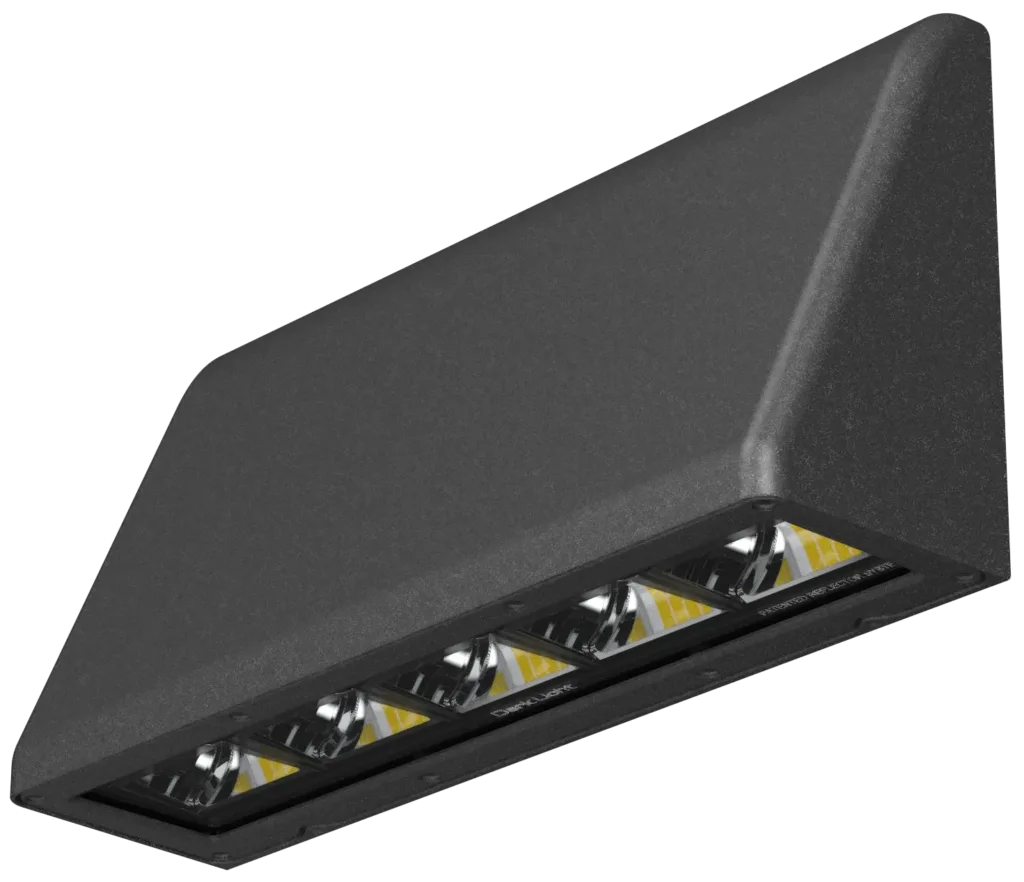
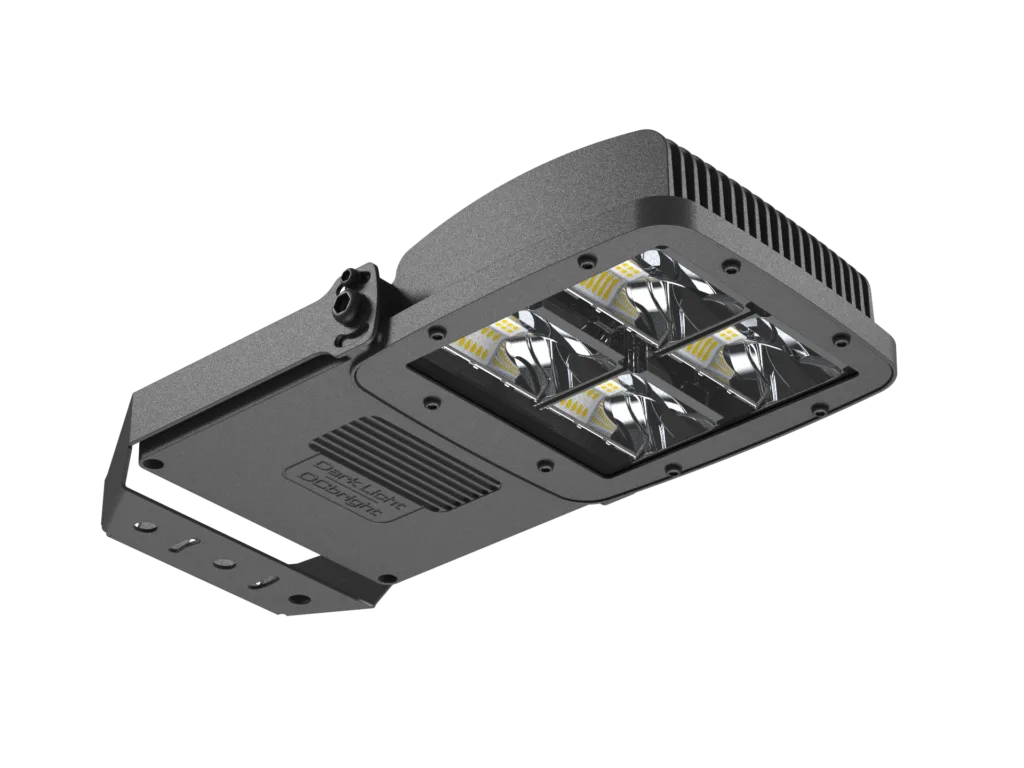
The Wallpack 100, Titanium Black. Also available in Titanium Gray and Neutral White.
at 100 W, 160 lm/W
above the chosen cut-off
five positions, chosen upon ordering
factory set, driver internal
IK08, C5 as per ISO 9223
up to 10 with maintenance contract
This is the only model in the DarkLicht line designed for wall mounting. That defines both its strength and its limitation: it provides excellent lighting for the strip along a building facade, but not for open areas.
A wallpack illuminates the strip beneath it; bridging distance is not its job.
The housing, dimensions, weight, and driver are the same: both feature an internal BLD120 housed in a 345 × 181 × 96 mm enclosure weighing four kilograms. The difference lies in the range within which the power is adjustable, and thus the maximum luminous flux.
The mentioned article numbers are the 5000K variants; the same versions are also available in 4000K, 3000K, and amber 2200K. Color switching between 4000K, 2200K, and 1700K is possible, switchable during operation.
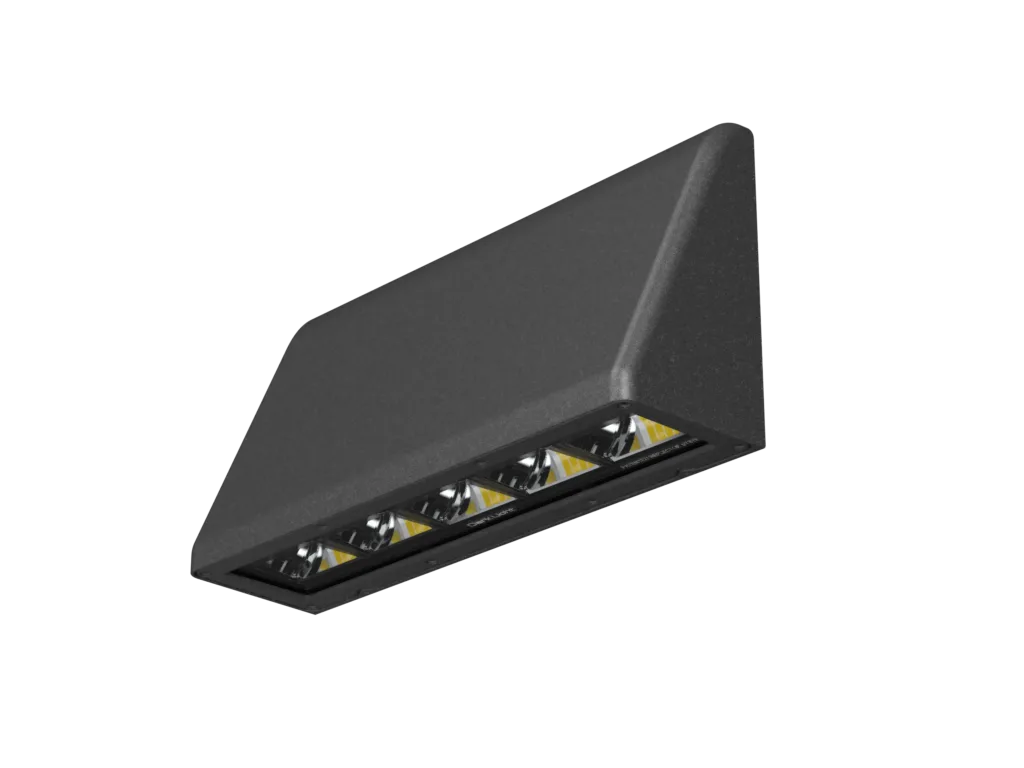
For walking routes, entrances, and emergency exits. Approx. 0.27 A at 220 V, so five luminaires on a B16 and eight on a C16; for a facade run, the cable length is the limiting factor.
DRKW02-50K · internal BLD120 · 4.0 kg
For loading bays, dock doors, and wider zones along the facade. Same housing, same driver, and the same five cut-off settings as the 60-watt.
DRKW01-50K · internal BLD120 · 4.0 kg
A pole luminaire hangs high and far from the property boundary. A wallpack hangs right on the property boundary itself, usually at the height where neighbors look out their window and where a driver approaches the premises. In practice, complaints about commercial lighting are more often about facade luminaires than about pole installations.
The DarkLicht line has been tested by a third party and complies with DarkSky and DS-1 at 1700 to 2200 K. Above the selected cutoff: zero, forward, and reverse.
In addition to DS-1, we evaluate against the NSVV Light Nuisance guideline, EN 12464-2:2024, and EN 12193. See the application at light pollution and glare, area lighting and the photo gallery.
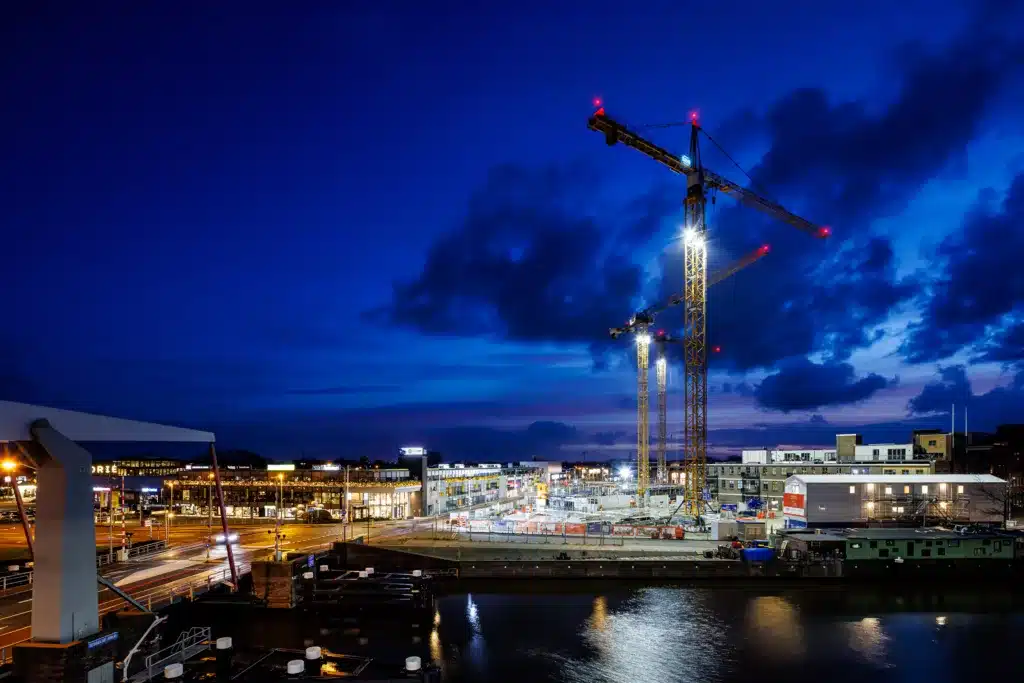
internal driver, mounting plate on the facade
63 to 75 degrees
Choose a trim level and the complete specification list below will change accordingly. The cut-off is chosen upon ordering and is therefore not included in the order code.
Item number
DarkLicht Wallpack 60 · also available in 40K, 30K, and 22K
For walking routes, entrances, and emergency exits. A series of evenly spaced luminaires provides a more uniform appearance there than a single powerful luminaire, and you can customize the wattage per position.
| Luminous flux at full power | 9,600 lm |
| Power consumption | 60 W, adjustable from 10 to 60 W |
| Efficiency | 160 lm/W |
| Optics | parabolic reflector, full cut-off |
| Cut-off standings | 63°, 66°, 69°, 72°, 75° cut-off |
| Measured beam angle | 132° beam, 138° field, shielding position |
| Color temperatures | 5000K, 4000K, 3000K, amber 2200K |
| Color-changeable | 4000K, 2200K and 1700K, switchable during operation |
| CRI (Ra) | > 70, or optionally 80 or 90 |
| Color consistency | 3-step MacAdam |
| Housing | cast aluminum, < 0.08 % copper |
| Surface treatment | conversion layer + 2-layer titanium e-coating |
| Mounting | facade mounting plate, aluminum |
| Front | impact-resistant glass (IK08) |
| Color | Titanium Black, Titanium Grey or Neutral White |
| Dimensions | 345 × 181 × 96 mm |
| Weight | 4.0 kg |
| Lead time | Standard within a week, custom by arrangement |
| Cable type | H07BQ-F, 0.3 m: supply pair 2×1.5 mm² with earth, control pair 2×0.5 mm² |
| Connection | pre-assembled cable, loose wires |
| Voltage range | 90 to 305 VAC |
| Current draw | approx. 0.27 to 0.22 A at 220-277 V; 0.5 A at 120 V |
| Driver | internal BLD120 |
| Driver (type) | BLD120 (120 W) |
| Driver lifespan | ≥ 100,000 hours at Tc 75 °C; ≥ 130,000 hours at Tc 50 °C |
| MTBF driver | ≥ 320,000 hours at Tc 75 °C (MIL-HDBK-217F) |
| Inrush current | 66.8 A peak, T50 350 µs at 220 V |
| Luminaires per MCB | B16: 5 · C16: 8 · C25: 13 · D16: 17 |
| Surge protection | 6 kV line-to-line, 10 kV line-to-ground (IEC 61000-4-5) |
| Power factor / THD | > 0.9 at 70–100 % load; THD < 15 % |
| Dimming | 0–10 V, PWM, and DALI-2 or via NFC |
| IP and IK | IP66, IP67, IP68, and IP69K / IK08 |
| Protection Class | Class I: the driver sits in the housing, so the housing is earthed |
| Corrosion class | C5 Industrial and Maritime (ISO 9223) |
| Operating temperature | −45 to +50 °C |
| LED lifespan | TM-21 L90B05 > 103,500 hours |
| Certification | CE, IEC 60598, EN 55015, EN 61547, EMC |
| Warranty | 5 years, with maintenance contract up to 10 years |
| Packaging | depending on quantity, upon request |
Item number
DarkLicht Wallpack 100 · also available in 40K, 30K, and 22K
For loading bays, dock doors, and wider zones along the facade. The same housing and the same internal driver as the 60 watt, with more headroom.
| Luminous flux at full power | 16,000 lm |
| Power consumption | 100 W, adjustable from 10 to 100 W |
| Efficiency | 160 lm/W |
| Optics | parabolic reflector, full cut-off |
| Cut-off standings | 63°, 66°, 69°, 72°, 75° cut-off |
| Measured beam angle | 132° beam, 138° field, shielding position |
| Color temperatures | 5000K, 4000K, 3000K, amber 2200K |
| Color-changeable | 4000K, 2200K and 1700K, switchable during operation |
| CRI (Ra) | > 70, or optionally 80 or 90 |
| Color consistency | 3-step MacAdam |
| Housing | cast aluminum, < 0.08 % copper |
| Surface treatment | conversion layer + 2-layer titanium e-coating |
| Mounting | facade mounting plate, aluminum |
| Front | impact-resistant glass (IK08) |
| Color | Titanium Black, Titanium Grey or Neutral White |
| Dimensions | 345 × 181 × 96 mm |
| Weight | 4.0 kg |
| Cable type | H07BQ-F, 0.3 m: supply pair 2×1.5 mm² with earth, control pair 2×0.5 mm² |
| Connection | pre-assembled cable, loose wires |
| Voltage range | 90 to 305 VAC |
| Current draw | approx. 0.45 to 0.36 A at 220-277 V; 0.83 A at 120 V |
| Driver | internal BLD120 |
| Driver (type) | BLD120 (120 W) |
| Driver lifespan | ≥ 100,000 hours at Tc 75 °C; ≥ 130,000 hours at Tc 50 °C |
| MTBF driver | ≥ 320,000 hours at Tc 75 °C (MIL-HDBK-217F) |
| Inrush current | 66.8 A peak, T50 350 µs at 220 V |
| Luminaires per MCB | B16: 5 · C16: 8 · C25: 13 · D16: 17 |
| Surge protection | 6 kV line-to-line, 10 kV line-to-ground (IEC 61000-4-5) |
| Power factor / THD | > 0.9 at 70–100 % load; THD < 15 % |
| Dimming | 0–10 V, PWM, and DALI-2 or via NFC |
| IP and IK | IP66, IP67, IP68, and IP69K / IK08 |
| Protection Class | Class I: the driver sits in the housing, so the housing is earthed |
| Corrosion class | C5 Industrial and Maritime (ISO 9223) |
| Operating temperature | −45 to +50 °C |
| LED lifespan | TM-21 L90B05 > 103,500 hours |
| Certification | CE, IEC 60598, EN 55015, EN 61547, EMC |
| Warranty | 5 years, with maintenance contract up to 10 years |
| Packaging | depending on quantity, upon request |
The cut-off is chosen at the time of ordering and determines how far the beam extends along the facade. The hole pattern of the mounting plate is on the datasheet: the plate is 344 mm wide with one Ø28 hole and six Ø5.2 holes at 315 mm and six at 200 mm. For a facade luminaire, this is just as decisive as the light distribution.
Direct download, no form required. Also included in the compilation document DarkLicht.
Because the BLD120 driver is built into the fixture, you connect the WP just like a standard exterior fixture: a single pre-assembled cable with bare wires, no separate junction box. When replacing the fixture, it can usually be installed at the existing connection point and connected to the same power circuit.
internal BLD120 driver
B16: 5 · C25: 13 · D16: 17
line-to-line and line-to-ground, IEC 61000-4-5
of 0–10 V, PWM or via NFC
Five fixtures on a B16, eight on a C16, thirteen on a C25, and seventeen on a D16. These numbers are taken from the driver manufacturer’s MCB table at 220 V and apply per driver; they are the same for the 60- and 100-watt models, since both use the same BLD120. The inrush current is 66.8 amps peak with a T50 of 350 microseconds.
For a façade lighting run, the cable length is usually the limiting factor, not the circuit breaker. Provide the number of luminaires and the run length, and we will calculate the load and voltage drop. During replacement, the power consumption is usually lower for the same lighting level because no light is lost outside the target area. See also engineering and custom work.
A classic wallpack features a lens or a cover and projects a broad beam outward from the facade. Part of that light inevitably goes upward and to the sides: into the sky, across the property line, and into the eyes of anyone walking or driving toward the building. That is the reason facade lighting is so frequently the subject of a complaint.
The WP uses the same parabolic reflector as the flat radiators on the mast. Above the chosen cut-off, the emission is zero, forwards and backwards. In the shielded position, we measure a beam angle of 132 degrees and a field angle of 138 degrees; those measured values are on the datasheet, not the nominal optical angle. The light falls on the ground where it is needed, which also saves power because nothing is lost.
| CUT-OFF | WHAT FOR |
|---|---|
| 75° | Far reach along the facade, for a wide strip of ground. |
| 72° | Wide bay, the standard position at a loading dock. |
| 69° | Medium distance, evenly distributed along the running route. |
| 66° | Close to the facade, near a narrow strip or a narrow passage. |
| 63° | Strictest boundary, for the most sensitive property line. |
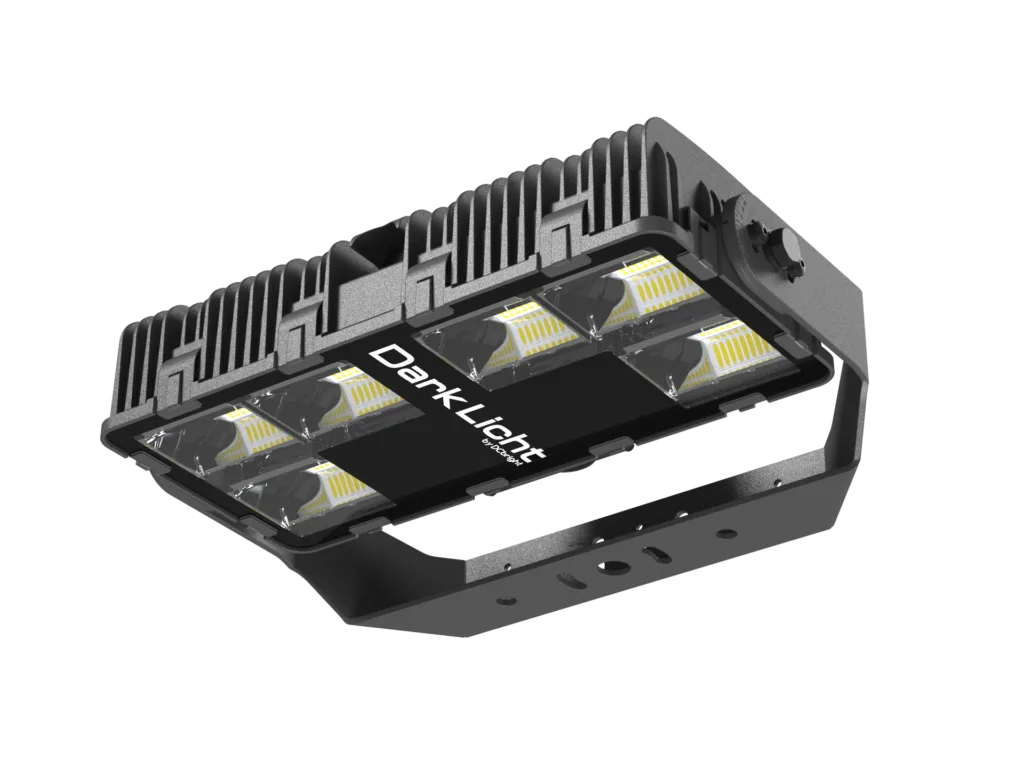
The reflector blocks everything above the selected angle; shown here at a 75-degree forward angle. The selection is finalized at the time of order, so we determine it in advance using a lighting calculation in accordance with the NSVV code of practice, based on the facade length, height, and number of fixtures.
In practice, three to six meters. Lower gives a short, sharp spot beneath the fixture; higher makes the beam wide but the illuminance low. For a walking route, a series of fixtures at equal distances is almost always better than a single powerful fixture, and that is precisely where the adjustable wattage helps: the same fixtures, custom-set for each position.
Facades and walls at three to six meters, often on the property boundary itself.
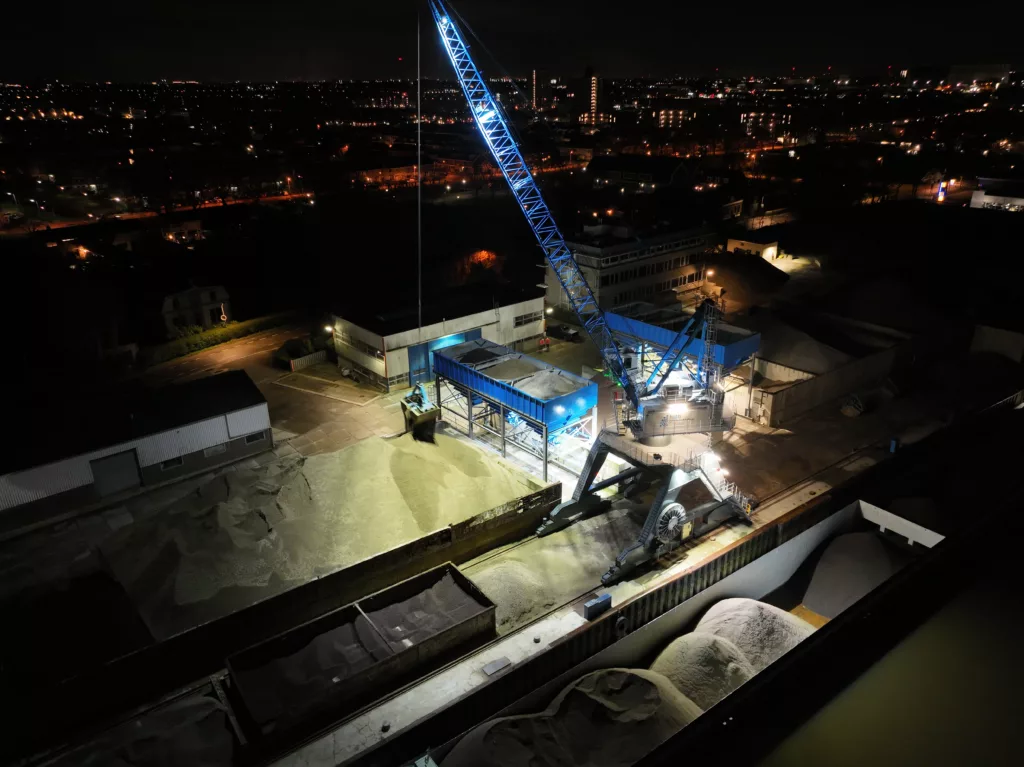
Drivers reverse up to the facade. A shielded beam illuminates the pit without shining in the mirrors.
For safe walking, continuity counts, not peak lighting: multiple luminaires along the route, each at the power output that position requires.

Where the property directly borders residences, a road, or a railway, screening is often a permit condition rather than a choice.
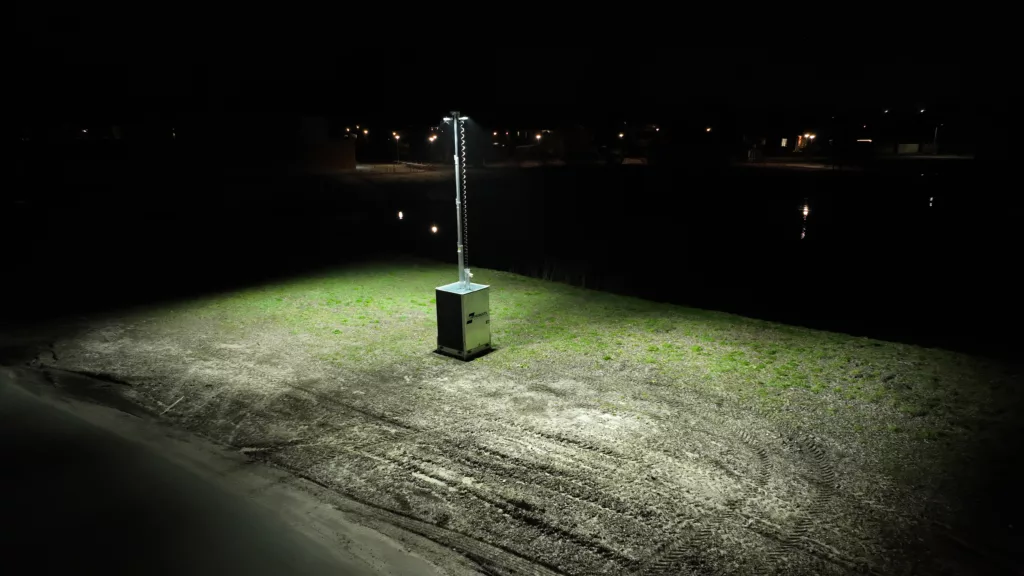
On the existing mounting point and in the same power supply scheme, with less power and without the complaints.
Six types with the same optical principle. The WP is the only one for wall mounting; the others are mounted on a machine, a mast, or a gantry. The One, Two, and Three together form a single product line with one datasheet.
| Version | Role in the range | Power | IP and IK | Mounting |
|---|---|---|---|---|
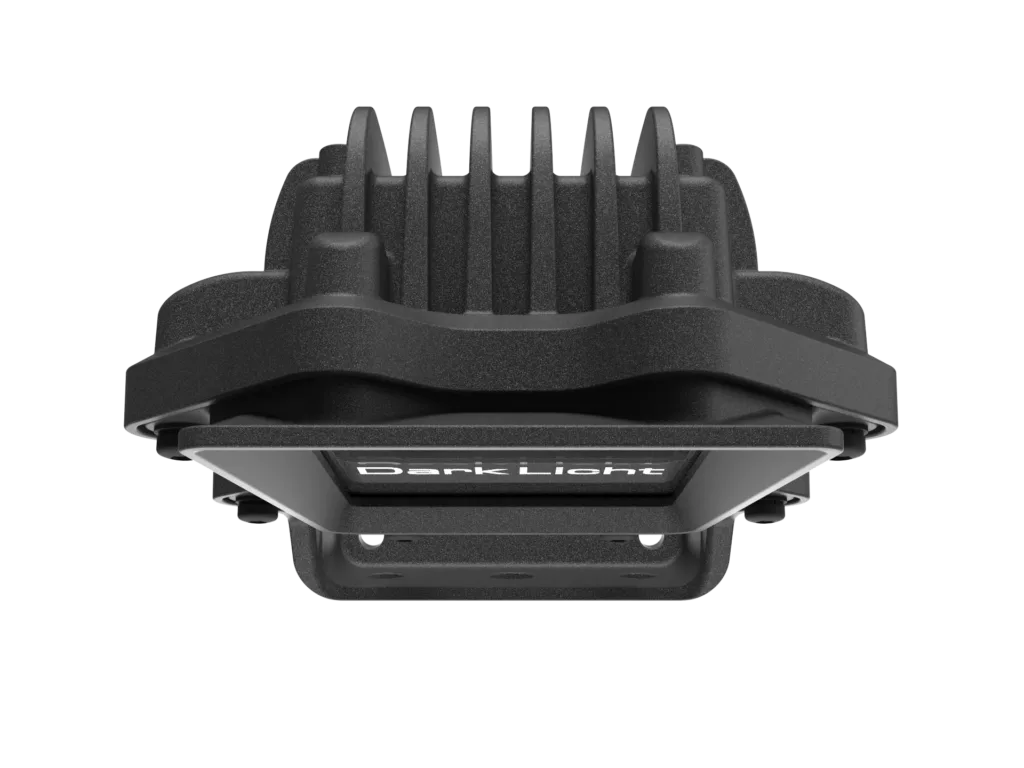 DarkLicht Mini4,800 lumens DarkLicht Mini4,800 lumens | Glare-free work light for machines and vehicles, connector integrated in the housing. | 30 W | IP69K / IK08 | machine |
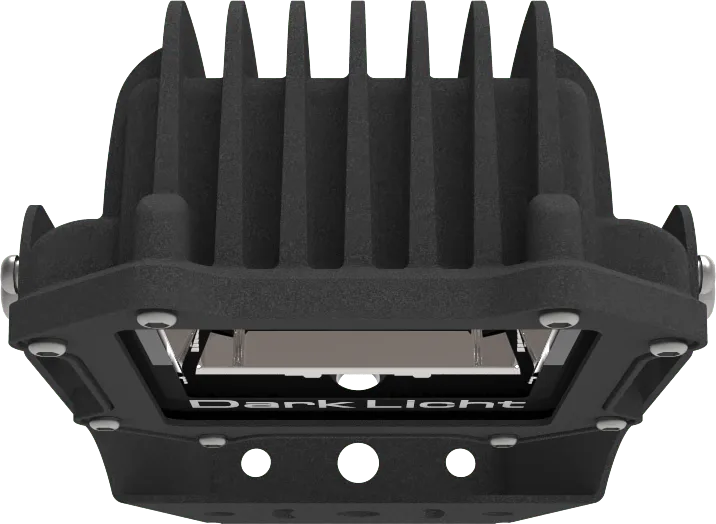 DarkLicht S10,260 to 12,825 lumens DarkLicht S10,260 to 12,825 lumens | Work light for larger nearby work areas, with 316L bracket. | 60 to 75 W | IP69K / IK08 | machine |
| DarkLicht WP9,600 to 16,000 lumens | The only one for wall mounting, with adjustable power per position. | 10 to 100 W | IP69K / IK08 | wand |
 DarkLicht M25,700 to 51,300 lumens DarkLicht M25,700 to 51,300 lumens | Site and mast lighting with power, in DC and AC, tested to 6 G vibration. | 150 to 300 W | IP69K / IK08 | mast, machine |
 DarkLicht D10,300 to 34,200 lumens DarkLicht D10,300 to 34,200 lumens | Floodlight with internal driver, easy to install on poles up to twelve meters. | 60 to 200 W | IP67 / IK08 | cool |
 DarkLicht One, Two, and Three51,200 to 307,800 lumens DarkLicht One, Two, and Three51,200 to 307,800 lumens | One product line in six power ratings, for the largest zones and high-mast. | 320 to 1,800 W | IP67 / IK07 | hoge mast |
The difference in the IP rating within the line is intentional: the WP, M, S, and Mini models are IP69K, while the D, One, Two, and Three models are IP67. These are differently designed products.
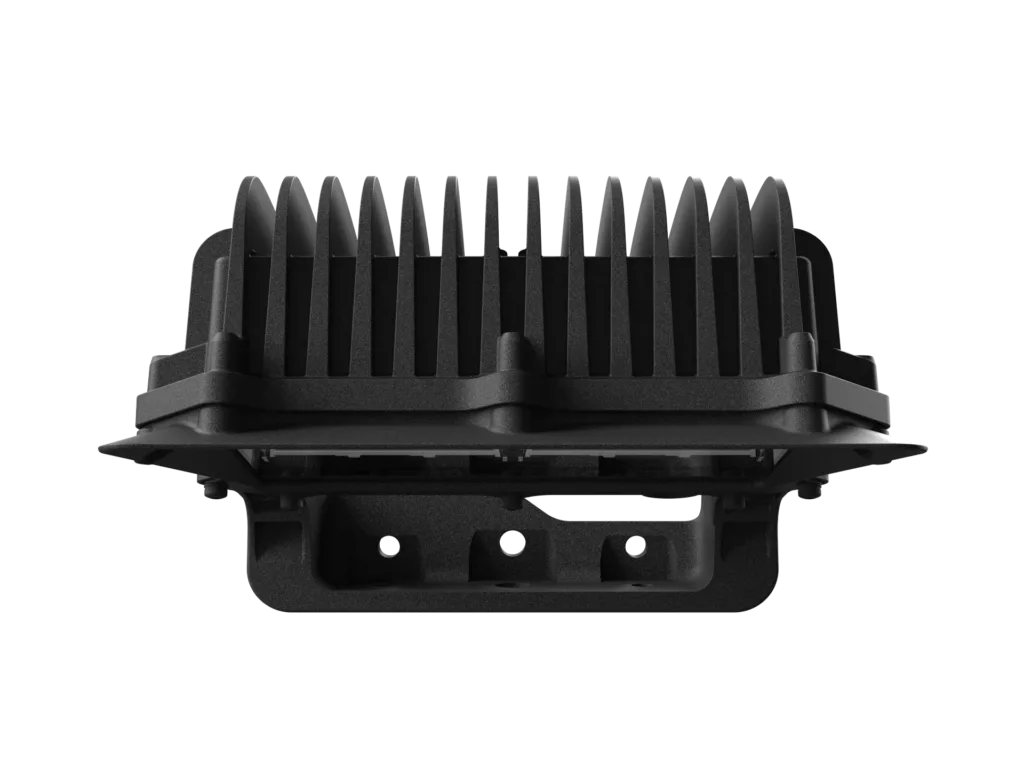
Both versions share the same housing: 345 × 181 × 96 mm at four kilos. When determining the height, take the cut-off into account: it determines how far the beam reaches along the facade, and that cannot be adjusted afterwards with a tilt angle.
| Dimensions | 345 × 181 × 96 mm |
| Weight | 4.0 kg |
| Mounting | facade mounting plate, aluminum |
| Walking pattern | on request |
| Cable | pre-assembled, 0.3 m, stripped leads |
| Driver | internal, BLD120 |
| Color | Titanium Black, Titanium Grey or Neutral White |
| Packaging | depending on quantity, upon request |
Dimensions in mm, length × width × height. The mounting plate hole pattern is on the datasheet: 344 mm wide, one hole Ø28 and six holes Ø5.2 at 315 mm and six at 200 mm. See also lighting advice and lighting calculations.
Render instead of dimensional drawing; the dimensional drawing with hole pattern is on the datasheet.
Every claim carries its condition in the same sentence. You can read more about the test methods at Product Quality and Warranty.
The DarkLicht line has been tested by a third party and complies with DS-1 at 1700 to 2200 K. In addition, we test for compliance with the NSVV Light Pollution guideline, EN 12464-2:2024, and EN 12193.
L90B05 according to TM-21: After that number of hours, at least 95 percent of the fixtures will still provide 90 percent of their original luminous flux. The internal driver has a lifespan of ≥ 100,000 hours at a housing temperature of 75 °C.
C5 Industrial and Maritime: cast aluminum with less than 0.08 % copper, conversion coating, and two-layer titanium e-coating. IP69K and IK08; no vibration class has been tested, so we do not list it.
Both versions with the measured beam angles, cut-off positions, and order codes. Direct download, no form required.
STEP or DXF for your own design work, with the enveloping dimensions of 345 × 181 × 96 mm.
Per cut-off level and color temperature, from our own IES library, for your calculation in DIALux or Relux. Because the optics are commercially sensitive, we share these files after signing a non-disclosure agreement (NDA).
Don't see your question listed? Call us and we'll go through your situation in five minutes. An engineer will respond within 1 business day.
The DRKW02-50K is the Wallpack 60 with 9,600 lumens, and the DRKW01-50K is the Wallpack 100 with 16,000 lumens. The housing, weight, and driver are identical: both feature an internal BLD120 in a housing measuring 345 × 181 × 96 mm and weighing four kilograms. The power output is adjustable for both starting at 10 watts, so in practice, you can select the maximum power you need. Both are also available in 4,000K, 3,000K, and amber 2,200K.
You set the power consumption per luminaire, from 10 watts to the maximum, also via NFC. Along a facade with different situations, such as a loading bay next to a walking route, you then hang the same type everywhere and configure the settings separately. That saves items in the specifications and makes post-completion adjustments possible without needing a different luminaire.
The optics. A classic wallpack uses a lens or a cover to cast a broad beam forward, while losing light upwards and to the sides. The WP works with a parabolic reflector: above the chosen cut-off, the emission is zero. The light falls on the ground instead of into neighboring windows, which also saves power because nothing is wasted.
That follows from the mounting height and the chosen cut-off. At 75 degrees, the beam reaches the furthest; at 63 degrees, it stays close to the facade. In the shielded position, we measure a beam angle of 132 degrees and a field angle of 138 degrees. Because the cut-off is fixed upon ordering, we determine it in advance using a lighting calculation based on the facade length, the height, and the number of luminaires.
In practice, three to six meters. Lower gives a short, bright spot beneath the fixture; higher makes the strip wide but the illuminance low. For a walkway, a series of fixtures at equal distances is almost always better than a single powerful fixture.
Five on a B16, eight on a C16, thirteen on a C25, and seventeen on a D16, with a inrush current of 66.8 amps peak and a T50 of 350 microseconds. These figures are taken from the driver manufacturer’s MCB table at 220 V and apply to both versions, since they use the same BLD120. In a row of facade units, cable length is usually the limiting factor rather than the circuit breaker; provide the number and length, and we will calculate the voltage drop.
6 kV line-to-line and 10 kV line-to-ground according to IEC 61000-4-5, provided by the internal BLD120 driver. That driver has a lifespan of at least 100,000 hours at a cabinet temperature of 75 °C and 130,000 hours at 50 °C, with an MTBF exceeding 320,000 hours according to MIL-HDBK-217F. MTBF and service life are two different metrics and are not interchangeable.
Usually yes, at the existing mounting point and on the same power circuit. The power consumption is generally lower for the same amount of lighting because no light is lost outside the zone, and the adjustable wattage allows you to fine-tune that for each position. Send a photo of the current situation and the mounting point, and we will assess whether it is a direct replacement.
Yes, and that’s the most common reason for complaints regarding facade lighting. Complaints are more often about fixtures mounted on a facade than about pole-mounted fixtures, precisely because they are at eye level for people in the surrounding area. The DarkLicht series has been tested by a third party and complies with DarkSky and DS-1 at 1700 to 2200 K; in addition, we provide a light calculation in accordance with the NSVV code of conduct, including the values at the sensitive points.
Yes: 0–10 V, PWM and DALI-2, or configurable via NFC. For buildings with residences nearby, a night mode is often the simplest way to comply with a permit condition: full output during operating hours, dimmed down outside of them. We tailor the control system per project, including for existing control systems.
The WP can be switched between 4000K, 2200K, and 1700K during operation. Amber light penetrates fog, rain, and dust, whereas cool white light does not; in port operations and winter road maintenance, that’s the difference between being able to continue working and not. Furthermore, at 1,700 to 2,200 K, the fixture complies with DarkSky and DS-1.
The specification is IP69K, which stands for high-pressure and steam cleaning in accordance with DIN 40050-9; in addition, IP66, IP67, and IP68. This is rarely the load on a building facade, but it is relevant in a car wash or cleaning area. Be sure to keep the cable entry away from the direct path of the jet.
No, and we’d rather say that up front. The DarkLicht line is rated at IK08 with a glass front; the heavy-duty DCbright line achieves IK10 with polycarbonate, or IK09 with glass. On a facade at a height of three meters or higher, IK08 is not a limitation in practice; however, it is a limitation in a location where equipment might scrape against it.
No, and that is a deliberate choice. A luminaire that shines upward illuminates the facade as well as the sky above it; exactly what this luminaire prevents. A different type is needed for facade lighting, and in light-sensitive environments we advise reconsidering that.
CE, IEC 60598, EN 55015, EN 61547, and the associated EMC requirements. IEC 60598 specifies requirements for construction, electrical safety, and thermal behavior; EN 55015 and EN 61547 address emissions and immunity. Corrosion resistance complies with Class C5 Industrial and Maritime as specified in ISO 9223. Configurations for North America are available upon request.
Not in the DarkLicht line. The HT versions rated up to +120 °C and the all-stainless-steel 316L fixtures are part of the DCbright series. If noise reduction is required in addition to heat resistance or continuous salt exposure, we determine on a case-by-case basis which of the two requirements dictates the design.
Five years on the entire fixture. With an active maintenance contract with JEL or a party designated by JEL, the warranty can be extended to ten years; the reason we do not offer this extension unconditionally is the seal, which requires maintenance. Within the DarkLicht line, this extension applies only to the WP, the D, and the One, Two, and Three models.
The facade length, the mounting height, the number of mounting points, and the distance to the property boundary. With a facade elevation or a site plan included, we can determine the layout, the set power per position, and the cut-off all at once, including the values at the sensitive points.
Please provide the facade length, the mounting height, and the distance to the property line. We’ll calculate the layout in accordance with the NSVV code of conduct: the illuminance at ground level and the values at the sensitive points around it. In the event of a complaint or a permit condition, that second calculation is the document you’ll need. There’s no charge for this.

You will receive a response from the person who is also preparing your lighting calculation.
We use your data solely to evaluate your request and respond appropriately.