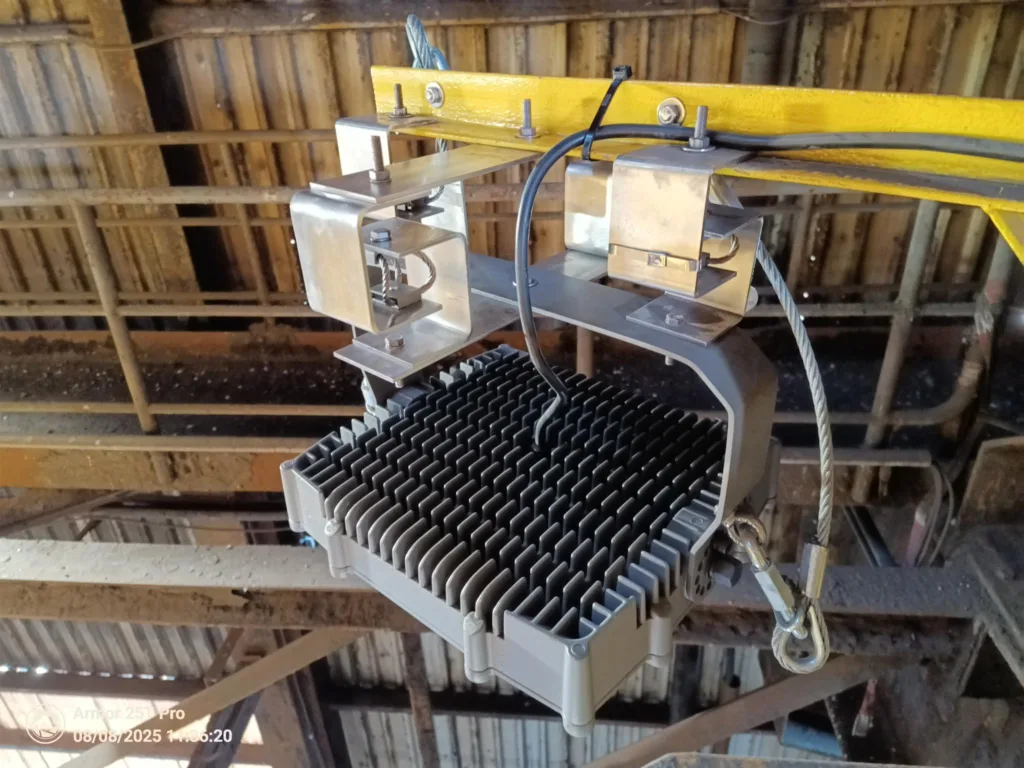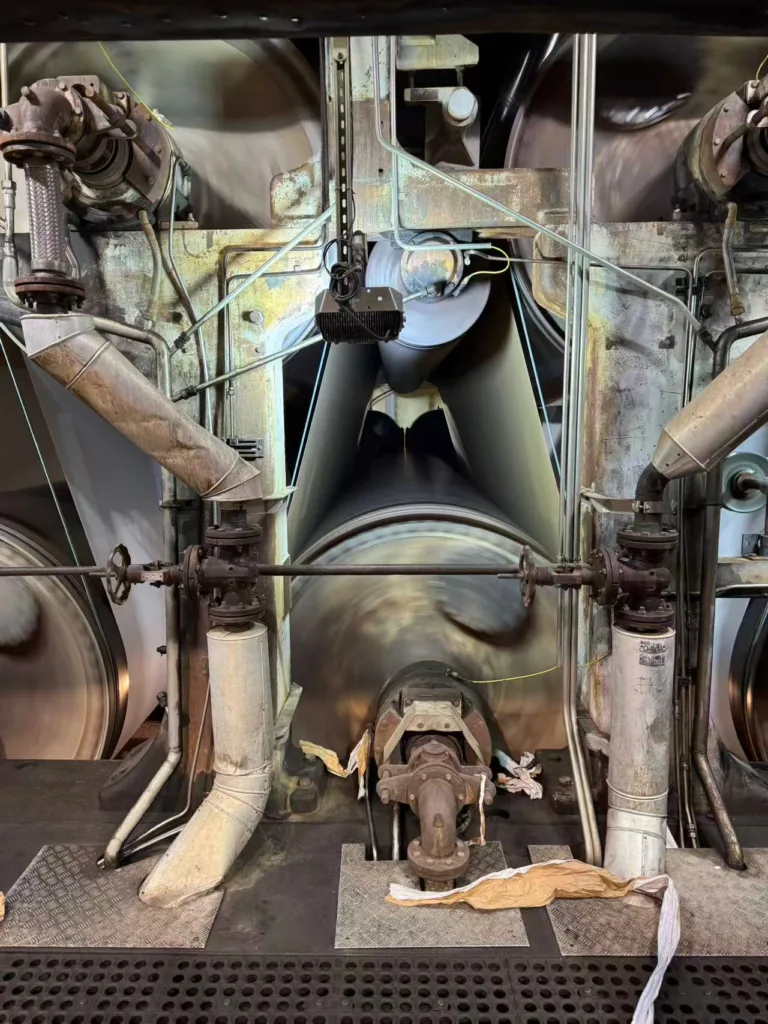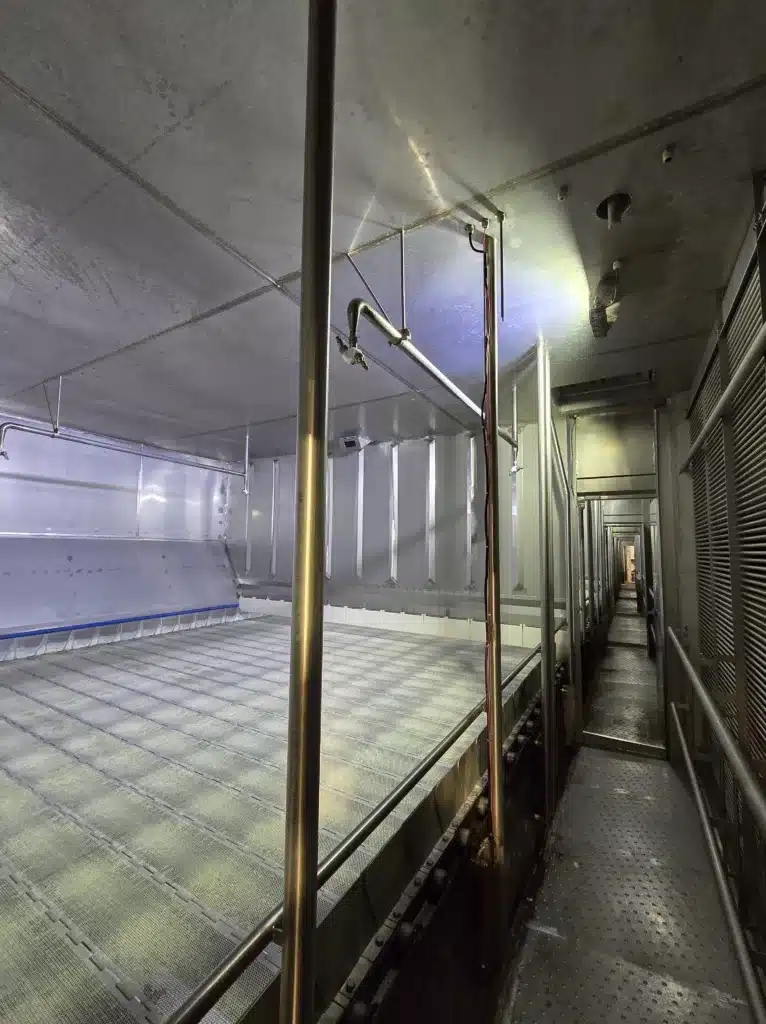

In a rolling mill, a foundry, or a paper mill, the problem is not the light level but the surrounding environment: radiation from the product, dust that creeps everywhere, vibration that loosens mountings, and a mobile elevated work platform that cannot enter during production. We build luminaires that continue to operate up to 120 °C ambient temperature and design the installation so that nothing needs to be done to it between two stoppages.
+120 °C
continue, where the nearest LED competitor stops at 105 °C
External driver
the electronics outside the hot zone, up to tens of meters from the luminaire
Between two stops
nothing needing to be done to the installation: lifespan and interchangeability over purchase price
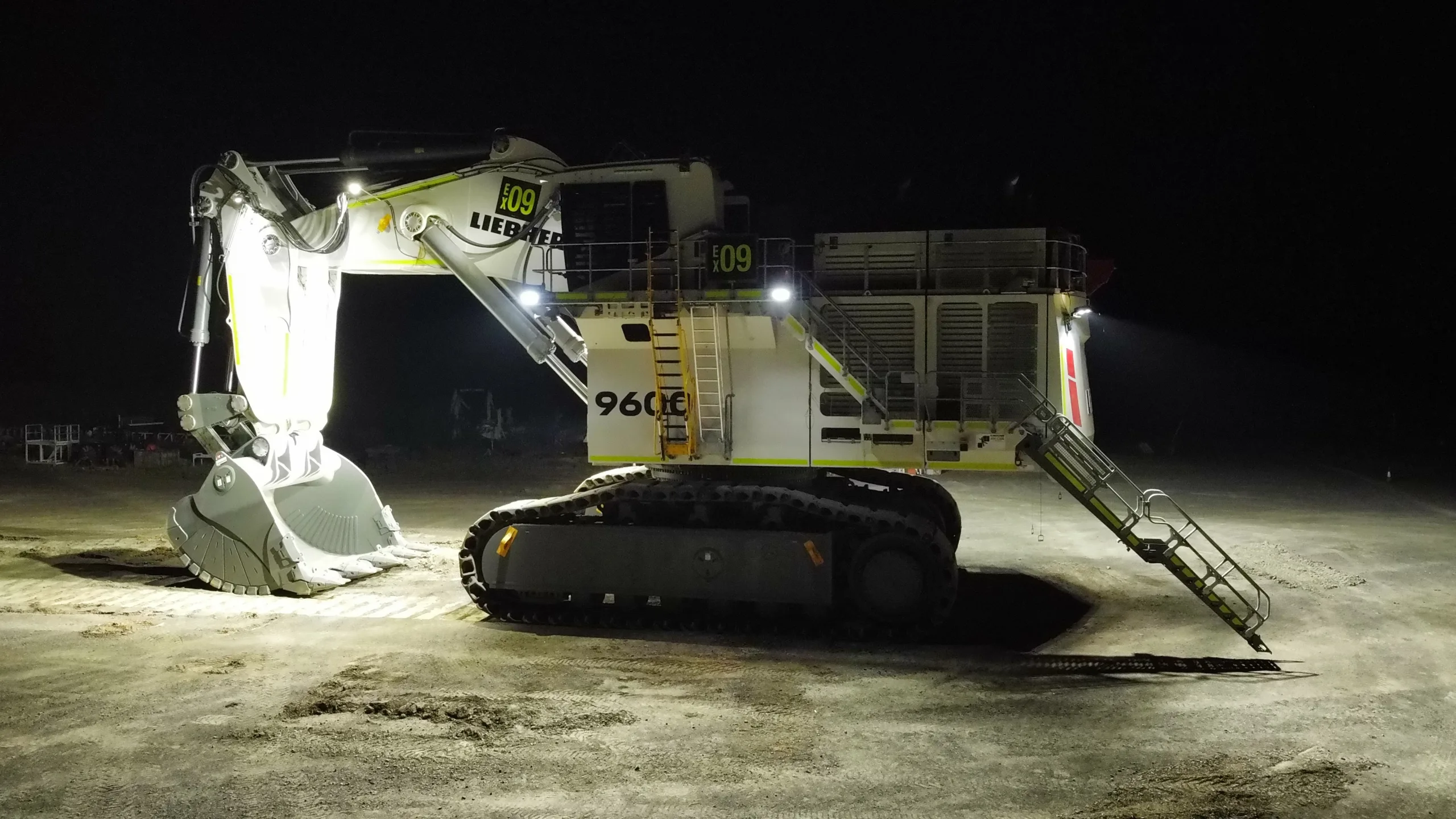
Mining: a Liebherr 9600 illuminating its own working face, dust, vibration, and 24-hour operation
In hot zones, lighting fails for three reasons: the wrong temperature was measured, the driver hangs in the hot zone, or maintenance is only possible during a shutdown. That is what we design for.
| what we encounter | what it costs you | what it is about |
|---|---|---|
| The air temperature has been measured, but the product's radiation has not. | A luminaire that on paper falls within budget and in practice fails within a year | measuring point and measuring method |
| The driver enclosure is in the same hot zone as the luminaire | Electronics that fail first, while the LED would still last for years | driver location and cable length |
| Spraying, dusting, or stoking goes on into every corner | Fixtures that lose half their light within a season | IP ratings and cleanability |
| The aerial work platform can only enter during a production stop | Outage persists until the next stop, sometimes for half a year | lifespan and interchangeability |
| Vibration from presses, rollers, and conveyor belts is continuously acting on the structure | Fastening that comes loose and cables that break at the feed-through | securement and strain relief |
| Design factor | What is going on here | What determines it in the design |
|---|---|---|
| Ambient temperature versus radiation | Air temperature is different from the radiation of a oven, a pouring stream or a hot rolled product. The wrong thing is often measured | Determine the measuring point and measuring method in advance. We expect a continuous ambient temperature of +120 °C. |
| Driver seat | Electronics do not belong in the hot zone, and the cabinet is often dozens of meters away. | External driver, maximum cable length between driver and fixture, location and cooling of the enclosure, grounding of the enclosure |
| Cleaning and dust | Spraying or dusting is taking place: flour, cement, grinding dust, fiber | IP ice cream including IP69K where high-pressure cleaning is used, smooth housing without dust traps |
| Chemical load | acids, lyes, ammonia in cooling systems, aggressive vapors | Material selection and coating, stainless steel where the vapors require it |
| Trilling | Rolling mills, presses, conveyor belts, and hammering work constantly vibrate the structure. | Vibration resistance, locking of the fastening and strain relief |
| Maintenance access | The aerial work platform cannot enter during operation, and downtime costs production | Lifespan and interchangeability outweigh purchase price, number of luminaires per light point |
| Color recognition | Visual inspection of product, process, and safety marking | Color rendering index and light color per zone, determined separately for inspection locations |
Which temperature limit belongs to which fixture, which driver is allowed to be placed at what distance, and what the measurement points per zone are, can be found on the page dedicated to that topic. That is more extensive than what fits here.
If chemical exposure plays a role in addition to heat, see lighting for extreme corrosion. What IP66, IP67 and IP69K mean for cleaning and dust is explained under IP and IK ratings.
Every process zone has its own critical problem. Around ovens and in foundries it is the radiant heat and the peak each time an oven door opens; industrial oven lighting therefore needs glass instead of plastic and the driver outside the hot zone. Above the rolling line it is the infrared radiation from the steel, above the dryer section of a paper machine the combination of heat and steam, and in a climate chamber the switch from deep freeze to +120 °C. Below you will find the page with the measured values for each zone.


STEP 1
Recording and lighting calculation
We measure the temperature at mounting height and calculate the light level per zone, free of charge.
STEP 2
Engineering and custom solutions
For each position we choose the luminaire, optics and driver box location, and where needed we design a custom solution.
STEP 3
Delivery from Nijkerk
Standard versions ship from Nijkerk and are delivered quickly; custom work follows the agreed schedule.
STEP 4
Installation assistance
We support your installer or install with our own VCA** certified technicians, preferably during a planned shutdown.
STEP 5
Maintenance and warranty
Maintenance on contract or on call, with a 5-year warranty on the complete luminaire and up to 10 years on the housing with a maintenance contract.
See for yourself: datasheets and lighting files · manuals · warranty and quality
Background: colour rendering and CRI and LB values and lifespan
Standard versions come from Nijkerk and are fast; project configurations upon consultation.
Complete for five years, and up to twenty years on a 316L enclosure.
Yes, that is the normal course of events; the planning is adjusted to the shutdown.
No, not at this moment. For a flour, sugar, or wood dust location in zone 21 or 22, we are not the right supplier.
No, our series is work relief.
Yes, in consultation with the factory concerned.
Luminaires designed as a system for continuous operation at +120 °C: with glass instead of plastic, silicone wiring and the driver outside the hot zone. Standard industrial LED is specified up to +50 °C and quickly deteriorates in light output and lifetime above that.
We assess that per position. We record the mounting, the thermal expansion of the structure and the cable length to the driver box. Existing mounting points remain usable if they can handle the weight and the expansion. The hot zone requires heat-resistant cable, such as the silicone cable supplied with the HT luminaires; existing cabling outside the hot zone can stay if the cross-section suits the cable length to the driver box.
Send us the zone, the measured or estimated temperature and what is happening nearby. You will receive a proposal including the measurement method, so it is clear where the figure comes from.
| Response | within 1 working day, by an engineer |
| Lighting calculation | free of charge, per zone |
| Trial luminaire | at your own site, on request |
| Warranty | 5 years full, 10 years on the housing with a maintenance contract |
Rather call directly: 033 785 9809