

A port is open 24 hours a day, is located in saltwater, and rarely has a moment when a boom lift can access the site. That determines the lighting design more than the number of lumens. We illuminate quays, stacks, cranes, and transshipment zones at European port and terminal companies, and calculate every setup before a single fixture is installed.
C5 through CX
three European terminals, permanently in the most severe corrosion classes
24/7
in business, so lifespan and driver selection carry more weight than the purchase price
Table 14
From EN 12464-2:2024: the guideline values for docks and berths, calculated by zone
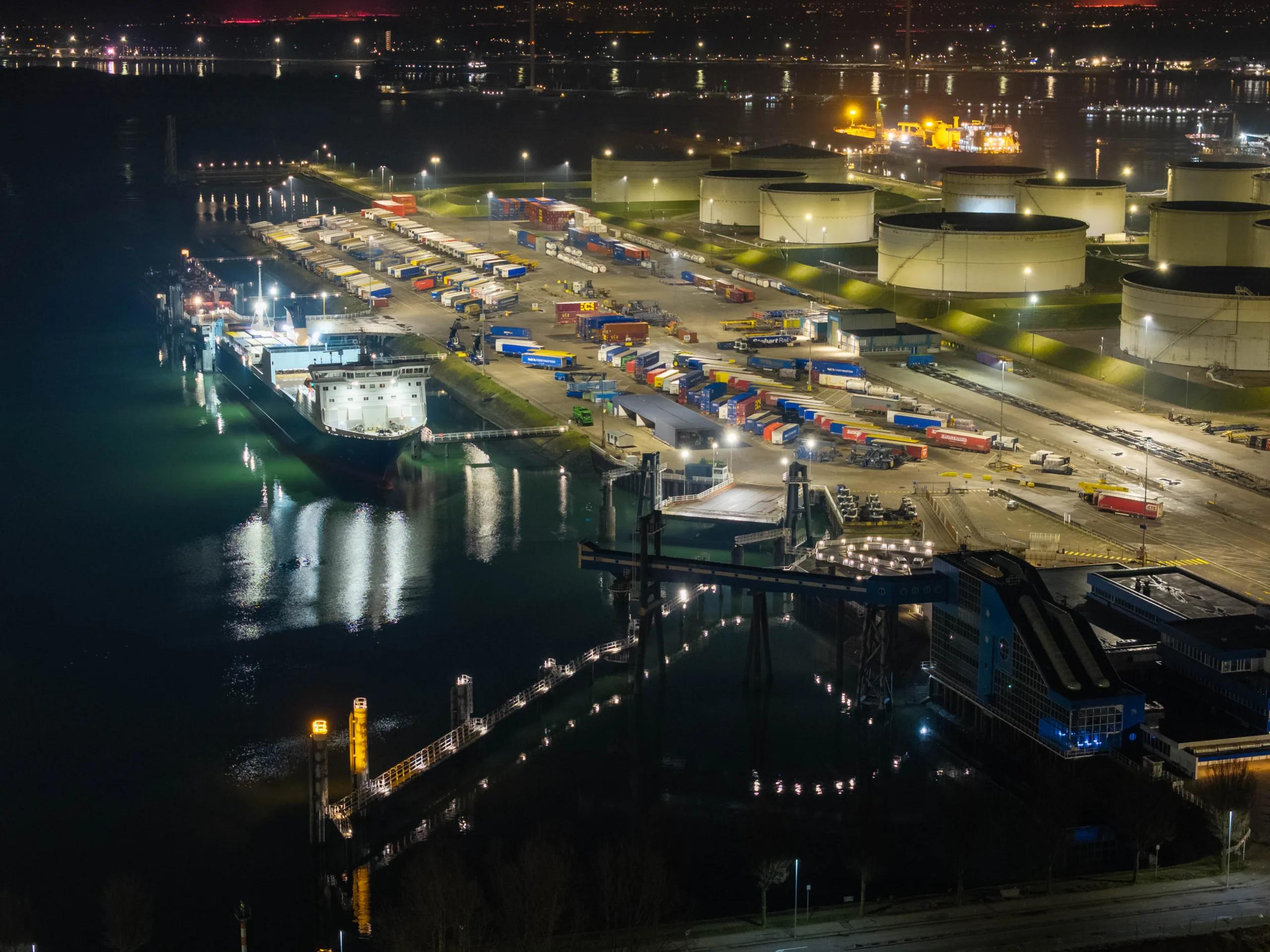
P&O Ferries Europoort: the entire site is lit by tall masts, with 316L lighting on the waterfront
Five observations. They are not about enlightenment, they are about your business. If you recognize them, you know we have been here before.
| what we encounter | what it costs you | what it is about |
|---|---|---|
| The terrain is shifting, so the cherry picker can only go between two ships in the field. | A defective fixture remains hanging for months, and maintenance is postponed until there are two | lifespan and driver selection |
| The crane operator looks down into the bundle from above | It dims or turns off, and then the ground crew works in the dark | glare and shielding |
| Brackets and bolts rust before the fixtures themselves do | A light fixture that still works but is no longer securely mounted | material selection across the entire fastener |
| The municipality or the environmental service is reviewing the permit | Discussion regarding light pollution at the time you want to expand the site | environmental zone and upward light |
| The cameras for license plates and container numbers read worse at night | Manual retroactive registration and errors in the records | flicker and color rendering |
In a port, the limitation is rarely luminous flux. It is the surrounding conditions that determine what can be installed, how long it remains installed, and how much light is permitted across the property boundary.
| Design factor | What is going on here | What determines it in the design |
|---|---|---|
| Corrosivity load | Salt, chlorides, and condensation, permanently outdoors. Corrosivity category C5 to CX according to ISO 12944-2 | Material of the housing, bracket, and mounting hardware; coating composition; solid 316L on the water side; salt spray test in accordance with ISO 9227 |
| Mounting height and mast | Masts from 20 to 50 meters, maintenance only with aerial platform or crane and only when the site area is out of service. A part of the site is also fenced off, so not every mast is accessible at the moment that is convenient | Bundle selection and number of fixtures per pole, crown or tiltable version, windage and foundation load, and the question of whether a pole must be lowerable |
| Business hours | 24 hours a day, seven days a week, no maintenance window | Lifespan selection and driver selection, because replacement here means downtime on site |
| Glare in the workplace | The crane operator looks down into the light beam, the shed and the skipper look from the water at the quay | Glare limit according to EN 12464-2:2024, shielding, direction and placement of the beam |
| Light pollution affecting the surrounding area | Fairway, residential area or nature reserve adjacent to the site, and permit conditions that direct this | Environmental zones E0 through E4, using the limit values from Table 4 of EN 12464-2:2024 and CIE 150, supplemented at the national level by the NSVV Light Pollution Guideline 2020 and the 2026 color temperature addendum. This results in the upward light percentage, luminous intensity per luminaire, and the values before and after the curfew. |
| Camera view | OCR portal, license plate recognition, CCTV and crane cameras operate on the same light | Flicker light and sufficient color rendering for recognition |
| Power supply and cable routing | Long routes across the site, groups per mast bay, inrush current upon switching on | Cable cross-section, voltage drop, and protection calculated in accordance with NEN 1010 (NEN-EN-IEC 60364), with Part 5-52 for cable selection and voltage drop. This also determines the driver location and circuit layout |
The guideline values for each subarea are not listed on this page. Quays and berths are covered by Table 14 of EN 12464-2:2024 and start at 10 lux; transshipment and loading and unloading at 30 lux; and different values apply to the area behind them. Which value applies where and how we calculate it is explained on the page dedicated to this topic.
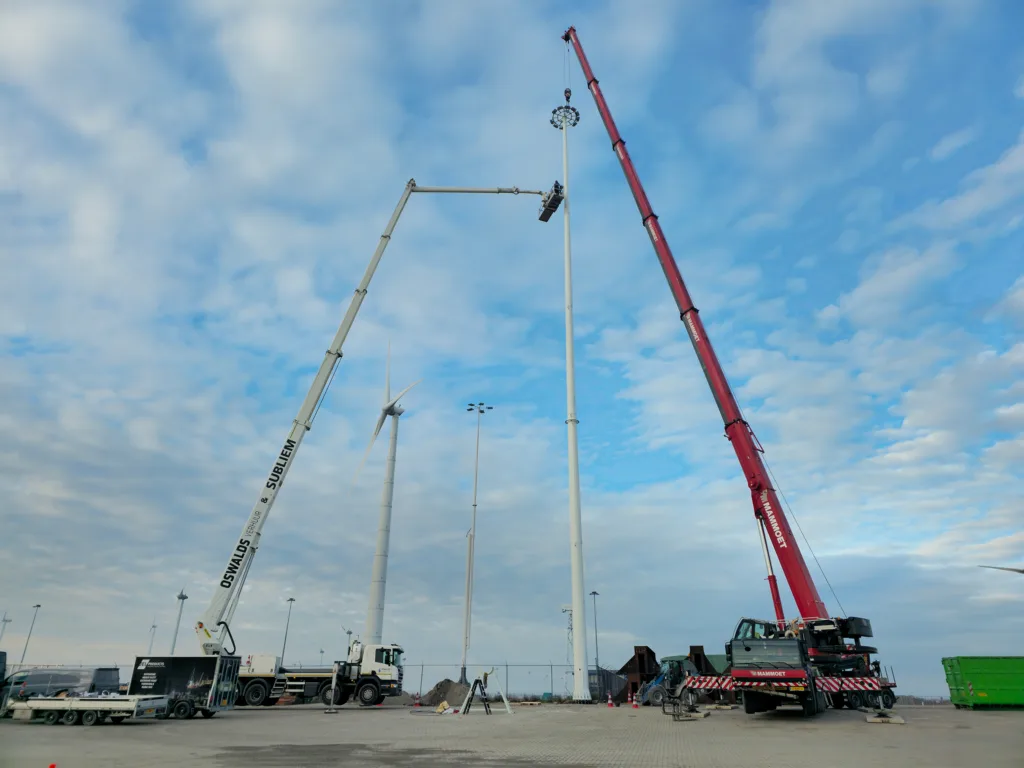 Eemshaven · container terminalBUSS Terminal EemshavenSite lighting on 50-meter-high masts, located on the water side in 316L.View the project →
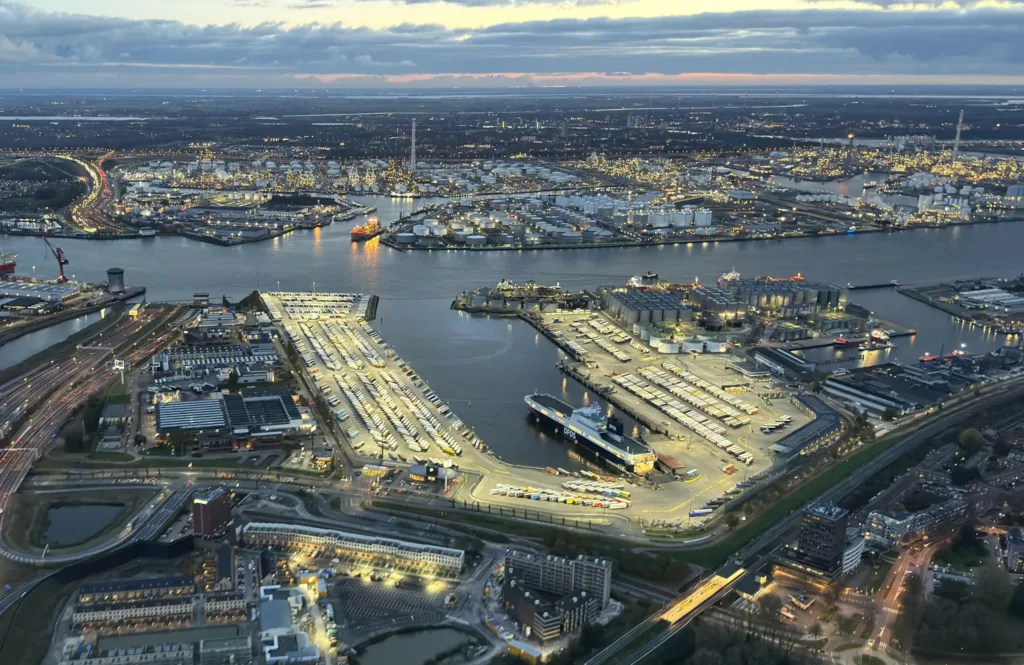 Vlaardingen · ferry terminalDFDS Seaways VlaardingenQuay, marshalling yard, and access illuminated with a light measurement as proof.View the project →
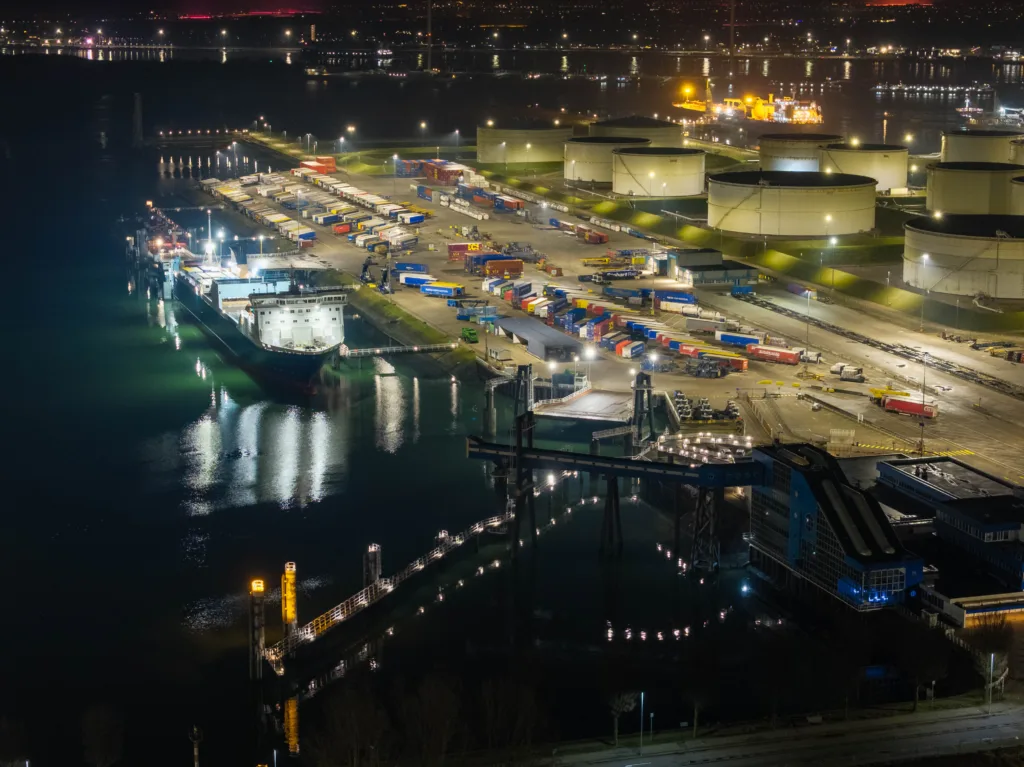 Europoort · ferry terminalP&O Ferries EuropoortThe complete site in one lighting design, with the 316L line in the wet locations.View the project →


STEP 1
Recording and lighting calculation
STEP 2
Engineering and custom solutions
STEP 3
Delivery from Nijkerk
STEP 4
Installation assistance
STEP 5
Maintenance and warranty
See for yourself: datasheets and lighting files · manuals · warranty and quality
Background: IP and IK rating and light pollution
Standard versions come from Nijkerk and are fast; project configurations upon consultation.
Complete for five years, and up to twenty years on a 316L enclosure.
We supply design, fixtures, and supervision; the installation work is done by your own department or your installer.
Yes, in consultation with the terminal concerned.
No, not at present.
Send us the size of the site, what happens at night, and what is next to it. You will receive a lighting calculation with the guideline values per zone and a layout that you can discuss.
| Response | within 1 working day, by an engineer |
| Lighting calculation | free of charge, per zone |
| Trial luminaire | on your own mast, on request |
| Warranty | 5 years full, 10 years on the housing with a maintenance contract |
Rather call directly: 033 785 9809