

Placing them higher means a larger surface area per mast position, and therefore fewer obstacles in an area where driving and handling take place. We supply high mast systems up to 50 meters with luminaires of 171 lm/W, plus low and standard lighting poles for everything below that.
A lighting column is not a loose component. Mast height, luminaire load, wind area, soil conditions, foundation, and maintenance strategy together determine what is technically sound. Because we supply both the lighting and the mast, we assess them as a single system rather than as two separate orders.
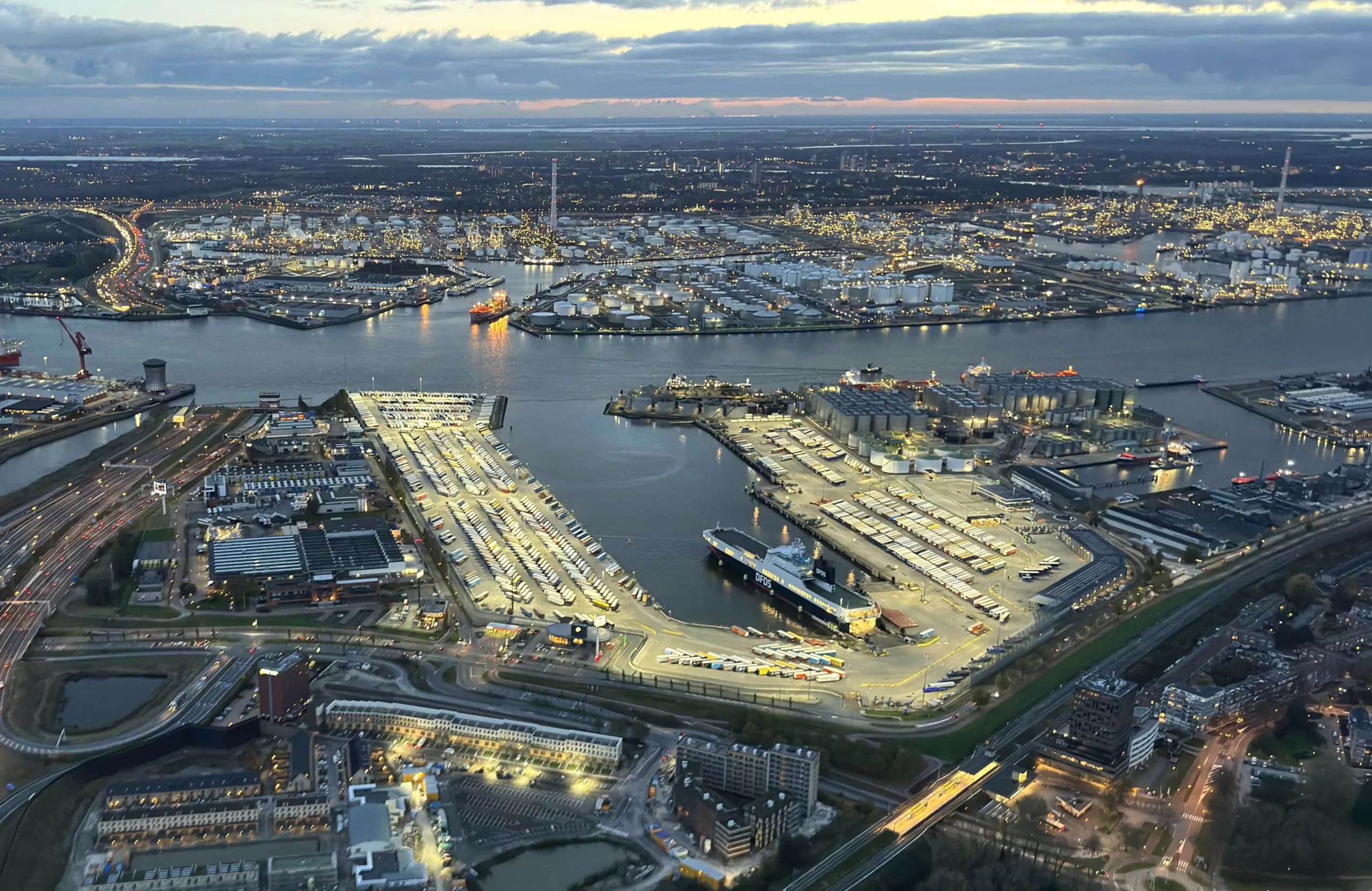
DFDS terminal Vlaardingen, illuminated by DarkLicht from high masts
The boundary between the categories is not only height but also the regulatory regime: up to 20 meters, a mast typically falls under EN 40; above that, it is assessed on a project-by-project basis in accordance with the Eurocode. That difference determines the lead time, the foundation, and the equipment required to install it.
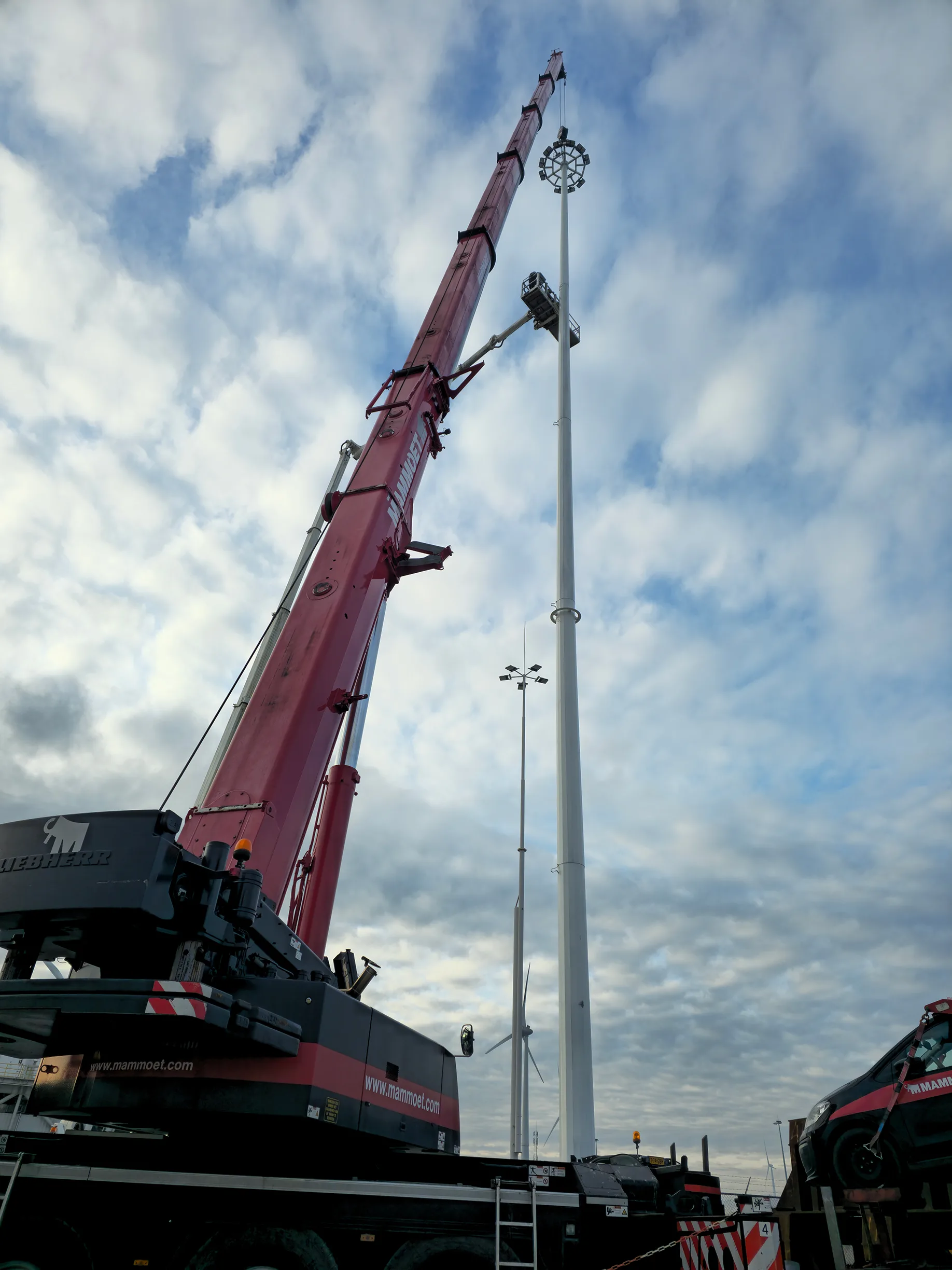
For large operational areas, high-mast lighting is often the most efficient solution. By mounting luminaires higher, a larger area can be illuminated with fewer mast locations, which is particularly important where open space, routing, and operational flexibility are key.
For tall masts, the structure is evaluated on a project-by-project basis in accordance with the Eurocode. Mast height, wind load, luminaire load, foundation, and site conditions collectively determine which mast structure is structurally sound. The luminaires we use for high mast lighting achieve 171 lm/W and are full cut-off, meaning less power is required per position and no light is emitted upward.

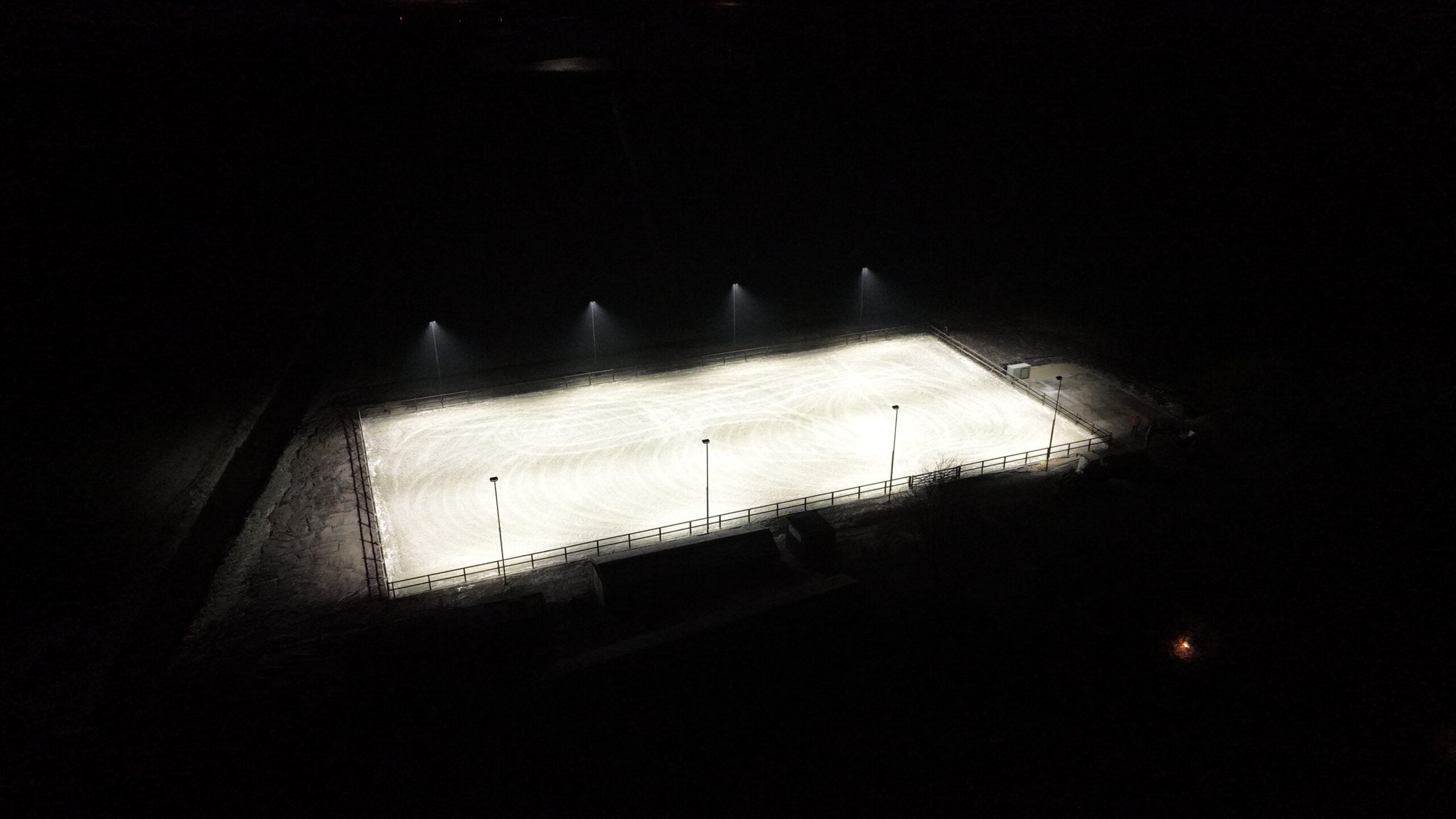
For larger outdoor areas where greater range, better distribution, and fewer obstacles are desired. Frequently used in logistics yards, industrial outdoor zones, sports fields, and smaller terminal areas.
Within these heights, the choice of pole is determined by the combination of pole height, bracket or cross-arm, the number of luminaires, the luminaire weight, the windage area, and the desired light distribution.
For locations where clear area lighting is required with a limited mounting height. Suitable where the distance between the mast and the work zone remains small and a large light range is not required.
These poles typically fall within the EN 40 system and are intended for standard area lighting with limited luminaire load. The final choice depends on soil conditions, luminaire weight, wind load, and mounting method.
The load on a light pole is not determined by height alone. The number of luminaires, the weight, the projected surface area, the mounting position, and the local wind load carry equal weight.
A 30-meter mast with a few compact luminaires requires a different assessment than that same 30 meters with multiple heavy floodlights on a large crown.
That works both ways. The lighting design choices determine the structural starting points, and the structural capacity determines how many luminaires can be safely mounted on it. If the mast, foundation, and lighting are ordered separately, that discrepancy only comes to light at the construction site.
A mast structure can only be assessed once the subsurface conditions are known. For new mast locations, and especially for high masts, a CPT soil test or geotechnical investigation is therefore often necessary. Based on this, the foundation type is determined: a concrete base, pile foundation, prefabricated foundation, anchor cage, or a project-specific design.
With taller masts and heavier luminaire loads, an assumption is not a responsible basis. That is why, in project-based mast solutions, we push for technical substantiation before the mast and foundation are finalized. That is sometimes a difficult message at the start of a project, but it is the cheapest place to find out.
We supply masts separately, but also as part of a complete lighting system. You choose the scope; we will tell you what responsibilities remain with you.
In areas where free space, routing, and operational flexibility matter, fewer mast positions are not only cheaper but also more practical: every mast is an obstacle that needs to be driven around.
Container yards, ferry terminals, bulk terminals, and terminal yards where large areas need to be reliably illuminated without obstructing logistical movements.
On the page terminal lighting you can read how we light a terminal, from mast height and zoning to light nuisance.
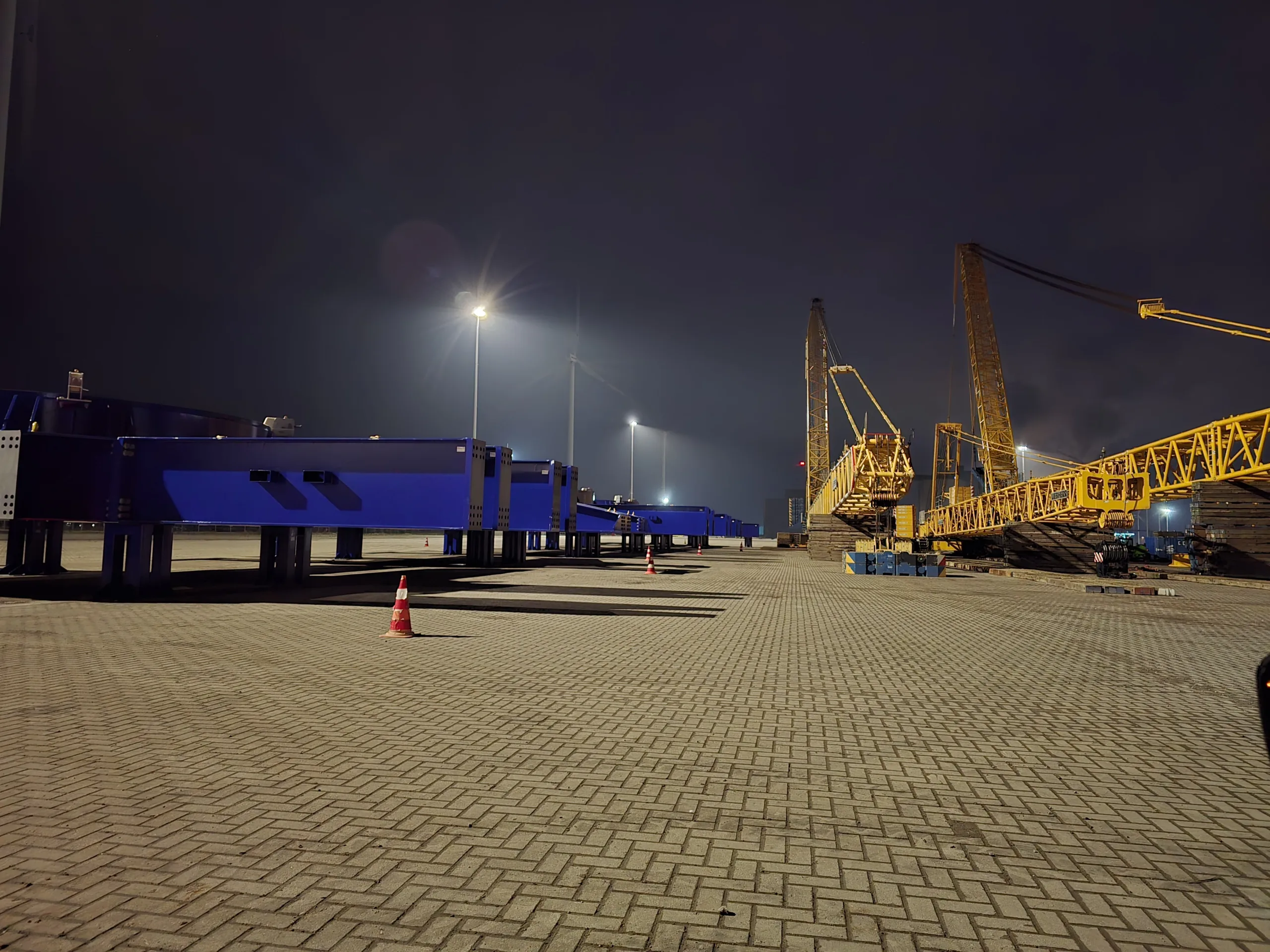
Industrial storage yards, loading and unloading zones, distribution centers, access roads, and business parks where safety and continuity are paramount.

Sports fields, construction sites, temporary work areas and infrastructure projects where pole position, light distribution and execution must be coordinated on a project basis.
Six steps, the first three of which happen on paper. That is deliberate: with a mast, the place where you can correct a mistake is the drawing board, not the site.
With project-based poles, an inquiry is rarely just about the height. The location, luminaire configuration, foundation, and desired design together determine which pole solution is appropriate.
If you don't have everything at hand yet, we will start with what is available. We will help you think about which data is needed to arrive at a technically substantiated proposal, and tell you which of those have the greatest impact on the outcome.
Can't find your question? Call us with the site dimensions and the desired height at hand.
Because you illuminate a larger surface with fewer pole positions. That limits the number of obstacles on the site, makes the layout clearer, and saves on foundations. The condition is that the lighting and structural design parameters are aligned: placing them higher requires different optics and a heavier structure.
Effective from 20 meters. That is also the threshold above which a mast no longer falls standardly under EN 40 and is assessed on a project basis. We install high mast systems up to 50 meters.
EN 40 is used in practice for lighting columns up to 20 meters nominal height. For taller columns or special configurations, the column is assessed on a project basis, based on wind load, luminaire load, mounting structure, and foundation, among other factors.
For new pole locations, high poles, or larger luminaire loads, a CPT soil sounding is often necessary to determine the soil composition and bearing capacity. Without soil data, the foundation remains based on assumptions, and for taller poles, that is not a responsible basis.
A concrete pier, a pile foundation, a prefabricated foundation, an anchor cage, or a project-specific construction. Which of these is suitable follows from the soil data, the mast height, and the load that the mast exerts on the foundation.
Yes. We supply lighting columns separately, but also as part of a complete system with luminaires, a lighting design, foundation advice, installation, and delivery. If you choose delivery only, we will also inform you which assessments remain your responsibility.
That is not a fixed number, but an outcome. It depends on the mast height, the weight and wind-catching surface of the luminaires, the ring or cross-arm, and the wind zone. A 30-meter mast with compact luminaires is very different from the same mast with heavy floodlights on a large ring.
Placing them higher does not automatically mean more nuisance, provided the optics are right. With full cut-off luminaires such as the DarkLicht Does the light remain within the site boundary and does nothing go upward? If the site borders residential properties or nature, we assess the calculation against the NSVV guideline for light nuisance.
That is a design question that must be answered prior to execution. With high mast lighting, it is predetermined how the luminaires will remain accessible: using a cherry picker, via a lowerable crown, or with a climbing system. Our mechanics are certified for working at height; see installation and maintenance.
Often yes, but not just like that. New luminaires usually have a different weight and wind-catching surface than what was there, so the existing pole must be reassessed. During an LED conversion, that is one of the first things we check.
That varies greatly between categories. Standard masts within EN 40 are a matter of delivery time; high masts involve a project-based assessment, often a soil investigation, and a foundation. We provide the schedule after the inventory, because any number before that is a shot in the dark.
Yes. We always do the engineering and lighting plan ourselves; for the execution outside the Netherlands, we work with trusted partners. Please provide the project location with your request, and we will explain how that would work in your case.
Yes, in addition to fixed masts. A mobile lighting tower is interesting for temporary work sites, events, or situations where there is no power supply or foundation yet. See the page about the mobile lighting tower for the versions.
For an industrial estate, terminal, port location, sports field or large outdoor area. We help with the choice based on application, location, wind load, foundation and the lighting that goes on the mast.
Your request is being reviewed by an engineer. We will respond within 1 business day.
Prefer direct contact?