

Home / Products / Full cut-off floodlights / DarkLicht D
34,200 lumens without a separate driver box: the only floodlight in the series with an internal driver. One fixture, one cable, no box on the pole.
On a mast up to about twelve meters high, an external driver box often creates more work than it’s worth: an extra mounting point, extra cable, and an extra potential point of failure. The DarkLicht D has its electronics built into the housing, making it the easiest-to-install floodlight in the product line. The patented reflector prevents light from being emitted above the selected cutoff point, so you get an LED floodlight that illuminates the target area without lighting up the surrounding area.
A response from an engineer within 1 business day. Free lighting calculation, in accordance with the NSVV code of conduct.
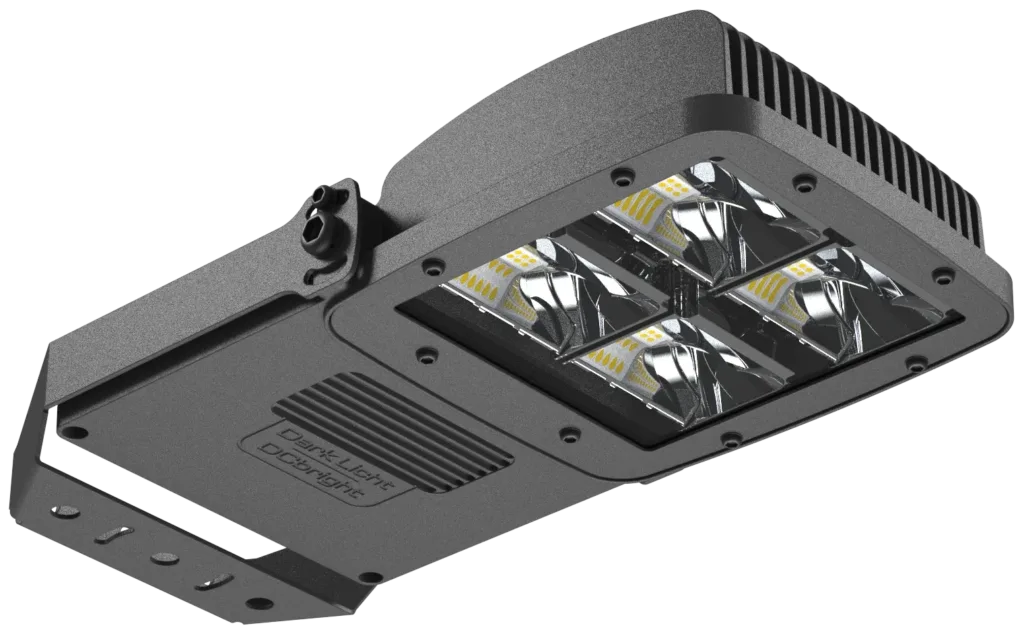
The D200, Titanium Black, with a bracket in 316L.
at 200 W, 171 lm/W
above the chosen cut-off
five positions, chosen upon ordering
driver intern, one assembly point
IK08, C5 as per ISO 9223
up to 10 years with maintenance contract
The D model stands out from the rest of the DarkLicht series in one respect: the driver is located inside the fixture. This simplifies installation and shifts maintenance to the top of the mast rather than at the base.
The internal driver's limitations lie precisely in this area.
The D series ranges from 60 to 200 watts, with the luminous flux increasing proportionally. All three have the driver built into the housing and the same five cutoff settings; the D60 and D120 share the same housing and driver, while the D200 is 100 millimeters longer and has a heavier driver.
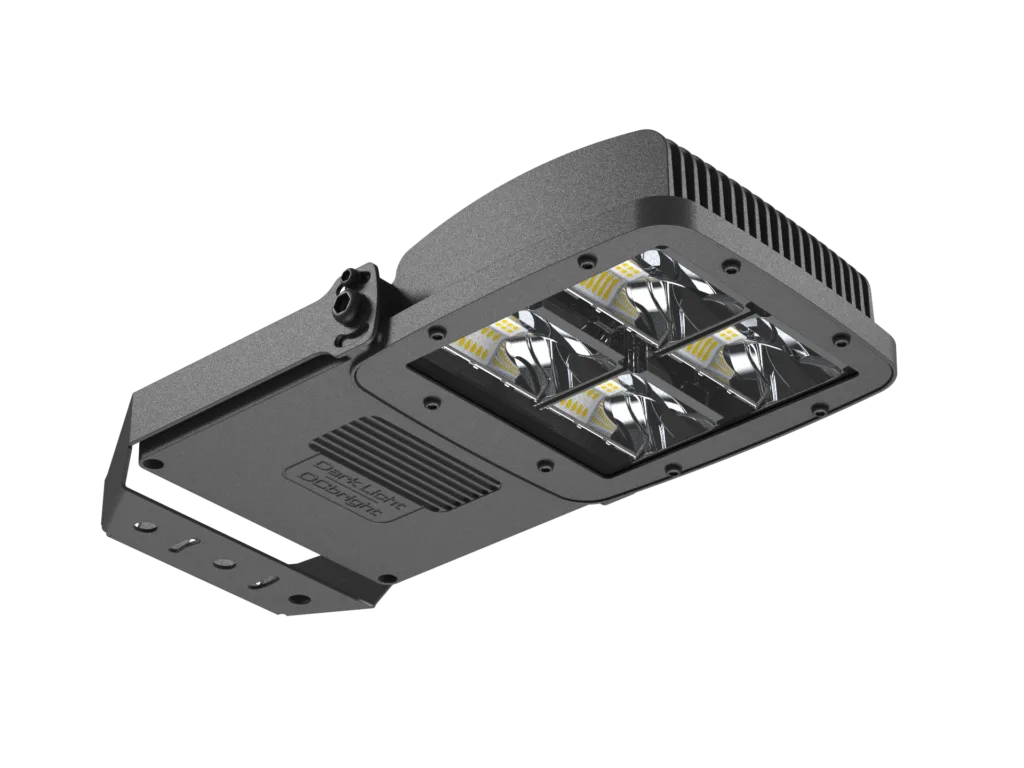
The smallest version, for a facade or a low pole. Approx. 0.27 A at 220 V: five on a B16, eight on a C16.
DRKD01-50K · internal BLD120 · 6.9 kg
The mid-range version, for masts up to approximately ten meters. Same 440 mm housing and same driver as the D60.
DRKD02-50K · internal BLD120 · 7.1 kg
The highest output with internal driver, for poles up to approximately twelve meters. One hundred millimeters longer, and with a heavier driver. Above that, the One wins in output.
DRKD03-50K · intern BLD200 · 8.5 kg
In the larger DarkLicht models, the driver is intentionally housed in a separate DRB box: this keeps the fixture lightweight and the electronics accessible. On an eight- or ten-meter pole with two luminaires, that advantage doesn’t outweigh the additional mounting point, the extra cable feed-through, and the second cable. That’s what the D is for.
Same reflector, same zero percent above the cut-off, but to be installed as a regular floodlight.
See the application under area lighting, light pollution and full cut-off and the photo gallery.

internal driver, no DRB box
63 to 75 degrees
Choose a trim level and the complete specification list below will change accordingly. The cut-off is chosen upon ordering and is therefore not included in the order code.
Item number
DarkLicht D60
The smallest version, for a facade or a low mast. Same housing as the D120.
| Luminous flux | 10,300 lm |
| Power consumption | 60 W |
| Efficiency | 171 lm/W |
| Optics | parabolic reflector, full cut-off |
| Cut-off standings | 63°, 66°, 69°, 72°, 75° cut-off |
| Measured beam angle | 132° beam, 138° field, shielding position |
| Color temperatures | standard 4000K; optional 1700K to 5700K |
| Color-changeable | 4000K, 2200K and 1700K, switchable during operation |
| CRI (Ra) | > 70, or optionally 80 or 90 |
| Color consistency | 3-step MacAdam |
| Housing | cast aluminum, < 0.08 % copper |
| Surface treatment | conversion layer + 2-layer titanium e-coating |
| Bracket | High tensile strength 316L, −20° to +20° |
| Front | impact-resistant glass (IK08) |
| Color | Titanium Black or Titanium Grey |
| Dimensions | 440 × 270 × 110 mm |
| Weight | 6.9 kg |
| Lead time | Standard within a week, custom by arrangement |
| Cable type | Optional with H07BQ-F |
| Connection | unused wires in the IP67 junction box |
| Voltage range | 90 to 305 VAC |
| Current draw | approx. 0.27 A at 220 V; 0.5 A at 120 V |
| Driver | internal BLD120 |
| Driver (type) | BLD120 (120 W) |
| Driver lifespan | ≥ 100,000 hours at Tc 75 °C; ≥ 130,000 hours at Tc 50 °C |
| MTBF driver | ≥ 320,000 hours at Tc 75 °C (MIL-HDBK-217F) |
| Inrush current | 66.8 A peak, T50 350 µs at 220 V |
| Luminaires per MCB | B16: 5 · C16: 8 · C25: 13 · D16: 17 |
| Overvoltage | 6 kV line-to-line, 10 kV line-to-ground (IEC 61000-4-5) |
| Power factor / THD | > 0.9 at 60–100 % load; THD < 15 % |
| Dimming | 0–10 V, PWM, and DALI-2 or via NFC |
| IP and IK | IP66 and IP67 / IK08 |
| Corrosion class | C5 Industrial and Maritime (ISO 9223) |
| Operating temperature | −45 to +50 °C |
| LED lifespan | TM-21 L90B05 > 103,500 hours |
| Drag coefficient (Cd) | 1,15 |
| Projected area | 18.750 mm² at 0°, up to 44,500 mm² |
| Certification | CE, IEC 60598, EN 55015, EN 61547, EMC |
| Warranty | 5 years, with maintenance contract up to 10 years |
| HS code | 9405500090 |
Item number
DarkLicht D120
The mid-range model, for masts up to about ten meters. It uses the same BLD120 driver as the D60, so it has the same group load.
| Luminous flux | 20,500 lm |
| Power consumption | 120 W |
| Efficiency | 171 lm/W |
| Optics | parabolic reflector, full cut-off |
| Cut-off standings | 63°, 66°, 69°, 72°, 75° cut-off |
| Measured beam angle | 132° beam, 138° field, shielding position |
| Color temperatures | standard 4000K; optional 1700K to 5700K |
| Color-changeable | 4000K, 2200K and 1700K, switchable during operation |
| CRI (Ra) | > 70, or optionally 80 or 90 |
| Color consistency | 3-step MacAdam |
| Housing | cast aluminum, < 0.08 % copper |
| Surface treatment | conversion layer + 2-layer titanium e-coating |
| Bracket | High tensile strength 316L, −20° to +20° |
| Front | impact-resistant glass (IK08) |
| Color | Titanium Black or Titanium Grey |
| Dimensions | 440 × 270 × 110 mm |
| Weight | 7.1 kg |
| Cable type | Optional with H07BQ-F |
| Connection | unused wires in the IP67 junction box |
| Voltage range | 90 to 305 VAC |
| Current draw | approx. 0.55 A at 220 V; 1.0 A at 120 V |
| Driver | internal BLD120 |
| Driver (type) | BLD120 (120 W) |
| Driver lifespan | ≥ 100,000 hours at Tc 75 °C; ≥ 130,000 hours at Tc 50 °C |
| MTBF driver | ≥ 320,000 hours at Tc 75 °C (MIL-HDBK-217F) |
| Inrush current | 66.8 A peak, T50 350 µs at 220 V |
| Luminaires per MCB | B16: 5 · C16: 8 · C25: 13 · D16: 17 |
| Overvoltage | 6 kV line-to-line, 10 kV line-to-ground (IEC 61000-4-5) |
| Power factor / THD | > 0.9 at 60–100 % load; THD < 15 % |
| Dimming | 0–10 V, PWM, and DALI-2 or via NFC |
| IP and IK | IP66 and IP67 / IK08 |
| Corrosion class | C5 Industrial and Maritime (ISO 9223) |
| Operating temperature | −45 to +50 °C |
| LED lifespan | TM-21 L90B05 > 103,500 hours |
| Drag coefficient (Cd) | 1,15 |
| Projected area | 18.750 mm² at 0°, up to 44,500 mm² |
| Certification | CE, IEC 60598, EN 55015, EN 61547, EMC |
| Warranty | 5 years, with maintenance contract up to 10 years |
| HS code | 9405500090 |
Item number
DarkLicht D200
The highest output with internal driver, for poles up to approximately twelve meters. One hundred millimeters longer than the D60 and D120.
| Luminous flux | 34,200 lm |
| Power consumption | 200 W |
| Efficiency | 171 lm/W |
| Optics | parabolic reflector, full cut-off |
| Cut-off standings | 63°, 66°, 69°, 72°, 75° cut-off |
| Measured beam angle | 132° beam, 138° field, shielding position |
| Color temperatures | standard 4000K; optional 1700K to 5700K |
| Color-changeable | 4000K, 2200K and 1700K, switchable during operation |
| CRI (Ra) | > 70, or optionally 80 or 90 |
| Color consistency | 3-step MacAdam |
| Housing | cast aluminum, < 0.08 % copper |
| Surface treatment | conversion layer + 2-layer titanium e-coating |
| Bracket | High tensile strength 316L, −20° to +20° |
| Front | impact-resistant glass (IK08) |
| Color | Titanium Black or Titanium Grey |
| Dimensions | 540 × 270 × 110 mm |
| Weight | 8.5 kg |
| Cable type | Optional with H07BQ-F |
| Connection | unused wires in the IP67 junction box |
| Voltage range | 90 to 305 VAC |
| Current draw | approx. 0.9 A at 220 V; 1.7 A at 120 V |
| Driver | intern BLD200 |
| Driver (type) | BLD200 (200 W) |
| Driver lifespan | ≥ 100,000 hours at Tc 75 °C; ≥ 130,000 hours at Tc 50 °C |
| MTBF driver | ≥ 280,000 hours at Tc 75 °C (MIL-HDBK-217F) |
| Inrush current | 63.2 A peak, T50 300 µs at 220 V |
| Luminaires per MCB | B16: 6 · C16: 11 · C25: 17 · D16: 12 |
| Overvoltage | 6 kV line-to-line, 10 kV line-to-ground (IEC 61000-4-5) |
| Power factor / THD | > 0.9 at 60–100 % load; THD < 15 % |
| Dimming | 0–10 V, PWM, and DALI-2 or via NFC |
| IP and IK | IP66 and IP67 / IK08 |
| Corrosion class | C5 Industrial and Maritime (ISO 9223) |
| Operating temperature | −45 to +50 °C |
| LED lifespan | TM-21 L90B05 > 103,500 hours |
| Drag coefficient (Cd) | 1,15 |
| Projected area | 18,750 mm² at 0°, up to 49,500 mm² |
| Certification | CE, IEC 60598, EN 55015, EN 61547, EMC |
| Warranty | 5 years, with maintenance contract up to 10 years |
| HS code | 9405500090 |
The cutoff is selected at the time of order and determines the light distribution. The 316L bracket is also infinitely adjustable from −20 to +20 degrees, allowing the beam to be adjusted to the terrain. The beam pattern for the bracket is not yet included in the datasheet; that vector drawing has been requested for the JEL.
Direct download, no form required. Also included in the compilation document DarkLicht.
Because the driver is located inside the fixture, you connect the D like a standard floodlight: one power cable to the pole arm, no separate box, and no intermediate wiring.
in a IP67 junction box, cable optional
internal, BLD120 or BLD200
THD < 15 % at 60–100 % load
of 0–10 V, PWM or via NFC
| EXECUTION | B16 | C16 | C25 | D16 |
|---|---|---|---|---|
| D60 and D120, BLD120 | 5 | 8 | 13 | 17 |
| D200, BLD200 | 6 | 11 | 17 | 12 |
These figures come from the driver manufacturer's MCB table at 220 V and apply per driver. The inrush current is 66.8 A peak with a T50 of 350 µs for the D60 and D120, and 63.2 A peak with a T50 of 300 µs for the D200. In the case of a long facade or mast route, the cable length is usually the limiting factor rather than the circuit breaker; we perform this calculation upon request, including the voltage drop along the route.
For a pole calculation, the weight and projected area per tilt angle are required, plus the number of luminaires per pole. These are in the dimensioning section below and come from the 2023 wind rating report. See also lighting poles and structures.
A lens-type fixture must be tilted to create a beam pattern, which inevitably directs light above the horizon. The DarkLicht hangs flat and creates the beam pattern using the reflector. Above the selected cutoff, light emission is zero, both forward and backward.
This achieves two things at once: no sky glow and no glare for nearby residents, traffic, or wildlife, as well as a net efficiency of 171 lm/W because the light that would otherwise be lost into the sky is instead directed onto the floor. For DarkSky requirements and permitting processes, that is the difference between compliance and non-compliance.
| CUT-OFF | WHAT FOR |
|---|---|
| 75° | Largest range, for the most distant part of the zone. |
| 72° | Long distance, the standard position on a site. |
| 69° | Medium range, highest uniformity across the plane. |
| 66° | Short distance, closer to the mast. |
| 63° | Strictest limitation, for the most sensitive environment. |
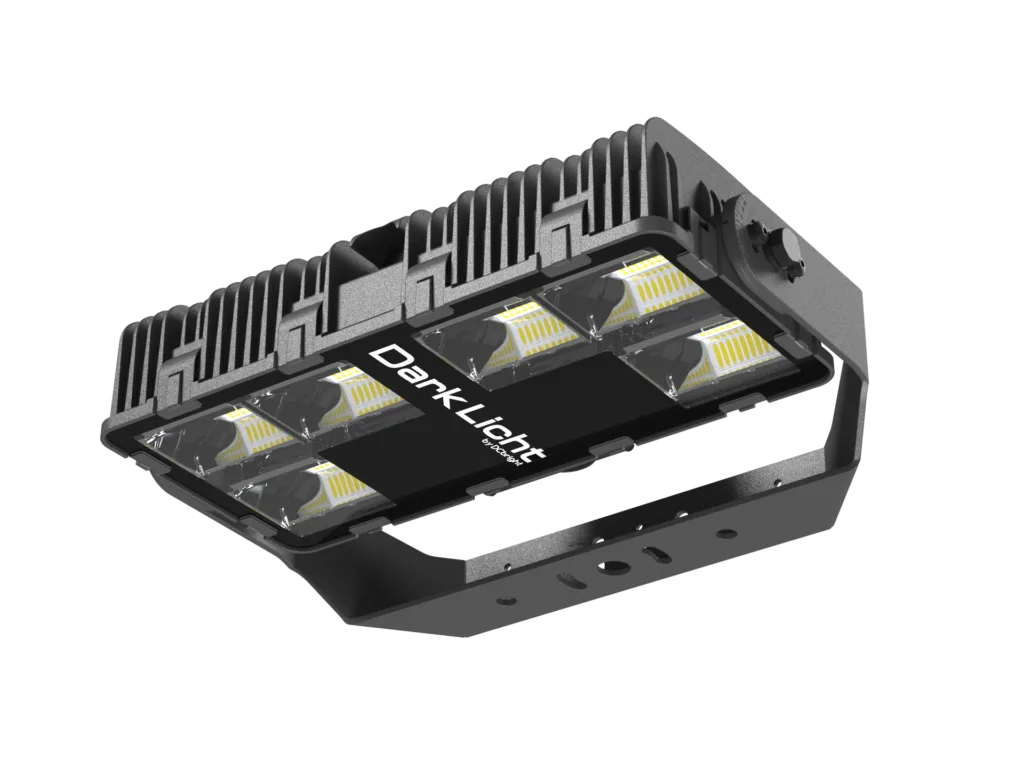
The reflector blocks everything above the selected angle; shown here at a 75-degree forward angle. The selection is fixed at the time of order; the 316L bracket can then be adjusted without limitation from −20 to +20 degrees to adapt the beam to the terrain. We substantiate the position with a light calculation in accordance with the NSVV code of conduct.
Sites on masts up to twelve meters, often close to the property boundary.
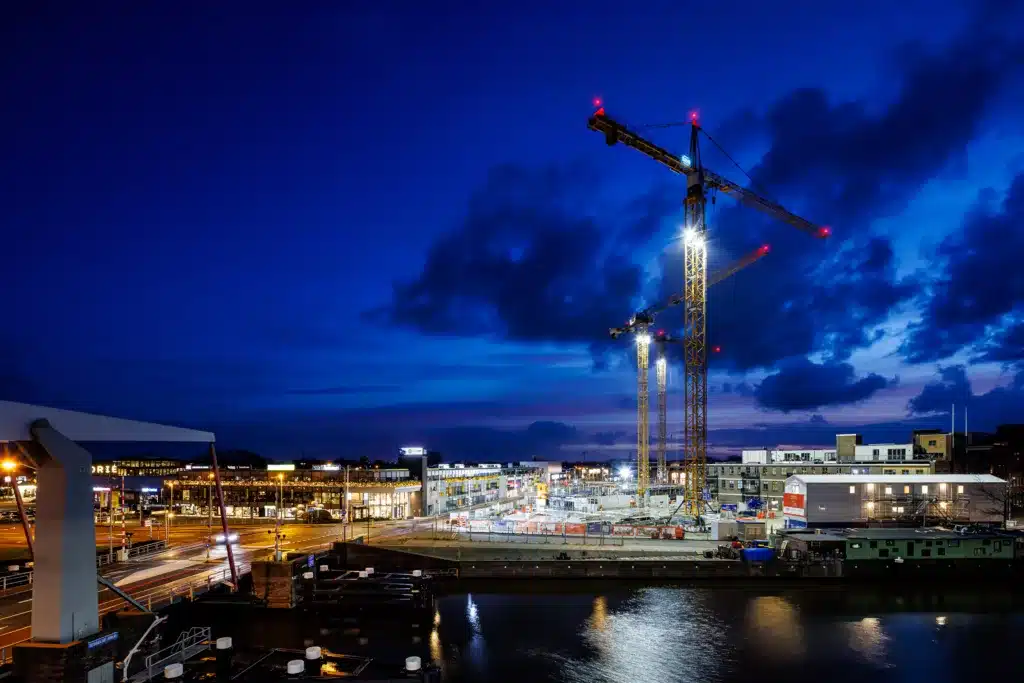
Masts of eight to twelve meters, often close to the property boundary. Shielded light keeps the site bright and the neighbors out of the beam.
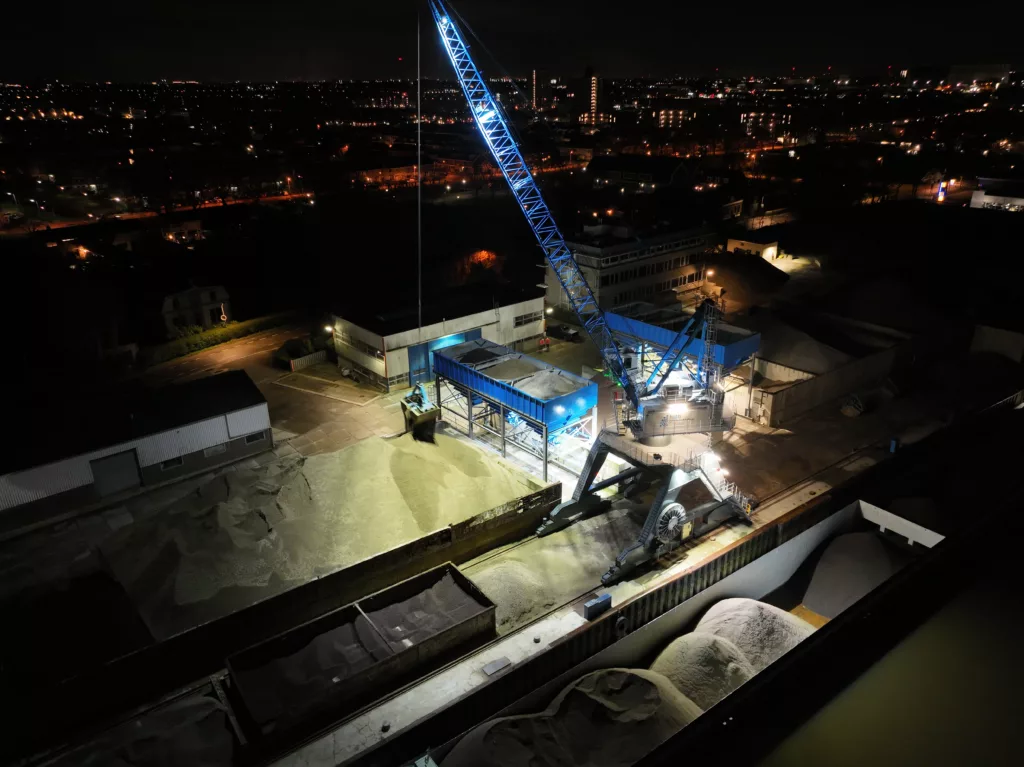
Loading and unloading areas, container yards, and storage areas where drivers drive towards each other and glare is a safety risk.

A luminaire without a separate driver box is quicker to install and remove. During night work in populated areas, shielding is usually a permit requirement.
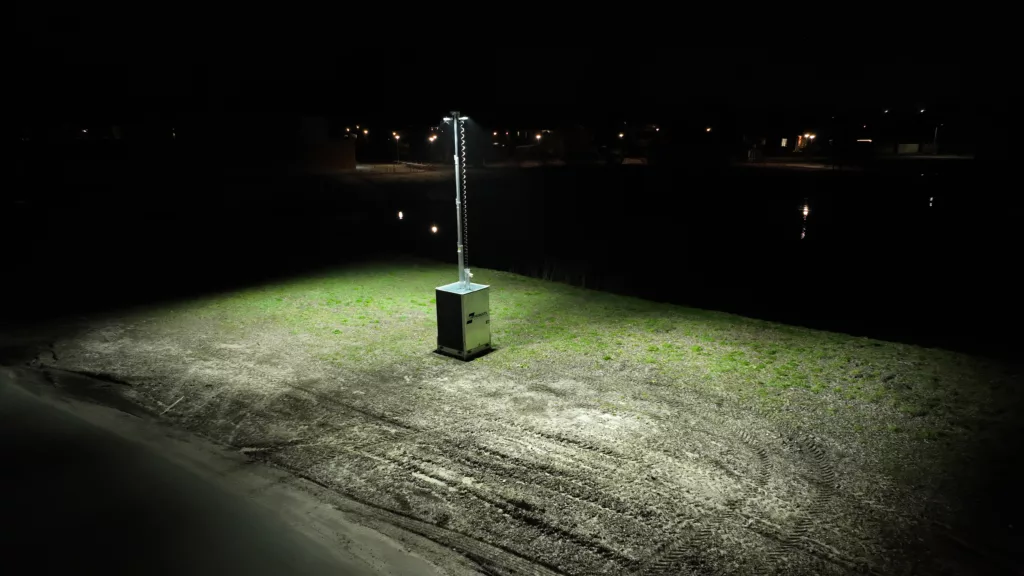
With a battery bank or solar panel, every watt counts. A net 171 lm/W and a beam that wastes nothing directly determine the size of the installation here.
Seven versions with the same optical principle, increasing in power; including the WP wallpack for facades, the line totals eight. The D is the only one with an internal driver; from the One onwards, an external DRB box is the standard.
| Version | Role in the range | Power | IP and IK | Driver |
|---|---|---|---|---|
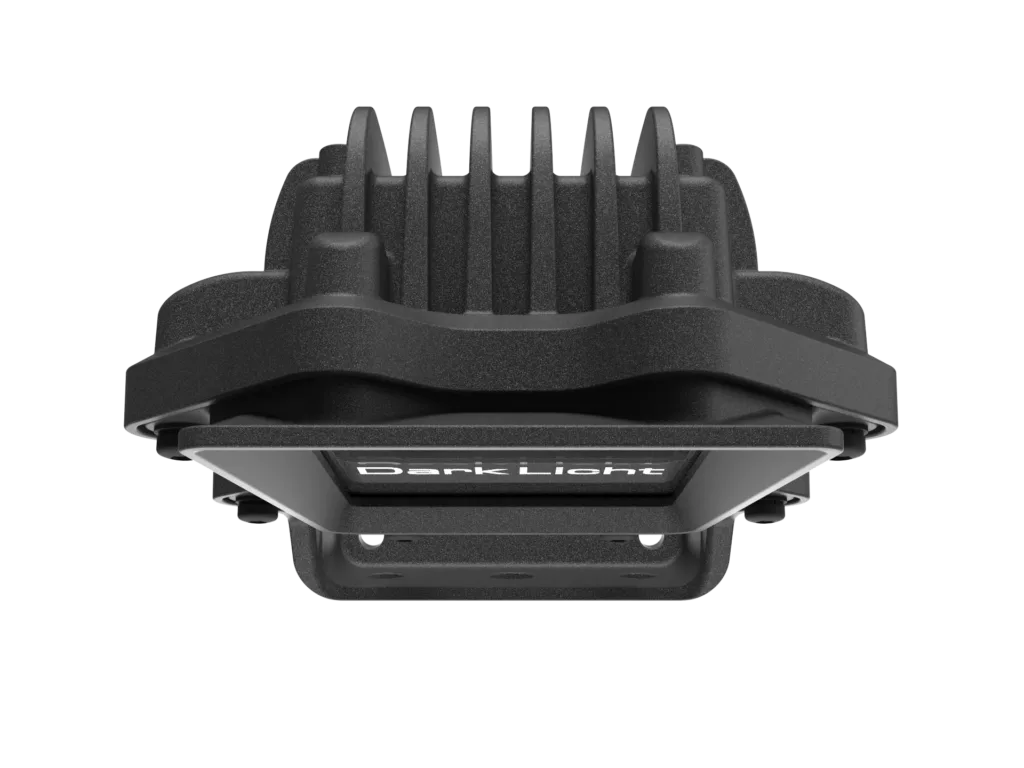 DarkLicht Mini4,800 lumens DarkLicht Mini4,800 lumens | Glare-free work lamp for machines and vehicles. | 30 W | IP69K / IK08 | op print |
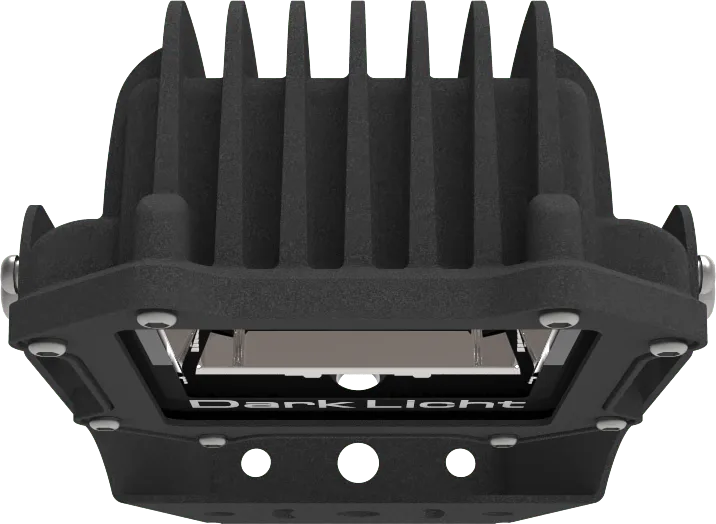 DarkLicht S10,260 to 12,825 lumens DarkLicht S10,260 to 12,825 lumens | Work light for larger nearby work areas, with 316L bracket. | 60 to 75 W | IP69K / IK08 | op print |
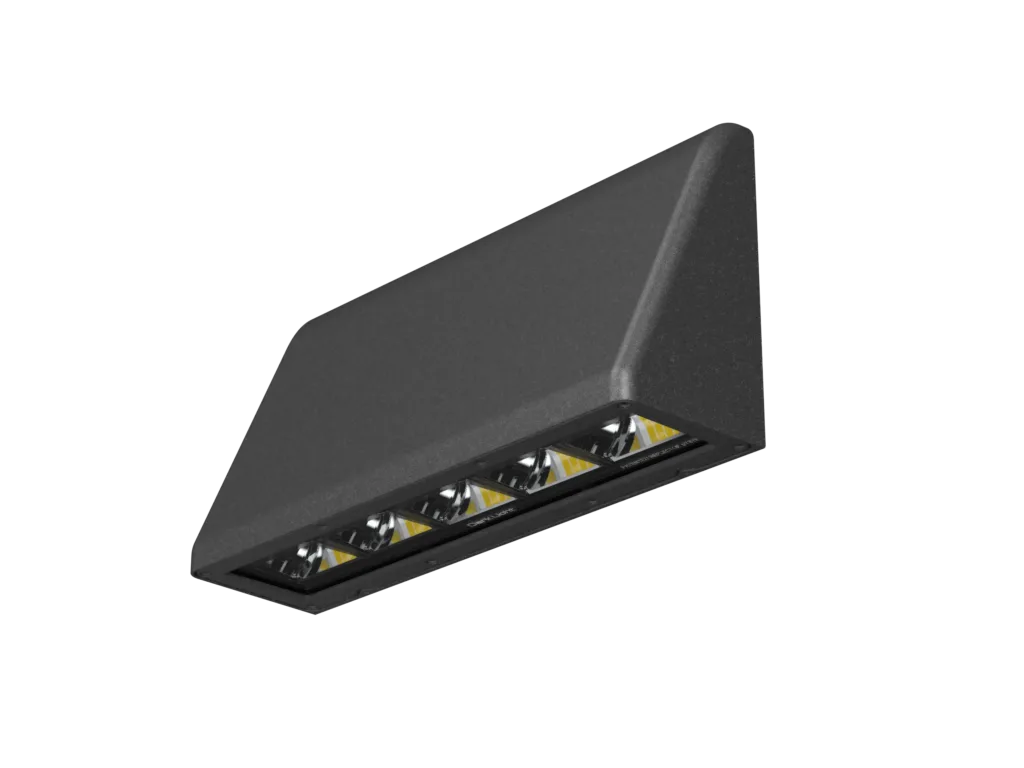 DarkLicht WP9,600 to 16,000 lumens DarkLicht WP9,600 to 16,000 lumens | The only one for wall mounting, with adjustable power per position. | 10 to 100 W | IP69K / IK08 | internal |
| DarkLicht D10,300 to 34,200 lumens | Floodlight with internal driver, easy to install on poles up to twelve meters. | 60 to 200 W | IP66 and IP67 / IK08 | internal |
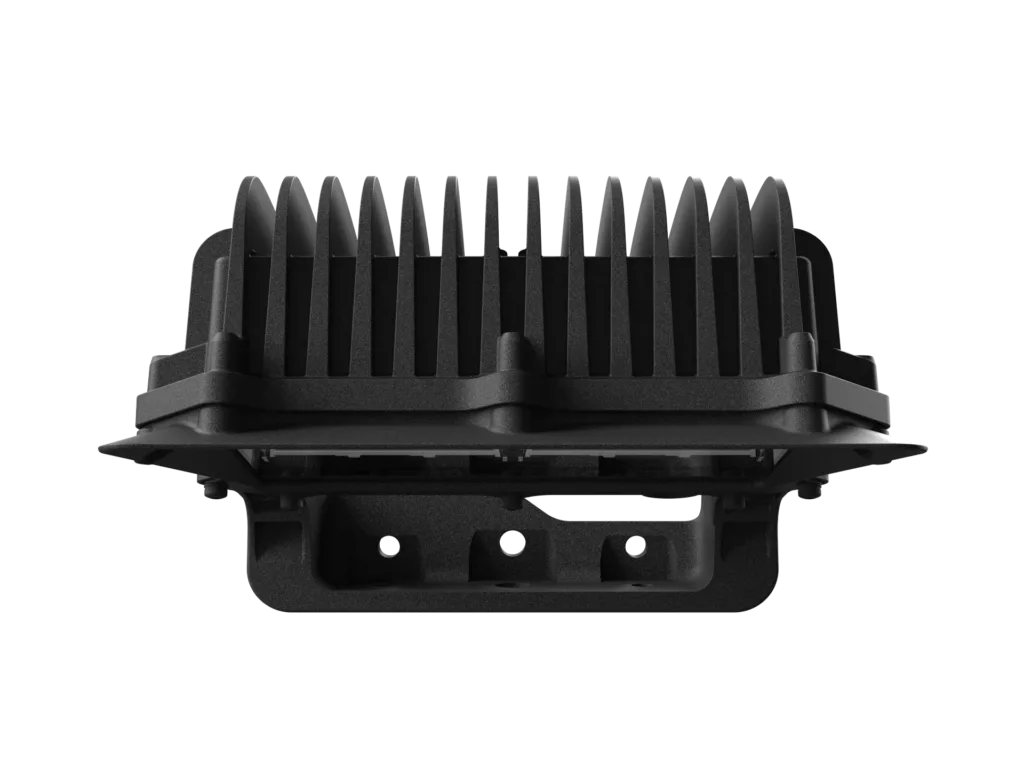 DarkLicht M25,700 to 51,300 lumens DarkLicht M25,700 to 51,300 lumens | Site and mast lighting in DC and AC, uniquely tested to 6G vibration. | 150 to 300 W | IP69K / IK08 | out of print |
 DarkLicht One, Two, and Three51,200 to 307,800 lumens DarkLicht One, Two, and Three51,200 to 307,800 lumens | One product line in six power ratings, for the largest zones and high-mast. | 320 to 1,800 W | IP66 and IP67 / IK07 | internal or external |
The D is mounted on a mast arm or gantry using a 316L bracket and is infinitely adjustable from −20 to +20 degrees. When determining the position, take the cutoff into account: it determines how the beam falls on the ground, and with a shielded luminaire, this cannot be adjusted afterward by changing the tilt angle.
| Dimensions D60 and D120 | 440 × 270 × 110 mm |
| Dimensions D200 | 540 × 270 × 110 mm |
| Weight | 6.9 · 7.1 · 8.5 kg |
| Drag coefficient (Cd) | 1,15 |
| Projected surface area, 0° | 18.750 mm² |
| Ditto, maximum tilt angle | 44.500 mm² (D60 and D120), 49.500 mm² (D200) |
| Driver | internal, BLD120 or BLD200 |
| Bracket | High tensile strength 316L, −20° to +20° |
Dimensions in mm, length × width × height. The wind data comes from the August 2023 DCbright wind rating report, in which the D-series was tested. Unlike the heavier models, the driver is integrated into the fixture here; therefore, no separate box is mounted on the mast.
Rendering instead of a dimensional drawing; the dimensional drawing with the cut pattern will follow as soon as JEL submits it.
Every claim carries its condition in the same sentence. You can read more about the test methods under product quality and warranty.
Above the chosen cut-off, the light emission is zero, both forward and backward. We provide the light calculation with the values at the sensitive points in the surrounding area, not just in the work zone.
L90B05 according to TM-21: After that number of hours, at least 95 percent of the fixtures will still provide 90 percent of their original luminous flux. The internal driver has a lifespan of ≥ 100,000 hours at a housing temperature of 75 °C.
C5 Industrial and Maritime: cast aluminum with less than 0.08 % copper, a conversion coating with a two-layer titanium e-coating, and a bracket made of 316L. IP66, IP67, and IK08; not tested for high-pressure and steam cleaning.
The specification per power version, with cut-off positions and ordering code. Direct download, without a form.
STEP or DXF for your own drawing work, including the bracket's bolt pattern and the wind-catching surface.
Per cutoff and color temperature, for your own calculation in DIALux or Relux. Because the optics are proprietary, we share these files after signing a non-disclosure agreement (NDA).
Don't see your question listed? Call us and we'll go through your situation in five minutes. An engineer will respond within 1 business day.
CE, IEC 60598, EN 55015, EN 61547, and the associated EMC requirements. IEC 60598 specifies requirements for construction, electrical safety, and thermal behavior; EN 55015 and EN 61547 address emissions and immunity. Corrosion resistance complies with Class C5 Industrial and Maritime as specified in ISO 9223. Configurations for North America are available upon request.
No. There is no type approval from DNV, Lloyd’s, Bureau Veritas, or any other classification society. If your client or classification society asks for this, we prefer to state that in advance. We do provide the substantiation that is available: certification, test reports, and the material specification.
6 kV line-to-line and 10 kV line-to-ground according to IEC 61000-4-5, provided by the internal driver: a BLD120 for the D60 and D120, and a BLD200 for the D200. That driver withstands at least 100,000 hours at a cabinet temperature of 75 °C and 130,000 hours at 50 °C, with an MTBF of 320,000 and 280,000 hours, respectively, according to MIL-HDBK-217F. MTBF is a statistical failure rate prediction and not a lifespan; the two are not interchangeable.
The D60 and D120 share the same BLD120 driver: five on a B16, eight on a C16, thirteen on a C25, and seventeen on a D16. The D200 has a BLD200: six, eleven, seventeen, and twelve. These numbers are taken from the driver manufacturer’s MCB table at 220 V and apply per driver. For a long run, cable length is usually the limiting factor; provide the number and length, and we’ll calculate the load and voltage drop.
The type designation plus the color temperature: DRKD01-50K for the D60, DRKD02-50K for the D120, and DRKD03-50K for the D200, each also in 40K, 30K, and 22K. The cut-off is deliberately not included there: that follows from the lighting calculation and is specified separately upon ordering, just like the lens angle for the floodlights. The HS code of the luminaires is 9405500090.
Power and size. The D model ranges up to 200 watts with 34,200 lumens; the One model starts at 320 watts with 51,200 lumens and goes up to 600 watts. Up to and including 400 watts, the driver in the One is also housed within the fixture; at 600 watts and above, it is external. The One, Two, and Three together form a single product line with a single datasheet; they are designated IK07 and weigh at least 14 kilograms; on a mast up to about 12 meters, the D is simpler and lighter.
The M is also available in a 24-volt version and connects directly to a vehicle’s electrical system; it is model IP69K and is the only one in the line tested for 6 G vibration, making it suitable for machinery, cranes, and high-traffic areas. The D is a mains-powered outdoor fixture with the driver integrated into the housing - models IP66 and IP67 - and provides higher output per fixture. The optical design and cut-off are the same.
Because an external box on smaller setups costs more than it yields: an extra mounting point, an extra feed-through, and a second cable per luminaire. With two luminaires on an eight-meter mast, that is unnecessary. Incidentally, this is not unique within the range: the WP and the One up to 400 watts also have an internal driver. Only from 600 watts does the driver go outside, because the luminaire then becomes so heavy that the accessibility of the electronics carries more weight.
As a rule of thumb: the larger the area to be illuminated, the higher the cutoff. 75 degrees for the widest coverage, 63 degrees for the tightest beam near the mast. The choice is fixed at the time of order, so we determine it in advance based on the light calculation; the 316L bracket is then infinitely adjustable from −20 to +20 degrees. In the shielded position, we measure a beam angle of 132 degrees and a field angle of 138 degrees.
No, in practice more with the same power. The light that a tilted lens fixture loses next to and above the zone is here within the zone: net 171 lm/W. What you specify is range in the distance; for illuminating a facade or a boom, a directional floodlight is more suitable.
Yes, and that is the most common reason. Above the cutoff, light emission is zero, both forward and backward. We provide a light calculation in accordance with the NSVV code of conduct, including values at sensitive points in the surrounding area - not just in the work zone; this is the document you use to demonstrate that you remain within the specified limits.
Yes. For sites with neighbors who are sensitive to noise, a night mode is often the simplest way to comply with a permit condition: full output during operations, reduced output at other times. We tailor the control system to each project, including integration with an existing control system.
The luminaires are IP66 and IP67: dust-tight, resistant to powerful water jets and temporary submersion, but not tested for high-pressure and steam cleaning. This distinction is intentional within the product line: where daily cleaning with a high-pressure wand is required, choose the M, S, or WP models - which are IP69K - or a IP69K fixture from the DCbright line.
No, and we’d rather make that clear up front. The DarkLicht line is rated at IK08, while the heavy-duty DCbright line is rated at IK10 with a polycarbonate front. Where a grapple, a brick, or a cleaning lance might strike the fixture, the Barracuda or the Orca is the better choice. On masts and facades, the IK08 poses no practical limitations.
Not in the DarkLicht line. The HT versions rated up to +120 °C and the all-stainless-steel 316L fixtures are part of the DCbright series. If noise reduction is required in addition to heat resistance or continuous salt exposure, we determine on a case-by-case basis which of the two requirements dictates the design.
Five years on the entire fixture. With a valid maintenance contract with JEL or a party designated by JEL, the warranty can be extended to ten years; we do not offer an unconditional ten-year warranty because the seal requires maintenance. Within the DarkLicht line, this extension applies only to the D, the WP, and the One, Two, and Three models.
The weight, drag coefficient, and projected area per tilt angle, plus the number of luminaires per mast. Those are in the dimensions section: 6.9 to 8.5 kilos, Cd 1.15, and a projected area of 18,750 mm² at zero degrees, increasing to 44,500 mm² at the D60 and D120, and 49,500 mm² at the D200. The D-series has been tested in the wind rating report of August 2023, and because the driver is located inside the luminaire, no separate box goes up the mast.
With a shielded luminaire, the cutoff determines the result, and you select it in advance. Provide the site dimensions, mounting height, and positions, and we’ll calculate the layout in accordance with the NSVV code of practice: the illuminance in the zone and the values at the sensitive points surrounding it. This service is free of charge.

You will receive a response from the person who is also preparing your lighting calculation.
We use your data solely to evaluate your request and respond appropriately.