
Around a furnace, foundry or drying tunnel the question is never whether it gets hot, but how long anything survives there.
Right next to furnace doors, above discharge zones and in drying tunnels, ambient temperatures rise far above what standard lighting tolerates, with peak moments every time a door opens. Our luminaires operate there continuously up to +120 °C, with peaks up to +130 °C, and the driver sits safely outside the hot zone. Ideal as kiln and industrial oven lighting.
Continuous operation around the process
Peak at every furnace door, without warranty consequences
Custom feed-through and recessed solutions

Annealing furnaces, hardening furnaces and reheating: radiant heat plus peak loads with every batch.
Glowing metal, dust and vibration; glass instead of plastic is a precondition here.
We cover casting platforms and melting zones in the steel industry on the page lighting for the steel industry.
Drying tunnels and drying lines in food, coating and ceramics: continuously high temperature plus vapour and grease.
| Situation | Critical load | Recommended luminaire | Installation note |
|---|---|---|---|
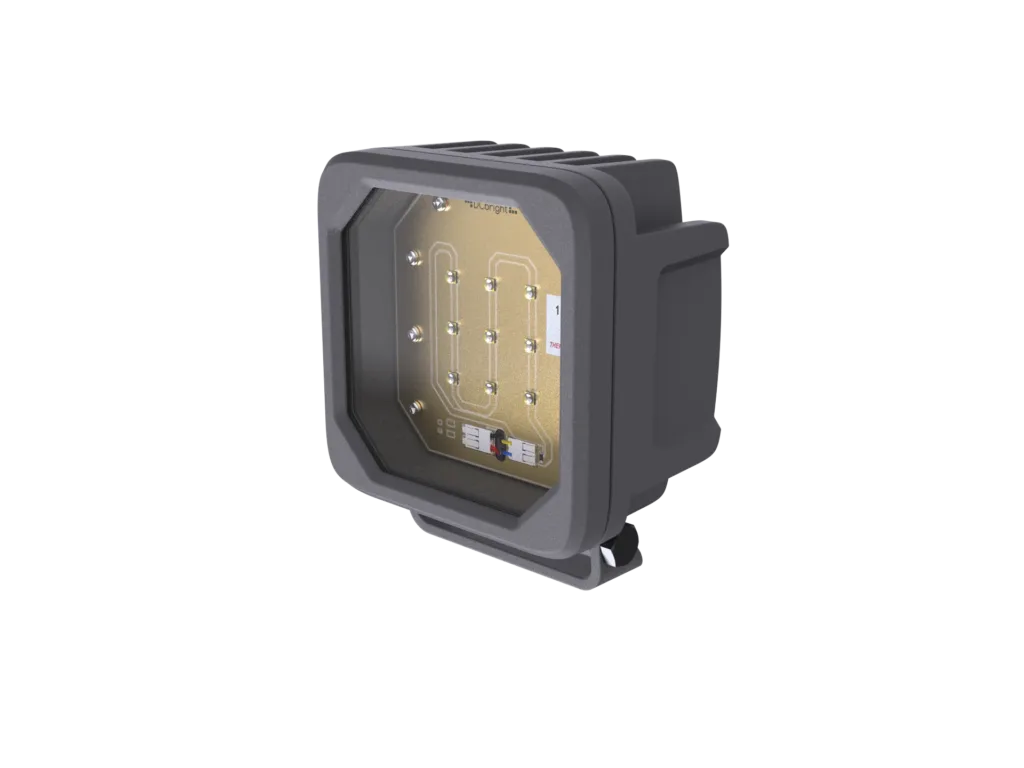
| Around the furnace | Radiant heat at the oven door, peaks up to +130 °C | Goby HT close to the oven, Snapper HT | Driver outside the hot zone, distance to the door opening |
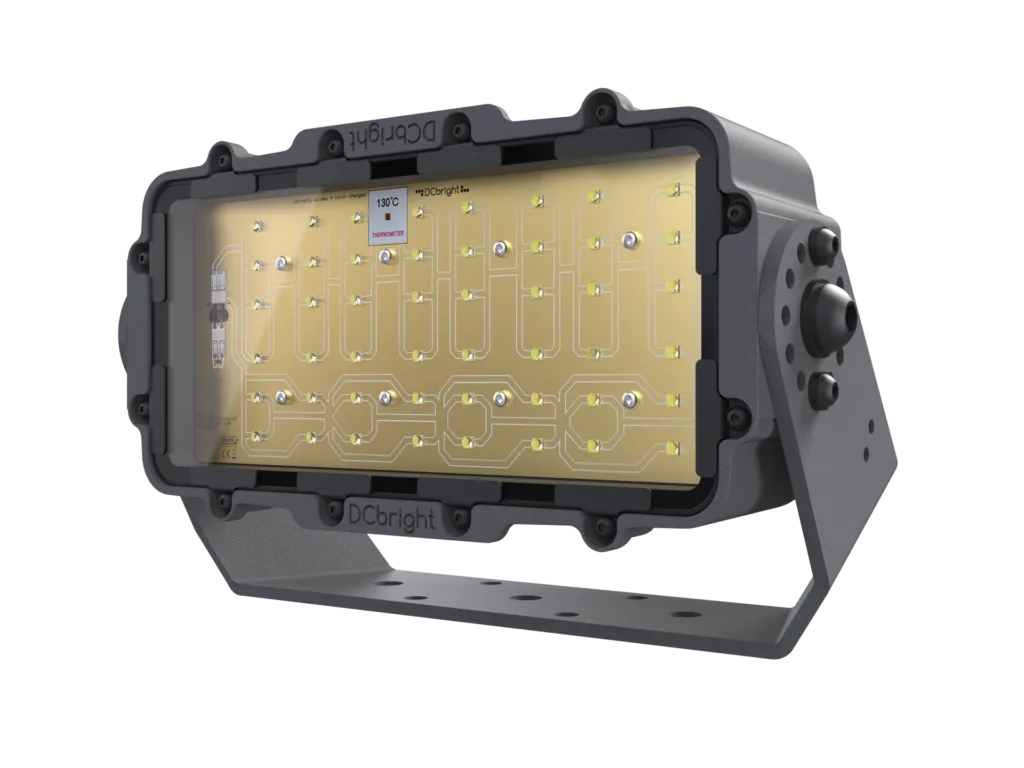
| In the foundry | Glowing metal, dust and vibration | Snapper HT, Barracuda HT, Orca HT for high positions | Glass instead of plastic, vibration-resistant mounting |
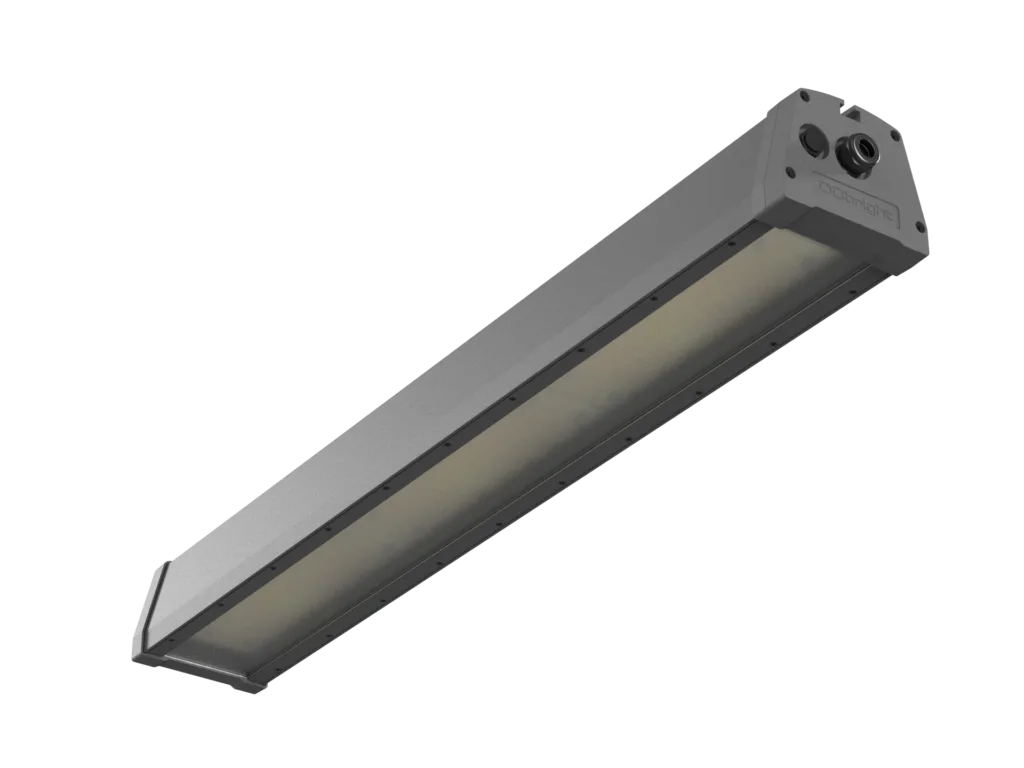
| In and above the dryer | Heat with vapour, moisture and grease | Linear HT in lines and tunnels, Manta HT on the ceiling, Snapper HT in 316L for food processing | Cleanability and sealing, IP69K for high-pressure cleaning |
In a foundry, the position determines which luminaire fits. Above the melting furnace the radiant heat is highest; that calls for high positions with the Orca HT or the Barracuda HT, with the driver outside the hot zone. During casting, spatter and smoke are added, so the luminaires hang at a distance and direct the light with HT glass optics. Above the cooling and shake-out line the temperature is lower, but dust and vibration remain; a more compact Snapper HT is often sufficient there.
Glass instead of plastic is a requirement in a foundry. Plastic lenses turn dull and brittle under radiant heat and lose their light transmission within a short time. Chemically toughened glass or borosilicate withstands this.
Not every position allows a surface-mounted luminaire. For furnace walls, feed-throughs and tight zones our engineers calculate per position what is possible: remote mounting, directed HT glass optics from outside the hot zone, or custom recessing.
Remote mounting is the first choice: the luminaire hangs outside the direct radiation and remains accessible for maintenance. Recessed mounting or a lead-through comes into play when there is no position outside the radiation that lights the work area properly, or when the light is needed inside a closed oven or tunnel.
And what hangs right next to the furnace reflects the radiation back: the gold-coloured IR reflector in the luminaire reflects 96 to 99.9 percent of the infrared radiation between 800 and 2500 nm.
See also engineering and custom solutions.
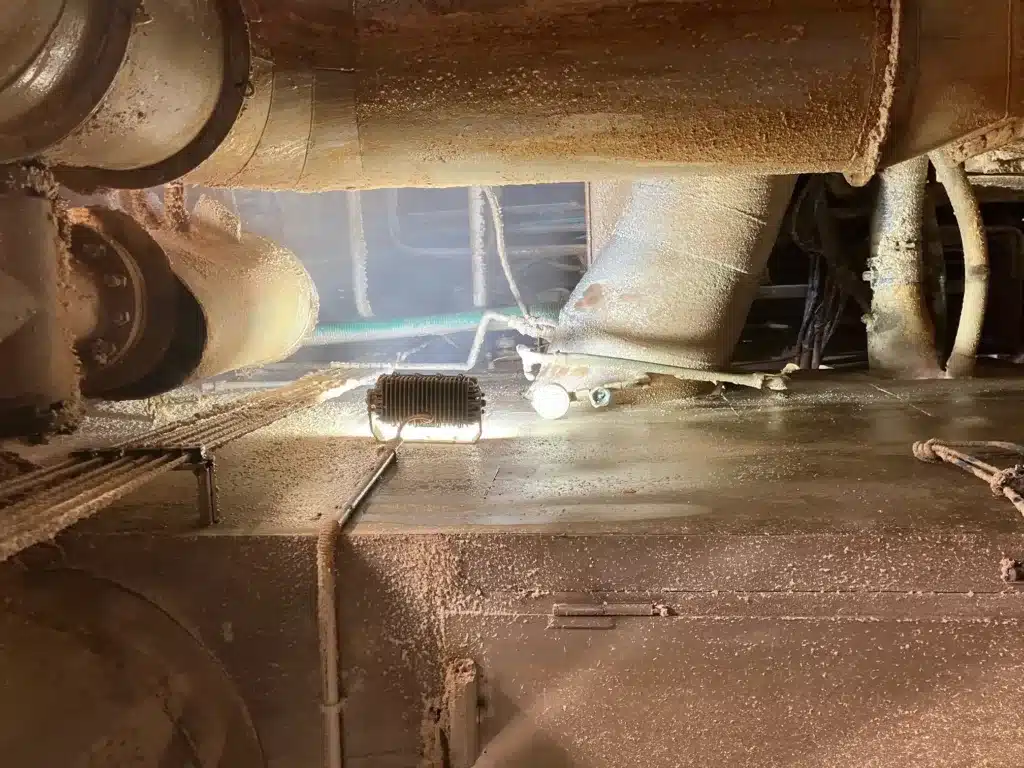
For high mounting positions in foundries and halls we use the Orca HT here: up to 65,000 lm, with HT glass optics of 20, 40 or 60 degrees.
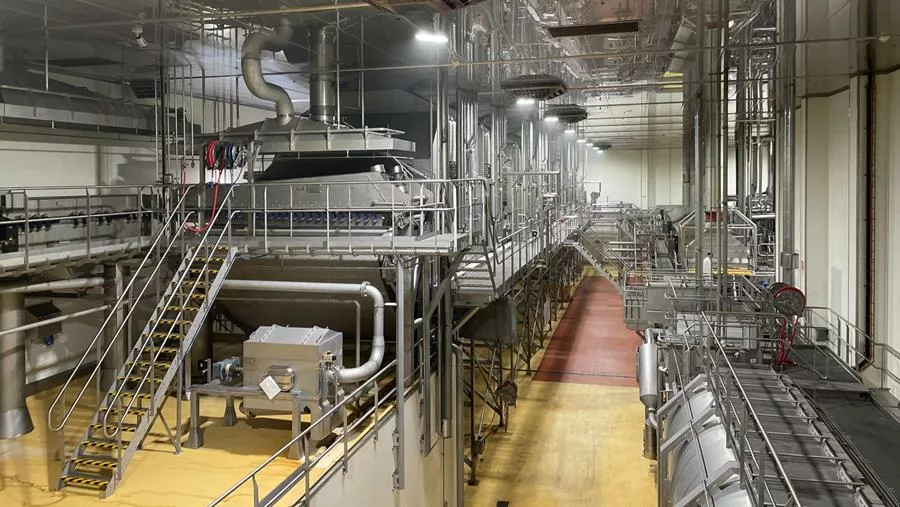
Frying and drying lines: continuous heat plus daily cleaning cycles, solved with 316L stainless steel versions and glass instead of plastic.
Result: 200 to 500 lux in the oven at 35 W per luminaire. Where previously one in three luminaires failed every six months, not a single one has failed to date.
Farm Frites is also the case study in the article on lighting for high and low temperature environments.

Stone wool production: heat and dust around the production lines and furnaces, with the driver outside the hot zone.
Result: more than 100 lux on the shop floor at an ambient temperature above 110 °C, in operation non-stop since April 2024.
Is your question not listed? Call 033 785 9809, you will speak with an engineer.
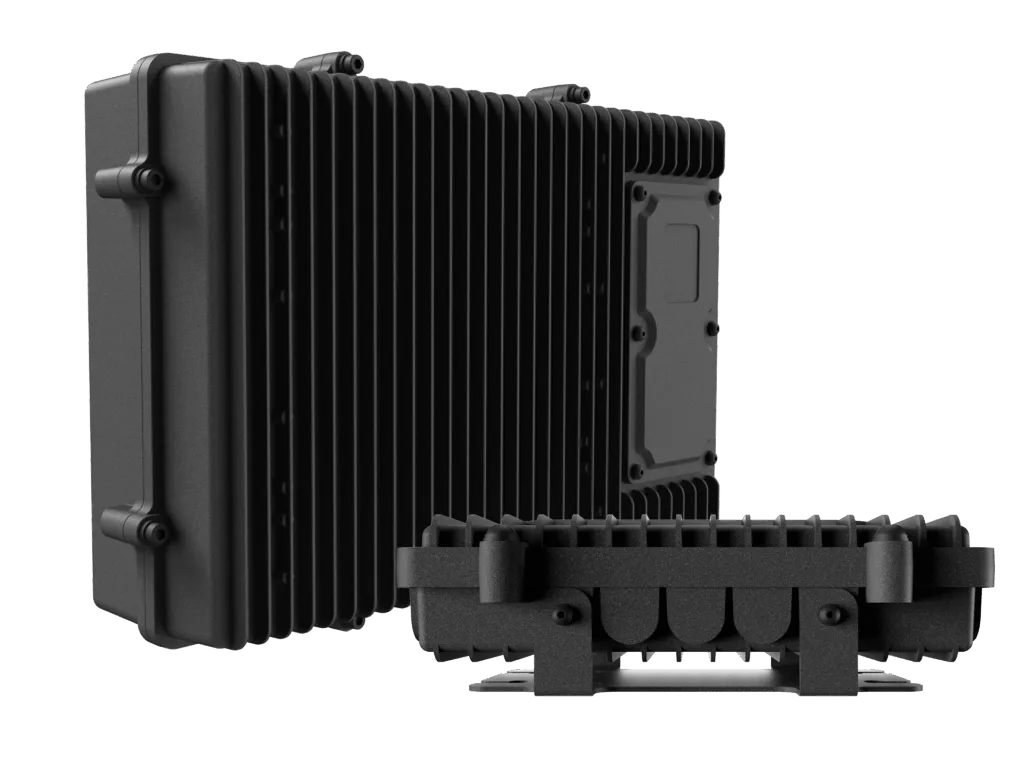
Luminaires designed as a system for heat: chemically hardened glass, heat-resistant housing, silicone cabling and the driver outside the hot zone. Our AC versions operate continuously up to +120 °C ambient temperature.
Nothing special: brief peaks up to +130 °C are permitted without consequences for the warranty. The luminaires are designed for exactly that profile of batch changes and doors opening.
Yes. The Snapper HT is available fully in 316L stainless steel and withstands, besides the heat, the daily high-pressure and steam cleaning and grease vapours of frying and drying lines. Proven at Farm Frites.
To be assessed per position. Our engineers calculate what is possible: custom recessing, feed-throughs, remote mounting or directed HT glass optics from outside the hot zone.
Foundries combine glowing metal, dust and vibration. Glass instead of plastic is a precondition there; the luminaire choice follows from the position, from the compact Goby HT to the Orca HT with glass optics for high positions.
HT versions carry a 5-year warranty on the complete luminaire for continuous operation up to +120 °C, with additional HT conditions. The Snapper CHEM-HT carries 3 years because of the aggressiveness of chemical environments. Above +130 °C it becomes custom work through engineering.
Measure at mounting height, not at floor level: warm air rises, and at the height where the luminaire hangs it is often considerably warmer than on the floor. With glowing product, also record the distance to the radiation source, because radiation heats the luminaire beyond the air temperature. On request, we carry out the measurement ourselves.
The cable between driver box and luminaire is supplied in 15 or 25 metres and can be extended, as long as the voltage drop stays below 2 V. For a 120 W HT luminaire that is 60 metres at 2.5 mm² and 381 metres at 16 mm².
Lighting of furnaces, foundries and dryers belongs to the sector heavy industry.
Furnace zones, foundries and dryers are core applications of our high temperature LED lights, with the driver outside the hot zone and a published lifespan curve.