

Eight DarkLicht versions from 4,800 to 307,800 lumens. No light above the horizon, no glare for local residents or traffic, and no stray light in the night sky.
A tilted floodlight always sends light next to and above the work zone. A full cut-off floodlight hangs horizontally and directs the light downward. That is the difference between a permit being issued and a complaint from the neighborhood: the same lux on the floor, without the surrounding nuisance.
Calculation in accordance with the NSVV code of conduct
Free lighting calculation
Response within 1 business day
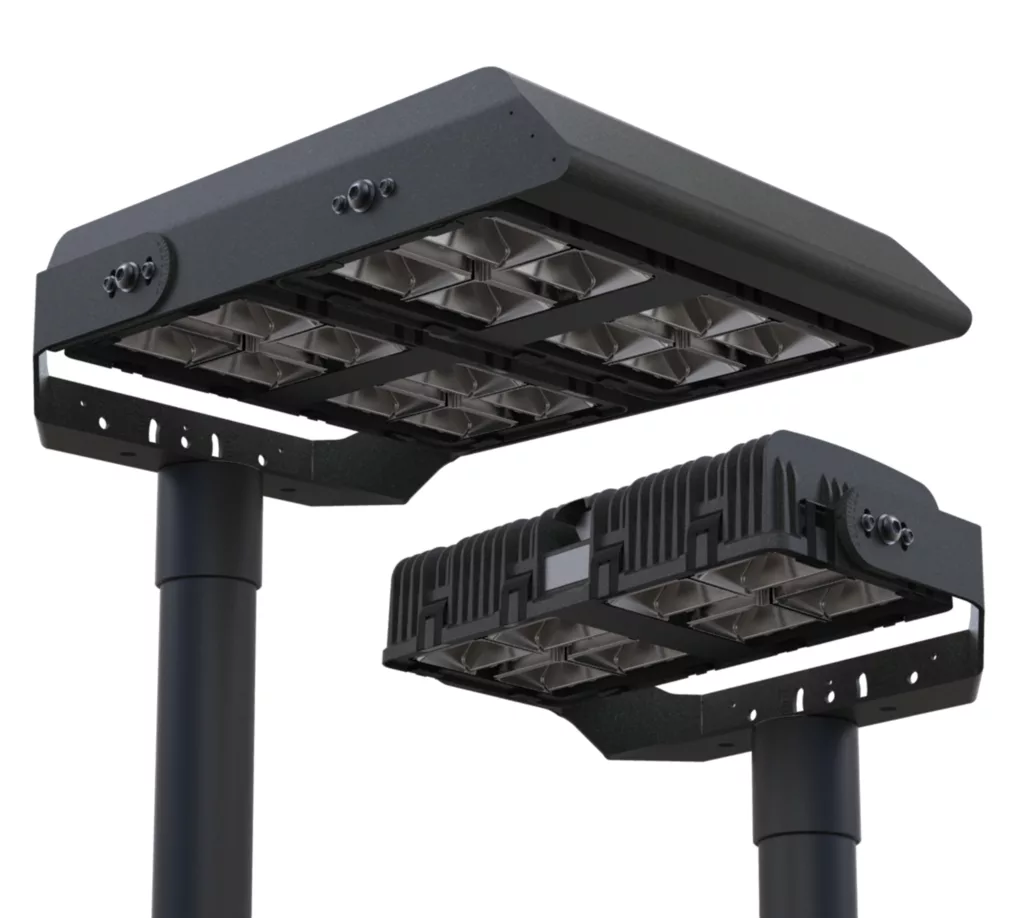
The flat design principle is: horizontally mounted, light strictly directed downwards
Highest output, DarkLicht Three
Full cut-off, all versions
Best efficiency, six of the eight versions
From machine position to high mast
The range extends from a machine work light to an 1,800-watt high-mast fixture, using the same optical principle. Choose below where the fixture will be installed; the full dimensions and weights can be found in the comparison below.
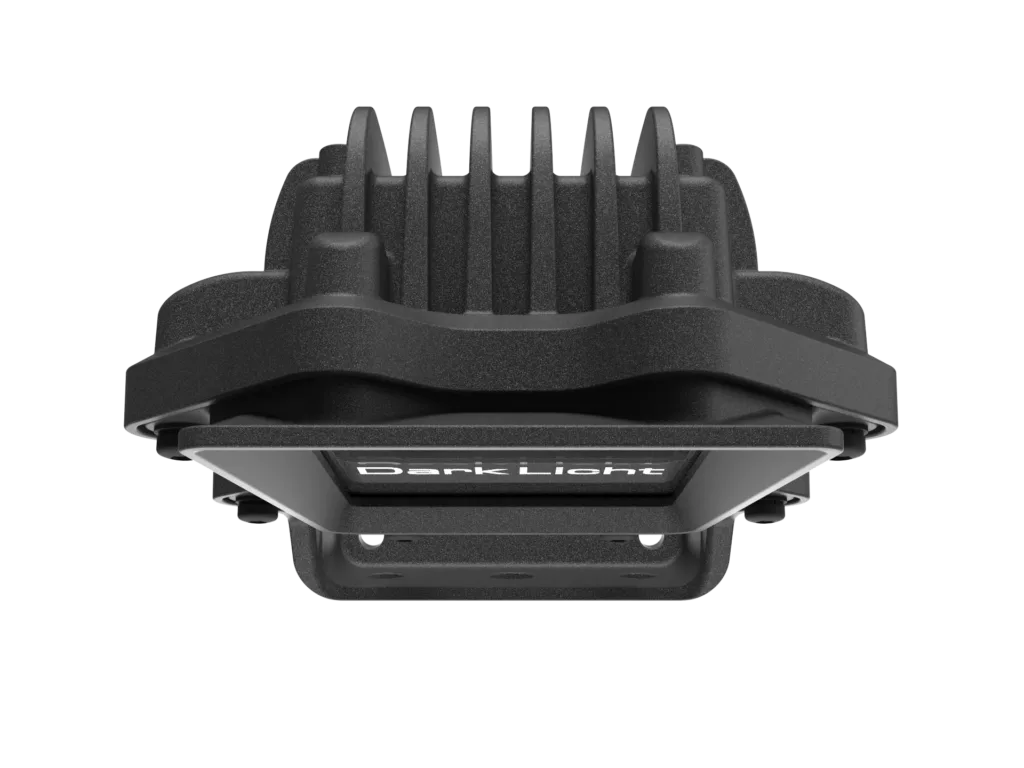
Machine or vehicle, glare-free
Glare-free work light for glare-sensitive positions on machines and vehicles.
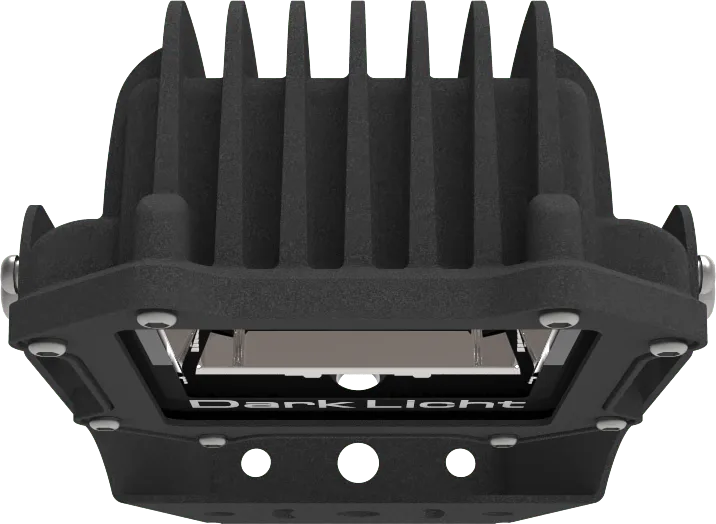
Work zones nearby, up to 12 meters
Glare-free work light for larger nearby work areas.
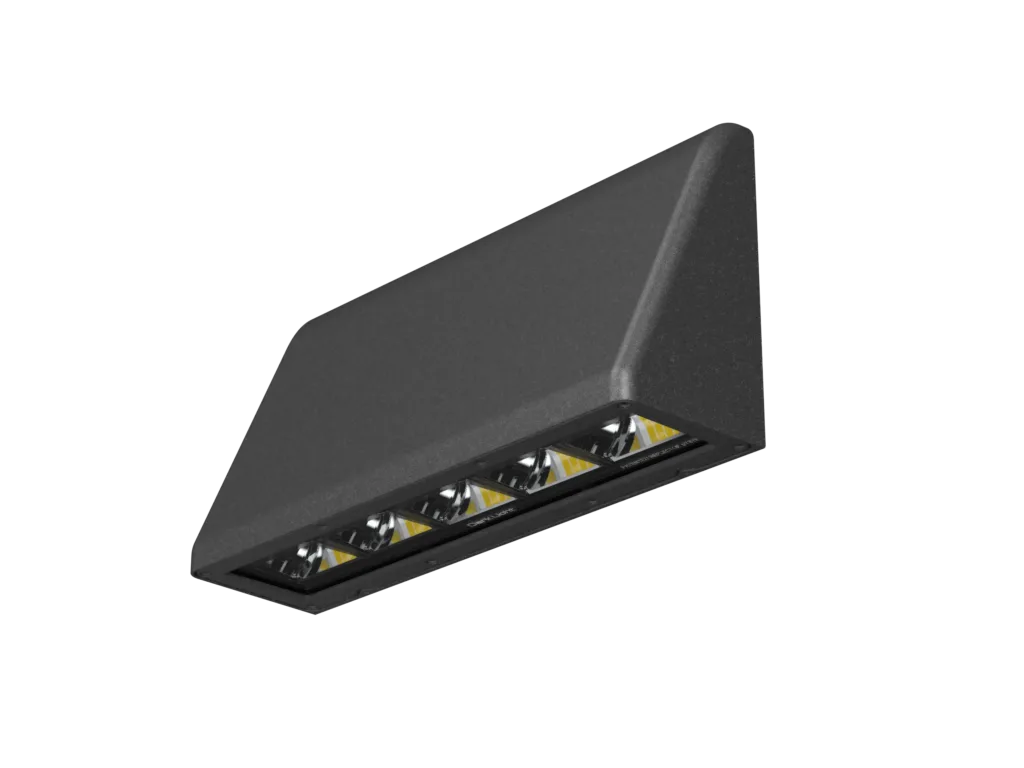
Wall and facade, walking routes
Facade luminaire that illuminates the facade and the pathway without affecting the surrounding area.
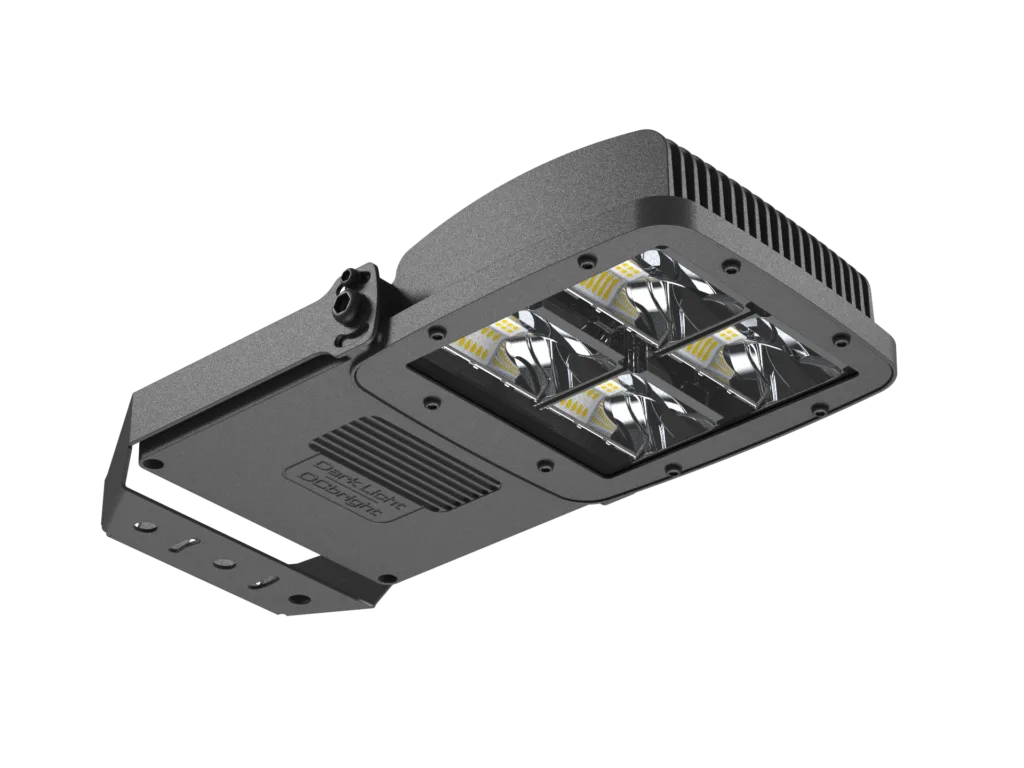
Mast up to 12 meters, site and loading zone
Site luminaire for low poles, loading and unloading zones, and parking lots.
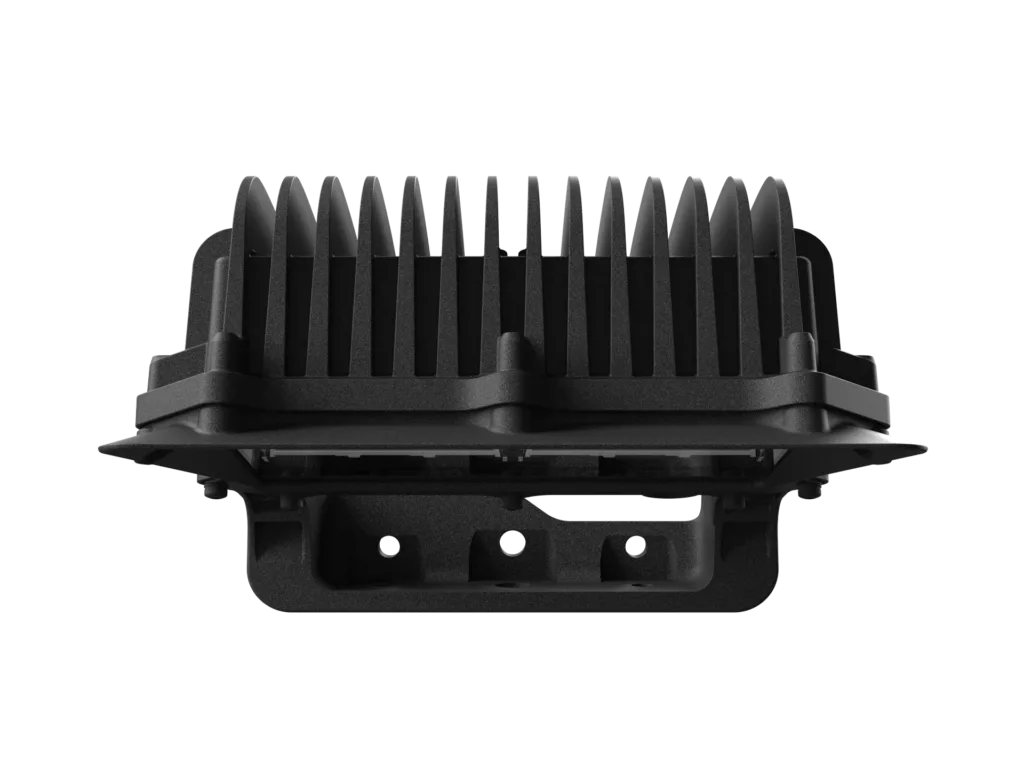
Mast 8 to 25 meters, wide sites
The most popular version for area lighting on mid-height masts.

Mast 12 to 25 meters, EXT version
High-output full cut-off floodlight without stray light beams.
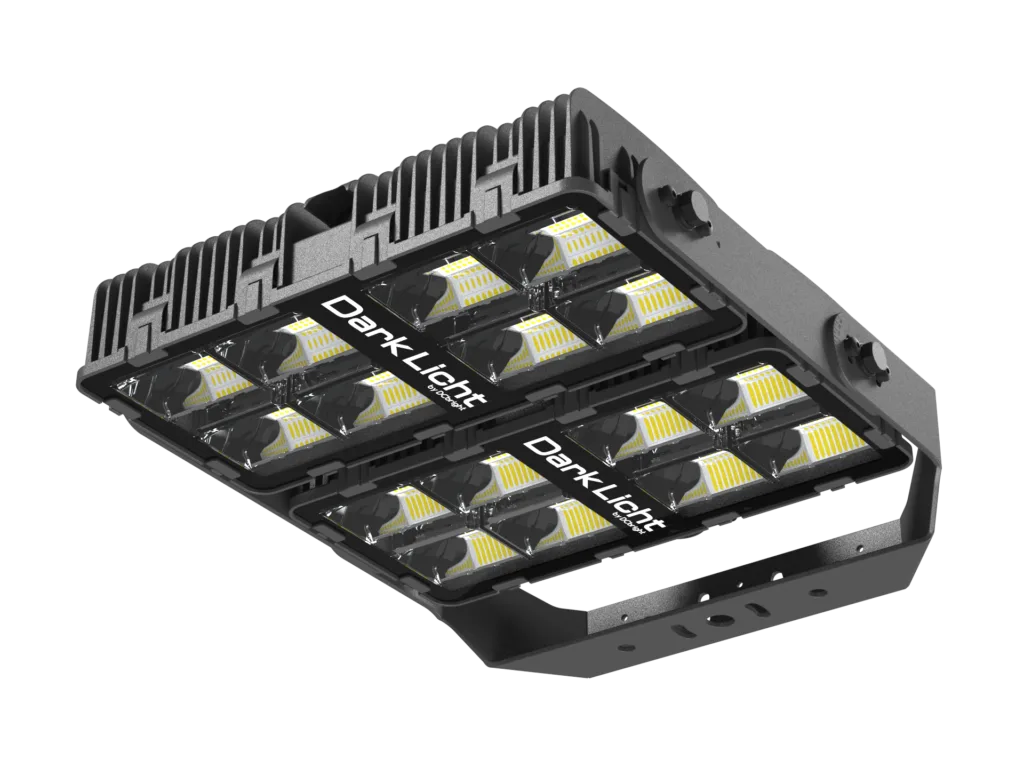
High mast, range and output combined
For high masts where range and output must come together.
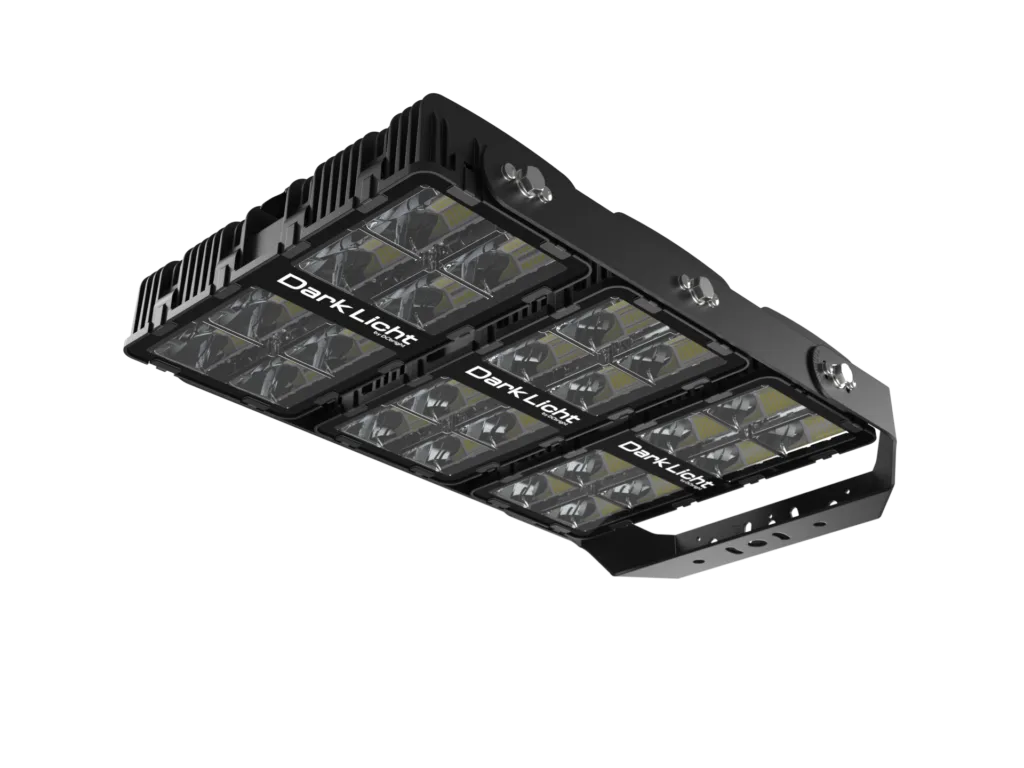
High mast, largest industrial zones
The heaviest full cut-off floodlight, for the largest industrial zones.
Wall and facade, walking routes
Facade luminaire that illuminates the facade and the pathway without affecting the surrounding area.
Machine or vehicle, glare-free
Glare-free work light for glare-sensitive positions on machines and vehicles.
Work zones nearby, up to 12 meters
Glare-free work light for larger nearby work areas.
Work zones nearby, up to 12 meters
Glare-free work light for larger nearby work areas.
Mast up to 12 meters, site and loading zone
Site luminaire for low poles, loading and unloading zones, and parking lots.
Mast 8 to 25 meters, wide sites
The most popular version for area lighting on mid-height masts.
Mast 8 to 25 meters, wide sites
The most popular version for area lighting on mid-height masts.
Mast 12 to 25 meters, EXT version
High-output full cut-off floodlight without stray light beams.
High mast, range and output combined
For high masts where range and output must come together.
High mast, largest industrial zones
The heaviest full cut-off floodlight, for the largest industrial zones.
The renders are all shown at the same size so that you can read the versions side by side. The actual dimensions vary widely, from 170 mm for the Mini to 905 mm for the Three; these are listed in the comparison table below. For the large versions, this dimension partly determines the wind load on the mast, and therefore the structural calculation.
Maximum values per version. The driver position for this series is a mounting decision: internal is easier to install, external keeps weight and heat away from the luminaire and allows ground-level maintenance.
| Version | Power | Luminous flux | lm/W | Dimensions | Weight | Driver | IP and IK |
|---|---|---|---|---|---|---|---|
| DarkLicht Mini | 30 W | 4,800 lm | 160 | 170 x 120 x 70 mm | 2.2 lbs | internal | IP69K / IK08 |
| DarkLicht S | 60 to 75 W | 12,825 lm | 171 | 260 x 200 x 130 mm | 3.3 kg | internal | IP69K / IK08 |
| DarkLicht Wallpack | 60 to 100 W | 16,000 lm | 160 | 340 x 180 x 100 mm | 4.0 kg | internal | IP69K / IK08 |
| DarkLicht D | 60 to 200 W | 34,200 lm | 171 | 440 to 540 x 270 x 110 mm | 6.9 to 8.5 kg | internal | IP66 and IP67 / IK08 |
| DarkLicht M | 150 to 300 W | 51,300 lm | 171 | 250 to 370 x 230 x 150 mm | 3.6 to 5.5 kg | internal or external | IP69K / IK08 |
| DarkLicht One | 320 to 600 W | 102,600 lm | 171 | 365 x 550 x 160 mm | 14.0 to 15.0 kg | external | IP66 and IP67 / IK07 |
| DarkLicht Two | 800 to 1,200 W | 205,200 lm | 171 | 635 x 550 x 160 mm | 24.8 kg | external | IP66 and IP67 / IK07 |
| DarkLicht Three | 1,800 W | 307,800 lm | 171 | 905 x 550 x 160 mm | 35.0 kg | external | IP66 and IP67 / IK07 |
The DarkLicht Mini, S and M are also featured on the work light and floodlight pages: they are used in both roles. The One, Two and Three are EXT versions with an external driver, intended for masts where maintenance at height must be avoided.
A floodlight must be tilted to create reach, and thereby inevitably sends light above the horizon. A full cut-off floodlight hangs flat and achieves its reach with optics instead of the tilt angle. The light that you would otherwise lose in the sky is here on the floor.
Where a permit or the NSVV Light Pollution Guideline sets limits on glare and sky glow, full cut-off is often the only design that meets those requirements. We provide the light calculation that allows you to demonstrate compliance, in accordance with the NSVV Code of Conduct, including the expected values for each measurement point.
An operator looking into a light source loses contrast and sees less, no matter how much lux is on the floor. By keeping the source out of the field of view, usable vision increases at equal or lower output. That is a safety argument, not a comfort argument.
Light above the horizon
0 %
Forward throw cut-off
75, 72, 69, 66 and 63 degrees
Color temperatures
6500K, 4000K, 2700K
Control
switching, dimming, night mode
For a permitting process or an environmental complaint, it starts with the calculation, not the fixture. See light pollution and glare.
Full cut-off is not always the answer. Three situations in which we advise otherwise.
You do not illuminate a crane jib, a silo, a facade, or a ship's hull with a luminaire that only shines downwards. For that, an angled floodlight is the right choice.
The DarkLicht series is rated IK08, while the One, Two, and Three series are rated IK07. Where a grapple, a rock, or a cleaning lance might strike the fixture, the IK10 line of DCbright fixtures is the better choice.
The HT line up to +120 °C and the all-stainless-steel versions are in the DCbright program, not in the DarkLicht series.
The fact that the luminaire emits no light above the horizontal axis. The light that a tilted floodlight sends into the sky, which returns as skyglow and glare, does not exist with this design. The beam is created using the optics rather than the tilt angle of the luminaire.
No, in practice often more at the same power level. The light that disappears next to and above the zone with a tilted fixture remains within the zone here. What you do sacrifice is reach in the distance: for illuminating a distant facade or a crane boom, a directional floodlight is more suitable.
Yes, and that is the most common reason. We provide a lighting calculation in accordance with the NSVV code of conduct with the values at the sensitive points in the surrounding area, not just in the work zone. That is the document with which you demonstrate that you remain within the set limits.
With an internal driver, everything is in a single fixture: easier to install and less cabling. With an EXT version, the driver is in a separate box, usually at the base of the pole or on a platform. This keeps weight and heat away from the fixture and makes maintenance on the driver possible without a climbing crew. Starting with the One, external is the standard.
As a guideline: Mini and S up to approximately 8 meters, D and M from 8 to 25 meters, One from 12 meters, Two and Three on high masts above 25 meters. It is not a hard limit: the site dimensions and desired uniformity also determine the number of luminaires and the height.
No, and we’d rather say that now than later. The DarkLicht series is rated IK08, and the One, Two, and Three are rated IK07; the heavy-duty DCbright line meets IK10. Where a grab, a brick, or a cleaning lance might strike the fixture, the Barracuda or the Orca is the better choice. On poles and building facades, IK08 poses no practical limitation.
Yes. For sites with neighbors who are sensitive to noise, a night mode is often the simplest way to comply with a permit condition: full output during operations, reduced output at other times. We tailor the control system to each project, including integration with an existing control system.
Not available in the DarkLicht series. The HT line, rated up to +120 °C, and the all-316L stainless steel versions are part of the DCbright program. If noise reduction is required in conjunction with heat or continuous salt exposure, we assess on a case-by-case basis which of the two requirements determines the design.
That depends on the existing poles and the power supply. In many cases, the luminaire can use the existing pole and the existing power supply scheme, and the benefits lie in power savings and the elimination of glare. We calculate the setup and energy consumption before you make a decision.
Five years on all fixtures under heavy industrial use. Extended warranties are available for projects. No periodic maintenance is required; for the EXT models, the driver is the only component that may require service over time, and it is intentionally designed to be easily accessible.
For a light-sensitive location, we calculate two things: the illuminance in the work zone and the levels at the sensitive points surrounding it, such as homes, a road, or a nature area. That second calculation is what you’ll need for a permitting process or in the event of a complaint.
Your request is being reviewed by an engineer. We will respond within 1 business day.

Calculation
Work zone and sensitive areas
In accordance with
NSVV Code of Practice for Light Calculations
Warranty
5 years
Response within 1 business day
No obligation
In accordance with the NSVV Code of Conduct