

A floodlight that is fixed to a lattice boom does exactly what the boom does: it swings along. The Crane Light Stabilizer suspends the floodlight in such a way that it maintains its own position while the boom moves, adjustable to the movement and shock you actually expect.
Spring-loaded, mechanical, no hydraulics or electronics
Damping level adjustable on the valve
Assembly without welding on the boom
For Shark, Barracuda and Orca, AC and DC
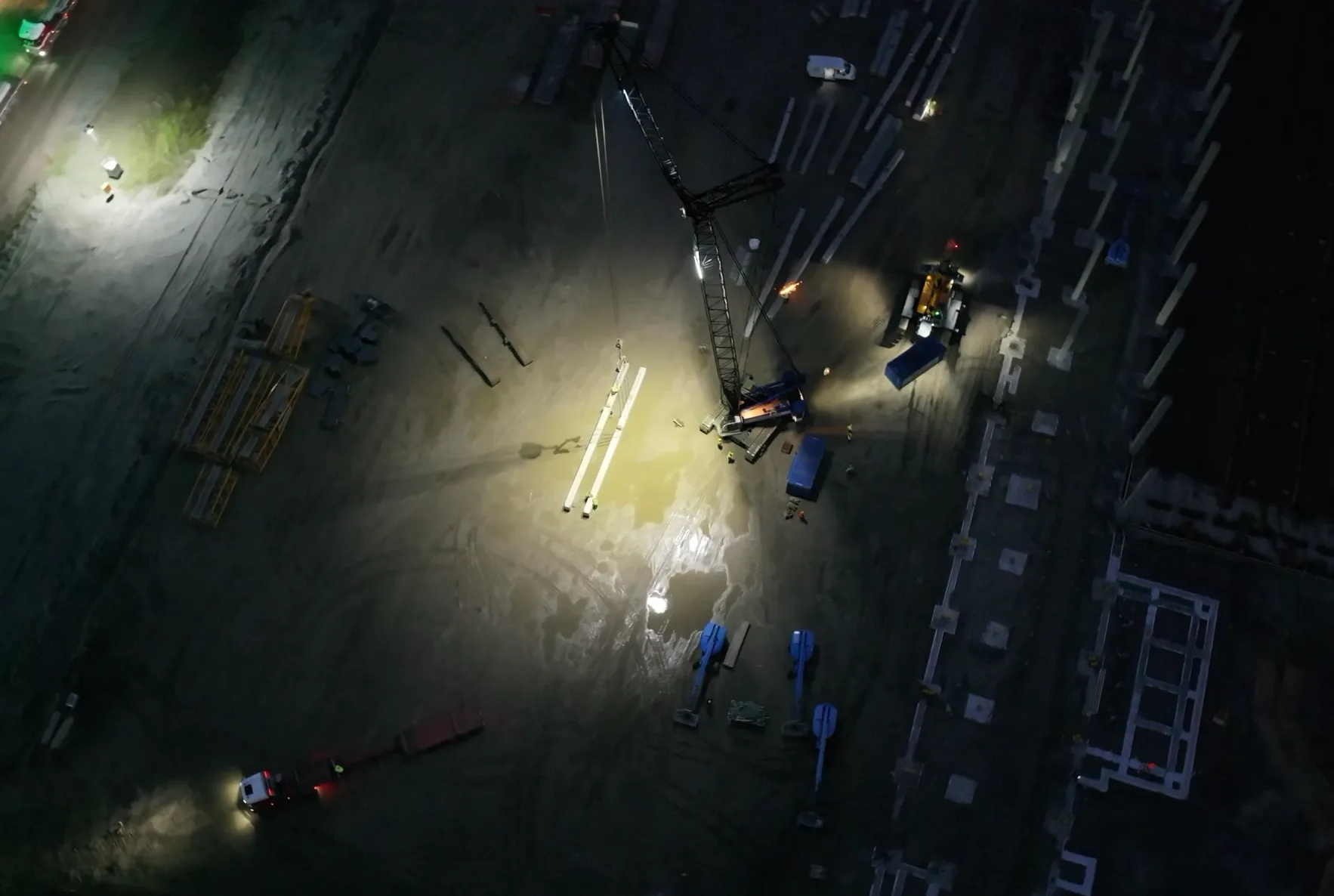
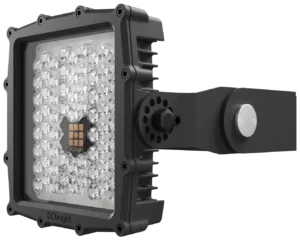
The system
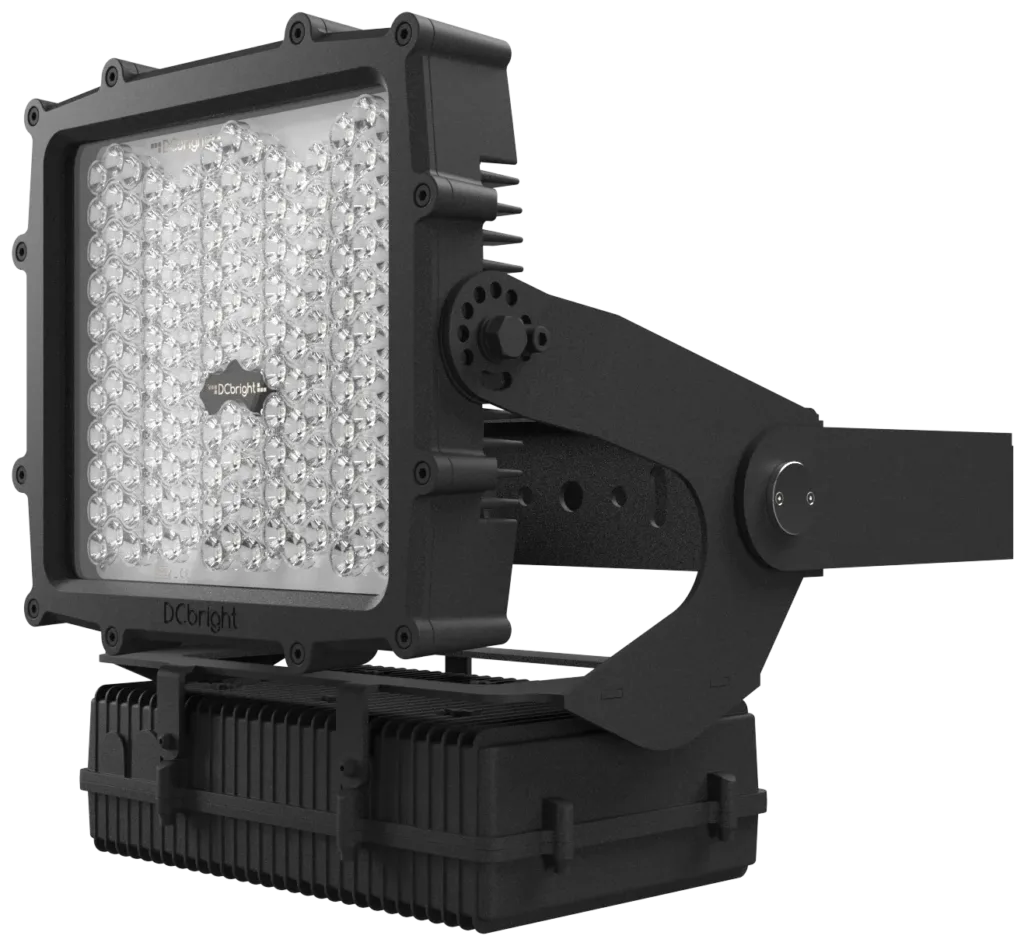
Shark in the Crane Light Stabilizer
On a fixed structure, you aim a floodlight once and then it is set correctly. On a crane boom, everything is constantly changing: the angle, the height, the slewing direction, the load. Four things go wrong as a result, and you do not solve any of them with a better lamp. They recur on every type of crane; see crane lighting for the overview per machine.
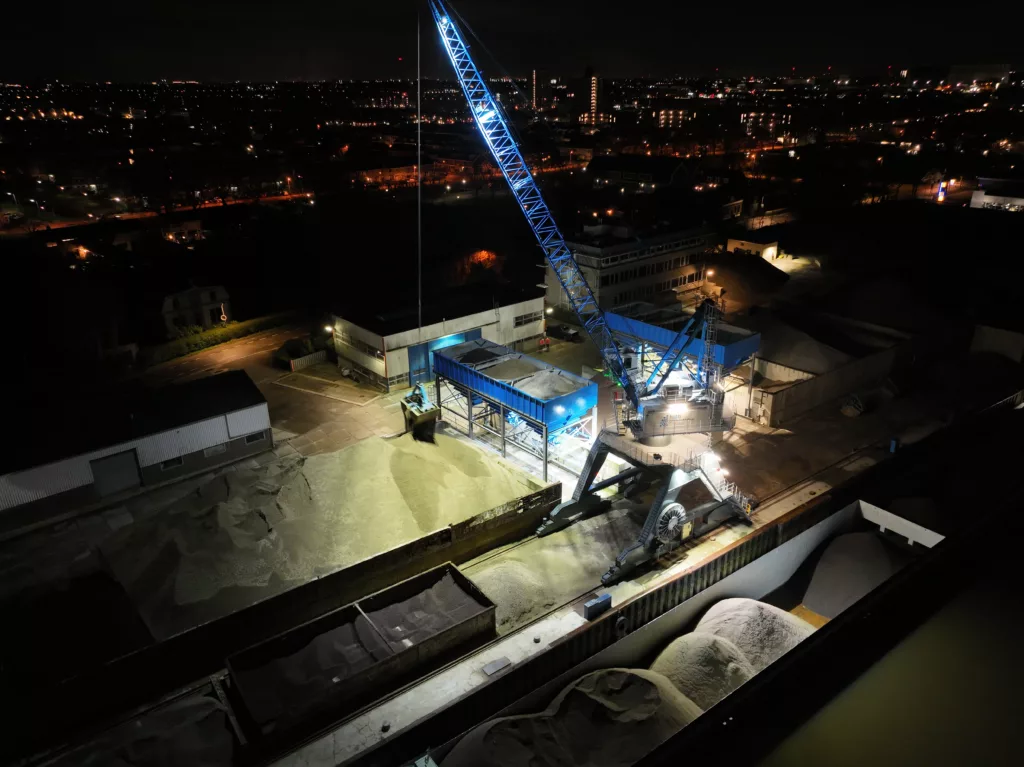
PLM harbor crane in Capelle, illuminated at night from the boom.

Adrighem port area, aerial photo of the illuminated storage yard under the crane.
The boom moves, so the beam moves. Precisely during picking up and setting down, the light moves away from the load. The further the lamp is from the pivot point, the greater the deflection.
Sooner or later, a swinging load ends up in the cabin or in the rigger's eyes. That costs visibility at the critical moment, and it is a recurring topic in HSE meetings.
A diesel engine, a load that kicks in, a grab biting into bulk material: it all ends up in the mounting. A rigid bracket transmits that shock directly to the housing.
Welding to a certified boom section is not an option for most crane owners. What you mount must work with what is already there: existing holes, existing profiles, clamps.
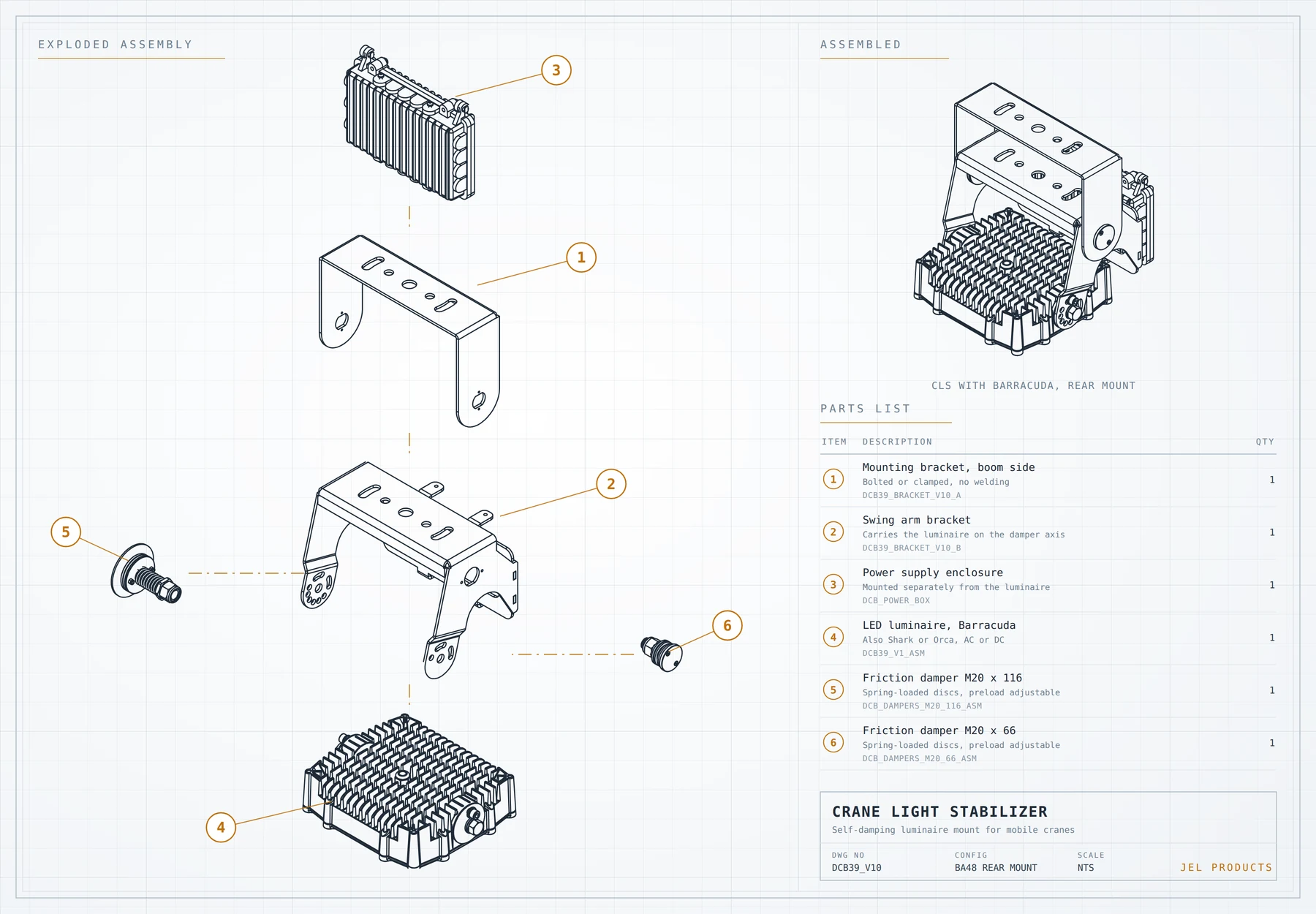
The CLS is deliberately mechanical. A spring presses two discs together; that friction determines how much force is required to move the luminaire out of its position. Below that set point, the luminaire maintains its direction while the boom moves. Above that point, in the event of a sudden shock, the joint yields rather than transmitting it to the housing.
There is no hydraulics, no gas spring, and no electronics in the bracket. That is a design choice: fewer parts that can break. An oil-damped construction is more expensive, more sensitive to leakage and temperature, and requires maintenance that simply does not happen on a crane in the field. Two discs and a spring are included in the crane's maintenance interval, using tools that are already in the workshop.


Two things are adjustable, and you set them on the crane itself.
Adjusting the spring tighter or looser determines how much movement the luminaire allows. A bulk crane with a grab requires a tighter setting than a crawler crane lifting on a construction site.
The output angle at which the spotlight is suspended depends on the luminaire type and where you want the light. This is done in fixed steps.
The adjustment takes place during commissioning and can subsequently be readjusted by your own technical department. No special tools are required.
Not every crane moves in the same way. The shocks that a grab crane produces never occur on a tower crane. We therefore set the bracket to three levels. During an advisory request, we determine together with you which of the three belongs to your operation.

Grab transfer, scrap handling, floating bulk cranes. Continuous movement, hard impact during closing and discharging, high vibration in the structure. Tightest spring setting.
Harbour cranes and floating cranes in bulk handling, scrap cranes.

Regular, predictable cycles with substantial masses, without the impacts of grab work. On a lifting vessel, the vessel motion is continuously superimposed on that.
Mobile harbor cranes, container cranes, cranes on offshore lifting vessels and heavy transport ships.
Mobile lattice boom cranes and crawler cranes in construction and infrastructure, and luffing jib tower cranes. Long, smooth movements and minimal shock: it is all about holding direction. You can read more about this application at lighting for construction and infrastructure.
Crawler cranes on construction sites, mobile lattice boom cranes, luffing jib tower cranes.
The bracket has been developed for booms that move and that you may not modify. In practice, it ends up on five types of cranes.
The largest group. Many attachment points, few flat surfaces, and a boom length that varies per project. The CLS is fitted to each crane and moves with luffing and slewing: the luminaire position is maintained, so after slewing no one has to go out onto the boom to re-aim the light.
High rotational speeds, continuous operation, and a salt load that eats most brackets within a few years. This is where damping and corrosion resistance come together.
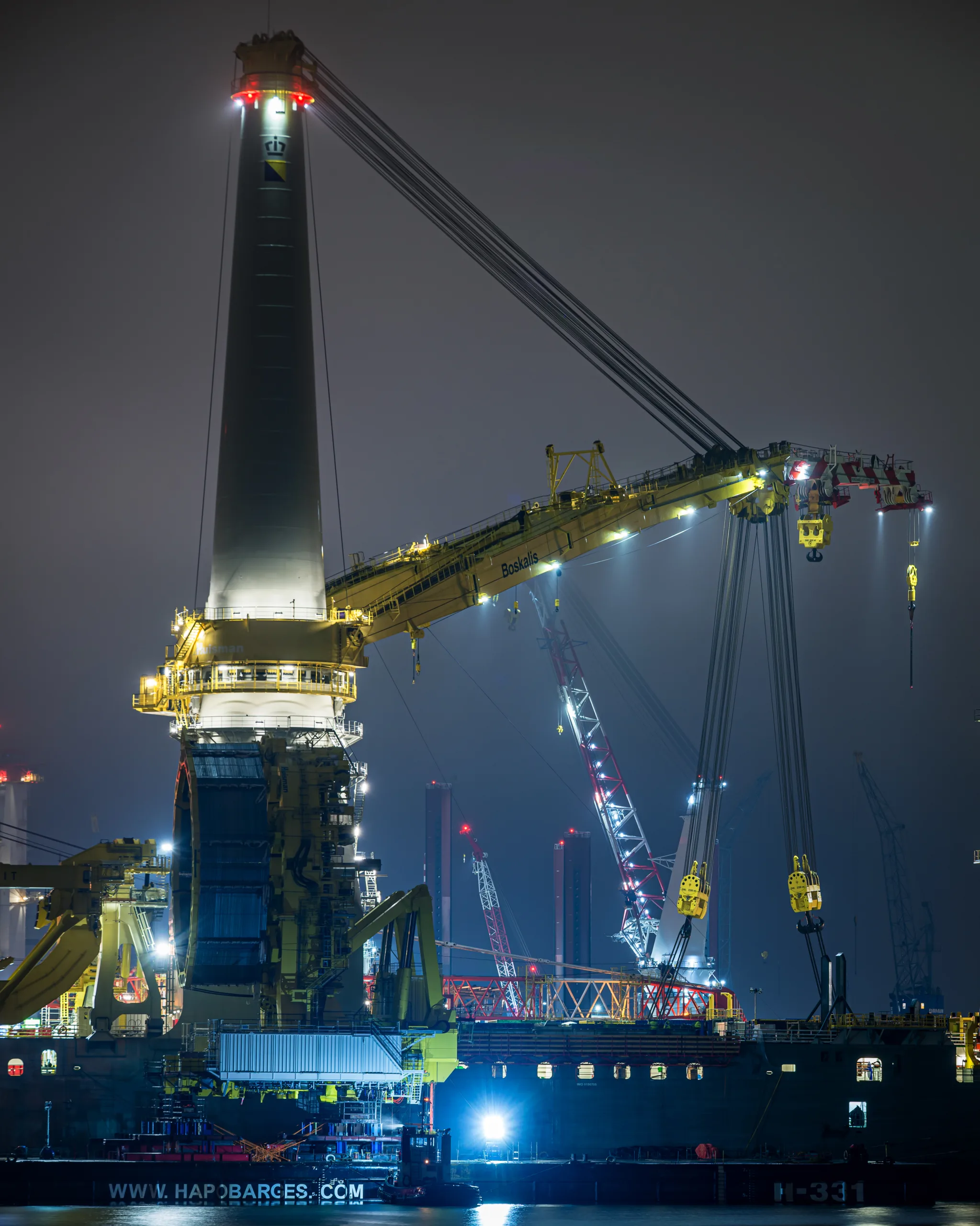
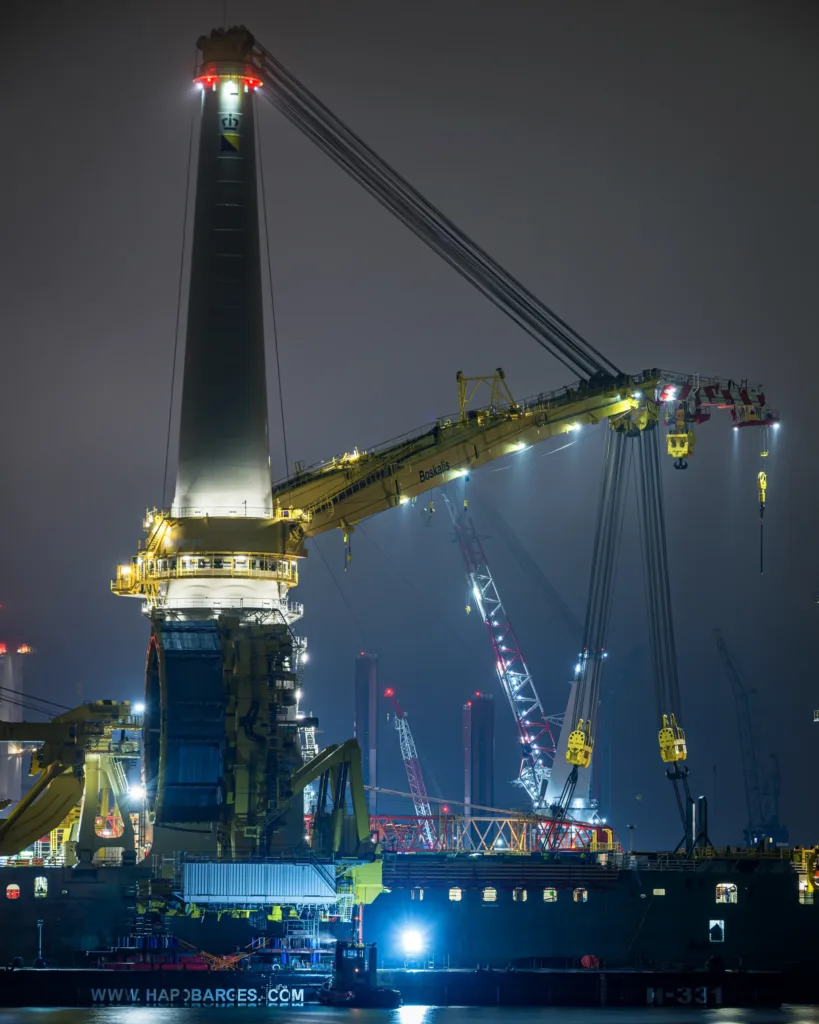
On a crane ship, not only does the boom move, but so does the deck. Fixed lighting will be pointing in the wrong direction within a minute. Here, too, we recommend coated aluminum: every kilogram at the end of a boom counts. The full 316L version is available when a classification society requirement calls for it. See how that worked out on the marine LED lighting on the Boskalis Bokalift 2.
Grab work in dry bulk and scrap metal. Heaviest damping class, and the application area in which the difference between a rigid and a stabilized mounting becomes visible most quickly in the number of failures. See also lighting for the harbor crane.
Limited space, significant height, and a strict requirement not to blind nearby residents. The lowest glare class is sufficient; the benefit lies in directing the beam and keeping it focused. The JEL applies that same principle to the Liebherr tower crane fleet at Van der Spek.
The CLS is the bracket. If you are looking for tiltable modules, driver box, and in-cab control, that would be the Crane Light Director. Also on mobile machines and equipment Generally speaking.
The CLS is available for three luminaires from our range. Which one you choose depends on the distance you need to bridge and the crane's electrical system. Each bracket version is designed for the luminaire it holds: the load capacity is the weight of that luminaire plus a 25 percent margin, and the spring characteristic is adjusted accordingly.


| Specification | Shark | Barracuda | Orca |
|---|---|---|---|
| Luminous flux | up to 50,000 lm | 44,100 lm AC / 40,800 lm DC | 111,300 lm AC / 100,200 lm DC |
| Power | 320 W | 240 or 320 W | 800 W |
| AC Spanning | 90 to 305 V / 180 to 528 V | 90 to 305 V / 180 to 528 V | 180 to 528 V |
| Spanning DC | 20 to 35 V / 35 to 60 V | 20 to 35 V | 35 to 65 V, nominal 48 V |
| Weight | 9.2 kg | 10.1 kg, Stainless steel 16.0 kg | 22.7 kg, stainless steel 36.3 kg |
| Dimensions | 335 × 350 × 90 mm | 320 × 290 × 90 mm | 515 × 440 × 95 mm |
| IP and IK | IP69K / IK10 | IP69K / IK10 | IP69K / IK10 |
| Service life | L90B05, 360,000 hours | L90B05, 360,000 hours | L90B05, 360,000 hours |
| What for | the standard choice on a lattice boom, also on 48 V on-board power systems | compact and light, where weight on the boom counts | maximum distance and area, heavy harbour cranes |
Standard one luminaire per bracket. Versions with multiple luminaires are made by us upon request.
There is no universal CLS with adapter plates. Every version is calculated for the weight and shape of the luminaire hanging in it. That is precisely the reason why the bracket is never sold separately.
Welding to a certified boom section is out of the question for almost every crane owner. Therefore, the CLS is designed in such a way that nothing needs to be changed in the structure.
In most cases we use existing holes in the boom or existing mounting points. Where those are not present, we mount with a clamping system around the profile. Which of the two it will be depends on the crane: this is custom work by definition, and therefore we always ask for the brand, model, and boom section when receiving an inquiry.
We set up the cable routing in the same way: routed along existing routes, or with a cable reel when the boom length varies. We also determine that per crane.
Make and type of crane, boom length and boom section, the on-board voltage, and a few photos of the intended mounting location. Initially, nothing more is needed.


Above: Shark in the bracket under the boom of a Liebherr LR 1160.
Subject: mounted in the lattice boom, cable routed along existing paths.
The bracket is made of standard aluminum with the same titanium-based industrial coating as our luminaires, qualified for C5 Maritime: the class for salt spray, alternating humidity, and chemical exposure.
That is also our recommendation, and not just because of the corrosion resistance. Everything that hangs at the end of a boom counts double: weight in that location acts on the structure, on the lifting capacity, and on the bracket itself. Coated aluminum provides the same protection at a fraction of the weight of stainless steel.
If your classroom desk, client, or your own material policy requires fully stainless steel, we can supply the bracket in 316L. That is an option for specific environments; the standard version is sufficient in most cases.
In a moving part, corrosion is a more critical issue than in a fixed housing: where the discs and the spring are located, material degradation must not lead to seizing or to a degree of damping that changes spontaneously. The choice of materials has been tailored to prevent this.
The CLS has been tested in-house up to 10 g shock load.
Wind load testing has not been performed. In practice, this does not become an issue: the fixtures are heavy enough not to be moved by the wind, and should it happen anyway, it can be resolved by tightening the spring. We do not claim a wind load figure that we have not measured.
Aluminum with titanium-based coating
C5 Marine qualified
Recommended, due to weight on the boom
316L stainless steel, solid
For class requirement or material policy
No standard upgrade
The bracket comes with a five-year warranty, the same as our luminaires. The discs do not, and that is intentional: those are wearing parts. They do their job through friction, so they wear out through use.
Depending on the intensity, you replace the disc set every one to two years. We supply these as spare parts from stock. The replacement can be done by your own technical service during regular crane maintenance; it is not work for which we need to come.
We prefer to say this in advance rather than afterwards. A bracket called „maintenance-free” that allows more movement than intended after a year and a half leads to an argument nobody wants to have.
| Delivery | From stock |
| Interval | 1 to 2 years, depending on use |
| How | your own technical service |
| Warranty bracket | 5 years |
The Crane Light Stabilizer is used by companies that operate their equipment daily and under all conditions. The focus is on retrofits: in virtually all cases, these were existing cranes on which the factory-installed lighting was inadequate—either providing too little light or failing to stay where it was needed. An example of such a retrofit is the ring crane lighting on the Mammoet PTC-210-DS.



A stabilized bracket keeps the beam steady; the optics determine where that beam ends up. On a crane boom, that is a trade-off between distance and width: the higher the light is mounted and the further the load, the narrower the beam can be. We determine this during the request based on boom length, mounting height, and the area you want to illuminate.

Long distance, 50 to 300 m. The choice for long booms and high mounting points.

Medium range, 30 to 100 m. The most commonly used optics on mobile cranes.

Up to 150 m, broadly spread out. For a working area that is wider than it is deep, such as a quay.

Short distance, 15 to 60 m. For the immediate work area around the load.
| Working principle | Spring-loaded disc system, fully mechanical |
| Adjustable | Damping degree via spring tension; luminaire position in steps |
| Damping classes | Heavy, medium and light |
| Luminaires | Shark, Barracuda, Orca, AC, and DC |
| Number of luminaires | 1 standard, more upon request |
| Standard material | Aluminum with titanium-based coating, C5 Maritime |
| Optional material | 316L stainless steel, solid |
| Load capacity | Weight of the assembled luminaire, plus a 25 percent margin |
| Mounting | Existing mounting holes or clamping system, no welding |
| Cable routing | Customized per crane, cable reel available |
| Shock resistance | Tested up to 10 g |
| Wind load | Not tested, to be absorbed via spring tension |
| Weight | Depending on the version |
| Dimensions | Depending on the version |
| Certification | CE, Machinery Directive |
| Warranty | 5 years on the braces, discs are wear parts |
| Lead time | From stock, all versions |
The datasheet is a direct download, without a form. To receive a 3D and IES file, we do ask about your situation.
Is your question not listed? Call Lucas de Graaf directly.
The bracket is brand-independent, but the installation is not. We determine per crane whether we can use existing mounting holes or if a clamp version is required. For this, we need the brand, model, and boom section, plus a few photos of the intended mounting location.
No. The CLS is mounted on existing mounting points or with a clamping system. Nothing changes to the construction of the boom.
The Crane Light Stabilizer is the bracket that keeps the floodlight stable. The Crane Light Director is the complete system surrounding it: tiltable modules, driver box, and in-cab control. The CLS is available separately, the CLD is not.
No. The adjustment of spring tension and position depends on the weight and shape of the luminaire. That is why we always supply the bracket in combination with a Shark, Barracuda, or Orca.
The discs are wearing parts and are replaced every one to two years, depending on the intensity of use. The set is available from stock as a spare part and can be installed by your own technical department during regular crane maintenance.
The bracket itself is mechanical and does not require a power supply. The luminaires are available in AC and DC versions. The Shark is available for both 24 V and 48 V vehicle electrical systems (20 to 35 and 35 to 60 VDC), the Orca for 48 V (35 to 65 VDC), and the Barracuda for 24 V (20 to 35 VDC). If your crane operates on line voltage, all three are also available in AC versions.
The standard version is aluminum with a titanium-based coating, qualified for C5 Maritime. For virtually all port and offshore applications, that is the best choice because it is significantly lighter than stainless steel, and weight at the end of a boom is a heavy factor. Should your classification society or material policy require stainless steel, we can supply the bracket entirely in 316L.
Yes. The spring tension is adjustable without special tools. If the type of work you do with the crane changes, you adjust the bracket accordingly.
All versions are available from stock. In practice, the lead time is determined by scheduling the installation; delivery is from stock.
Both spellings occur. We use Crane Light Stabilizer, abbreviated as CLS. In previous documentation, the part also appeared as Crane Light Stabilizer or self-centering mounting bracket.
The Crane Light Stabilizer is made for the lattice boom. Other crane types need their own setup; if you light several, we match the luminaires to each other.
The Crane Light Stabilizer belongs to the sector mobile machines and equipment. On board workboats, he sits on the crane fittings, see Deck and ship lighting.
Lighting from the jib of a self-erecting crane, using the DarkLicht crane frame for fully shielded light.
Four fixed sets, from Dual to Five, for the fast-erecting tower crane.
The Crane Light Director for telescopic cranes, where the light must tilt with the boom.
Lighting for crane runways and bulk handling, where salt, wind and continuous operation determine the requirements.
Red aviation lights to ICAO Annex 14 for the top and the jib ends, with control and power supply.
Light distribution, on-board power and mounting per crane type, on one overview page.
Every assembly is different, so we start with your crane and not our product datasheet. Send us the make and model, the boom length, and a few photos of the location where you want the lighting. You will receive a concrete proposal: which version, which luminaire, which optics, and which dimming setting.
| Response | within 1 working day, by an engineer |
| Delivery | In stock, all models |
| Mounting | without welding on the boom |
| Warranty | 5 years in braces |
We use your information solely to review your request.