

Home Crane lighting
Lighting on a crane is not area lighting that you hang higher up. A boom moves, vibrates, and changes length, the on-board electrical system is rarely 230 volts, and alterations to the structure are usually not permitted. That makes it a specialized field of its own, with unique solutions for each crane type.
We supply lighting for mobile cranes, lattice boom and crawler cranes, tower cranes, mobile tower cranes, and harbour cranes, both in the Netherlands and abroad, as new installations and as retrofits on existing equipment. Below is an overview per crane type of what goes wrong and what we manufacture for it.
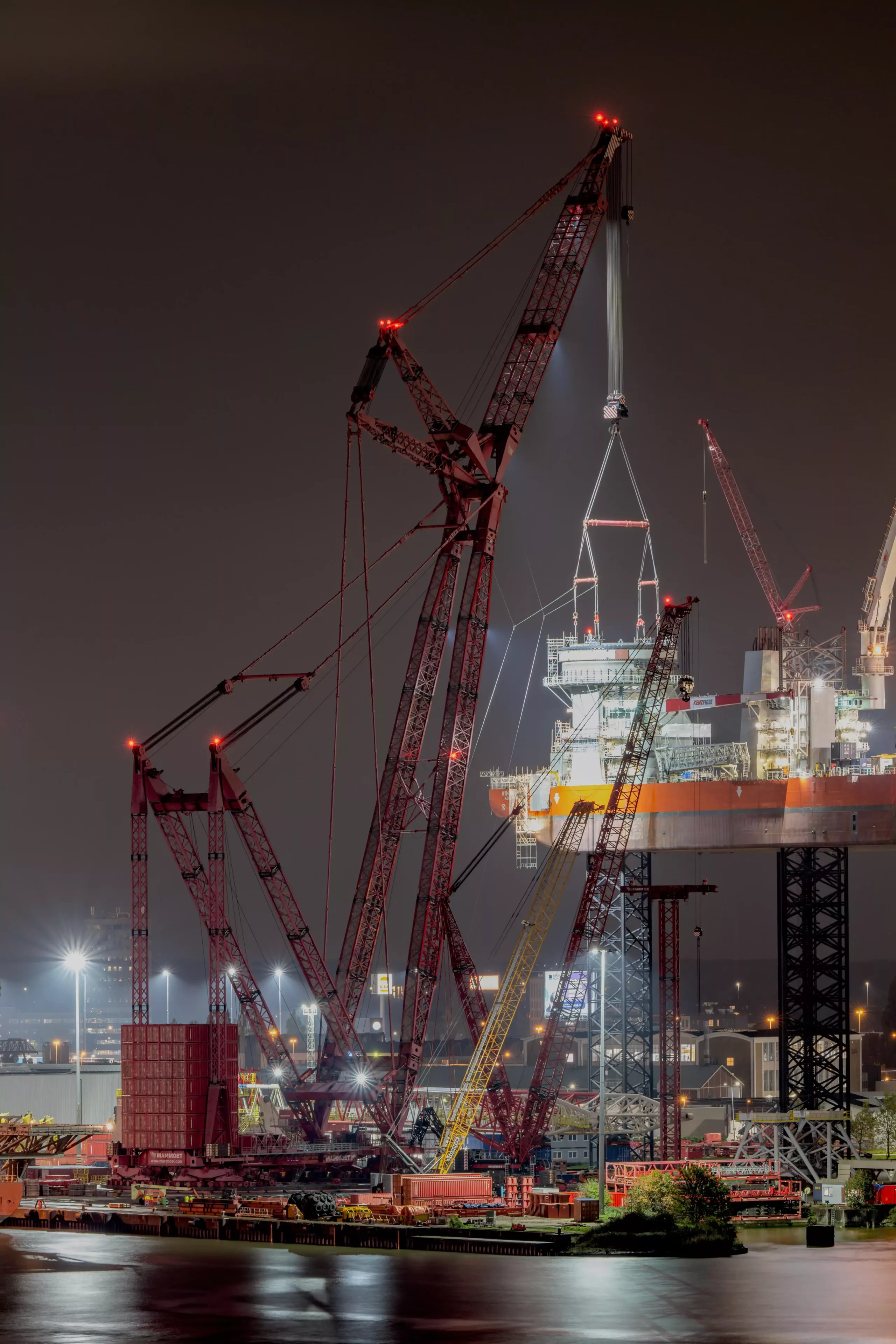
Crane lighting that moves with the boom
| Works on 24 and 48 V electrical systems, as well as on mains voltage |
| Assembly without welding to the structure |
| IP69K and IK10, built for vibration and shock |
| 5-year warranty, L90B05 360,000 hours |
What sets a crane apart from a building is that everything moves: the angle, the height, the length, the load. Four things are present in every crane type, from a tower crane on a construction site to a harbor crane with a grab. Together, they determine why an ordinary work light does not last long here.
01
The boom moves, so a fixed-mounted floodlight moves with it. Precisely during hooking and setting down, the beam moves away from the load. On one crane you solve this with a tiltable system that is adjusted from the cabin, on the other with a bracket that holds the position.
02
A diesel engine, a load kicking in, a grab biting into bulk material. All of that ends up in the mounting and the housing. IK10 and IP69K are not a luxury here, but a requirement, and the mounting counts just as heavily as the luminaire itself.
03
Many cranes supply 24 or 48 volts direct current. A luminaire that requires a converter adds a source of failure in the least accessible place on the machine. Our luminaires are available in a DC version that operates directly on the onboard power grid.
04
Welding to a certified boom section or mast part is out of the question for almost any owner. What you mount must work with what is already there: existing holes, existing profiles, clamps.
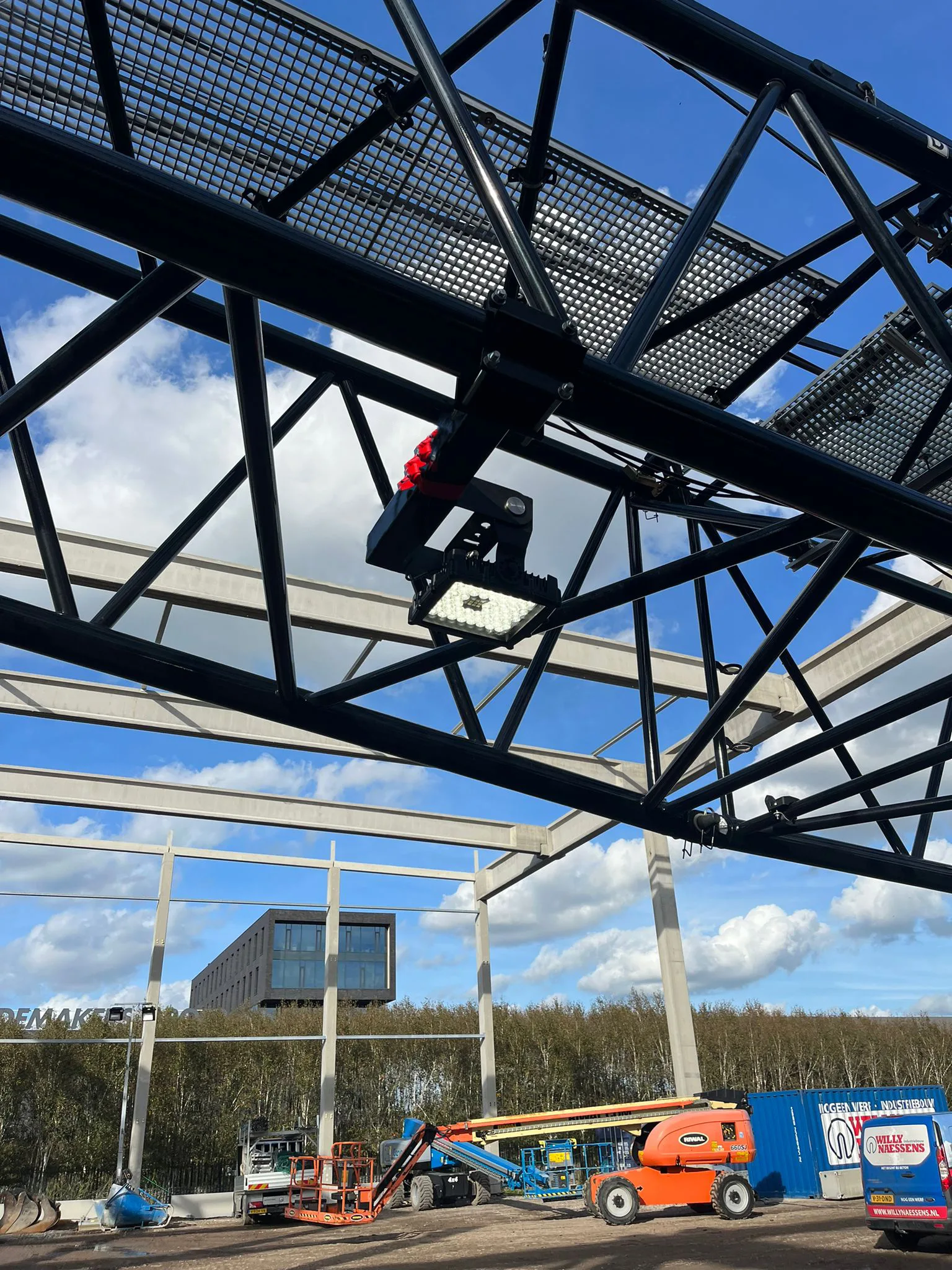
The focal point of our crane projects lies in existing equipment: cranes for which the factory-supplied lighting was inadequate, provided too little light, or would not stay where it needed to stay.
The solution varies by machine. Below is the problem for each crane type and where you can read further. If you are unsure, or if your crane is not listed, ask for advice: we will look along based on brand, type, and boom length.
Does your crane also have to be marked for aviation? Read more about obstruction lighting for cranes.
On a telescopic crane, the boom length changes during operation, and the light beam shifts with every extension. The Crane Light Director is the system that crane manufacturers install factory-standard: tiltable modules controlled from the cab, complete with a driver box and controls. Also available as a retrofit for your existing fleet.
Default choice: mostly the Goby.

A lattice boom offers many attachment points and few flat surfaces, and goes up and down in length. The Crane Light Stabilizer is a spring-loaded bracket that allows the spotlight to maintain its own position while the boom moves, adjustable to the shock you actually expect.
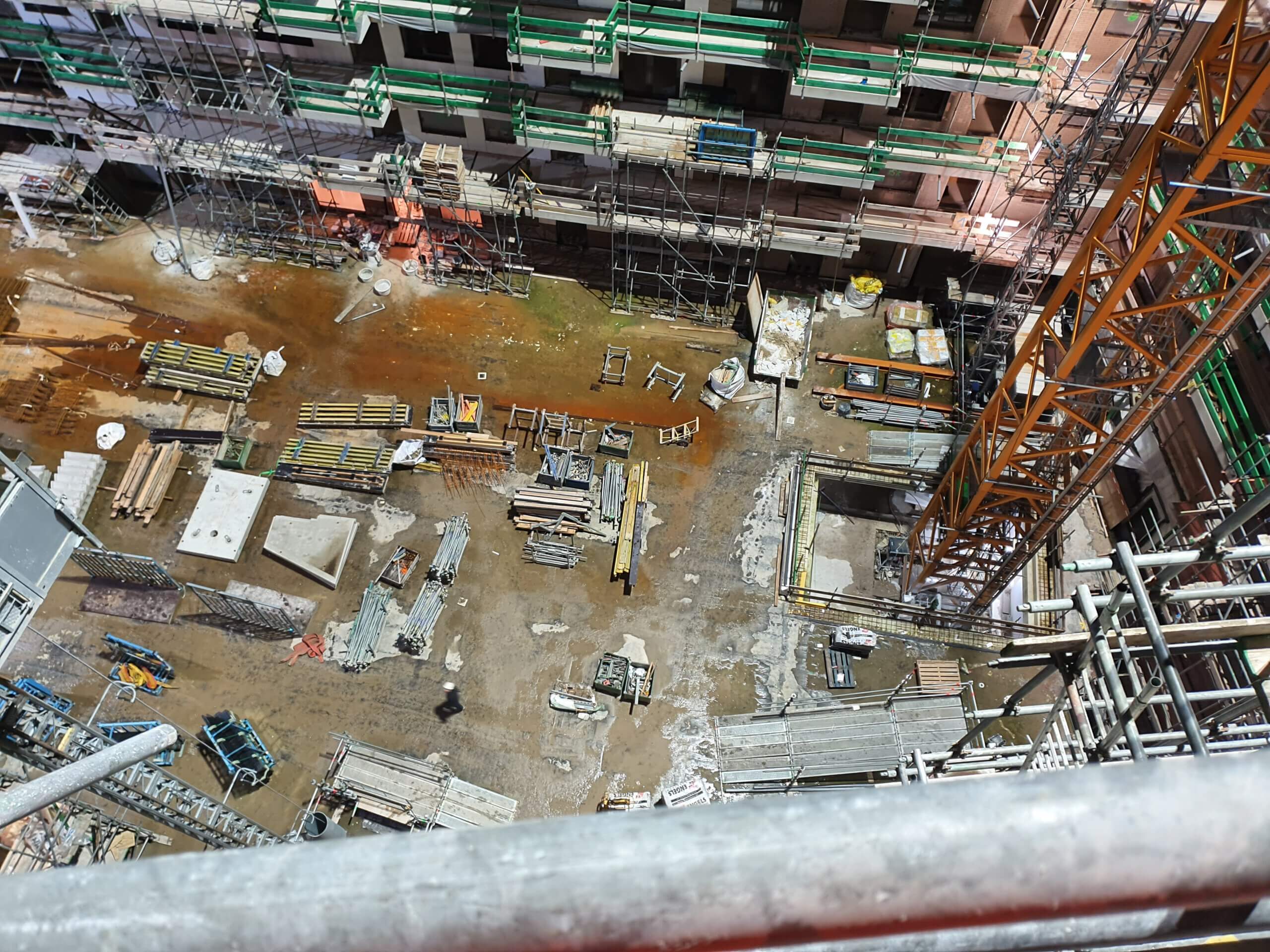
A tower crane not only illuminates its own load but often half the construction site, and stands there for months. Here, beam control matters more than elsewhere: local residents must not get spill light in their homes. We supply the frame, the luminaires, and the connection to the temporary site power as a single integrated unit.
Default choice: DarkLicht One for the mast lighting, Barracuda AC for the boom.
Tower crane lighting · brochure, pdf
Also in: Nederlands · English · Deutsch · Français · Español
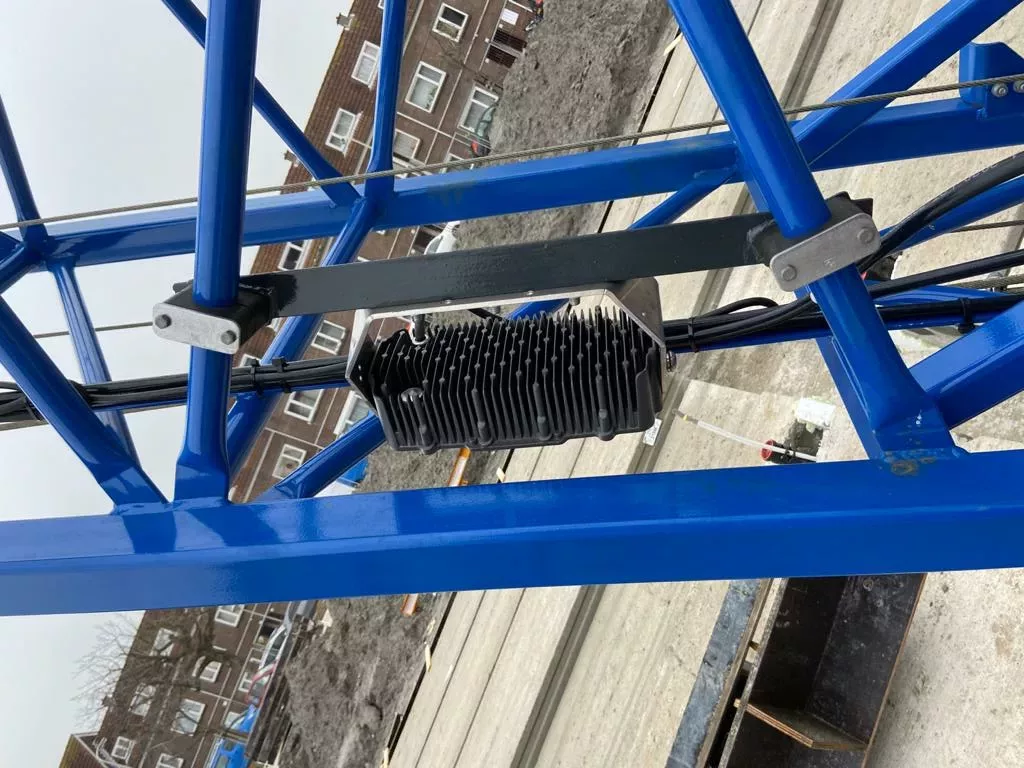
More compact, faster to set up, and relocated more frequently than a fixed tower crane. This places different demands on weight and the speed at which the lighting can be assembled and dismantled, without anyone having to climb the mast.
Default choice: mostly the Snapper in AC.

Continuous operation, high rotation speeds, and a salt load that eats most luminaires within a few years. This is where corrosion resistance, long-distance light output, and dimming come together. For crane vessels, the ship's movement adds to the crane movement.
Default choice: mostly the Snapper HC; also Barracuda AC and Orca AC are deployed here.
Send us your brand, model, and boom length, plus a few photos of the intended mounting location. Then we will determine which system fits. See also mobile machines and equipment.
The number of lumens matters less on a crane than where the beam lands. A floodlight at a height of fifty meters with a wide beam mainly illuminates the air and blinds the ground crew. The same floodlight with a narrow optic puts the same power onto the load.
We determine the optics for the application based on the mounting height, the distance to the work area, and the shape of that area. A quay is wider than it is deep, a construction pit is not.

Large distance, 50 to 300 m. For long booms and high mounting points.

Medium range, 30 to 100 m. The most commonly used optics on mobile cranes.

Up to 150 m, spread out wide. For a work area that is wider than it is deep.

Short distance, 15 to 60 m. For the immediate work area around the load.
Upon request, we will make a prior lighting calculation, so that you can see what you are getting before anything is assembled.
This is the point where most standard luminaires fail. A crane supplies 24 or 48 volts direct current, not 230 volts. Anyone who solves that with a converter is putting an extra component in a place where no one can reach.
Our crane luminaires therefore come in a true DC version. If your crane operates on mains voltage or temporary construction power, we supply the same luminaires in AC.
| Version | Tension | What for |
|---|---|---|
| 24 V DC | 20 to 35 V | The most common electrical system on mobile cranes |
| 48 V DC | 35 to 60 V | Heavier machinery and ring cranes |
| AC 90-305 V | single-phase | Construction power and permanent connection |
| AC 180–528 V | three-phase | Port Cranes and Fixed Installations |
Which luminaire is available in which version varies per model. When you request advice, we check this against your on-board voltage.
Welding to a certified boom section or a mast section is out of the question for almost any owner. All three of our mounting systems are built on that principle.
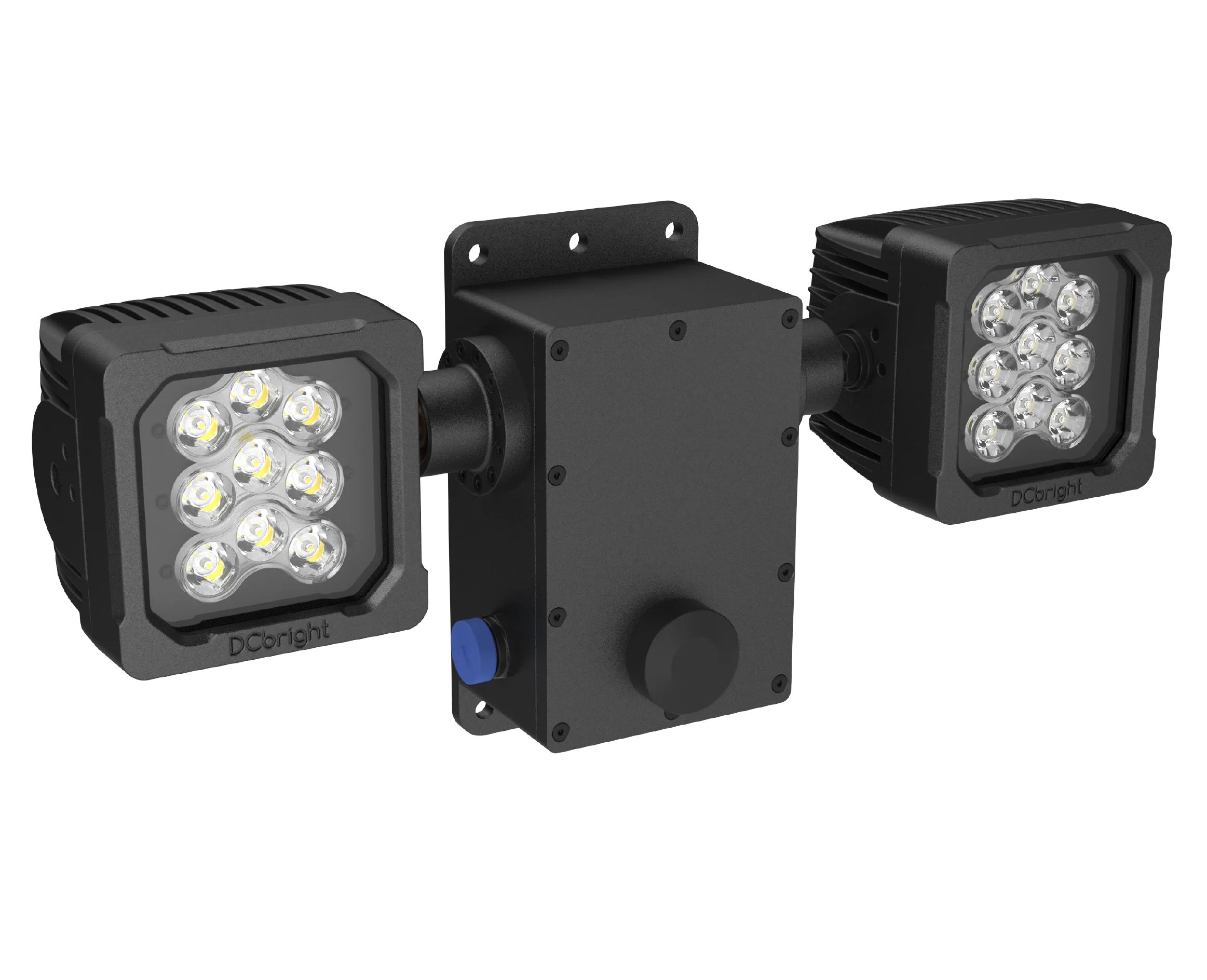
Tiltable modules with driver box and in-cab control, for telescopic booms.
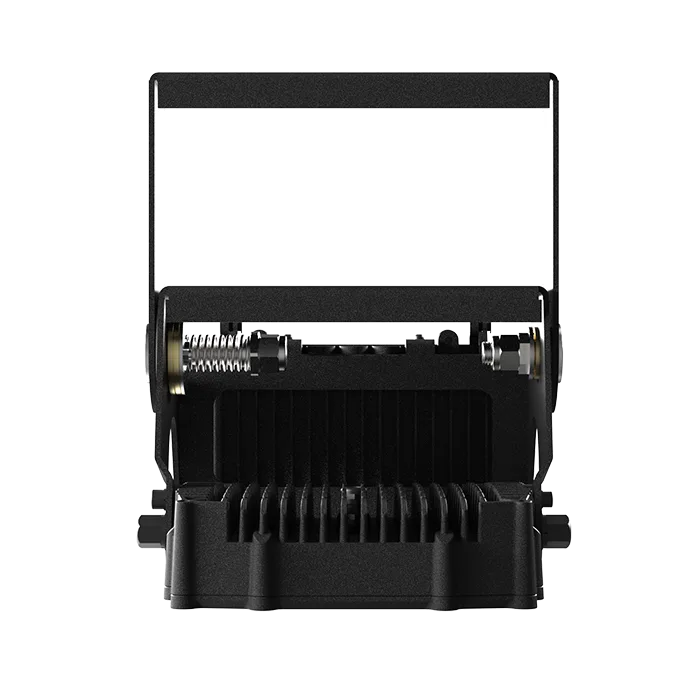
Spring-loaded bracket that holds the luminaire position while the boom moves, for lattice booms and crawler cranes.
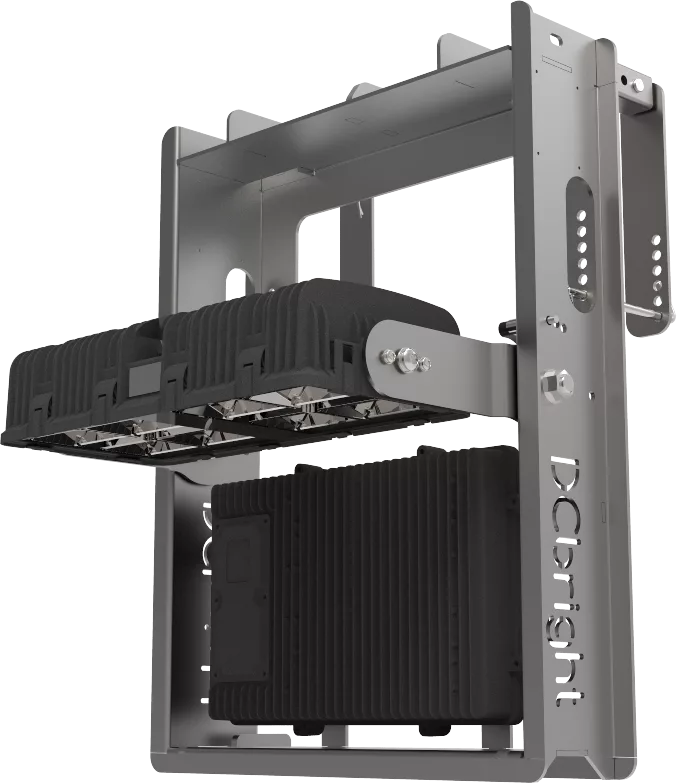
Support frame with luminaires and connections, for the boom of a tower crane.
In all three cases, we use existing mounting holes or install the system using a clamping mechanism around the profile. Which of the two methods we use depends on the machine. That’s why, when we receive a request, we always ask for the brand, model, and boom section, along with a few photos of the intended installation site.
The brand and model of the crane, boom length, on-board voltage, and a few photos of the location where the lighting will be installed. That’s all that’s needed for now.
Crane lighting is located in the hardest-to-reach place on an expensive machine. Whatever is installed there has to endure without anyone having to go up for it. These are the characteristics upon which we build our crane luminaires, regardless of the crane type.
| Ingress protection | IP69K |
| Impact Resistance | IK10 |
| Service life | L90B05, 360,000 hours |
| Warranty | 5 years of industrial use |
| Coating | titanium-based, C5 Maritime |
| Version | aluminum, 316L on request |
| Tension | 24 and 48 V DC, or AC |
| Optics | 14°, 38°, 14° × 46°, 69° |
| Certification | CE, Machinery Directive |
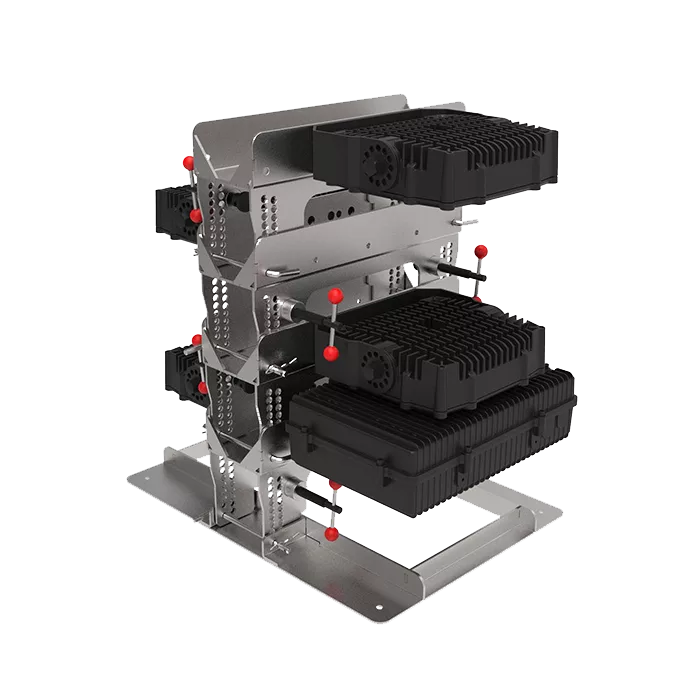
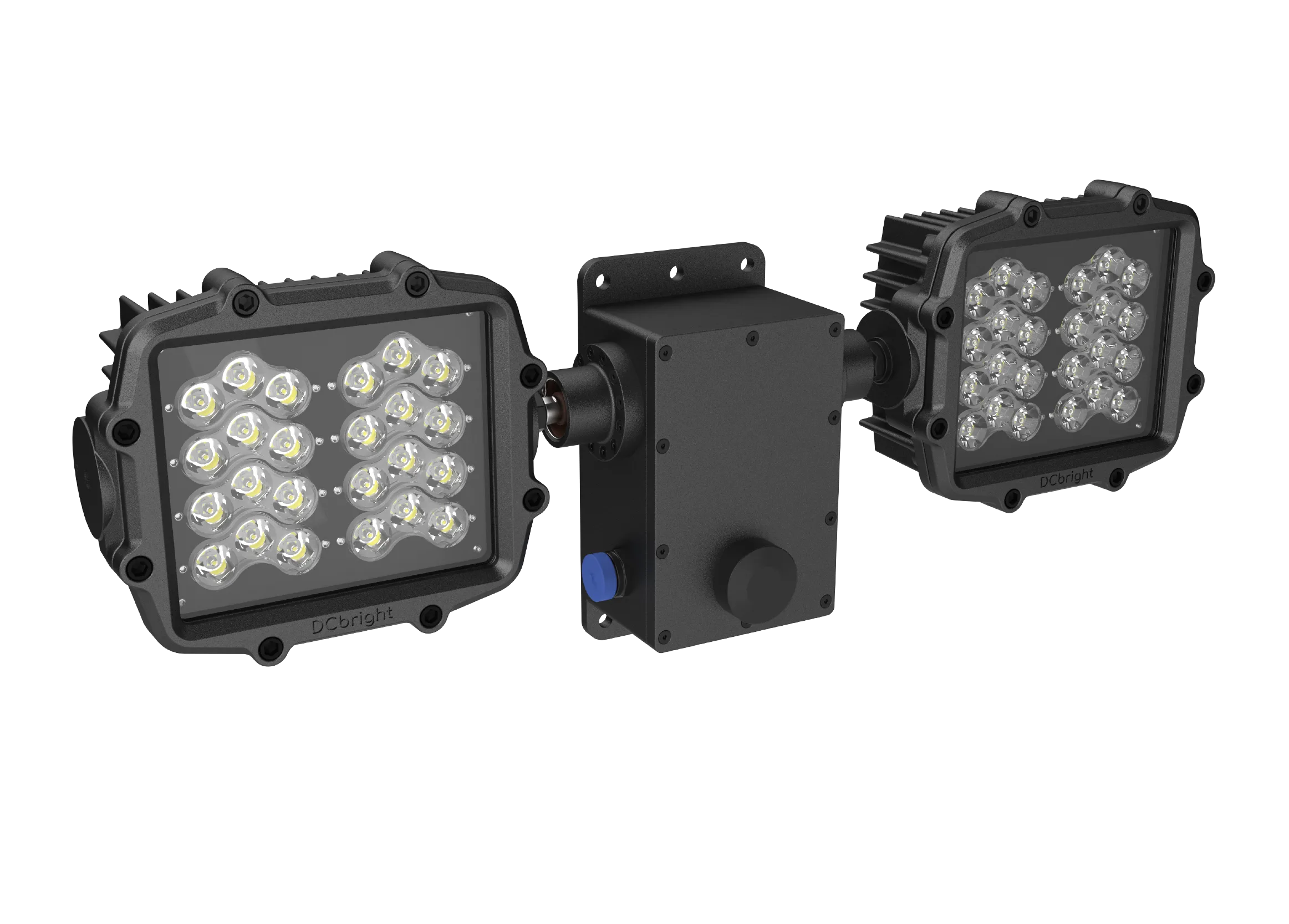
Our crane lighting systems are used by companies that operate their equipment daily and under all conditions. Our focus is on retrofits: existing cranes where the factory-installed lighting was inadequate, provided insufficient light, or did not stay in place where it was supposed to.
Crane lighting at the best-performing construction site in Leiden.
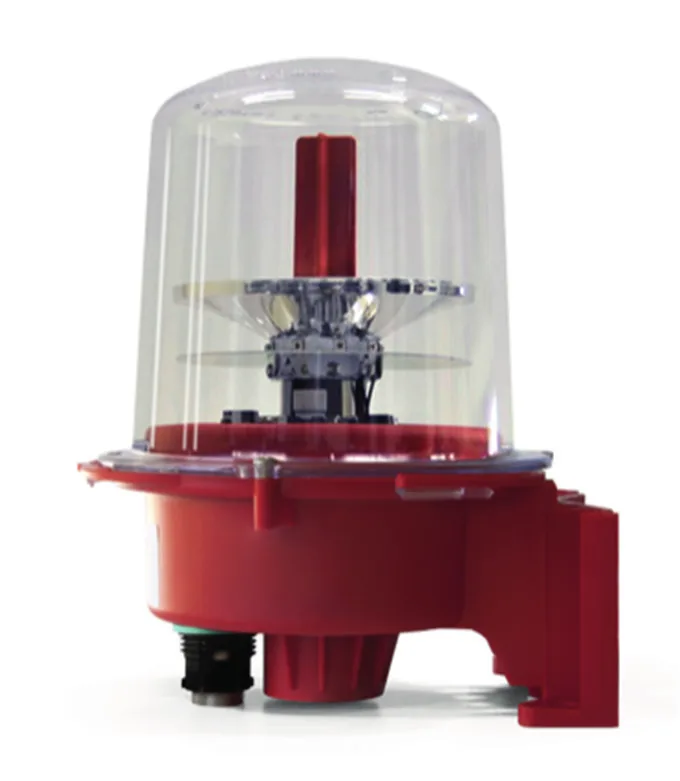
Cranes of 100 metres and higher must be reported to the aviation authority; around airports and low-flying routes lower limits apply. We supply the red obstruction lights, the Lantern L32 of 32 cd and the Lantern M2K of 2,000 cd, with photocell and controller as a complete set from stock, and advise which light belongs at which height.
Is your question not listed? Call Lucas de Graaf directly.
Yes. Our crane luminaires are available in a DC version for 24 V (20 to 35 V) and 48 V (35 to 60 V) on-board electrical systems, without a converter. If your crane operates on temporary site power or mains voltage, we supply the same luminaires in AC, 90 to 305 V single-phase or 180 to 528 V three-phase.
No. We mount on existing attachment points or with a clamping system around the profile. Nothing changes in the construction of the boom or the mast.
Both, and the focus is precisely on retrofit. In most projects, it involves existing cranes where the factory-supplied lighting was inadequate.
The Crane Light Director is a complete system for telescopic booms: tiltable modules, driver box, and in-cab control. The Crane Light Stabilizer is a spring-loaded bracket for lattice booms that maintains the luminaire position while the boom moves. The Stabilizer is available separately, the Director is not.
With the choice of optics and direction, so that the light level at the work area remains the same. A narrower beam at a high mounting point puts the same power into the work area instead of the surroundings. Upon request, we can make a lighting calculation in advance.
Our crane luminaires are rated at L90B05 for 360,000 hours and come with a five-year industrial warranty. Wear parts, such as the pulley set in the Crane Light Stabilizer, have their own replacement intervals.
The standard version is aluminum with a titanium-based coating, qualified for C5 Maritime. If your classification society or material policy requires stainless steel, we supply in 316L.
We produce the lighting calculation upon request and determine the optics per crane. We carry out the installation or supervise it, depending on the project and the location.
Crane lighting is returning to the sectors Ports and terminals and mobile machines and equipment. For cranes on board work vessels, see Deck and ship lighting.
Every crane is different, so we start with your machine rather than our product sheet. Send us the make and model, the boom length, and a few photos of the location where you want the lighting. You will receive a concrete proposal: which system, which luminaire, which optics, and which connection.
Your request will be reviewed by our team. We will respond within 1 business day.
| Response | within 1 working day, by an engineer |
| Lighting calculation | upon request, in advance |
| Mounting | carried out or supervised by us |
| Warranty | 5 years of industrial use |
Call us and we'll go through your situation in five minutes.

