
Short answer
An auditor checks three things: can anything fall from the luminaire into the product, does it survive cleaning, and is there enough light to spot deviations.
Lighting in the food industry must meet strict hygiene requirements, as defined by international standards such as HACCP, IFS Food, and BRC. These requirements focus on water resistance, shatter resistance, cleanability, and appropriate light intensity. Those purchasing lighting for a food production facility must consider regulations, food safety audits, and the practical demands of intensive cleaning routines. This article answers the most frequently asked questions about food-safe lighting.
IP69K
for cleaning with hot water under high pressure
500 lux
for product control and inspection
Ra 90
recommended for visual inspection
What standards and certifications are mandatory for lighting luminaires in the food industry?
Not every lighting luminaire is suitable for a food production facility. Lighting luminaires must demonstrably comply with HACCP requirements, and in many cases also with the retail standards IFS Food and BRC Global Standards. These standards stipulate that lighting must not pose a risk to food safety, meaning that luminaires must be shatterproof, easy to clean, and resistant to the environmental conditions in production areas.
In practice, auditors and clients are increasingly requesting demonstrable certification. The most relevant certifications and standards for LED lighting in the food industry are:
| Standard or requirement | What it means for the lighting |
|---|---|
| HACCP Compliance | Lighting must not pose a physical contaminant and must support risk management. |
| IFS Food and BRC: | retail standards that specify requirements for the layout of production facilities, including lighting |
| IP protection class | minimum IP rating depending on the zone within the facility |
| IK impact resistance | Protection against mechanical shock, relevant for production environments |
| CE Marking | required for all electrical equipment on the European market |
In addition to these standards, internal quality systems of food companies also play a role. Many manufacturers use their own specifications that go beyond the minimum legal requirements. It is therefore wise to always request the technical documentation of the luminaire when purchasing and to check it against the applicable standards within the facility.
What does IP rating mean for lighting in food environments?
The IP (Ingress Protection) rating indicates the degree to which a luminaire is protected against the ingress of dust and water. In food environments, a high IP rating is essential, as luminaires are regularly exposed to steam, cleaning water, and humid air. The minimum requirement in production areas is typically IP65, but in areas with high-pressure sprayers, IP66 or IP69K applies.
The two digits in the IP code represent different levels of protection. The first digit (0-6) indicates protection against solids, and the second (0-9) indicates protection against water. IP69K is the highest degree of protection against water ingress and is specifically designed for environments where cleaning with hot water at high pressure is performed. This makes IP69K the standard for slaughterhouses, dairies, and other wet production environments.
More explanation about the difference between IP and IK ratings and what they mean for your choice can be found on the page about IP and IK ratings.
Why do light luminaires in the food industry need to be shatterproof?
A broken lamp above a production line is more than a technical problem, it's a direct threat to food safety. Within HACCP legislation, therefore, any physical risk of contamination must be eliminated or controlled. Luminaires without shatter protection are thus simply not permitted in zones where open products are present.
Edge protection is realized in different ways:
- Coated lamps and diffusers: A transparent coating holds together shards if the lamp breaks, so that no loose fragments can fall.
- Polycarbonate housing Luminaires with a robust polycarbonate cover are virtually unbreakable and therefore form a structural solution
- Closed construction: A fully enclosed luminaire with no loose parts or openings prevents fragments from escaping.
- IK-certified impact resistance A high IK rating (IK08 or higher) confirms that the luminaire is resistant to mechanical impacts.
In practice, many food companies opt for LED luminaires with a polycarbonate diffuser and IK10 certification. This is the highest impact resistance class and offers the best protection in environments where machines, conveyor belts, or vehicles operate near lighting.
What color temperature and illuminance are required in food facilities?
For accurate color rendering and early detection of product defects, the correct light color is essential. A color temperature of 4000K to 6500K, cool white to daylight, is most common in food facilities. Illuminance varies by zone: inspection rooms typically require a minimum of 500 lux, while general production areas can suffice with 300 lux.
The Color Rendering Index (CRI or Ra) is at least as important as color temperature. A CRI of 80 or higher is the minimum requirement for production environments, but for quality control and visual inspection of products, a CRI of 90 or higher is strongly recommended. A high CRI makes discolorations, damage, or contamination of products easier to spot.
Read more background on the meaning of light color and Kelvin values for industrial applications on the page light color and Kelvin.
| Zone | Guide value on the working plane |
|---|---|
| Sorting, washing, milling, mixing and packing | 300 lux |
| Critical zones in slaughterhouses, dairies and mills | 500 lux |
| Product control, inspection, trimming and sorting | 500 lux |
| Laboratory | 500 lux |
| Colour inspection | 1,000 lux |
How do cleaning and disinfection procedures influence the choice of lighting luminaires?
Intensive cleaning and disinfection procedures place high demands on the chemical resistance and waterproofness of lighting luminaires. High-pressure sprayers, aggressive cleaning agents, and steam cleaning can damage luminaires if they are not specifically designed for such conditions. Therefore, the choice of the right luminaire begins with the cleaning protocols used in the facility.
When selecting luminaires for food production environments, the following factors are decisive:
What cleaning tests the luminaire for
For environments with extreme corrosion or aggressive chemical exposure, specialized lighting for extreme corrosion A suitable solution.
Food production
We specify per zone: lux, IP rating, front material and cleaning
Send us the floor plan with the zones, the cleaning method and the temperatures. You receive a luminaire choice per zone with IP rating, front material and lighting calculation, so that the lighting fits your HACCP file.
Free of charge and without obligation · Response within 1 working day from an engineer
What are the consequences of non-compliant lighting during a food safety audit?
Non-compliant lighting during a food safety audit can lead to non-conformity points, temporary production stops, or even revocation of certification. Auditors of IFS, BRC, or FSSC 22000 assess lighting as part of physical risk management. Luminaires without shatter protection, with too low an IP rating, or with visible damage are immediately registered as non-conformities.
The severity of the finding depends on the location and risk. Lighting above open products or in direct food contact zones is assessed more strictly than lighting in storage areas or canteens. A critical non-conformity can lead to the audit not being approved, which has direct commercial consequences for suppliers who must be certified to supply retail chains.
Proactive action is the only sensible approach. Maintain an up-to-date register of all lighting luminaires, including their IP rating, shatter-resistance class, and replacement history. This register is a standard component of an HACCP file and is always requested during audits. Regular maintenance and timely replacement of damaged luminaires are therefore not only a technical requirement but also a commercial interest.
Self-check
Is your lighting register audit-ready?
This is what an auditor asks for. Whatever you cannot tick is an open point for the next audit.
- Every luminaire position is in the register, with type and zone
- The IP and IK rating is recorded for each luminaire
- The front material is known, and glass is also in the glass register
- The cleaning method and temperature per zone are recorded
- Damage and replacements are logged with dates
For wet and hygienic zones
Practical example: Farm Frites
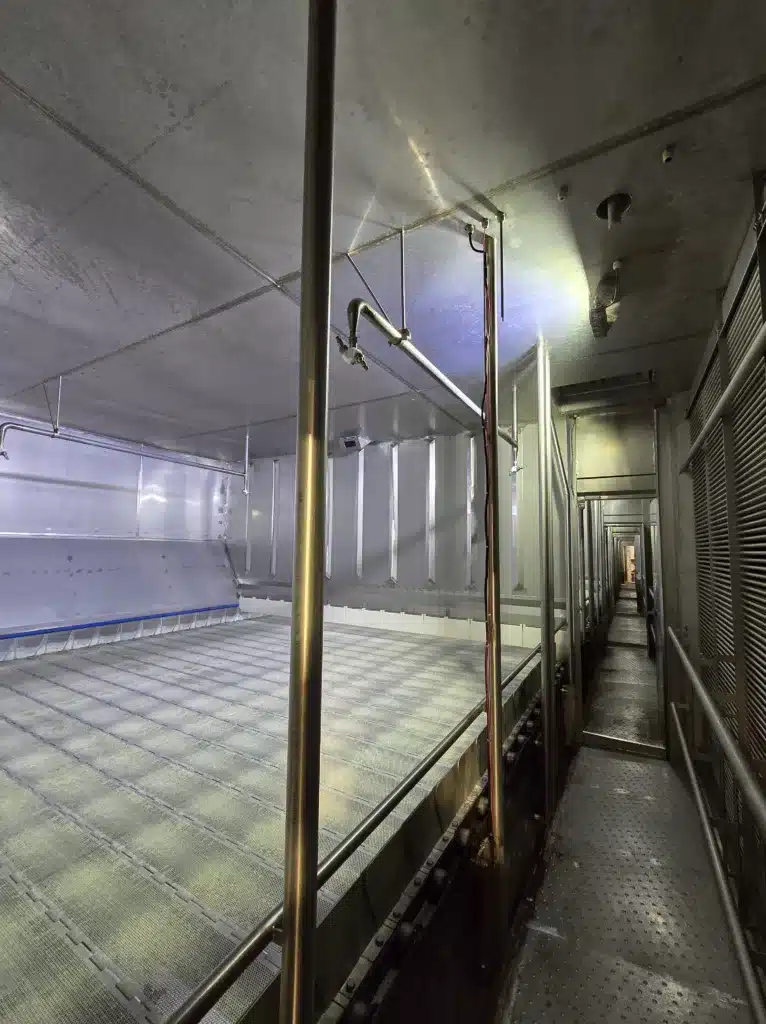
Project · Food industry
HACCP-compliant lighting at Farm Frites
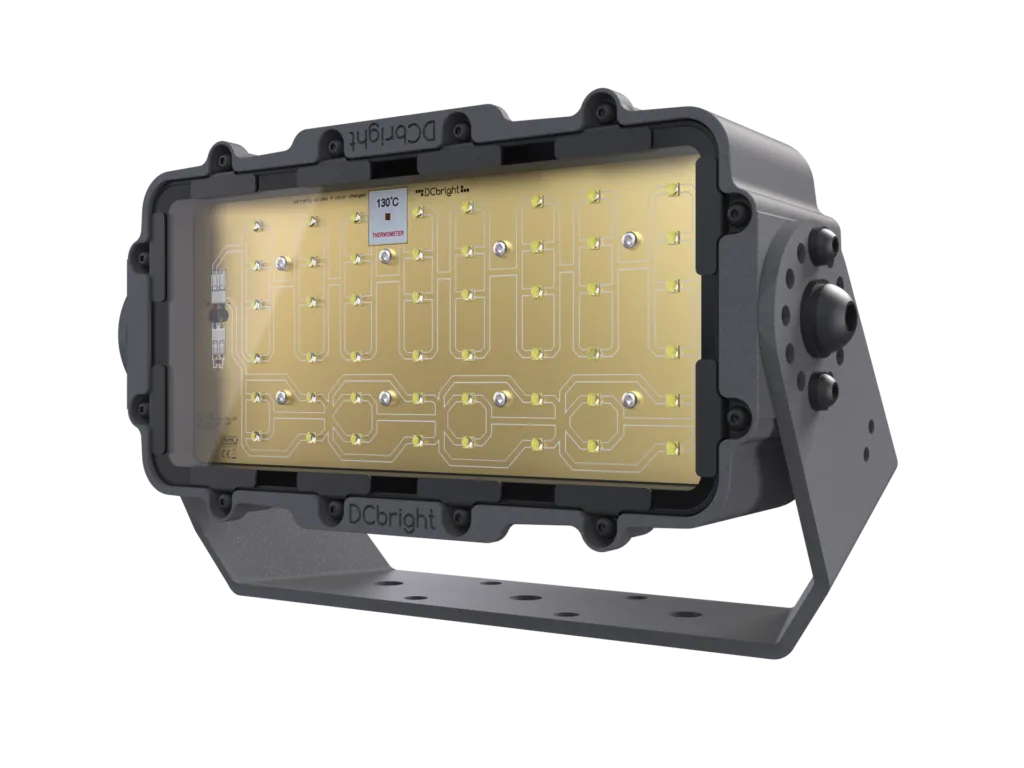
A special food version of the stainless steel Snapper HT, with borosilicate glass and IP69K, for drying tunnels, production ovens and freezing tunnels with intensive cleaning.
78
Snapper HT-SS luminaires of 35 W
200 to 500 lux
in the oven
IP69K
with borosilicate glass, HACCP-compliant
Farm Frites, a producer of potato products with production sites worldwide, was dealing with LED lighting that repeatedly failed in the drying tunnels and production ovens. The luminaires chosen earlier could not withstand the high thermal stress and the intensive cleaning routine. For the freezing tunnels, a temperature range of -40 °C to +70 °C also applied during the cleaning processes. JEL designed a special food-grade version of the stainless steel Snapper HT, the Snapper HT-SS, with borosilicate glass, a HACCP-compliant design and IP69K protection. 78 luminaires have been supplied, achieving 200 to 500 lux in the oven at 35 W per luminaire.
In the food industry, cleaning is not a side issue but a design requirement. Cleaning at high pressure and high temperature finds every weak point in the seal. Borosilicate glass withstands sharp temperature changes and does not break under thermal shock.
A luminaire that fails above a production line is also more than a replacement cost, because replacement means downtime. Including the cleaning routine, the temperatures and the hygiene requirements in the specification from the outset prevents lighting from falling short after the first cleaning cycles or during an audit.
Read more about the Farm Frites project
Further reading
How JEL Products Helps Ensure Food-Safe Lighting
JEL Products provides lighting solutions for industrial environments where standard luminaires fall short. For the food industry, this means luminaires designed for intensive cleaning routines, high IP ratings, and shatter-resistant construction,with support throughout the entire process, from consultation to delivery.
What JEL Products offers food production facilities:
- Luminaires with IP65 to IP69K protection, suitable for high-pressure washing and steam cleaning
- Vandal-resistant constructions with polycarbonate diffusers and high IK certification
- Chemically resistant housings for environments with aggressive cleaning agents
- Tailored advice on color temperature, illuminance, and zoning within the facility
- Assistance in compiling an HACCP-compliant lighting register
Would you like to know which luminaires fit your production environment and meet the requirements of your next audit? Get in touch Contact JEL Products for a no-obligation consultation.
Related Articles
- How do you illuminate a heat-tracing or tunnel in an industrial environment?
- What are the differences between lighting for high and low temperature environments?
- How does lighting affect the safety of crane operators during night shifts?
- How do you know if your industrial lighting is outdated?
- What are the benefits of LED lighting compared to the investment?