

Short answer
A Dialux calculation is a digital lighting simulation that allows you to calculate in advance how much light will reach a given surface, how uniform that distribution is, and whether the installation complies with applicable standards. It is the standard method in professional lighting practice to validate a lighting design before a single luminaire is installed. The questions below delve deeper into when you need such a calculation, what it yields, and how you work with it in practice.
The standards against which the outcome is assessed.
When is a Dialux calculation mandatory or necessary?
Not always legally required, but in many industrial and public projects a documented lighting calculation is indeed a hard requirement. Clients, contractors, insurers, and safety authorities are increasingly requesting a calculation as justification for the lighting design, especially in projects where safety is directly at stake.
In practice, a lighting calculation is necessary in the following situations:
- In tenders for industrial sites, ports, logistics centers, or construction projects where minimum lighting levels are contractually stipulated
- When an installation must comply with NEN standards or European EN standards for workplace lighting
- For permit applications where light pollution or light emission to the environment must be demonstrated
- As a basis for subsidy processes or energy-saving programs where the efficiency of an LED installation must be demonstrated
- In complex environments such as warehouses, production halls, or outdoor areas where uniformity and shadow formation are critical
Even if there is no formal obligation, a calculation is wise. It prevents you from discovering after installation that certain zones are too dark or that luminaires are positioned incorrectly. Remedial work is expensive and time-consuming.
Lighting calculation
We make the calculation on your own drawing
Send a floor plan or DWG. You will receive a complete Dialux Evo calculation with an isolux map, uniformity per zone, maintenance factor, and a compliance check against the applicable EN standard. Response within one business day, by an engineer.
No newsletter, no sales pitch. Our photometric files are free to download if you want to calculate it yourself.
What exactly does Dialux calculate and what results does it produce?
The software simulates the lighting performance of a lighting installation in a virtual room or outdoor environment. Dialux uses the photometric data of luminaires, the geometry of the room, and the reflectance values of surfaces to calculate how light spreads. The results are direct measurements that you can test against standards and specifications.
The main results of a Dialux calculation are:
- Average illuminance (Em)the average number of lux on the work surface or the floor
- Minimum illuminance (Emin)the darkest place in the calculated zone
- Uniformity (U0 or Uo)the ratio between the minimum and average value, a measure of how evenly the light is distributed
- Glare rating (UGR): the Unified Glare Rating, which indicates the extent to which luminaires cause distracting glare
- Color Rendering Index (Ra/CRI)how well colors are rendered under the calculated lighting
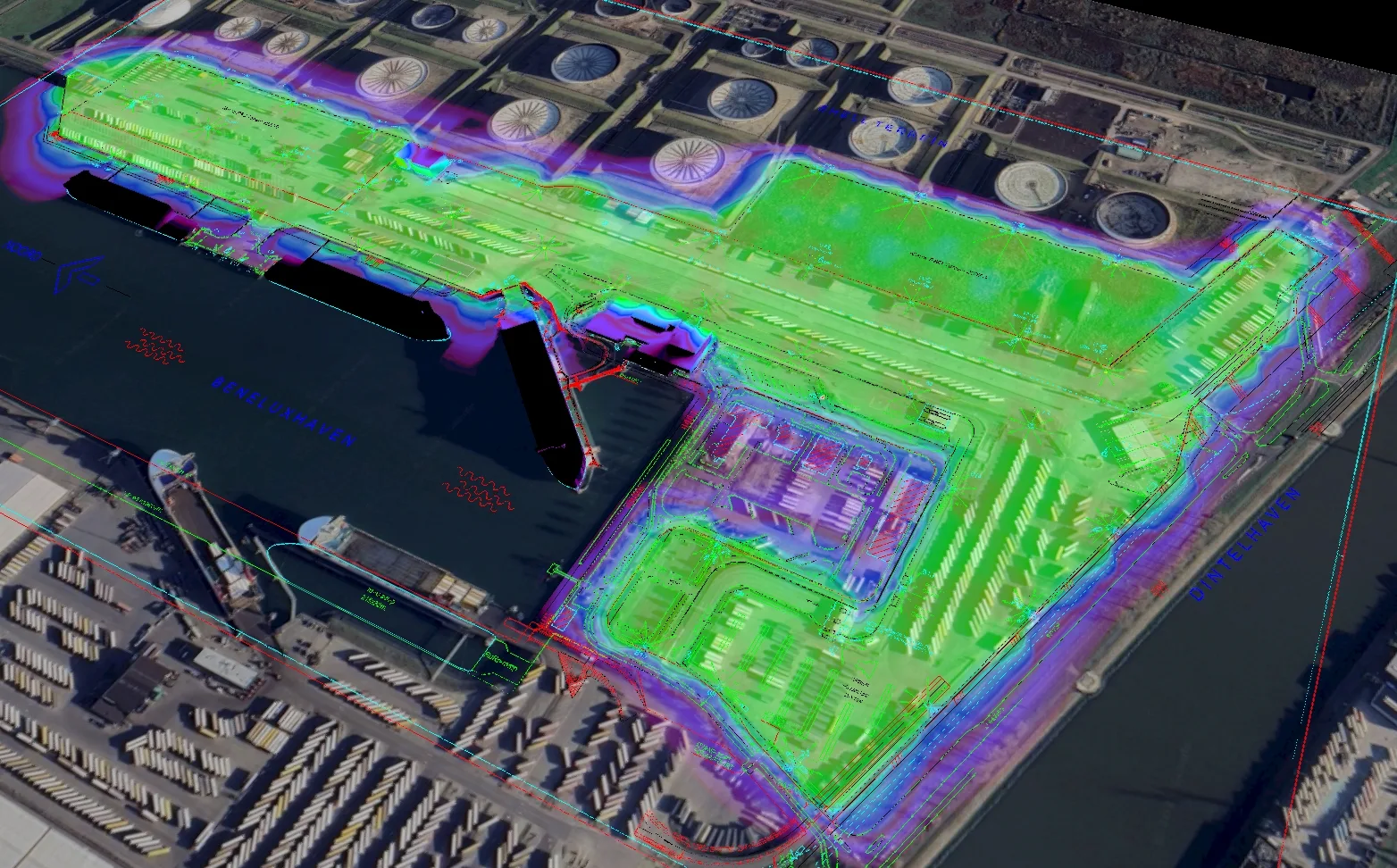
In addition to these core values, Dialux also generates false-color plots, isoline maps, and 3D visualizations. These make it clear for both technicians and non-technical decision-makers where the bottlenecks are in the lighting design.
How reliable is a Dialux calculation in practice?
The simulation itself is mathematically correct, but the outcome depends entirely on the quality of the input data. Consider the photometric files of the luminaires, the accuracy of the room geometry, and the correctness of the assumed reflectance values.
In industrial practice, there are a number of factors that influence reliability:
- Photometric dataUse only IES or LDT files measured and certified by the manufacturer. Generic or inaccurate files will lead to inconsistent results.
- Pollution factorIn industrial environments, the light output of luminaires decreases due to dust, grease, or other buildup. A calculation without a maintenance or depreciation factor overestimates the actual illuminance over time.
- Reflection valuesIn a steel workshop or chemical plant, walls and floors are darker than in an office. Anyone who enters standard values gets an overly optimistic picture.
A well-executed calculation with correct input data yields a result that is accurate to within a few percentage points in practice. That is sufficient to base a responsible installation choice on, even for demanding environments such as Heavy industry with extreme heat.
What is the difference between Dialux and Dialux Evo?
Dialux Evo is the successor to the original Dialux and the version that is actively developed and supported today. The most important difference lies in how projects are structured: Dialux Evo works with a building structure where floors, rooms, and outdoor areas are managed as a single entity, whereas the original Dialux worked with separate, independent calculation scenes.
For industrial projects, the practical differences can be summarized as follows:
- Dialux Evo supports large, complex projects with multiple zones, floors, and outdoor areas in a single file. This is ideal for ports, terminals, or manufacturing facilities.
- Dialux Evo has a more modern interface and better 3D rendering, which simplifies communication with clients.
- The original DIALux is no longer actively updated, but is still in use by part of the market due to familiarity with the workflow.
Dialux Evo is the standard for new projects. Anyone still working with the old version runs the risk that manufacturers no longer provide compatible photometric files for the older format.
Who performs a Dialux calculation for an industrial project?
Typically, that is a lighting consultant, a specialized installer, or a lighting supplier with lighting engineering expertise. It is not a standard job: a correct calculation requires knowledge of photometry, standards, and the specific environmental requirements of the project.
In the industrial market, there are three common routes:
- The client is requesting an independent consultancy firm to make the calculation as part of a larger engineering or construction project. This provides the most independence, but requires a separate budget.
- The installer or main contractor Have the calculation performed as part of the installation process. Many installers work with lighting suppliers who provide the calculation.
- The lighting supplier performs the calculation as part of the product advice. This is the most common route in the industrial market, where the supplier uses its own luminaire data and provides a lighting design as the basis for the quotation.
Regardless of who performs the calculation, it is wise to check whether the photometric data used come from certified measurements and whether the calculation takes into account the specific conditions of the location. More background on what qualitative lighting advice entails can be found on the page about lighting expertise.
Which standards determine the outcome of a Dialux calculation?
The outcome is tested against lighting standards that set minimum requirements for illuminance, uniformity, and glare per type of workplace or activity. In Europe, these are primarily the EN 12464 standards for workplace lighting and the EN 12193 standard for sports lighting. Additional guidelines apply to outdoor locations and sites.
The most relevant standards for industrial lighting projects are:
- EN 12464-1: indoor workplace lighting. Gives minimum values for Em, Emin, uniformity, and UGR per type of activity.
- EN 12464-2lighting of outdoor workplaces. Applicable to sites, loading and unloading areas, construction sites and outdoor storage areas.
- ATEX Guidelinesin potentially explosive environments, additional requirements apply to the luminaires themselves, which indirectly also influence the calculation parameters.
Dialux lets you set the desired standards as a reference, so you can immediately see in the report which zones comply and which fall short. For industrial area lighting is EN 12464-2 typically the starting point, supplemented by any sector-specific requirements from the client or competent authority.
Practical example: DFDS Vlaardingen
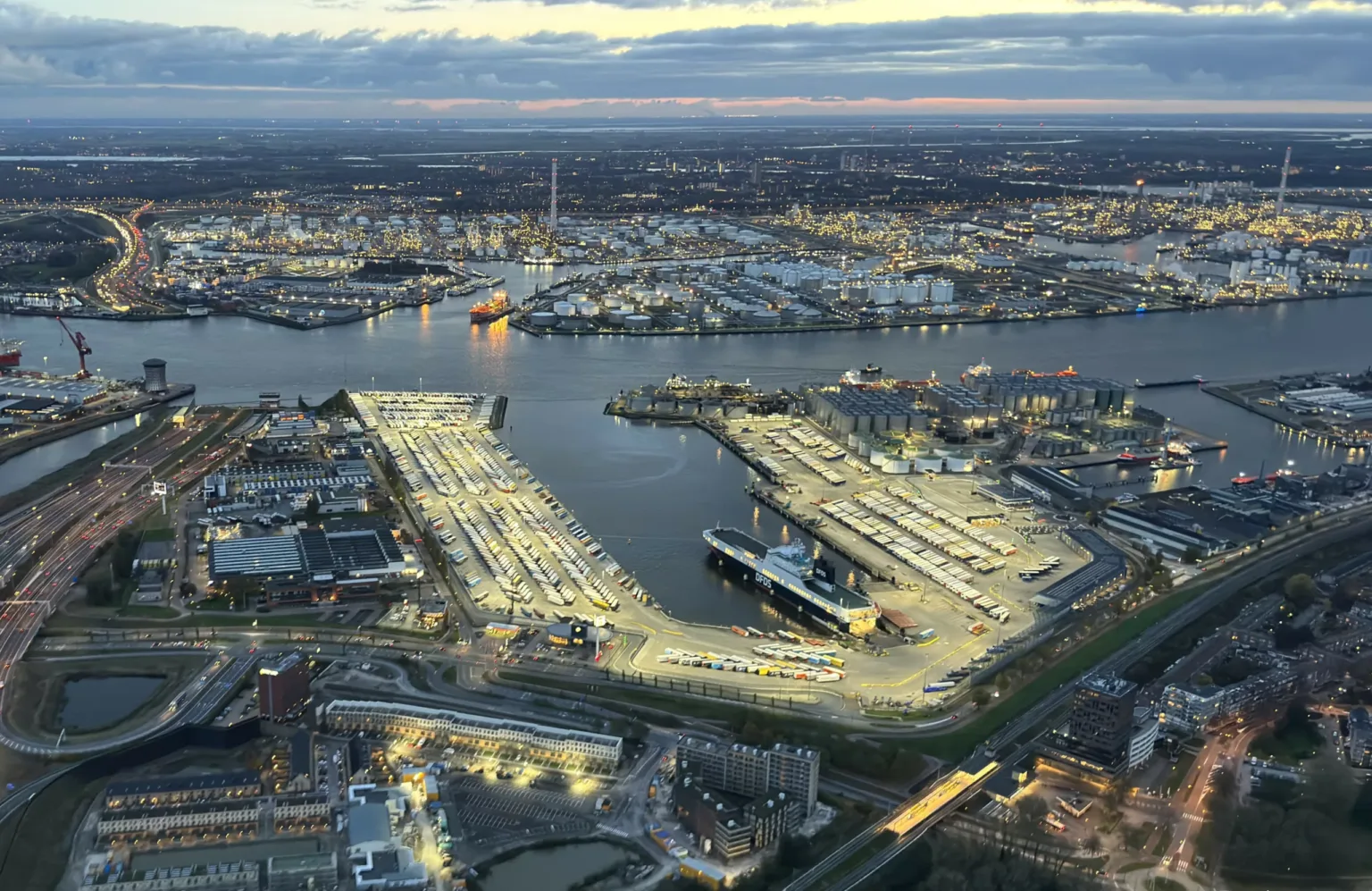
What the calculation at DFDS Seaways in Vlaardingen yielded
DFDS modernised its port terminal in Vlaardingen, which operates 24/7: the existing section was made more sustainable while a new terminal section was built at the same time. Commissioned by main contractor Boskalis, JEL handled the lighting design and the installation of the terminal lighting on 34 lighting masts of 30 metres, with a total of around 180 DarkLicht DL1 and DL2 luminaires. The masts stand 145 metres apart and the terminal directly borders homes and residential towers. After completion it was verified that the site achieves an average of 50 lux with a uniformity of up to 0.45, well above the standard requirement of 0.25.
With such a ratio between mast spacing and mast height, dark zones and hard shadows quickly appear between the masts. A lighting calculation works out light distribution, uniformity and glare before a luminaire is chosen. This shows in advance whether a mast layout is feasible, which optics it requires and how much light will reach the homes. The measurement after handover completes the process: the calculated values are checked against what is actually achieved on site.
Continue reading: datasheets and photometric files, light pollution and full cut-off, lighting poles and high mast lighting and the energy investment allowance.
How JEL Products Helps with Your Lighting Calculation
As part of its comprehensive solution, JEL Products also handles the lighting design based on Dialux calculations. This means you don’t have to look for a consultant yourself: from the initial technical analysis to the final lighting plan, everything is handled in-house, using luminaire data based on certified photometric measurements.
What JEL Products specifically offers in the field of lighting design:
- DIALux calculations tailored to your specific environment, including pollution and maintenance factors for industrial conditions
- Testing against relevant EN standards and sector-specific requirements
- Lighting plans as a basis for tenders, permits, or subsidy processes
- Advice on luminaire selection, positioning, and pole variants for sites, halls, and machinery
- Guidance of the entire process: from calculation to installation and commissioning
Whether it’s a new installation at a port terminal, a production facility with extreme temperatures, or an outdoor location with strict standards: JEL Products works with you from the very first calculation. Get in touch for a no-obligation consultation about your lighting challenge.