

Short answer
For a production environment, the general guideline is a minimum illuminance of 300 to 500 lux on the work floor, depending on the nature of the work. For precise or visually demanding tasks, this increases to 750 lux or more. The exact recommended illuminance depends on applicable standards, the layout of the hall, and the specific work tasks being performed. This article answers the most frequently asked questions regarding lux values, standards, and lighting choices in the production environment.
Guideline values according to NEN-EN 12464-1.
What lux values apply to different tasks in a production hall?
Not every spot in a production hall requires the same light level. The recommended illuminance varies greatly depending on the type of work task: for general production work, a minimum value of 300 lux generally applies, while for precision assembly, quality control, or intricate manual labor, you quickly reach 500 to 1000 lux at the workstation itself.
The guidelines below provide a practical overview of the recommended lux levels per situation:
| Work task or zone | Recommended illuminance |
|---|---|
| Aisles and storage areas: | 100 to 150 lux |
| General production floor: | 300 lux |
| Machine operation and assembly: | 500 lux |
| Precise craftsmanship and quality control: | 750 to 1000 lux |
| Visually demanding tasks (color inspection, fine measurement): | 1000 lux or more |
In addition to horizontal illuminance at workbench height, vertical illuminance is also relevant, for example at machines or shelves. A good balance between ambient lighting and task lighting prevents glare and reduces visual fatigue for employees.
What standards and guidelines determine lighting requirements in industry?
The lighting requirements in industry are primarily determined in Europe by the standard EN 12464-1 for indoor lighting in workplaces and EN 12464-2 for outdoor environments. These standards specify minimum lux values, uniformity requirements, and glare limits (UGR) per type of workplace and activity.
In addition to the EN 12464 series, other frameworks also play a role in industrial contexts:
- Working Conditions Decree (Arbobesluit) Dutch legislation setting minimum lighting requirements for workplaces
- ATEX Guidelines applicable in potentially explosive atmospheres, with specific requirements for luminaire selection
- Sector-specific standards For ports, offshore, or the food industry, additional requirements may apply
The EN 12464 standard is not legislation in itself, but is widely used in practice as a technical standard. Deviating from this standard requires a well-founded justification. For lighting expertise and knowledge of standards it is advisable to consult a specialist familiar with the specific requirements in your sector.
What is the difference between lux, lumen and candela in industrial lighting?
Lux, lumen, and candela are three different quantities that each describe a different aspect of light. Lumen indicates the total luminous flux emitted by a luminaire. Lux indicates how much of that light actually falls on a surface. Candela describes the luminous intensity in a specific direction.
A practical comparison clarifies the difference:
- Lumen (lm): the total amount of light a lamp or luminaire produces, regardless of direction
- Lux (lx): the amount of light per square meter on a certain surface (1 lux = 1 lumen per m²)
- Candela (cd): Luminous intensity in a particular direction, relevant for directional lighting
For illuminance on the work floor, lux is the most relevant quantity. A luminaire with a high lumen output does not automatically deliver sufficient lux at working height, especially if the light is widely dispersed or the mounting height is considerable. You can find more background on what these values mean in practice on the page about luminous flux.
How do reflection, height, and layout affect the lux on the workplace floor?
The measured illuminance on the factory floor is strongly influenced by the mounting height of luminaires, the reflection values of walls and ceilings, and the spatial layout of the hall. A luminaire suspended at a great height spreads light over a larger area, which reduces the lux value at worker level.
Concrete factors determining effective lux on the workplace:
- Mounting height The higher the luminaire, the larger the illuminated surface area, and the lower the lux per m².
- Reflection coefficient Light-colored walls and ceilings reflect more light and increase ambient lighting
- Beam angle A narrow beam concentrates light onto a smaller area, a wide beam spreads it out.
- Spacing of luminaires: An excessively large gap leads to dark zones and poor uniformity
- Obstacles and machines Large installations cast shadows and reduce local illumination intensity.
In large production halls, such as those found in heavy industry, it is essential to choose luminaires with a suitable light distribution and sufficient lumen output to achieve the desired lux levels at the work floor. LED floodlights which are deployed for these types of environments, are specifically designed to achieve effective lighting levels even at high altitudes.
When is a lighting calculation mandatory or necessary?
A formal lighting calculation is legally required for new construction or major renovations of workspaces that involve building activities requiring a permit. Additionally, a calculation is necessary when an employer needs to demonstrate that the lighting installation complies with the requirements of the Dutch Working Conditions Decree (Arbobesluit) and applicable standards.
Even outside of legal requirements, a lighting calculation is strongly recommended in the following situations:
Is a calculation useful in your case?
Check what applies to your situation. A single checkmark is already enough reason to calculate in advance.
- When replacing conventional lighting with LED in an existing installation
- In case of changes to the hall layout, machine setup, or workstations
- In case of employee complaints about glare, shadows, or insufficient visibility
- When setting up new production zones with specific visual requirements
- When demonstrating compliance for audits, inspections, or insurance requirements
A professional lighting calculation uses software simulations (such as DIALux or Relux) and takes into account room geometry, luminaire positions, reflection values, and maintenance factors. The result is a substantiated basis for luminaire selection and placement. Via the page Lighting advice read more about how such a calculation is performed in practice.
Lighting calculation
We calculate your production hall
Send a floor plan with the height and machine layout. You will receive a calculation containing the lux per workstation, uniformity, and an assessment against NEN-EN 12464-1. Response within one business day, by an engineer.
No newsletter, no sales pitch.
What factors determine if LED lighting is suitable for a heavy-duty manufacturing environment?
Whether LED lighting is suitable for a heavy production environment depends on several technical factors: the degree of protection (IP and IK rating), temperature resistance, vibration resistance, and suitability for the specific environmental conditions. Standard LED luminaires are often insufficiently resistant to the conditions in heavy industry.
Relevant selection criteria for industrial LED lighting:
- IP rating determines protection against dust and moisture (for production halls, at least IP65 or IP66)
- IK rating: indicates the mechanical impact resistance, important in case of vibrations or risk of collision
- Temperature range luminaires must function within the actual ambient temperature, including heat from machinery or processes
- Corrosion resistance In environments with chemicals, sea air, or humidity, special materials or coatings are required
- Light color and CRI: The color rendering index (CRI) determines how well colors are perceived, relevant for quality control.
- Ease of maintenance In 24/7 operations, long lifespan and easy replacement are crucial factors.
For environments with extreme heat, corrosion, or explosion hazards, additional requirements apply, such as ATEX certification or specific material specifications. IP and IK rating is one of the first technical parameters to check when selecting a luminaire.
Fixtures for production halls
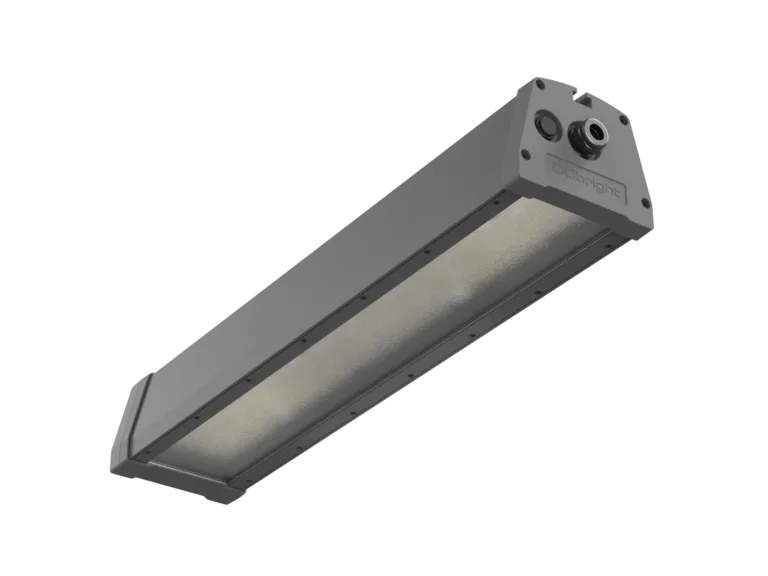 LinearLinear lighting above workstations25,600 lm at 120 W (1,200 mm)
Optics 30 to 120 degrees
IP69K, IK09, C5-MView Linear
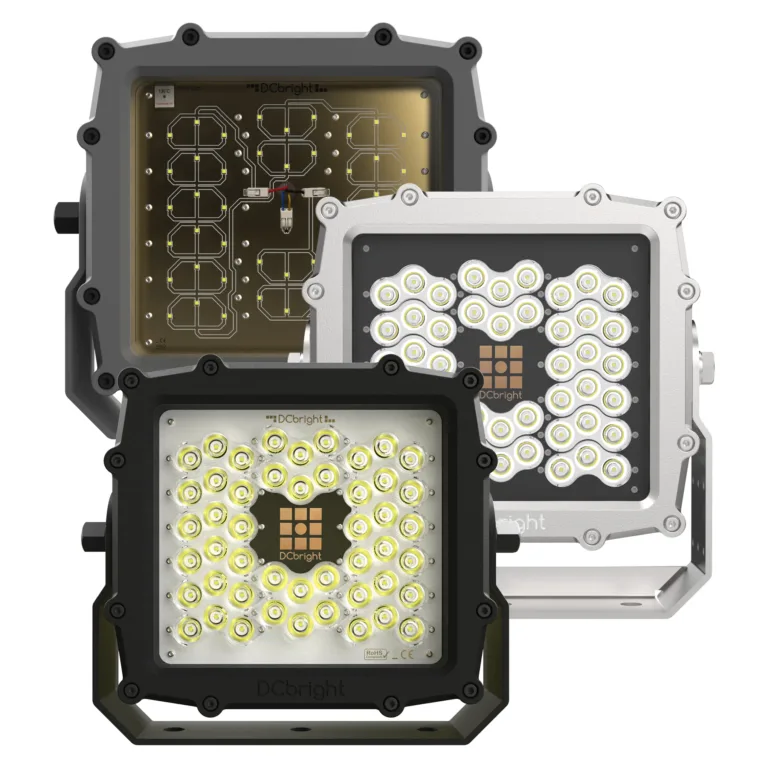 BarracudaHot zones up to 120 degreesHT version 20,600 lm at 120 W
Operating temperature up to +120 degrees
IP69K, 5-year warranty up to +120View Barracuda
 OrcaHigh halls and large spans111,300 lm at 800 W
Optics 14 to 69 degrees
IP69K, IK10, 22.7 kgView Orca
Practical example: Rockwool Croatia

Heat-resistant LED lighting in the Zajci factory
At the Rockwool factory in Zajci, Croatia, lighting was needed that could withstand ambient temperatures above 110 °C and the infrared radiation released during the production process. Standard LED lighting, and even many heat-resistant versions, fails under those conditions. JEL handled the lighting design, the engineering and the design of the installation, and supplied more than 50 Barracuda HT, more than 20 Snapper HT and more than 30 Linear HT. The installation delivers more than 100 lux on the shop floor, in line with EN 12464-1.
By combining three product types, every zone could be lit appropriately: Linear HT for general shop floor lighting, Barracuda HT and Snapper HT as directional floodlights. A recommended lux value is therefore the starting point of the design, not the end point. Which luminaire delivers that value at a given spot depends on the task in that zone and on the conditions in which the luminaire has to operate. Moreover, a lux value at handover only counts if the luminaire keeps achieving it under the actual thermal load.
Continue reading: High-temperature lighting, color rendering and CRI, LB values and lifespan and the energy investment allowance.
How JEL Products Helps with Illuminance in Manufacturing Environments
JEL Products helps industrial organizations achieve the right illuminance levels in production facilities and demanding work environments. This goes beyond simply supplying lighting luminaires: it begins with a thorough analysis of the work environment and its specific requirements.
What JEL Products offers:
- Professional lighting calculations based on room geometry, mounting height, and task requirements
- Luminaires from DCbright and DarkLicht, for which JEL Products is the exclusive distributor, designed for extreme industrial conditions
- Solutions for high temperatures, corrosive environments, and 24/7 operations; at sites with ATEX zones, lighting for the areas outside the zones, with a referral to a certified Ex manufacturer for the zones themselves
- Guidance from engineering and design to installation, commissioning, and maintenance
- ISO 9001 and VCA** certified working method, with a focus on safety and quality
Whether it’s a new production facility, a renovation of existing lighting, or a specific challenge in a demanding environment, JEL Products works closely with you every step of the way,from the initial technical inquiry to the completed installation. Get in touch for a no-obligation consultation on lighting levels and luminaire selection in your production environment.