
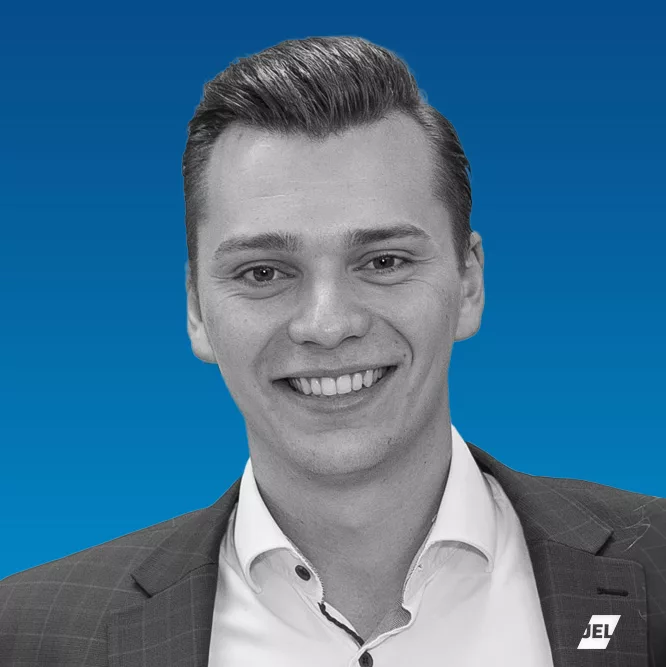
Technical Director and co-founder of JEL Products. Vice Chair of the Outdoor Knowledge Area at the NSVV.
I make lighting for places where lighting has a tough time: container terminals and ports, tower cranes, offshore, factories where temperatures reach up to 120 degrees Celsius, and sites and maritime work locations that simply have to keep going at night. On this site, I write about what that involves.
I wasn’t trained in this field; I just fell into it. I started out as a technical draftsman at my parents’ company, studied entrepreneurship at Windesheim in Zwolle, and founded JEL Products with my father in 2019. My interest in lighting came through my father, who introduced me that year to someone who had been in the lighting industry for years. From that moment on, I was drawn into the field. What began as technical curiosity turned into a passion for lighting.
What draws me to this work isn’t the lighting itself, but the question that precedes it: what exactly needs to be seen here, by whom, and at what moment? In practice, that often proves to be more decisive than the number of lumens. At JEL Products, in addition to technical matters, I’m also responsible for health and safety. These may seem like two different roles, but they amount to the same thing: lighting is there to enable people to do their work safely.
Less obvious, more thoughtful.
My daily world is the industrial outdoor space: terminals, crane tracks, construction sites, industrial estates, and factories. That is outdoor lighting, but it falls just outside of public lighting, which most guidelines and knowledge are about. That is precisely why I write about it: a lot has been documented about a residential street and a sports field, and considerably less about a container terminal or crane track, even though work continues there at night with the strictest safety requirements and often the greatest light emission of all.
At the end of 2020, with the arrival of updated lighting control technology, I worked together with specialists from various crane rental companies on light-shielding crane frames. Goal: to make crane lighting do what it is supposed to do without burdening the surrounding area. The NSVV Guideline on Light Nuisance at the time served as the framework.
Fifty-meter-tall light poles in the immediate vicinity of a UNESCO World Heritage Site. We handled every aspect of that project, from lighting calculations and drawings to on-site coordination. It’s precisely this kind of challenge that shows what really matters: providing enough light to work safely on a site that operates 24 hours a day, while ensuring that the night remains undisturbed just a few hundred meters away.
Work lights with full-cutoff optics that allow an asphalt crew to work on the highway at night without blinding oncoming traffic.
For offshore wind farms, an amber-colored light of 1,800 K with less than half a percent blue, so that the facility can operate as intended with minimal impact on the surrounding environment.

I don't spend all my time on projects; some of it is devoted to the field itself. That's where the frameworks I refer to in my articles come from.
Vice-chair of the Outdoor knowledge area, NSVV
Co-founder of JEL Products
Reference pages on lighting and standards
Within the NSVV, the Dutch Foundation for Lighting Science, I have served as vice chair of the Outdoor Knowledge Area since June 2026. Together with Chair René Staps, I set the direction for the knowledge area: the agenda and meeting schedule, liaison with the board and other knowledge areas, and recruiting new members.
In terms of content, I’m focusing on three things this year. The OVL Symposium 2026, for which I, together with the other members, submitted the thematic framework,ranging from social safety and smart lighting to the balance between people, wildlife, and the night. The revision of the Light Pollution Directive, which we as a field of expertise want to be involved in from the early stages. And staying abreast of developments in standards: EN 13201-2, the calculation grids in DIALux, and Blue Hazard.
On behalf of JEL Products, I have signed the Code of Conduct for Lighting Calculations, because a lighting calculation should be verifiable by the recipient, even if the result is not to the supplier’s advantage.
What it has taught me most of all is that I’m much more willing to say that less light, a shorter burn time, or simply not using lighting at all is the better solution. For a supplier, that’s an uncomfortable thing to say,and yet it’s the statement that inspires the most trust.
The reference material on this site is rarely about products and almost always about the question that precedes them: which figure belongs in a specification, what a lifespan code really says, and what the light does to the environment. These are the four lines, with the pages that remain for each line.
The values that determine whether the lighting on the site does what you want it to do, and the number that should be included in the specifications.
in which you compare lifespan, efficiency, and robustness, and why a number without context means nothing.
The topic where permits, the neighborhood, and nature come together, and the point where my work with the NSVV and my projects intersect.
Which regulations apply to your situation, and which figures from the lighting plan must be included in an application or notification.
| Function | Technical Director and Co-Founder, JEL Products, Nijkerk |
|---|---|
| In the field since | 2019 |
| Education | BSc Entrepreneurship, Windesheim University of Applied Sciences Zwolle |
| Additional | Lean Six Sigma Green Belt |
| Professional association | NSVV, knowledge area Outdoor, vice-chair since June 2026 |
| Signed | Code of Conduct for Lighting Calculations |
| Responsible for | Technology, Health, and Safety at JEL Products |
JEL Products designs and supplies lighting for industrial and maritime environments under the DCbright and DarkLicht brands. The company was founded in Nijkerk in 2019 and serves terminals, ports, crane rental companies, the offshore sector, the process industry, and contractors, both domestically and internationally.
If you want to know what is possible in your situation, lighting advice is the starting point. We calculate per position what is needed and what is not needed.
A question about an article, a calculation, or a position on your premises? Feel free to ask it.