

Short answer
Port lighting is site lighting that withstands sea air, vibration and 24/7 operation, and that does not blind crane operators or shipping.
Harbor lighting is a specialized form of industrial lighting specifically designed for the unique demands of port areas, terminals, and transshipment locations. It encompasses all lighting installations that ensure safety, visibility, and operational continuity on quaysides, yards, cranes, warehouses, and water-related infrastructure. The sections below answer the most frequently asked questions about applications, technical requirements, and the proper selection of luminaires.
IP65
or higher; in practice IP66 to IP69K
IK08
to IK10 against impact and vibration
C5-M
corrosion class for salty sea air
On the page port lighting you can read how JEL Products lights ports and terminals.
Which specific environments in a port require lighting?
Virtually every zone in a port requires targeted lighting, but the requirements vary greatly by location. Quays, container terminals, transshipment areas, warehouses, crane structures, access roads, and water surfaces each have their own demands regarding illuminance, beam distribution, and the robustness of the luminaires.
The most critical lighting zones in a harbor are:
| Zone | What the lighting has to do there |
|---|---|
| Campsites and loading/unloading areas | High lighting levels for safe operation of heavy machinery |
| Container storage areas | uniform illumination without shadow formation for overview and control |
| Harbor cranes and gantry cranes: | dishes lighting on harbor cranes for the crane operator and the work surface below |
| Warehouses and storage halls | diffuse, flat lighting for internal transport and warehouse work |
| Access roads and security zones: | brightly lit paths for pedestrians, vehicles, and access control |
| Water surfaces and berths: | visibility for shipping movements and mooring operations |
Each zone requires its own lighting strategy. A container terminal operating 24 hours a day has different requirements than an inland port used only during the day. The combination of outdoor lighting, crane and machine-bound lighting, and indoor lighting makes port terminals one of the most complex lighting projects in the industry.
What technical requirements apply to lighting in ports?
Lighting in ports must meet strict technical standards due to the combination of extreme environmental factors. The main requirements are a high IP rating for protection against water and dust, corrosion resistance due to exposure to sea air, high mechanical strength (IK rating), and sufficient light output for large illuminated areas.
Specifically, the following technical minimum requirements apply to most port applications:
Minimum technical requirements
For specific zones, additional requirements apply. For ATEX zones, such as fuel storage areas, explosion-proof luminaires are mandatory. In the case of Extreme corrosion Due to chemical exposure, standard aluminum luminaires are insufficient and stainless steel versions are necessary. More information about IP and IK ratings can be found on the page about IP and IK ratings.
| Outdoor zone | Guide value according to EN 12464-2 |
|---|---|
| Walkways for pedestrians | 5 lux |
| Roadways for slow traffic, up to 10 km/h | 10 lux, U0 0.40 |
| Roadways for regular traffic, up to 40 km/h | 20 lux, U0 0.40 |
| Short-term handling of large units and bulk | 20 lux, U0 0.25 |
| Continuous loading, unloading and stacking | 50 lux, U0 0.40 |
| Reading labels, covered loading platforms, working with tools | 100 lux, U0 0.50 |
| Difficult assembly, electrical and mechanical work outdoors | 200 lux, U0 0.50 |
What is the difference between harbor lighting and standard outdoor lighting?
The fundamental difference is that port lighting is designed for continuous exposure to sea air, mechanical stress, and operational conditions that standard outdoor lighting cannot withstand. Whereas street lighting or park lighting is built for relatively protected environments, port lighting must perform in a combination of corrosion, vibration, dust, moisture, and 24/7 use.
Standard outdoor lighting is designed for roads, squares, and buildings, with an emphasis on energy saving and aesthetics. Port lighting prioritizes robustness, low maintenance, and high lighting performance under extreme conditions. A typical parking lot luminaire has an average lifespan of five to ten years under normal conditions. That same luminaire in a port with salty sea air and daily vibrations from heavy cranes can fail within a year.
In addition, port lighting places different demands on beam distribution. Large areas require luminaires with a wide asymmetric beam to uniformly illuminate surfaces without glare for crane operators or shipping. Standard outdoor lighting is typically not designed for this.
What types of luminaires are used in port lighting?
In port lighting, four main types of luminaires are used: high-power LED floodlights for masts and towers, crane-mounted work lights, flat beam lights for sheds and covered areas, and specialized luminaires for crane structures and mobile equipment. The choice depends on the specific application and environmental requirements.
The most common luminaire types are:
| Luminaire type | Application in the port |
|---|---|
| LED floodlights on light poles | for illuminating large open areas, container stacks, and quays from a great height |
| Crane lighting | Specially mounted luminaires on harbor cranes for the work surface and the operator's cabin |
| Work lamps for mobile equipment. | robust LED work lights for reach stackers, terminal tractors, and other vehicles |
| Warehouse floodlights | High-efficiency lighting luminaires for internal logistics spaces and storage halls |
| Access road luminaires | focused on safe traffic flow and access control |
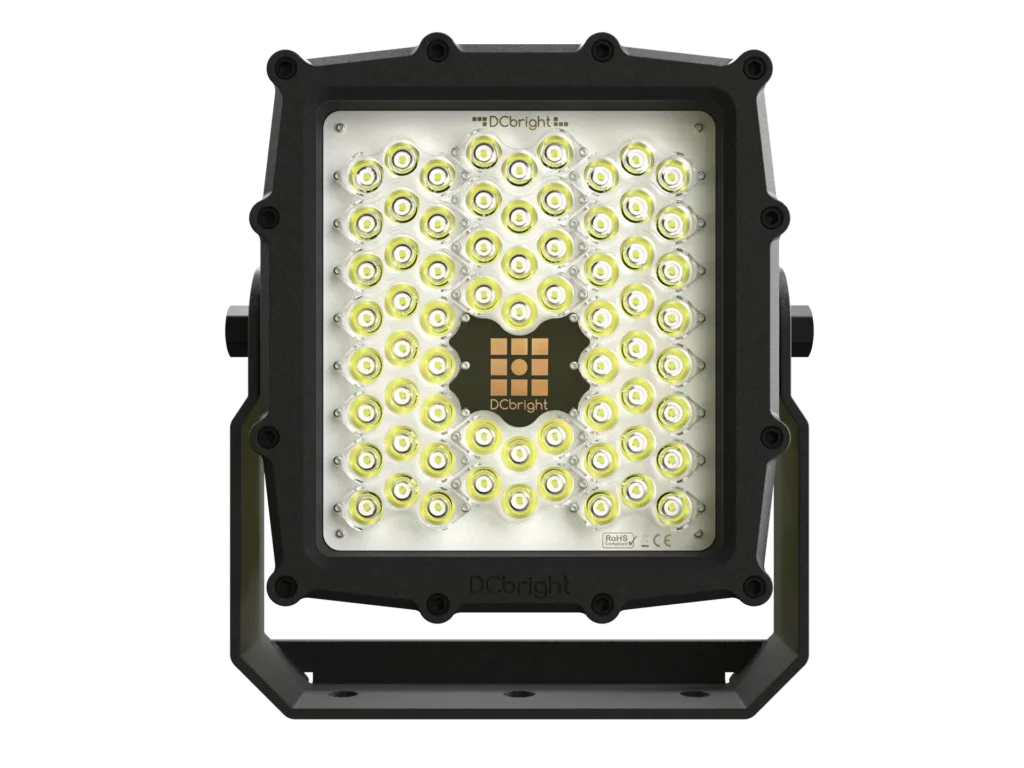
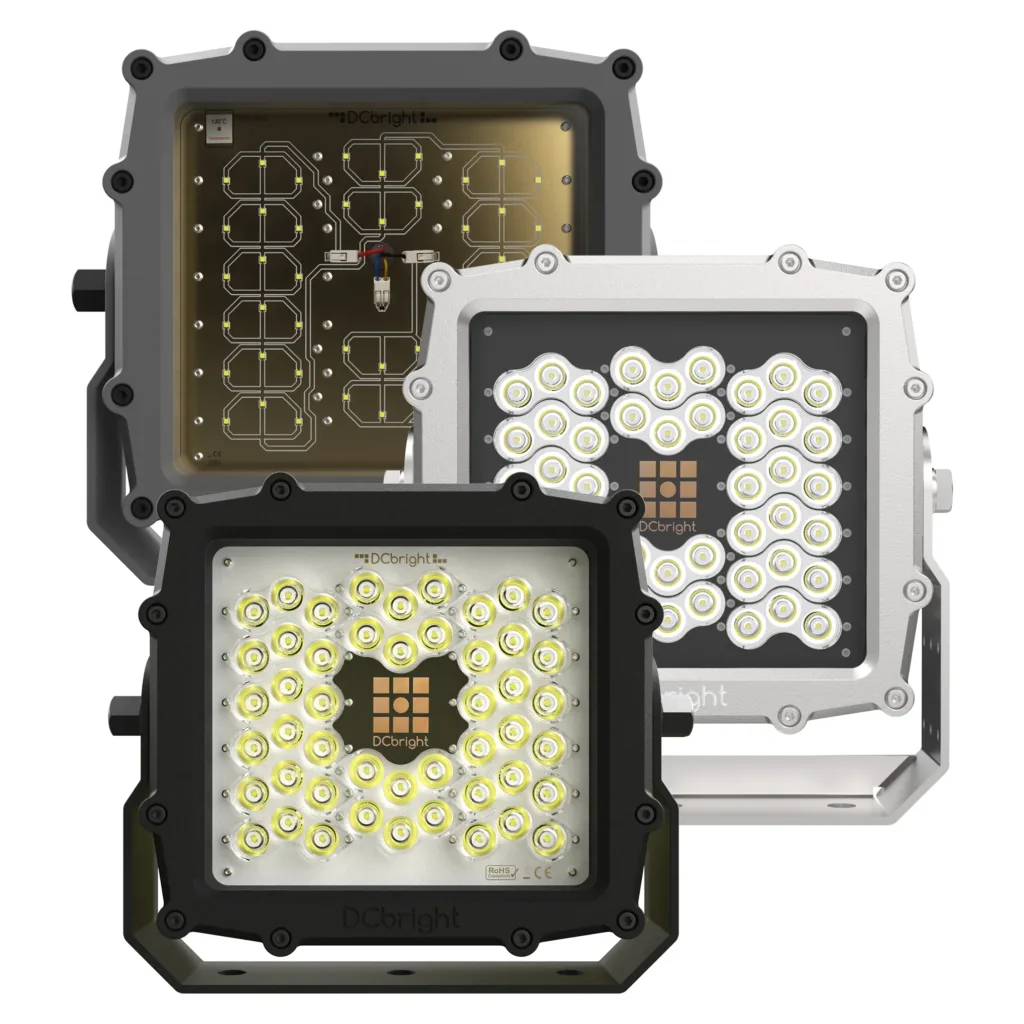
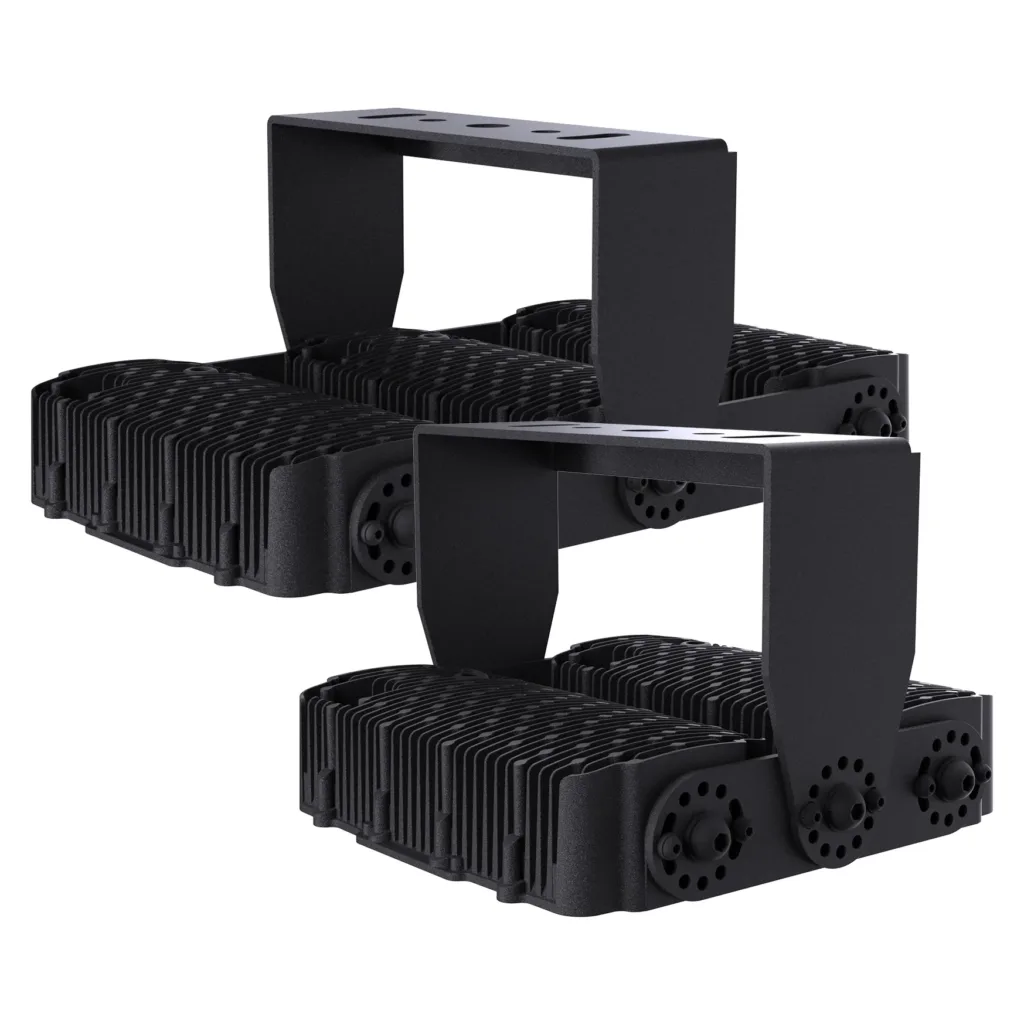
For the toughest applications on terminals and in Ports and terminals luminaires that are specifically developed for industrial use, with a long lifespan and minimal maintenance requirements, are deployed.
Luminaires for ports
How does port lighting affect safety and productivity?
Good harbor lighting has a direct and demonstrable impact on both safety and productivity. Insufficient lighting increases the risk of workplace accidents, cargo damage, and errors during loading and unloading. Adequate and well-directed lighting enables operators, machine operators, and ground personnel to work faster and more accurately.
The safety effects are most directly visible in situations where people and heavy equipment operate on the same site. Crane operators must be able to see precisely where they are lowering loads from a great height. Ground personnel must be visible to vehicle drivers, even in the early morning or late evening. Poor lighting in these situations leads to an increased risk of incidents.
The productivity gain lies in the ability to operate 24 hours a day without compromising speed or accuracy. Ports that rely on daylight or work with outdated lighting systems face operational limitations. Modern LED port lighting ensures a consistently and brightly illuminated work surface, regardless of the time of day or weather conditions.
Port lighting
We design the lighting from quay to crane
Send an aerial photo or site plan with the quays, stacks, cranes and traffic routes. You receive a lighting design per zone with mast positions, luminaire choice in the right corrosion class and the glare towards operators and shipping.
Free of charge and without obligation · Response within 1 working day from an engineer
When is it time to replace or upgrade port lighting?
Street lighting should be replaced or upgraded when luminaires are visibly outdated, the light output has noticeably decreased, maintenance is structurally increasing, or when the installation no longer meets current safety standards. A switch from conventional lighting to LED is also a strong reason for an upgrade in most cases.
Concrete signs that replacement or upgrade is necessary:
Self-check
Is your port lighting due for replacement?
If you recognise two or more signs, a baseline measurement of the current installation pays off.
- Luminaires are breaking down more and more often or require frequent repairs.
- Light output has visibly decreased, areas look darker than before
- The installation is over ten to fifteen years old and based on outdated technology such as high-pressure sodium or metal halide lamps
- Energy costs for lighting are disproportionately high compared to lighting performance.
- Safety inspections or audits indicate insufficient lighting levels
- Expansion or redevelopment of the site requires a new lighting layout
An upgrade to modern LED harbor lighting offers not only better lighting performance but also a significant reduction in energy consumption and maintenance effort. Furthermore, for many organizations, fiscal benefits are available through schemes such as the Energy investment tax credit.
Project · Ports and terminals
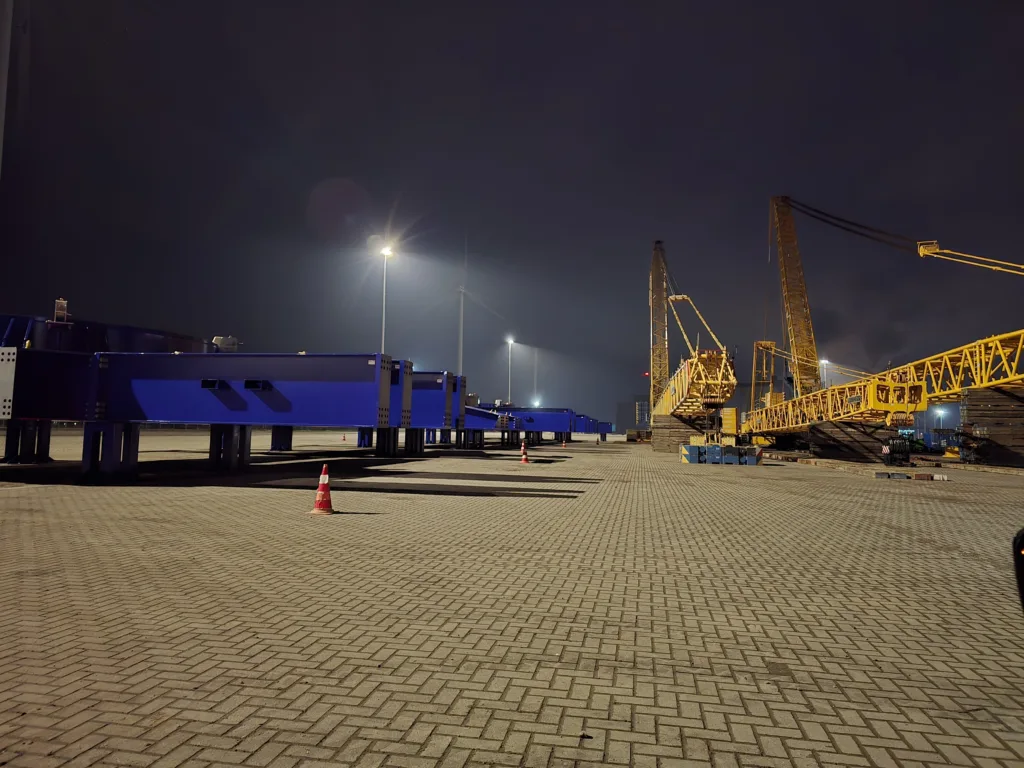
Complete terminal lighting for BUSS Terminal Eemshaven
From lighting design and light nuisance assessment to foundations, 50 m masts, power infrastructure and installation: an offshore wind terminal that works 24/7 in an environmentally sensitive area.
50 m
high masts, including geotechnics and foundations
600 W
DarkLicht luminaires with controlled light emission
24/7
offshore wind logistics and heavy port operations
Further reading
How JEL Products Helps with Port Lighting
JEL Products provides comprehensive lighting solutions for ports, terminals, and related industrial environments. We don’t just supply luminaires; we handle the entire process, from engineering through commissioning and maintenance. Our approach is tailored to environments where standard solutions fall short.
What JEL Products offers for port applications:
- High-power LED floodlights and crane lighting specifically designed for industrial port use
- Luminaires with high IP and IK ratings, corrosion-resistant designs for salty environments
- Custom lighting design and engineering, tailored to the specific site layout and operational requirements
- Guidance on subsidy and tax regulations for the investment
- Full project management from design to installation and aftercare
Would you like to know the right lighting solution for your port or terminal? Get in touch Contact JEL Products for a no-obligation consultation.