

Short answer
The difference between horizontal and vertical illuminance lies in the direction in which the light is measured. Horizontal illuminance measure the light falling on a horizontal surface, such as the ground or a work floor. Vertical illuminance measures light on a vertical surface, such as a container wall, a vehicle side, or a person moving through the port. In ports, both measurements are necessary because safety and operational control depend on multi-directional visibility. This article answers the most frequently asked questions about illuminance in ports and terminals.
Guideline values according to NEN-EN 12464-2:2024.
Why do ports measure lux both horizontally and vertically?
Activities in a port are not limited to illuminating the ground. Crane operators, truck drivers, and security personnel need to recognize objects, vehicles, and people on vertical surfaces,and horizontal-only lux is insufficient for this.
\nMore about the approach of JEL Products can be found on the page port lighting for ports and terminals.
\nComplex logistical movements take place in a port, where visibility in all directions is of vital importance. A well-lit roadway says little about the visibility of a passing forklift at eye level. Security cameras also work much better when there is sufficient vertical illuminance, as faces and license plates are then clearly captured.
By port lighting So, it's always about a combination of both measurements. A lighting plan that only focuses on horizontal lux does not meet the practical and normative requirements of a modern port area.
What lighting standards apply to ports and terminals?
The European standard EN 12464-2 is leading for ports and terminals. This standard specifies minimum illuminance levels for outdoor workplaces, including both horizontal and vertical values. For traffic routes in ports, a minimum horizontal illuminance of 20 lux generally applies, while work areas require higher values.
In addition to EN 12464-2, sector-specific guidelines also play a role. Consider requirements from port authorities, ISPS security standards for security zones, and additional requirements for ATEX zones where there is a risk of explosion. For vertical illuminance, a minimum of 50 lux at a height of 1.5 meters is often used in work zones, but this varies by application and risk class.
Relevant considerations for lighting standards in ports:
- EN 12464-2 as a basic framework for outdoor workplaces
- Uniformity requirement: the ratio of minimum to average illuminance must not be too low
- Specific requirements for security zones (CCTV-compatible lighting levels)
- ATEX classifications in explosive atmospheres
- Additional requirements from local port authorities or clients
How does the height of light poles affect the vertical illuminance?
Mast height has a direct impact on how well vertical surfaces are illuminated. The higher the mast, the greater the angle at which light strikes a vertical surface. With large mast heights, the light falls more from top to bottom, which benefits horizontal illuminance but can reduce vertical illuminance.
In practice, this means that a 20-meter or higher mast, while illuminating a large area, is less effective at eye level for recognizing vertical objects than a lower mast with a wider beam pattern. The optimal mast height is therefore always a trade-off between the size of the area, the desired uniformity, and the required vertical illuminance.
An lighting design that only controls at mast height without considering the luminaire's beam angle almost always leads to deficiencies in vertical lux. Specialized LED floodlights Adjustable optics offer a solution here, as the light beam can be directed to the areas where vertical illuminance is most needed.
Vertical light
We calculate the vertical lux on your property
Please send us your site plan with the pole heights. We will provide you with the illuminance levels at 1.5 meters, broken down by zone, in accordance with NEN-EN 12464-2. You will receive a response within one business day from an engineer.
No newsletter, no sales pitch.
What are the consequences of insufficient vertical illuminance in harbors?
Insufficient vertical illuminance directly leads to safety risks. People, vehicles, and obstacles are poorly recognized at eye level, increasing the likelihood of collisions, falls, and other incidents. Security systems also perform poorly when vertical lighting levels are too low.
The consequences are concrete and multifaceted:
Do you recognize this on your property?
Check off what you encounter. Two or more points almost always indicate insufficient vertical lux.
- Increased risk of collisions because crane operators and drivers do not notice vehicles and people at eye level in a timely manner.
- Reduced camera surveillance why license plates and faces remain unrecognizable in security footage.
- Lower labor productivity because employees have more difficulty reading labels, numbers, and signage on containers or vehicles.
- Non-compliance with standards such as EN 12464-2, with possible liability in case of incidents as a result.
- Higher chance of errors during loading and unloading, with cargo or equipment damage as a risk.
How is illuminance measured and controlled on a port site?
A lux meter is used to measure illuminance on a port site. For horizontal measurements, the measuring plane is kept horizontal at working surface height, typically between 0 and 0.85 meters above the ground. For vertical measurements, the sensor is positioned vertically at a fixed height of usually 1.5 meters, directed at the surfaces to be assessed.
A thorough measurement follows a grid of measurement points spread across the site, allowing both average illuminance and uniformity to be assessed. In the design phase, lighting simulations are also used with software such as DIALux or Relux. These programs calculate the expected horizontal and vertical lux in advance based on the chosen luminaires, mast heights, and placement.
Control during installation is just as important as the design itself. Luminaires can decrease in light output over time due to dirt or wear, causing the actual illuminance to drop below normative limits. Periodic measurements and maintenance are therefore an integral part of professional lighting management.
What type of luminaire provides the best vertical illuminance in harbors?
Luminaires with an asymmetric or adjustable light beam perform best when it comes to vertical illuminance. They direct light onto vertical surfaces instead of exclusively downwards. High-power LED floodlights with a narrow to medium beam are ideally suited for use on high masts in port terminals.
Besides the beam angle, the following characteristics are also decisive for performance in a harbor environment:
- High IP rating (min. IP66) for protection against sea air, rain, and dust
- Corrosion-resistant material, preferably stainless steel or specially coated aluminum for salty environments
- Vibration resistance for mounting on cranes or masts that move
- High luminous efficacy per watt for efficient lighting coverage over large areas
- Adjustable optics so that the light beam can still be adjusted after installation
For specific applications such as crane lighting, the choice of luminaire is even more critical. Lighting for port cranes sets additional requirements for shock resistance and the ability to illuminate vertical surfaces at a great distance.
Fittings with directional or adjustable optics
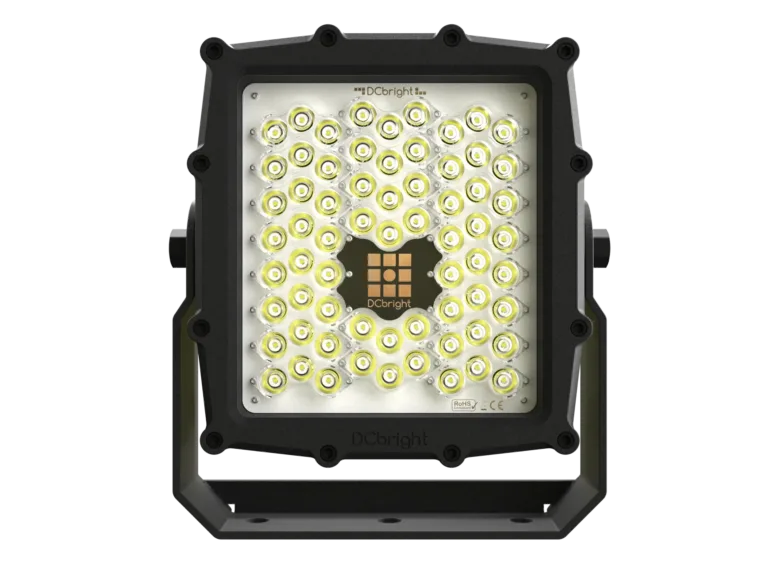 SharkAdjustable optics on high masts50,000 lm at 320 W
Optics 14 to 69 degrees, also 14 x 46
IP69K, IK10, C5-MView Shark
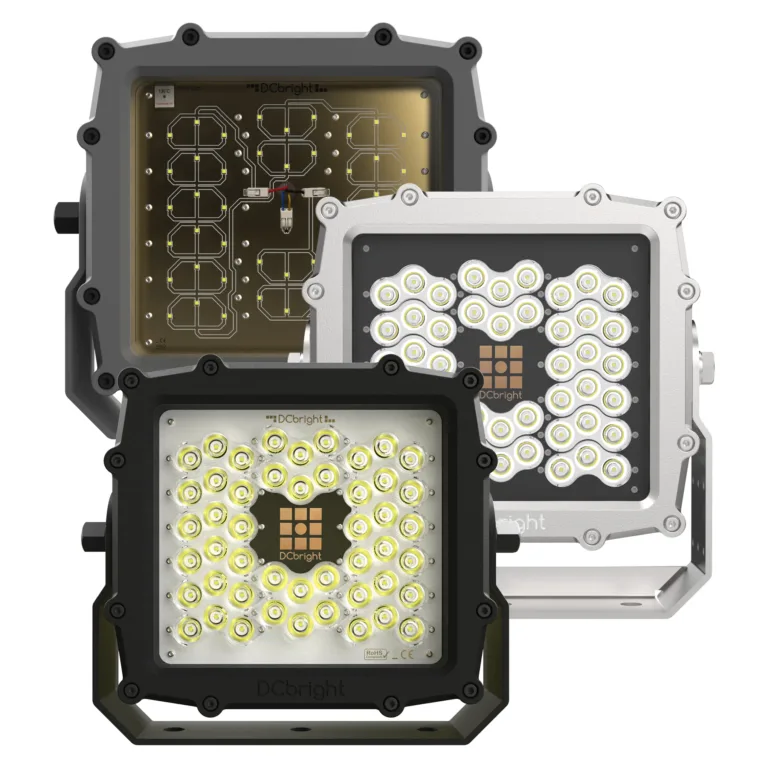 BarracudaSea air, vibrations, and stainless steel44,100 lm at 320 W
Stainless Steel 316L with a 20-year warranty on the housing
6 G vibration, IP69K, IK10View Barracuda
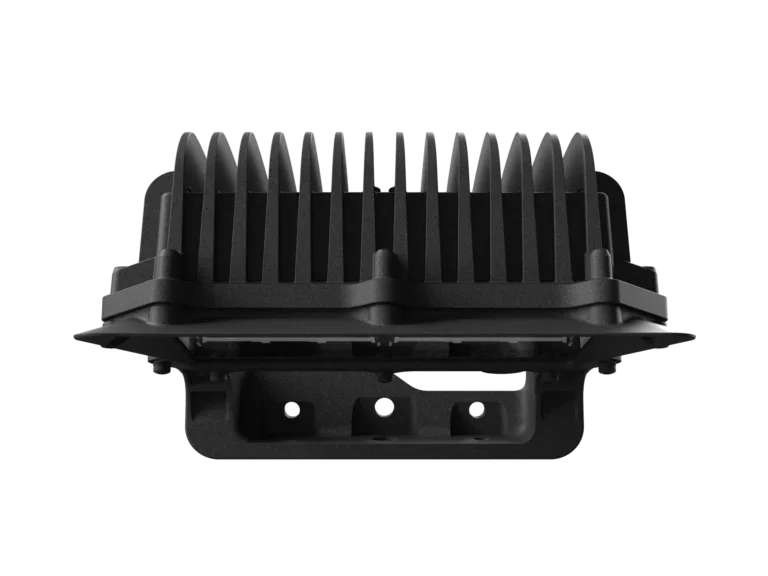 DarkLicht MGlare-free vertical lux51,300 lm at 300 W
Cut-off 63 to 75 degrees
IP69K, IK08, C5-MView DarkLicht M
Practical example: DFDS Vlaardingen
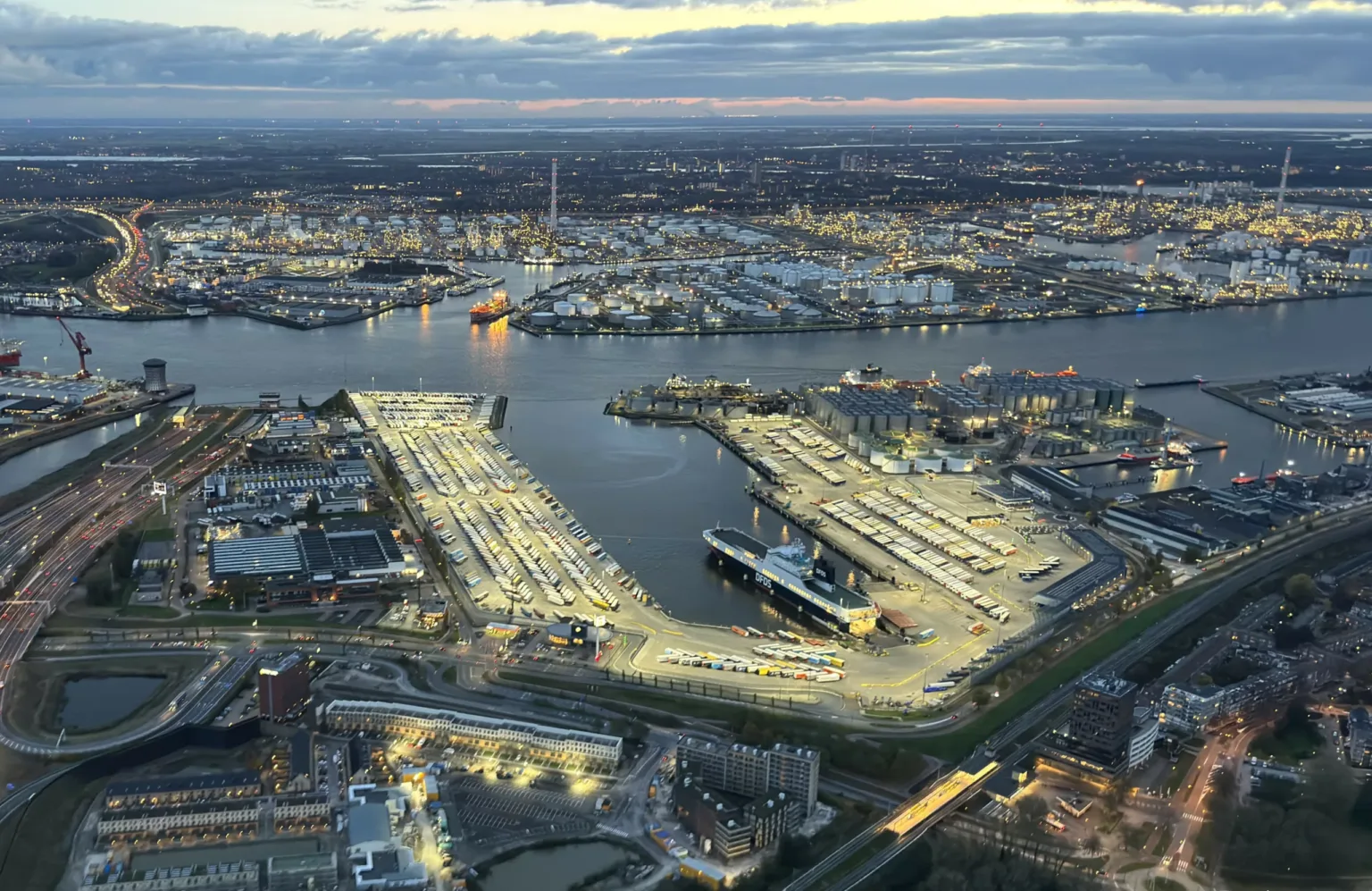
DFDS modernised its port terminal in Vlaardingen, which operates 24/7 and borders directly on a residential area. Commissioned by main contractor Boskalis, JEL handled the lighting design, light pollution control, lighting masts, installation and maintenance: 34 masts of 30 metres with a total of around 180 DarkLicht DL1 and DL2 luminaires. The site achieves an average of 50 lux with a uniformity of up to 0.45 (Uo), with around 30% energy savings compared to the other LED solutions offered.
The mast spacing of 145 metres, around five times the mast height, made dark zones and harsh shadows between the masts a real risk. This is exactly where the difference between the two quantities becomes visible. An average across the site can be fine, while a vehicle or person halfway between two masts receives little light on its sides.
With such a ratio between height and spacing, optics and aiming angles determine whether light falls on vertical surfaces from several directions. At the same time, glare towards the homes had to be prevented, which limits the scope for aiming luminaires more horizontally to gain vertical light. Both requirements therefore belong in a single calculation.
Continue reading: lighting poles and high mast lighting, light pollution and full cut-off, IP and IK rating and lighting for extreme corrosion.
How JEL Products Helps with Lighting Intensity in Ports
JEL Products offers a comprehensive approach to lighting challenges in ports and terminals, systematically incorporating both horizontal and vertical illuminance into the design. It begins with a thorough analysis of the operational requirements, applicable standards, and specific environmental factors of the port area.
What JEL Products specifically offers for port projects:
- Custom lighting design with DIALux simulations, including vertical lux analyses
- Luminaires from DCbright and DarkLicht, for which JEL is the exclusive distributor, tested for sea air, corrosion, and vibrations
- Full scope from engineering to installation, commissioning and maintenance
- Experience with complex port environments, including cranes, quays, and security zones
- ISO 9001 and SCC** certified for quality assurance on every project component
Whether it's a new lighting plan for a terminal or optimizing an existing installation: the approach starts with the initial technical question and continues through to final delivery. Please feel free to contact us via contact page for a no-obligation consultation about your port lighting.
Related Articles
- Why is visibility at high temperatures crucial for worker safety?
- Why is lighting on container storage yards often challenging?
- What is the difference between warm white and cool white light in an industrial setting?
- How does lighting affect the safety of crane operators?
- Why do companies choose industrial LED lighting?