

Home / Applications / Construction site lighting
A construction site changes every phase, and the light changes with it. Earthwork requires 20 lux, setting elements 100, and installation work 200. We calculate these levels per phase, choose the setup that fits your site, and keep the light within the property boundary. Without complaints from the neighborhood, and with a lighting calculation that you can submit.
200 lx
on the installation work, the highest requirement from table 13 of EN 12464-2:2024
0 %
of the light above the horizon, full cut-off factory-fresh
Per phase
calculated: earthworks, structural work, finishing, and installation

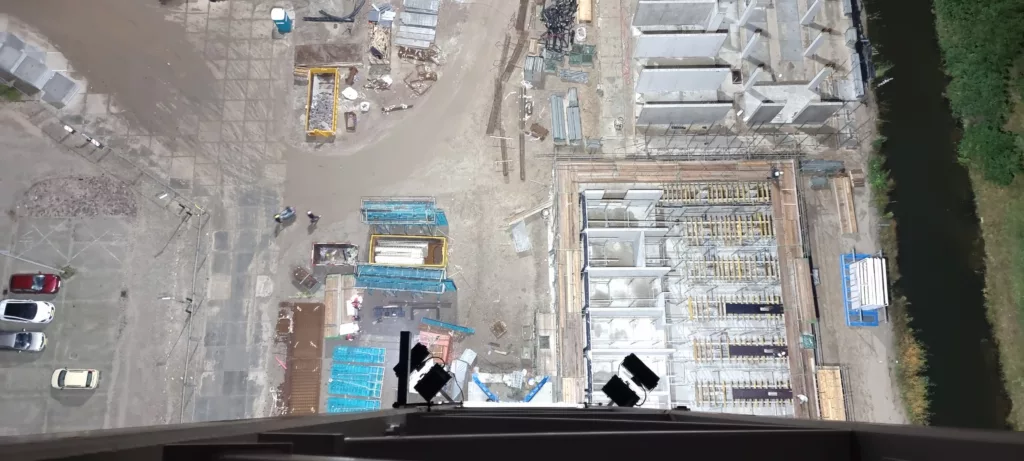
HSB Hilversum: the entire construction site illuminated from the crane jib, the surrounding neighborhood remains dark
Five things we encounter on almost every construction site. None of them cost a lot of money to fix, but they do cost money as long as they are there.
| what we encounter | what did it cost you | what we change |
|---|---|---|
| Construction lights on tripods, moved per phase, nobody calculates anything | Too little light on the work surface and too much on the walking routes, and not a single document if the labor inspector asks for it | A lighting calculation per phase, compliant with EN 12464-2:2024, which you can submit. |
| Fixtures that illuminate half the neighborhood | Complaints from local residents, and in the worst case, an official directive from the municipality | Full cut-off fixtures: nothing above the horizon, nothing across the property line |
| Glare towards the public road | Dangerous situations at the entrance and exit, and discussion with the road authority | Orientation and shielding chosen such that the threshold value increase remains below 15 percent |
| The generator is running at full capacity for lights that nobody is using | Diesel, noise and CO2 in an era where all of that matters | Power switched per zone, and where possible mains electricity or battery instead of diesel |
| Fittings that become dull after two seasons | Replaced during the project, and nothing left over for the next construction site | Fixtures that last through three to five projects and move from construction site to construction site |
The standard is not about the construction site as a whole, but about the working plane. That means that on a single site, 20, 50, 100, and 200 lux are needed simultaneously, and that a single high mast almost never solves that on its own.
Excavating, loading, backfilling, and setting out. The standard requires 20 lux here with a uniformity of 0.25. The working plane moves with the machine all day, so the lighting belongs on the machine or on a mast that can be moved quickly. This is the phase where a single mobile mast can handle the entire site.
Suitable: mobile lighting towers · LED work lights
Formwork, reinforcement, drainage, transport and storage: 50 lux. From here on, the requirement increases rapidly and the uniformity goes to 0.40, which means that you can no longer get away with a single light point. Shadowing by the structure itself becomes the design problem here, not the light level.
Suitable: mobile lighting towers · Tower crane lighting
Element installation, piping, electrical work and machine assembly: 100 to 200 lux, uniformity up to 0.50 and a glare rating of 45. The standard itself adds that this level may be achieved with local movable lighting. That is precisely what a work light on the machine or a movable luminaire is for.
Suitable: LED work lights · DarkLicht M
Driving routes, loading and unloading areas, and the storage yard: 20 to 50 lux. Pay attention to the surrounding area here: with a work surface of 50 lux, the standard requires a minimum of 20 lux in a two-meter band around it, so that no black hole is created next to the illuminated zone.
Suitable: DarkLicht D · area lighting
Under and around the crane, vertical light is just as important as horizontal light, because the crane operator and the rigger need to see the load and each other. Lighting from the boom works best here: the light comes from above along with the load and there is no mast in the way. See Tower crane lighting.
Suitable: Tower crane lighting · lighting for the mobile crane
The entrance and exit, the construction fence, and the site trailer are where the construction site meets the public space. Two things apply here simultaneously: enough light to recognize who is entering, and no glare toward the road. Wall-mounted luminaires on the trailer and the fence make more sense here than a pole.
Suitable: DarkLicht WP wallpack · light pollution
NEN-EN 12464-2:2024 covers construction sites in table 13. The 2024 edition has gained a second column, the modified value, and it is precisely that column on a construction site that is usually the actual design value. We explain why below.
| Activity | What does it require? | Genetically modified | U0 | RGL | Ra |
|---|---|---|---|---|---|
| Excavation, loading, and site clearance | 20 lx | 30 lx | 0,25 | 55 | 70 |
| Construction zones, piping, transport, auxiliary and storage tasks | 50 lx | 75 lx | 0,40 | 50 | 70 |
| Setting of elements, light reinforcement work, formwork, electrical and piping installation | 100 lx | 150 lx | 0,40 | 45 | 70 |
| Connecting elements, demanding electrical, machine and pipe assembly | 200 lx | 300 lx | 0,50 | 45 | 70 |
Source: NEN-EN 12464-2:2024, table 13. Highlighted: the column we use for practical design.
The standard increases the design value by one step as soon as one or two of the context factors from Table 1 apply, and by two steps for more than two. On a construction site, there are already two by default: the task or the employee moves, and Mistakes are expensive to fix. If a third factor is added, such as work that takes an unusually long time or a crew with a high average age, the value goes up another notch. Anyone on a construction site who sticks to the ‘required’ column is therefore designing for the absolute minimum.
With a work surface of 200 lux, the standard requires a minimum of 50 lux in the two-meter band surrounding it, at 150 lux a minimum of 30, and at 50 to 100 lux a minimum of 20. Below 50 lux, the standard sets no requirement for the surroundings. This is why a construction site with only spot lighting on the work surface feels restless and unsafe: the contrast between the task and the surroundings is too great.
The values in the table are maintained values. The initial illuminance results from Ēi = Ēm / fm, where fm is determined according to ISO/CIE TS 22012 based on the environment and the cleaning schedule. On a dusty construction site, that factor is lower than in a clean environment, and that is precisely the figure on which many designs fall short. We calculate the factor per project and include it in the report.
On a construction site, the limitation is rarely luminous flux. The limitation is what the support can handle: the head load of a mast, the wind catch at a height of ten meters, the available power of the generator, and the space on a boom winch or machine cabin. That is why we choose the location first and only the fixture afterwards.
four positions,
25,700 to 307,800 lm
Here is the translation: The head load and windage determine the fixture here. Light where the pole cannot handle much, heavy where it is anchored.
Mobile mast, smaller site
25,700 to 51,300 lm
3.6 to 5.5 kg
Mobile or temporary mast, larger site
51,200 to 102,600 lm
14.0 to 15.0 kg
Fixed or semi-permanent mast, large site
136,800 to 307,800 lm
up to 35.0 kg
Site and parking area next to the construction site
10,300 to 34,200 lm
6.9 to 8.5 kg
three positions,
4,800 to 16,000 lm
Where there is no mast, the light hangs on what is already there: the boom, the machine, or the shed. Smaller, lighter, and with its own mounting.
Tower crane jib, on crane frame
according to the crane frame
n/a
Mobile crane, telehandler, excavator
4,800 to 12,825 lm
1.0 to 3.3 kg
Cabin, fencing and entrance
9,600 to 16,000 lm
facade installation
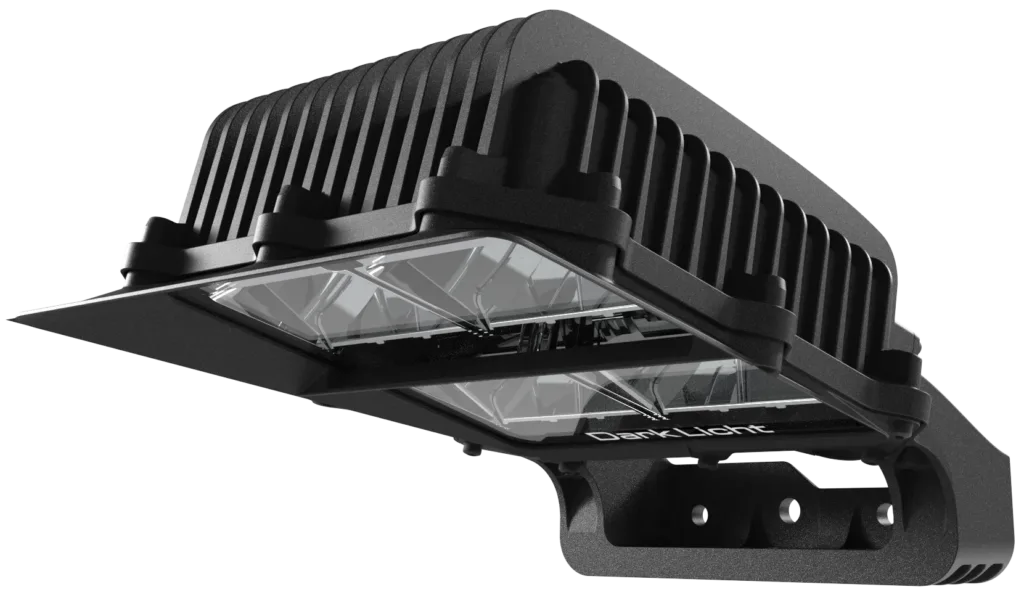
DarkLicht M150 in M300, 3.6 to 5.5 kg: the logical choice for a mast with limited top weight capacity
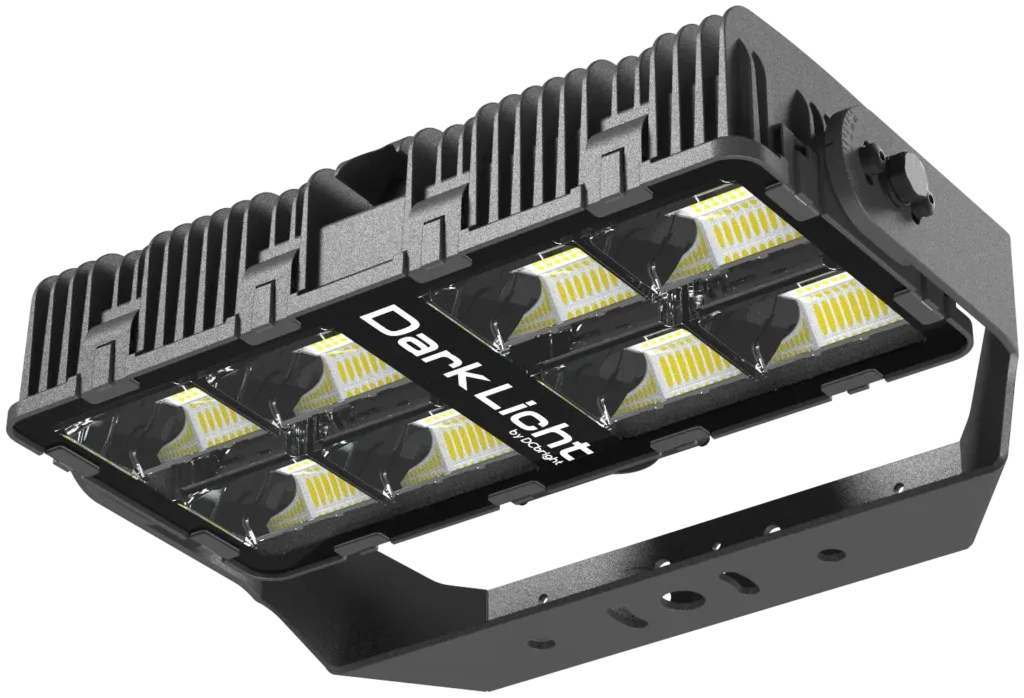
DarkLicht One, up to 102,600 lm: for larger mobile and temporary masts
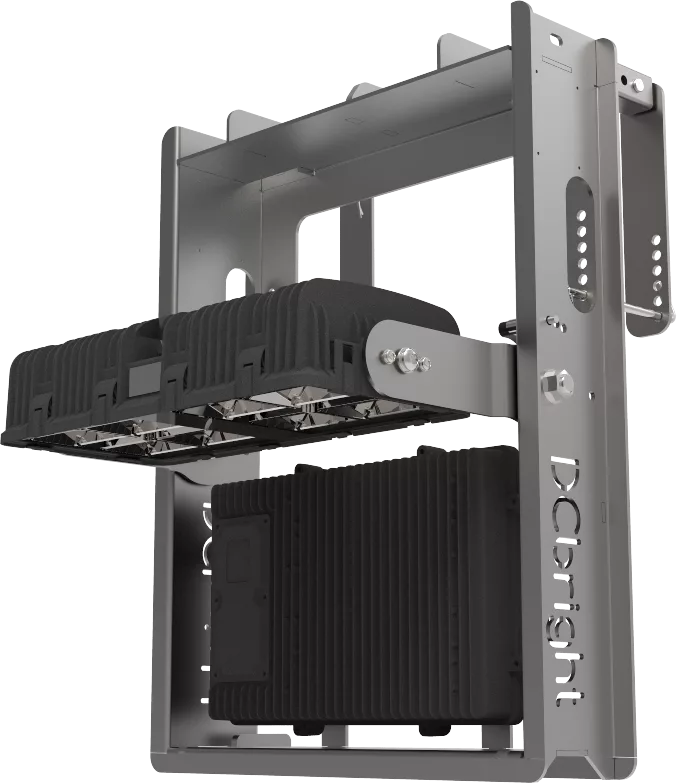
Crane boom frame: the light comes from above along with the load
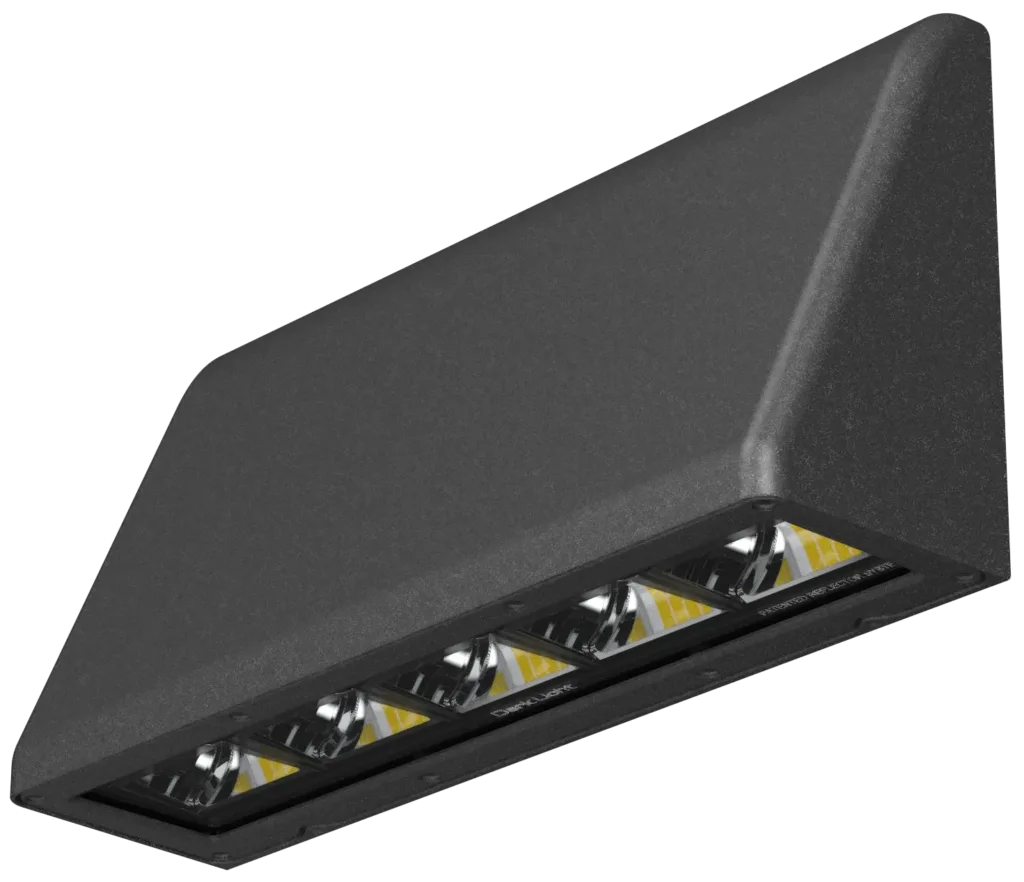
DarkLicht WP wallpack: on the site shack and on the fence, without blinding the road
Four DarkLicht M300 on a masthead weigh 22 kg for over 205,000 lumens. Four DarkLicht One weigh 60 kg for over 410,000 lumens. That difference determines whether a mast stays upright in force 8 winds, and it determines how heavy the foundation or outriggers need to be. On a mast with limited head load, the M is therefore the logical choice, even though the One can do more.
4 x DarkLicht M300
22 kg
over 205,000 lm
4 x DarkLicht One
60 kg
over 410,000 lm
If you don't want to assemble a mast yourself, we have two, both with our own fixtures on them. The JEL Sentinel Tower is fully automatic and completely obstruction-free: it slides up and down on a timer, runs on mains power, a battery up to 20 kWh, a solar panel, or diesel, and is illuminated with full cut-off fixtures without a single lumen escaping into the sky or the neighborhood. 2AXL is the other extreme: 798,720 lumens from twelve Shark fixtures, a 10.5-meter hydraulic mast with 340-degree rotation, wind-resistant up to 100 km/h, and 200 operating hours on a single 240-liter tank. We sell the Sentinel Tower, and the 2AXL is also available for rent. Everything about both can be found at mobile lighting towers.
A construction site is rarely located on an industrial estate by itself. Usually, there is a residential area next to it, a road running alongside it, or the site borders on greenery. The standard sets strict limits on this, and those limits are stricter after the curfew than before it.
| Environmental zone | Vertical strength on facades, before and after curfew | Luminous intensity per luminaire, before and after | Upward light percentage |
|---|---|---|---|
| E1, nature reserve or protected area | 2 lx / 0 lx | 2,500 cd / 0 cd | 0 % |
| E2, rural residential or industrial area | 5 lx / 1 lx | 7,500 cd / 500 cd | 2,5 % |
| E3, urban fringe, suburban | 10 lx / 2 lx | 10,000 cd / 1,000 cd | 5 % |
| E4, center and commercial area | 25 lx / 5 lx | 25,000 cd / 2,500 cd | 15 % |
Simplified from EN 12464-2:2024, table 4.
Most inner-city construction sites fall into E3, and a construction site on the edge of a village falls into E2. In both cases, the requirement after the curfew is a factor of five stricter than before it, and that is precisely the moment when the night shift continues working. A luminaire that shines at full power on the facades across the street after ten o'clock will not meet that limit.
That includes the public road. If your property borders a road, the lighting may not increase the threshold increment for road users by more than 15 percent. In the case of an unlit road, this imposes a strict restriction on the direction of the beam, because the adaptation luminance used in the calculation is lowest there.
Our DarkLicht fixtures are full cut-off from the factory. At the HSB construction site in Hilversum, the entire site was illuminated from the crane jib on that basis, in accordance with DarkSky principles: working level at the site, nothing upward, and nothing across the property boundary. There were no complaints from the neighborhood.
More information about the limit values and zone classification can be found at light pollution, and about the choice of light color at light color and Kelvin.
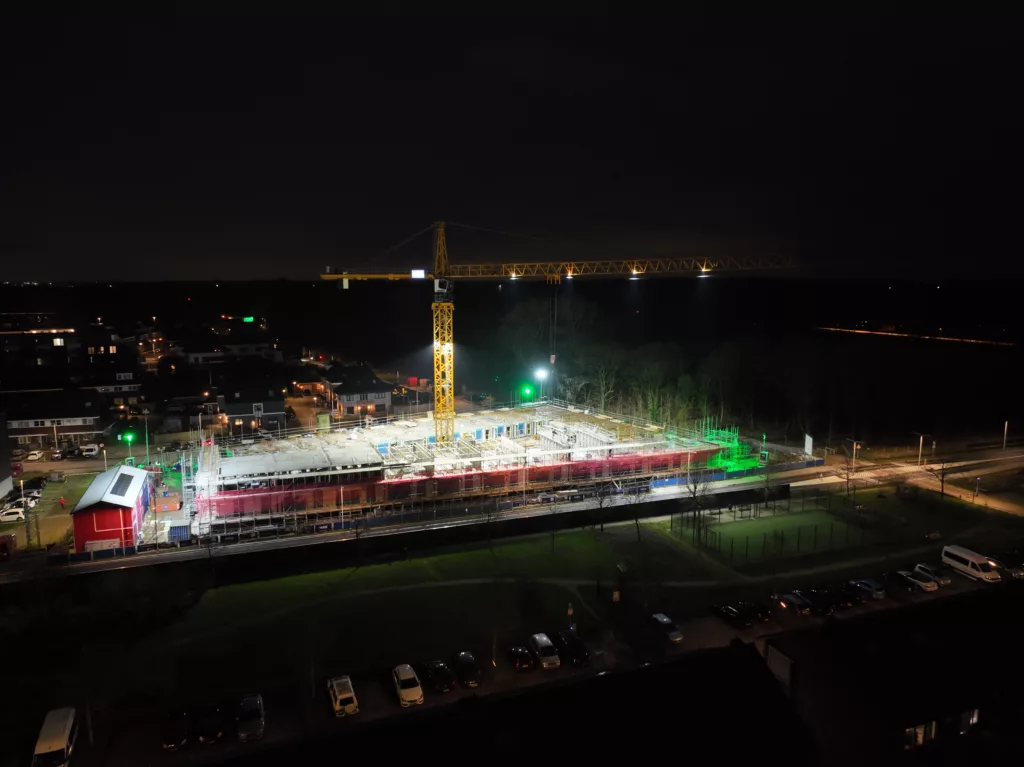
HSB Hilversum, zone E3: work level on site, the facades across the street are dark
On most construction sites, the power supply comes from a generator in the initial phase and only later from the permanent grid connection. That has two consequences for the design. First, the voltage dips briefly as soon as heavy equipment starts up, so the luminaire must have a wide voltage range and not trip because of it. Second, every watt you do not need is literally diesel.
Based on Dutch practice: between October and March, outside of daylight hours, you will have approximately 1,800 operating hours per season, and more with night shifts. A 4 kW setup that runs the entire season will therefore consume roughly 7,200 kWh. We place that consumption alongside the setup used in the lighting report, so that you can see what switching per zone yields.
What makes the biggest difference is not the fixture but the layout: switching the construction road, work area, and hoisting zone separately, and dimming to the level of the phase rather than to the maximum. The standard explicitly supports this, because dimming is the way to keep room for a later change in working conditions.
Calculation example, Dutch practice
18:00
fire hours outside daylight hours, October to March, more during night shifts
4 kW
a setup that runs all season
7,200 kWh
consumption per season, and every watt you don't need is literally diesel
Calculate your own situation with the payback period calculator.
Construction lighting is rarely a one-time purchase. What is used in one place has to be taken along to the next. There are three routes for that.
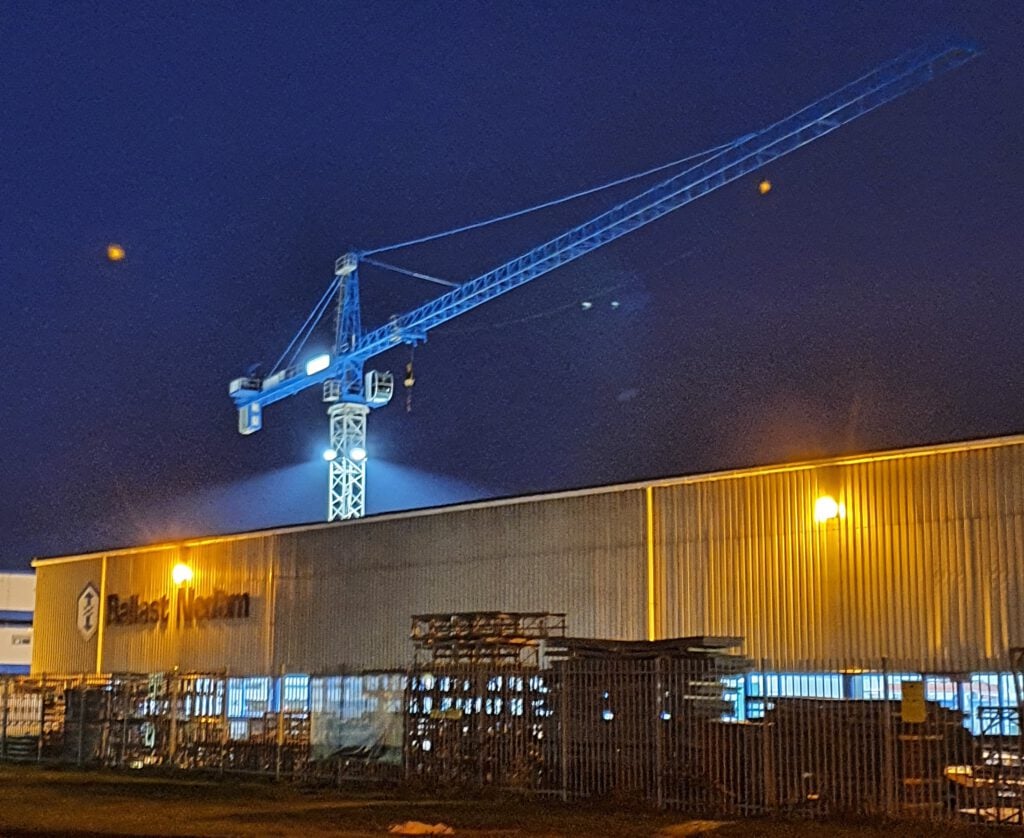
Buy · route 1
You buy the fixtures, we determine the lighting package based on your site and substantiate that with a lighting calculation. The fixtures move along to the next project. This is the route for contractors with their own masts or their own equipment.
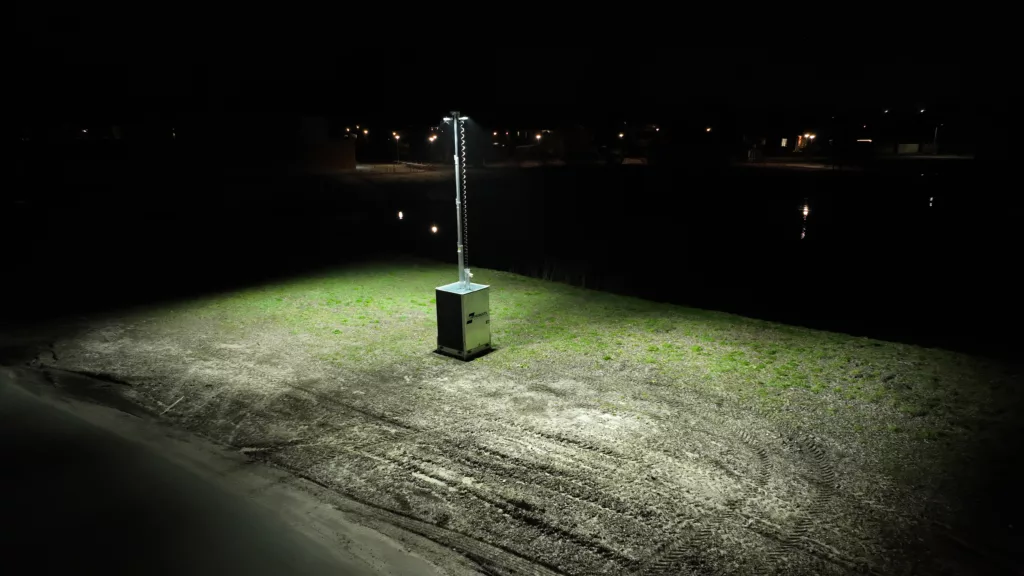
Buy · Route 2
Fully automatic, barrier-free and built per order. For inner-city work, along residences and in ecologically sensitive areas, where the lighting must be right and disruption must be zero.

Rent · route 3
Europe's brightest LED light mast is also available for rent per project. For large and deep sites: earthmoving, infrastructure projects, and work where a single setup needs to cover the entire site. With 500-hour service intervals and 24-hour support.
Whatever is stated below, the lighting calculation and the advice remain the same. We first determine what the site needs per phase, and only after that whether it will be rented, purchased, or delivered separately.
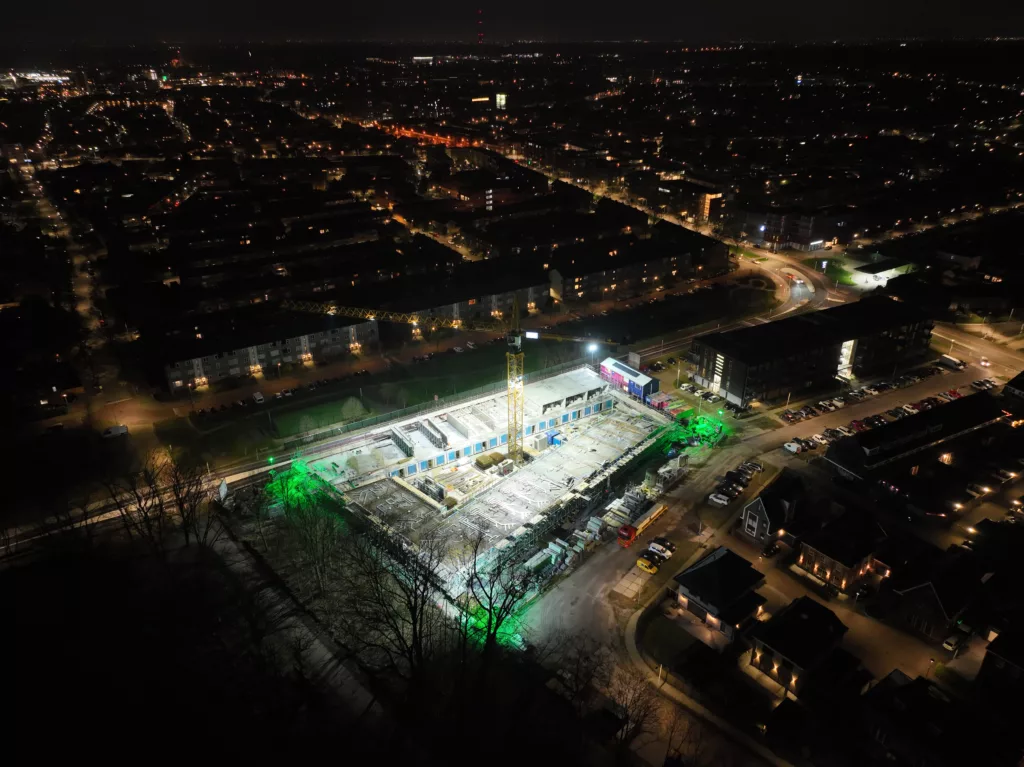
Hilversum · tower crane
Illuminating the entire construction site from the tower crane jib using DarkLicht full cut-off fixtures on a crane frame. Working level on site, nothing pointing upward and nothing crossing the property line. No neighborhood complaints and yet a complete view of the work.
View the crane fleet of Van der Spek →
Leiden · project More
Construction site lighting on the More project in Leiden, resulting in the award for best performing construction site.
View the project →
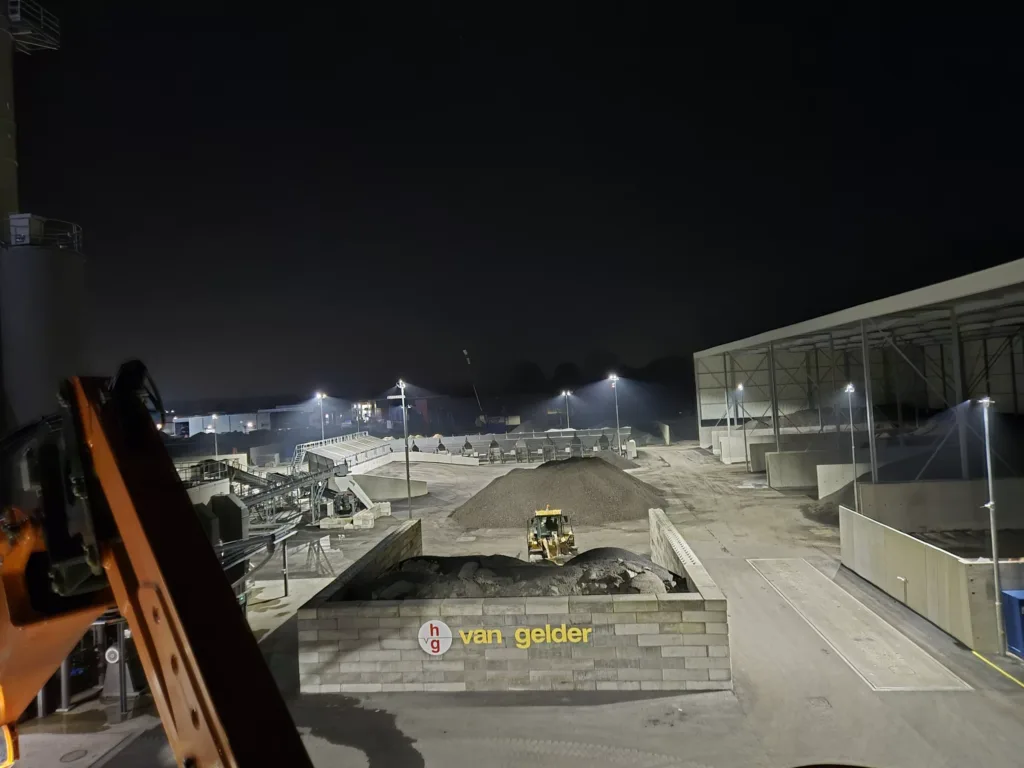
Nijkerk · asphalt plant
Site and work lighting at the asphalt plant in Nijkerk, calculated and installed by our own people.
View the project →





That depends on the phase. EN 12464-2:2024 requires 20 lux for earthwork, 50 for rough construction, 100 for setting elements, and 200 for demanding installation work. Because two context factors generally apply on a construction site (the task moves and errors are costly to fix), we practically design for the modified values: 30, 75, 150, and 300 lux.
No. The standard applies to the work surface, plus a two-meter band around it which also has a minimum value. The rest of the site does not need to be at the same level.
In a suburban environment (zone E3) that is 10 lux vertically on the facade before curfew and 2 lux after, with a maximum of 5 percent of the luminous flux above the horizon. In a rural environment (E2) it is 5 and 1 lux at 2.5 percent. We calculate that through and show it in the report.
Regarding the threshold value increase for the road user: it may not increase by more than 15 percent due to your lighting. In the case of an unlit road, this is the strictest, because the eye is adjusted to a low luminance there.
Yes, and that is what they are built for. The warranty is five years complete and up to twenty years on the housing with a maintenance contract, and the fixture moves with it to the next location.
Yes. Pay attention to the voltage range and the voltage dip when heavy equipment starts; we will adjust the drivers and group layout accordingly.
The 2AXL light mast is available for rent. We sell the Sentinel Tower and the separate lighting fixtures.
Standard versions come from Nijkerk and are fast; project configurations upon consultation.
Yes. Every setup is calculated in DIALux and tested against EN 12464-2:2024 and the NSVV Light Nuisance Directive, including the maintenance factor.
Green light is used on construction sites as a signal, not as task lighting: it marks a safe zone, a cleared walking route, or an approved setup, so that it is visible at a glance that an area is clear. It is not sufficient for the work itself, because green light does not provide color recognition and the standard requires a color rendering index of at least 70 on a construction site. Therefore, use it alongside the task lighting and never in place of it. Which light color corresponds to which work can be found on light color and Kelvin.
No, JEL currently does not supply ATEX-certified fixtures.
Scaffolding lighting is usually line lighting and that is not in our range. For the work on the scaffolding, we do supply the work lighting.
Construction site lighting is part of the sector construction and infrastructure. It states what a construction project requires as the environment for the lighting design.
Send us the size of the site, the phase you are in, and what is located next to it. You will receive a light calculation with guideline values per zone, a layout, and a justification that you can submit.
| Response | within 1 working day, by an engineer |
| Lighting calculation | free of charge, per zone |
| Test luminaire | on your own mast, upon request |
| Warranty | 5 years complete, 10 years on the housing with maintenance contract |
Rather call directly: 033 785 9809