

Home / Offshore and maritime / Deck and ship lighting
On a working deck, the layout changes with every operation and the height of the work surface changes with the job. A luminaire that is properly positioned in port illuminates the wrong spot at sea. We design the lighting for the ship as a whole: overlapping beams that remain uniform at every working height, virtually shadow-free, and without disturbing the bridge or navigation lights.
200 lx
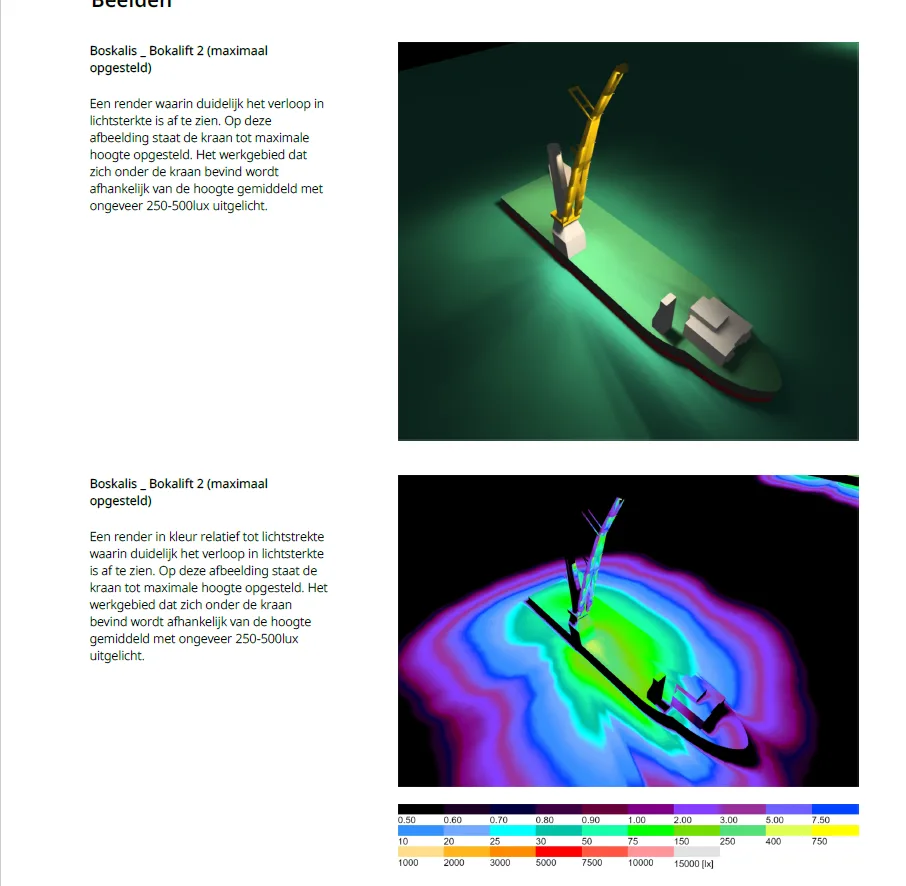
below the crane of the Bokalift 2, the level required by the standard for pump areas and lifesaving appliances
0,70
evenness over the height, from deck level to the working plane on the load
6 areas
separately calculated: deck, crane, walkways, transfer, lifesaving appliances and shipyard
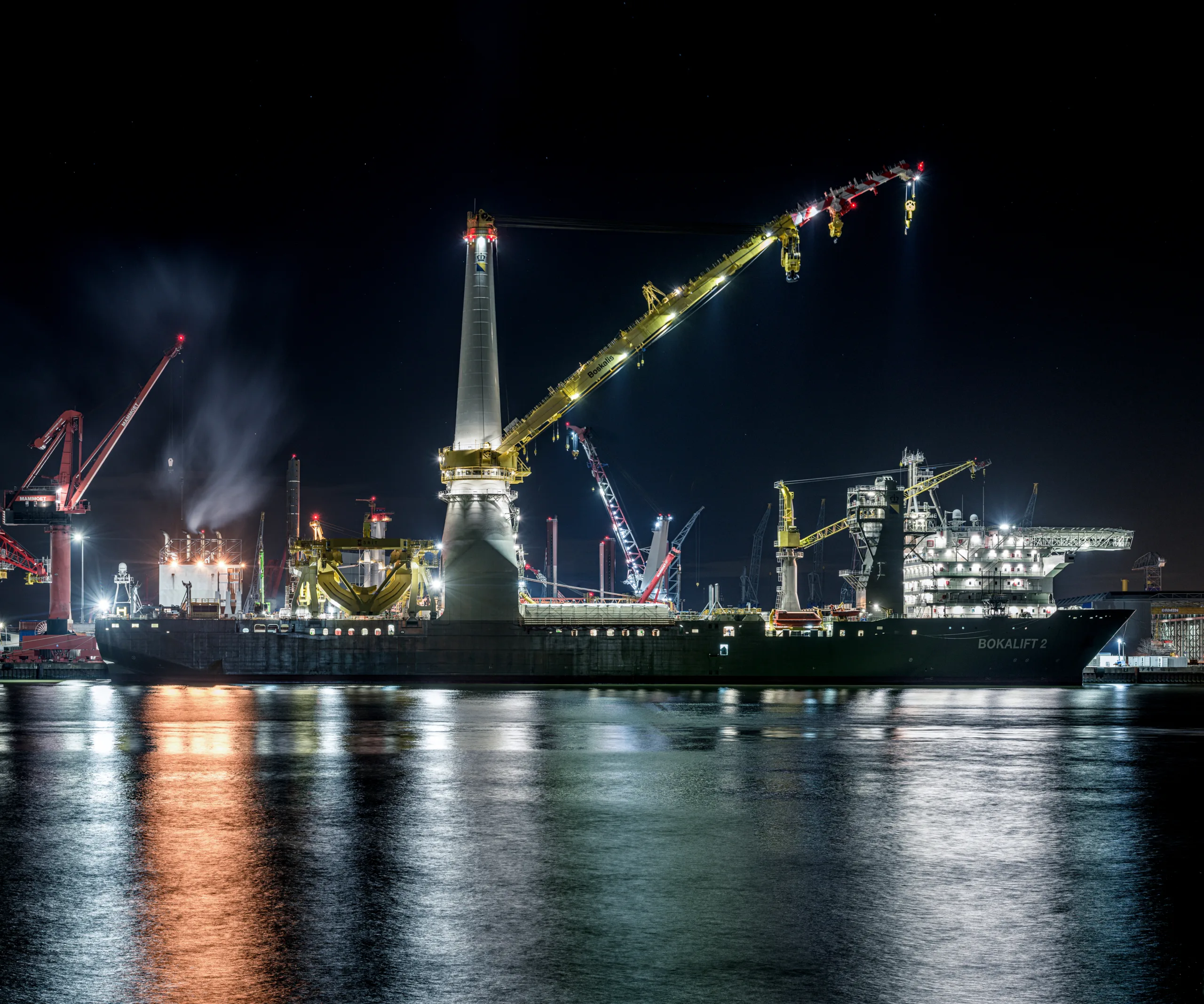
Bokalift 2, Boskalis: the entire working deck illuminated under the crane, with no dark areas
Virtually every ship we re-examine already had LEDs. The problem is rarely the fixture and almost always the design. We encounter this.
| what we find on board | what did it cost you | what we change |
|---|---|---|
| Spots with a narrow beam, selected by lumen output per luminaire | The deck is illuminated, the work surface is not, and at working height everything falls into shadow | Optics choice per position, with bundles that overlap instead of complementing each other |
| Fittings placed where a bracket fit | Dark patches right where work is being done, and glare where nobody needs to look | A lighting design on the ship's drawing, calculated per work station |
| One setup for a ship that does five things | Every non-standard operation requires separate construction lamps and extension cords across the deck | Switching zones separately, with a setup that complies in all operating positions |
| Light shining onto the bridge | The watch loses night vision and is going to switch off luminaires, and then the deck works in the dark | Shielding and direction chosen so that the bridge and navigation lights remain unobstructed |
| Coated aluminum in a permanently wet location | Severely rusted cable glands and water in the electronics within a few seasons | 316L on the wet positions, coated aluminum where possible |
The standard does not view the deck as a single plane. It recognizes work areas, and on a ship, these are located close to each other with a factor of three difference in light level. That is the reason why a single row of luminaires along the railing is never the right answer.
The deck where work, stowage, and screening take place. The standard requires 150 lux on a pipe deck with a uniformity of 0.50. The tricky part is not the level, but the height: during one operation the working surface is at deck level and the next three meters higher on a shipping container or a spool.
Below and around the crane, the vertical light counts just as much as the horizontal, because the crane operator and the rigger must see the load and each other at every height. On the Bokalift 2, that work area extends up to 125 meters above deck. This is the place where the beams must overlap and where stabilization makes all the difference.
Suitable: Crane Light Stabilizer · Orca · Barracuda
The standard requires 100 lux on ladders, stairs, and walkways, measured on the steps and not on the deck below it. That is a requirement that is not met in almost every existing installation we measure, because the lighting is from above and the step lies in its own shadow.
Suitable: LED work lights · Snapper
Transferring to or from a ship is the most dangerous operation on board. The standard requires 100 lux and a glare rating of 50 here, because anyone transferring looks upwards and at the water at the same time. Also account for the water surface: the standard specifies a separate 30 lux for that.
The standard requires 200 lux at the lifeboats and the assembly point. That is the highest level on the outer deck and it applies regardless of whether daily work is performed there. This is the first item checked during an inspection.
If the ship is undergoing maintenance, different values apply: 50 lux for scraping, cleaning, and painting the hull, 100 for painting and welding, and 200 for assembling electrical and mechanical components. The standard itself adds that this last level may be achieved using local movable lighting.
Suitable: LED work lights · LED floodlights
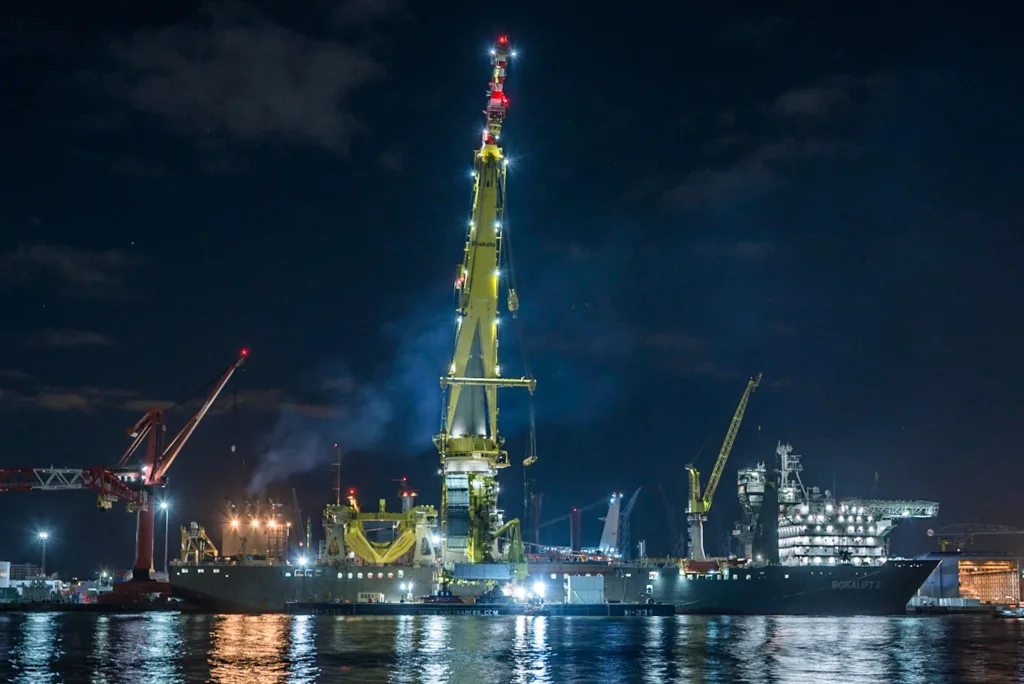
Working deck of the Bokalift 2: overlapping beams, the working surface in the light at any height
NEN-EN 12464-2:2024 covers offshore oil and gas installations in table 19 and shipyards and docks in table 24. For the working deck of a work vessel, table 19 is the applicable standard, as it specifies the working areas that also exist on a work vessel.
| Area of operation | Hmm | U0 | RGL | Ra |
|---|---|---|---|---|
| Water surface below the installation | 30 lx | 0,25 | 50 | 40 |
| Ladders, stairs and walkways (on the treads) | 100 lx | 0,25 | 45 | 40 |
| Boat landing and transfer zones | 100 lx | 0,25 | 50 | 40 |
| Treatment zones | 100 lx | 0,50 | 45 | 70 |
| Pipe rack and pipe deck | 150 lx | 0,50 | 45 | 40 |
| Pump zones | 200 lx | 0,50 | 45 | 40 |
| Lifeboat zones | 200 lx | 0,40 | 50 | 40 |
Source: NEN-EN 12464-2:2024, table 19.
| Area of operation | What does it require? | Genetically modified | U0 | RGL | Ra |
|---|---|---|---|---|---|
| General site lighting and prefab storage | 20 lx | 30 lx | 0,25 | 55 | 40 |
| Temporarily moving large sections | 20 lx | 30 lx | 0,25 | 55 | 40 |
| Scraping, cleaning and painting the hull | 50 lx | 75 lx | 0,25 | 50 | 70 |
| Painting and welding | 100 lx | 150 lx | 0,40 | 45 | 70 |
| Assembly of electrical and mechanical components | 200 lx | 300 lx | 0,50 | 45 | 70 |
Source: NEN-EN 12464-2:2024, table 24. Highlighted: the modified value that becomes the design value on site.
Table 19 does not have a modified column. At construction and work sites, the design value may increase by one step if circumstances so require; for offshore installations, the standard does not provide that flexibility and the required value is immediately the design value. That makes the calculations stricter: there is no margin provided by the standard itself, so that must come from the maintenance factor and from the design.
The color rendering may be low, except where something is being evaluated. For the majority of an installation, a color rendering index of 40 is sufficient. Only in treatment areas does the requirement jump to 70, and on the worksite, 70 applies as soon as painting, welding, or assembly is taking place. In practice, we design higher than 40 because the crew also needs to be able to distinguish color-coded hoses, cables, and markings, but it is good to know that the standard itself does not impose a requirement for that.
If the ship is at the quay, the values for quays and berths from Table 14 apply, and those are much lower: 10 lux on the quay and 30 lux during loading and unloading. That side is on Terminal lighting.
This is the core of the page. A site design is finished when the calculation grid is correct. A cover design is only finished when it is correct in every single operational setup, and that is a different kind of problem.
Not only across the deck, but also in height and along with the ship. A beam that achieves a uniformity of 0.7 at deck level will no longer achieve that at a height of four meters, unless the design is made for it. Therefore, we calculate on multiple planes and not just on the deck.
On a deck, cranes, containers, spools and structures get in the way. A single strong fixture creates sharp shadows; multiple fixtures with overlapping beams do not. That is why on the Bokalift 2 we redesigned the entire concept instead of replacing fixtures.
Hoisting work, transfer, maintenance, and sailing each require a different illuminated zone. Zones that switch separately are not a luxury, but rather the prerequisite both to meet the requirements and to avoid having everything illuminated permanently.
When illuminated from a crane or a boom, the beam moves with the movement and alternately illuminates the work and the sky. The Crane Light Stabilizer keeps the bundle in place; on the Bokalift 2, it is located on the crane fittings.
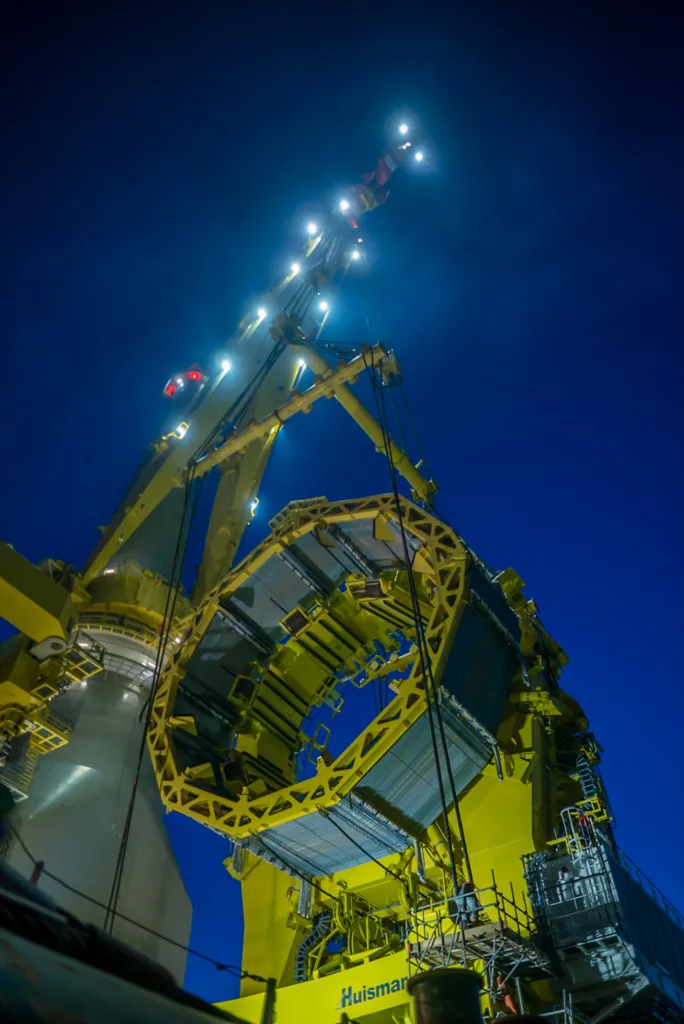
Crane of the Bokalift 2: the fittings in the Crane Light Stabilizer hold the bundle on the work surface while the crane moves
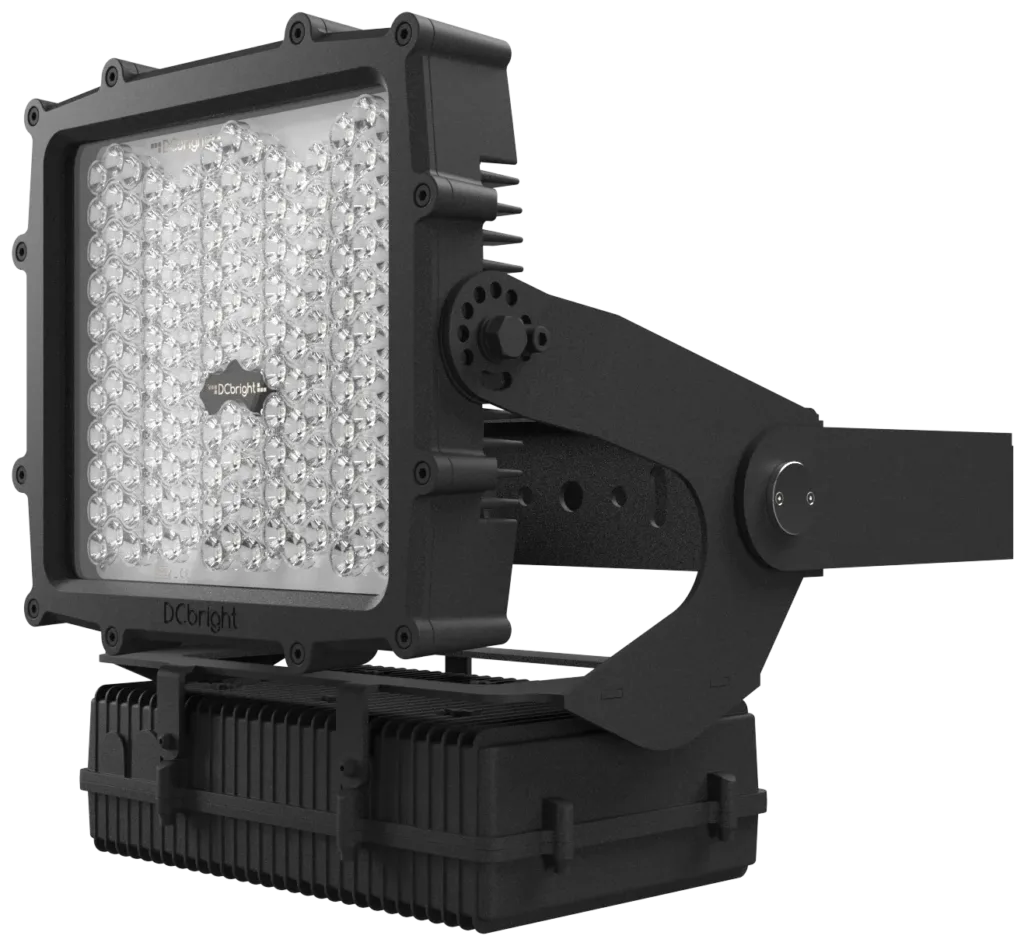 Crane Light StabilizerAutomatic stabilization for Orca and Barracuda on crane and boom. View the product
Replacing a luminaire above water requires a work permit, often a shutdown, and sometimes a aerial work platform that isn't there. That shifts the balance: lifespan and interchangeability carry more weight here than the purchase price. Read more about that at LB values and lifespan.
Every ship has operations for which the fixed installation was not designed: a repair in the hold, work at the stern during a transfer, an inspection in a place where nothing is installed. In practice, this is solved with construction lights and extension cords across the deck, and that is precisely where tripping hazards and damaged cables come from.
We supply the same luminaires for this purpose in a portable version: on a magnetic base, a clamp bracket, or a rear-mount bracket with the driver box on the back of the luminaire, featuring the ship's connector and voltage range. That means one type of luminaire on board, one set of spare parts, and one familiar lighting performance, instead of a work light that no one has calculated.
Suitable: LED work lights · Piranha · Snapper
Magnetic base
On steel deck and superstructure, without drilling and without bracket. Less common on board, but available.
Clamping bracket
On railing, tube, or profile, for work on the side or in the hold.
Rearmount bracket
With the driver box on the back of the luminaire: one compact unit that you move and connect without a separate power supply.
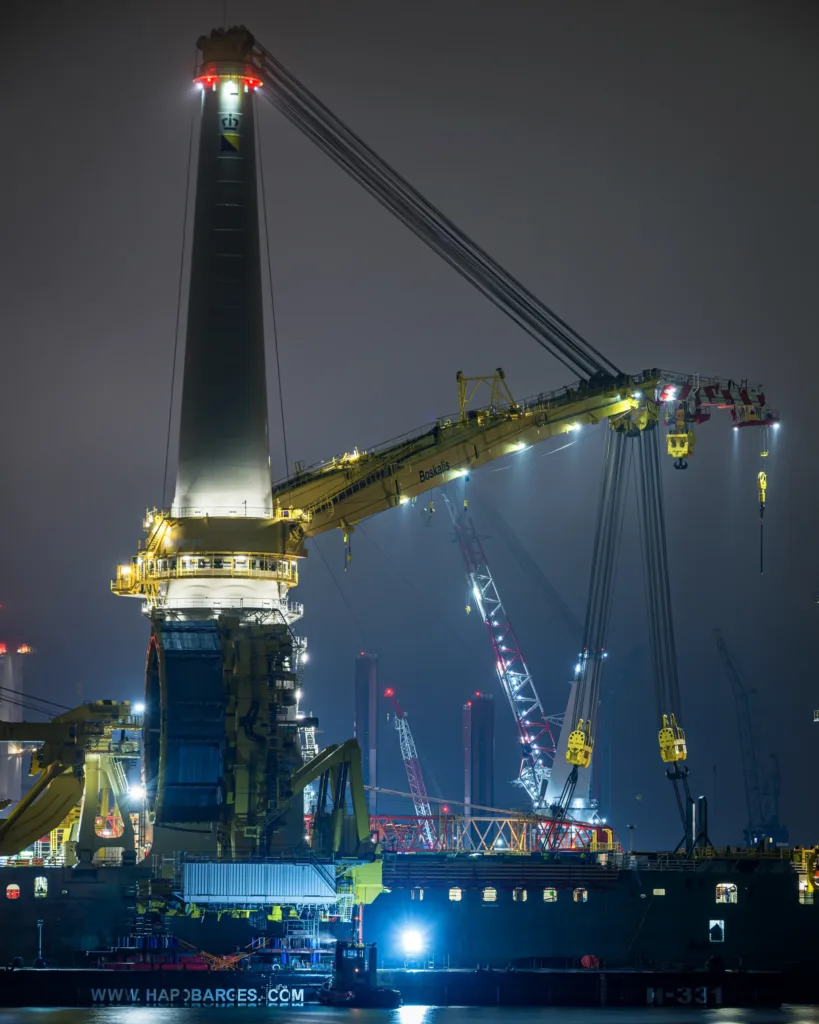
The crane and the deck are on fire, the bridge and navigation lights remain clear
Working deck lighting must not impair the view from the bridge and must not be able to be confused with navigation lighting. That is not a lighting standard but seamanship practice, and in most cases it is the reason why the crew switches off fixtures. An installation that is half turned off at night complies with nothing.
Three things solve that: shielding on the bridge side, placement below the watchkeeper's eye level where possible, and zones that can be switched separately so that the work zone is illuminated and the rest is not. The standard provides the glare limits per work area, between 45 and 50 on the outer deck, and these are verified in the lighting design.
A separate regime applies to the helideck: direct light towards the control tower and the approaching aircraft must be avoided, and light above the horizon must be kept to a minimum. We do not supply helideck lighting, and where a helideck is present, we adjust the surrounding deck lighting accordingly.
On board, systems exist side by side: 24 V DC on one deck, 230 and 400 V AC on another, and a generator voltage that fluctuates as soon as a load is added. The fixture has to get through that without failing, and the circuit arrangement must be such that a single defect does not leave an entire deck in the dark.
That causes movement. Main engines, wave action, and hoisting work exert continuous vibration and shock on the structure. This requires secured fastening, strain relief at every penetration, and brackets made of the same material as the housing, because a stainless steel fixture on a galvanized bracket creates precisely the galvanic couple you wanted to avoid.
For the deck connection, we also supply the distribution in 316L, ensuring that the terminal box in a wet location does not become the weakest link in the installation.
On board at a glance
24 V DC
230 to 400 V AC side by side, each deck with its own version
Per group
arranged so that a single defect does not make an entire deck dark
316L
for brackets, cable glands, and the terminal box in the wet area
More about degrees of protection at IP and IK rating.
Not every position on board requires the same thing. On a sheltered deck, coated aluminum will last for years. Close to the waterline, in the splash zone and in areas that never dry out, solid 316L is the way to go: no coating that can peel off, brackets and fasteners in the same material class, and a 20-year housing warranty. The standard range has been tested with 1,007 hours of salt spray in accordance with ISO 9227.
Which version goes where, and where 316L also has its limits, is fully detailed on lighting resistant to extreme corrosion.

On this point, we deviate from what is customary in this market. We state here what we do not do, so that you do not find out in week three of a project.
No ATEX or IECEx. For gas zones and dust zones on board or on an installation, we cannot deliver today.
No type approval from DNV or ABS. Our light fittings are not class-approved. What we can demonstrate is material, salt spray testing with test duration, and references on board.
No navigation, signal or helideck lighting. Those are regulated luminaires with their own approval regime.
No accommodation and interior lighting. Our range is outdoor and technical room work lighting.
What we do demonstrate
Material: solid 316L on the wet positions, brackets in the same class.
Trial 1,007 hours salt spray according to ISO 9227, with test duration on the datasheet.
References on board: The Bokalift 2 from Boskalis, and the 316L line at P&O Europoort and BUSS Eemshaven.
Warranty: 20 years on the 316L housing.

Offshore heavy-lift vessel · Boskalis
The Bokalift 2 is an offshore heavy-lift vessel. The ship was already equipped with LED lighting from a well-known A-brand, but the deck was insufficiently illuminated for the operations: due to the use of spotlights, the light was too concentrated and the work area fell into shadow. Working heights reach up to 125 meters above deck and the vessel is deployed in widely varying configurations.
Instead of replacing fixtures, JEL redesigned the entire lighting concept for the deck and crane: overlapping beams, choice of optics per position, and automatic stabilization on the crane fixtures. 4 have been delivered Orca, 12 Barracuda, 16 DarkLicht DL1 and the Crane Light Stabilizers, in stainless steel, in the C5 marine version.
200 lx
under the crane
0,70
uniformity over the height
Shadow-free
virtually at any working height

Illuminated the lifting area down to the load, without blinding the bridge
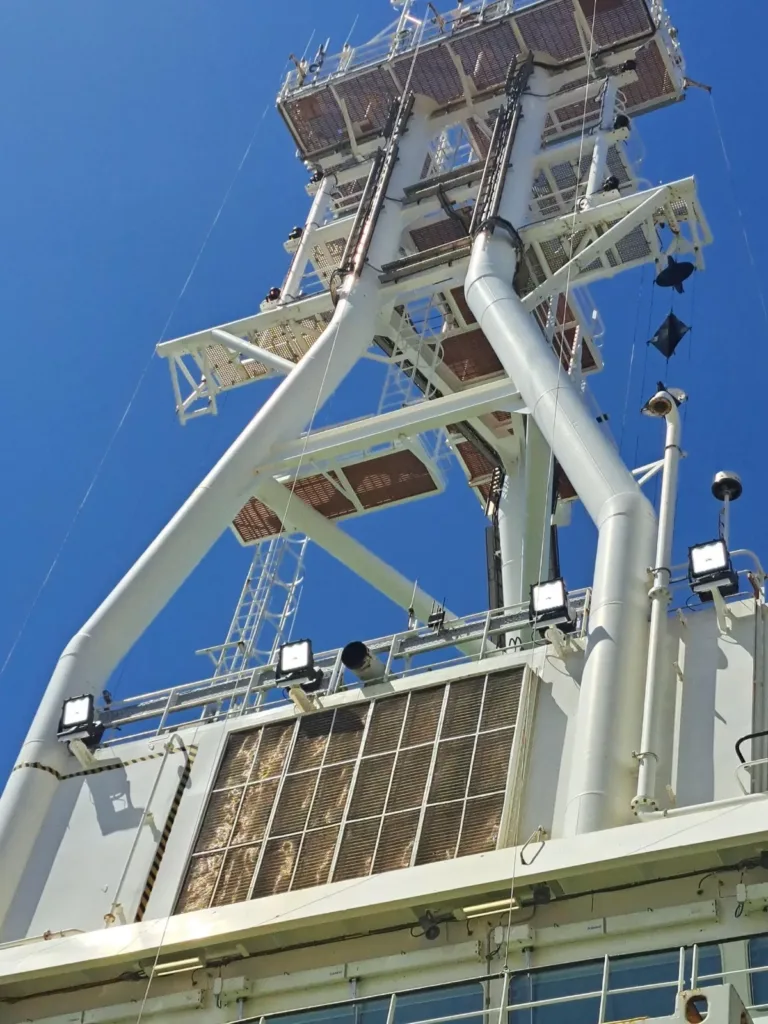
The 316L line is also installed at the P&O ferry terminal in Europoort and at the BUSS Terminal Eemshaven, among other locations.
That varies by work area. EN 12464-2:2024 requires 100 lux on stairs and walkways, measured on the steps, 150 lux on a pipe deck, 200 lux at pump zones and life-saving equipment, and 300 lux on a drill floor. For offshore installations, the standard does not specify an increased alternative value, so the required value is immediately the design value.
Usually the fixture is not the problem, but the optics and the placement. We first create the lighting design on the ship's drawing and per work station, and only after that follows the choice of the fixture.
No. We provide material, salt spray testing with test duration, and onboard references. Where class approval is a hard requirement, we are not the right supplier.
No, not at this moment.
Solid 316L, featuring brackets and fasteners in the same material class and a 20-year warranty on the housing.
Yes, there are DC versions. When making your request, please specify which system is on which deck, and we will tailor the design and group layout accordingly.
Yes, that is for the Crane Light Stabilizer. That holds the bundle on the work surface while the crane moves.
We provide the design, fixtures, and technical support during installation. The assembly work itself is done by the shipyard or your own technical service. See also installation and maintenance.
Then the values for shipyards and docks apply: 50 lux for hull treatment, 100 for painting and welding, and 200 for assembly work.
That depends on the position. We provide the L-values per execution and include the maintenance factor in the design, precisely because replacement at sea is a major operation. More on LB values and lifespan.
Send us the vessel type, deck layout, and the operations for which the ship will be used. You will receive a lighting design per workstation, tested against EN 12464-2:2024, featuring an arrangement for each position.
| Response | within 1 working day, by an engineer |
| Lighting calculation | free of charge, per zone |
| Test luminaire | on your own mast, upon request |
| Warranty | 5 years complete, 10 years on the housing with maintenance contract |
Rather call directly: 033 785 9809