

Short answer
Height determines the beam: the higher the luminaire hangs, the narrower the optic and the more lumens each luminaire needs.
Industrial lighting is preferably mounted at a height between 6 and 12 meters, depending on the application, the type of luminaire, and the desired illuminance at working surface level. There is no universal standard: the correct mounting height for industrial luminaires depends on factors such as the hall size, required lux values, and the beam angle of the luminaire. The following sections cover the most frequently asked questions about lighting height in industry.
6 to 12 m
usual mounting height of hall lighting
1 to 1.5 ×
times the height as the maximum spacing between luminaires
6 to 20 m
mast height on outdoor sites
What factors determine the correct mounting height?
There isn't a single answer to the question of how high industrial lighting should hang. The correct mounting height is the result of a combination of factors: the desired illuminance on the work surface, the beam angle of the luminaire, the dimensions of the space, and the presence of obstructions such as cranes or installations. They directly influence each other, and if you ignore one factor, the rest of the calculation will also be incorrect.
The key factors at a glance:
What determines the mounting height
By LED work lights for machinery different rules apply than for general hallway lighting. Here, the position relative to the work object is more decisive than the absolute mounting height.
What are the recommended lux levels per industrial application?
European standards EN 12464-1 (indoor) and EN 12464-2 (outdoor) specify the required illuminance levels for different situations. For corridors and storage areas, 100 to 200 lux is generally sufficient, while precision production work requires 500 lux or more. The mounting height also influences how many lumens a luminaire must deliver to achieve these values.
Global guideline values per environment:
| Environment | Guide value |
|---|---|
| Storage areas and aisles: | 100 to 200 lux at floor level. |
| General production areas: | 200 to 300 lux at work surface height (approx. 0.85 meters above the floor). |
| Accurate production and assembly work: | 500 to 750 lux, sometimes supplemented with task lighting. |
| Inspection and Quality Control | 1000 lux or more, depending on the detail size. |
| Outdoor areas and riding routes: | 20 to 50 lux at lane level, with higher values at loading and unloading areas. |
| Crane operators and aerial platform operators | Specific standards depending on the task, also considering contrast and shadow effects. |
The lux value on the work surface is the end result of the combination of lumen output, mounting height, reflection from ceilings and walls, and the light distribution angle of the luminaire. A lighting calculation clarifies whether the chosen combination meets the standards.
How do you calculate the optimal ridge height for an industrial hall?
The optimal mounting height is calculated by combining the required illuminance value on the work surface with the luminaire's lumen output, light distribution curve, and the ambient reflection values. In practice, lighting simulation software such as DIALux or Relux is used for this purpose.
A simplified approach works as follows: first, determine the desired illuminance (lux) and the surface area to be illuminated. Then, use the photometric data of the luminaire to calculate how many luminaires are needed at what height and spacing. As a rule of thumb, the spacing between luminaires in high-bay applications (above 8 meters) should not exceed 1 to 1.5 times the mounting height to ensure uniform illumination.
Would you like to know more about how lumen values translate to practical lighting performance on-site? Then check out the page on Luminous flux and lumens for a technical background.
Calculator
Which beam and which grid suit your mounting height?
Enter the height at which the luminaires will hang and the illuminance you need on the working plane. The tool uses the measured light distribution of our luminaires and finds, for each beam, the largest spacing at which uniformity still reaches 0.60.
Advice
m
spacing between luminaires, maximum
luminaires per 1,000 m²
W/m²
installed power
All beams at this height
| Luminaire and beam | Lux directly below a luminaire | Max. spacing | Per 1,000 m² | W/m² |
|---|
Cross-section
Indication for a continuous grid with maintenance factor 0.90, 30 percent reflectance and 15 percent edge loss, without machines or racking. The Linear 600 mm is calculated at half the luminous flux of the 1,200 mm. Spacing is capped at 1.5 times the height above the working plane, because the edge zones along the walls would otherwise become too dark. For a quotation we calculate your hall in DIALux.
What happens if industrial lighting is hung too high or too low?
An incorrect mounting height has direct consequences for both lighting performance and workplace safety. If lighting is hung too high, the illuminance on the work surface drops significantly due to the square of the distance loss of light. The result is insufficient lux levels, uneven lighting, and higher energy costs because more or more powerful luminaires are needed. If the lighting is hung too low, glare, shadows, and safety risks arise.
Specifically, an incorrect mounting height means:
Consequences of the wrong height
In environments with cranes, forklifts, or other moving machinery, an excessively low mounting height also poses a physical safety risk. The luminaires can be struck by equipment, leading to damage and downtime. Therefore, correct industrial lighting height is not only a matter of lighting performance but also operational safety.
Are there different requirements for outdoor lighting on industrial sites?
Outdoor lighting for industrial sites requires a different approach than indoor lighting. The mounting height of luminaires on poles is typically between 6 and 20 meters, depending on the site size, activities, and desired lighting uniformity. Additionally, light pollution for the surroundings and full-cutoff requirements play an important role.
Specific considerations for outdoor areas:
Outdoor sites
More information on the specific requirements for industrial site area lighting help determine the right combination of pole height, luminaire type, and light distribution.
Lighting calculation
We determine height, beam and grid in one calculation
Send the dimensions, the clear height and what happens in the hall or on the site. You receive a DIALux calculation with the mounting height, the optic and the grid that brings every zone up to the standard, including uniformity and glare.
Request a lighting calculation
Free of charge and without obligation · Response within 1 working day from an engineer
When is a professional lighting design mandatory or necessary?
A professional lighting design is legally required when an installation must comply with specific safety standards, such as in ATEX zones, emergency lighting situations, or for new construction requiring a building permit. Beyond these legal obligations, a professional design is highly recommended for any industrial environment where lighting directly impacts safety and productivity.
Situations where professional design is necessary, even without a legal requirement:
Self-check
Does your situation need a lighting design?
If you recognise one or more of these situations, a rule of thumb does not give enough certainty.
- Halls with a clear height above 8 meters, where standard calculation rules are insufficient.
- Environments with extreme conditions such as high temperatures, corrosion, or explosion hazards.
- Locations with changing activities requiring different lux levels in the same space.
- Projects requiring substantiation for energy performance, payback period, or subsidy applications.
- Outdoor areas with multiple masts where light uniformity and light pollution must be ensured.
An lighting design based on photometric simulation not only ensures compliance with standards but also prevents costly retroactive corrections. The investment in a solid design pays for itself through lower installation costs and better performance over the installation's lifespan.
Luminaires by height
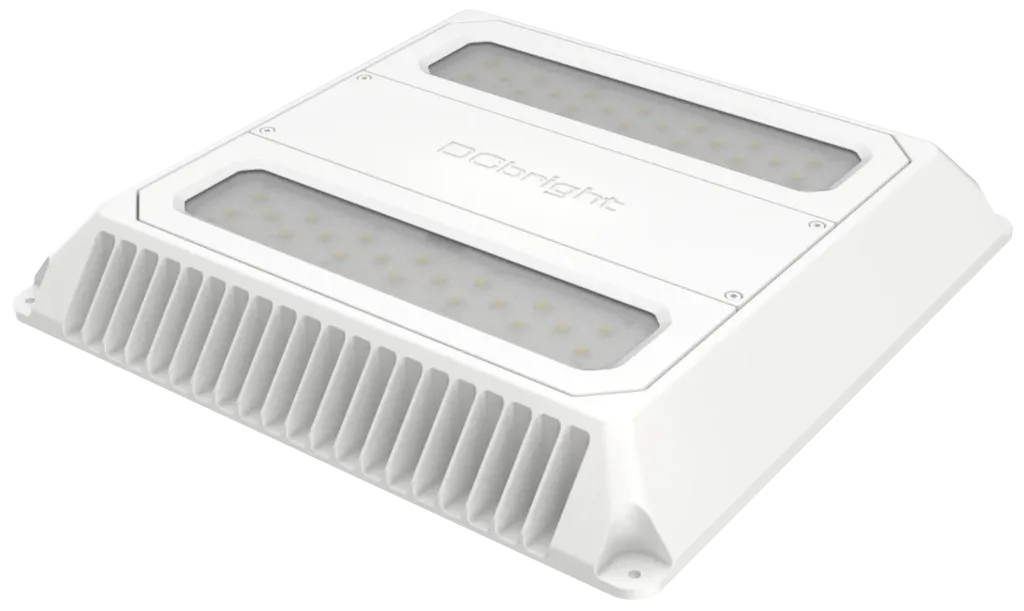
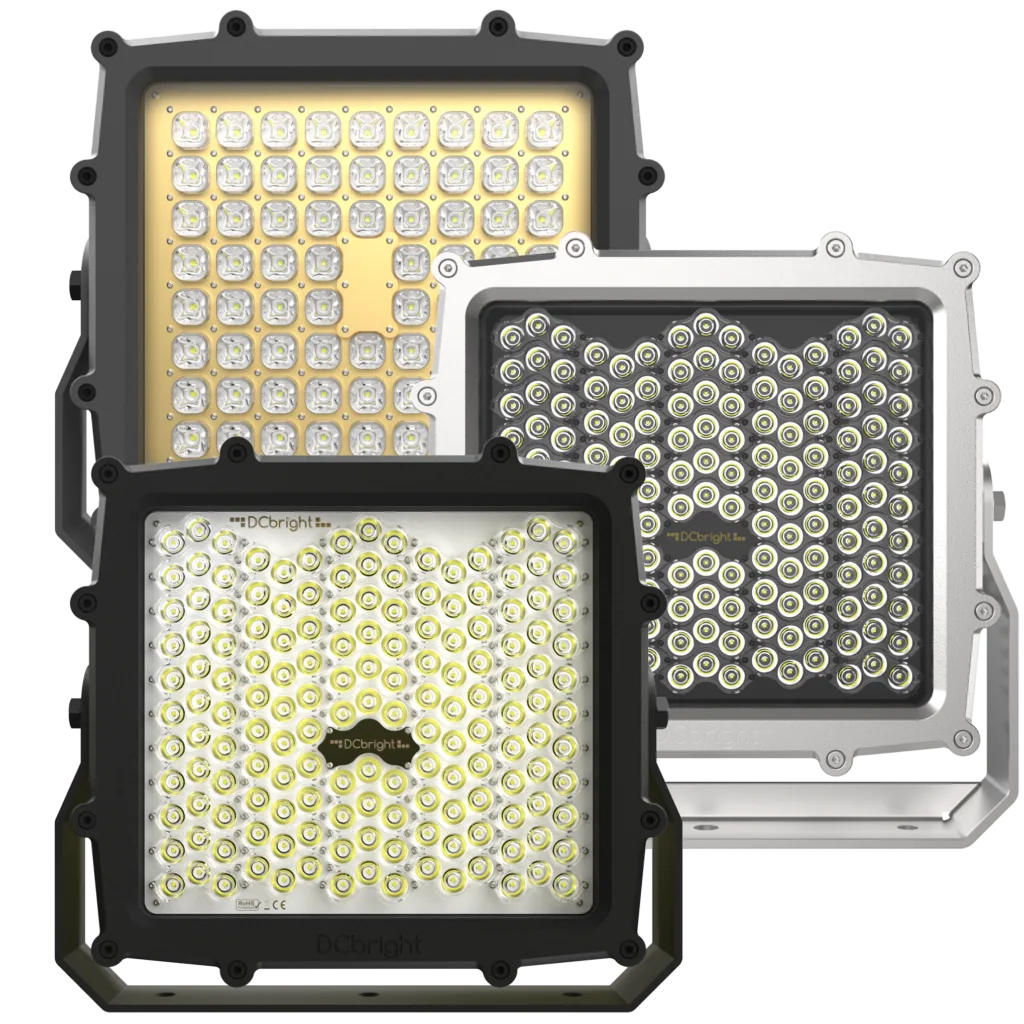
Practical example: Van Gelder Nijkerk
Project · Site lighting
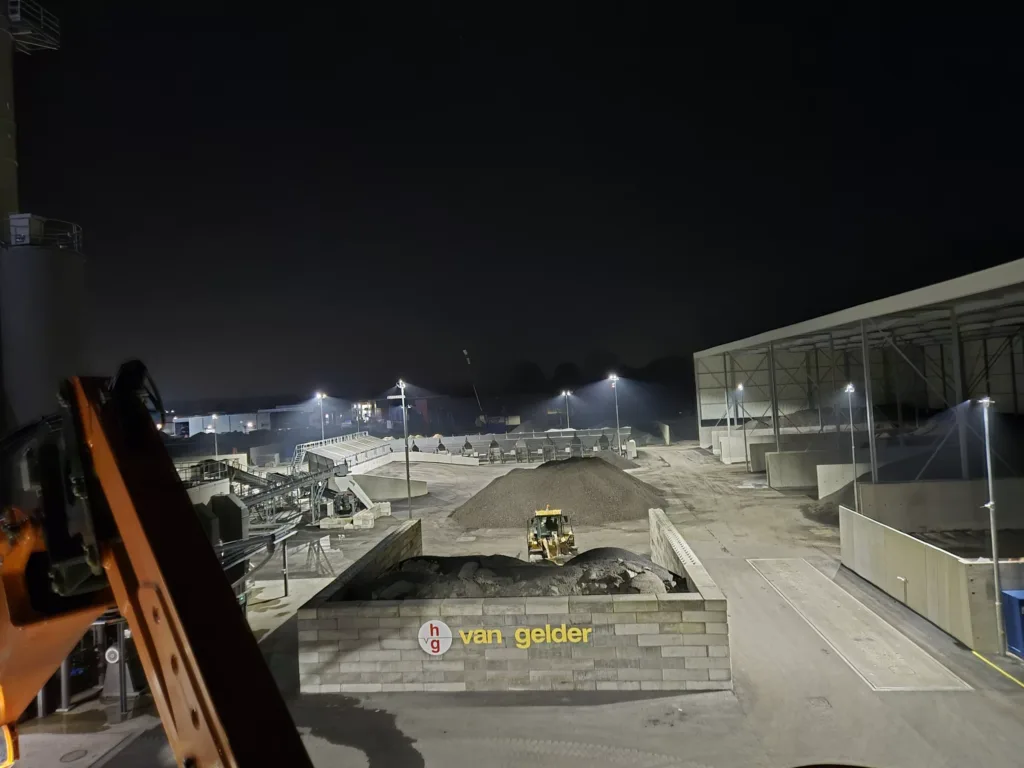
Van Gelder asphalt plant in Nijkerk
Lighting design, engineering, installation and final aiming of 36 DarkLicht D luminaires on 15 masts of 10 and 12 m. The site gets 20 lux and the work zones 50 lux, while the canal with its bat routes stays dark.
36
DarkLicht D luminaires on 15 masts of 10 and 12 m
20 and 50 lux
site and work zones, uniformity 0.55
< 0.3 lux
on the water along the bat route
Van Gelder built a new asphalt plant in Nijkerk, close to a canal with bat routes. JEL took care of the lighting design and engineering, the installation and the precise re-aiming of the luminaires. The result was 36 DarkLicht D-series luminaires on 15 new lighting masts of 10 and 12 m, kept as low as possible and with a full cut-off light distribution. The installation delivers 20 lux on the site and 50 lux in the work zones, with a uniformity of 0.55, and less than 0.3 lux on the water.
A taller mast seems attractive because fewer masts are needed, but the higher a luminaire is mounted, the further its light can reach and the harder it becomes to keep that light on the site. Where the surroundings are sensitive, a lower mounting height with targeted optics can be the better choice.
Mounting height is therefore not a stand-alone parameter. It is determined together with the wattage per luminaire, the optics and the required illuminance per zone. Only a lighting calculation of the whole site shows whether that combination achieves the required level and uniformity.
Read more about the Van Gelder Nijkerk project
Further reading
How JEL Products Helps Determine the Correct Mounting Height for Industrial Lighting
The mounting height of industrial lighting is not just a minor detail: it is a technical decision that directly affects safety, energy consumption, and working conditions. JEL Products offers industrial organizations a comprehensive approach to finding the right lighting solution, including the optimal mounting height for every type of environment.
What JEL Products offers in this regard:
- Professional lighting design based on photometric calculations for your specific location and activities.
- Luminaires for extreme conditions such as high temperatures and corrosion, assembled and custom-built in the Netherlands.
- Guidance from engineering to installation and commissioning, including masts and foundations for outdoor locations.
- Advice on standards, certifications, and potential subsidy or financing opportunities.
Whether it's a production hall, an outdoor area, or an environment with special requirements, we'll think along with you from the first technical question. Feel free to contact us via contact page for a no-obligation discussion about the lighting height and luminaire selection that suit your situation.
Related Articles
- What certifications should an industrial LED luminaire have?
- What does lumen mean in industrial LED lighting?
- Can industrial LED lighting be linked to occupancy detection?
- Why is good visibility important in container handling?
- What is the difference between horizontal and vertical illuminance in harbors?