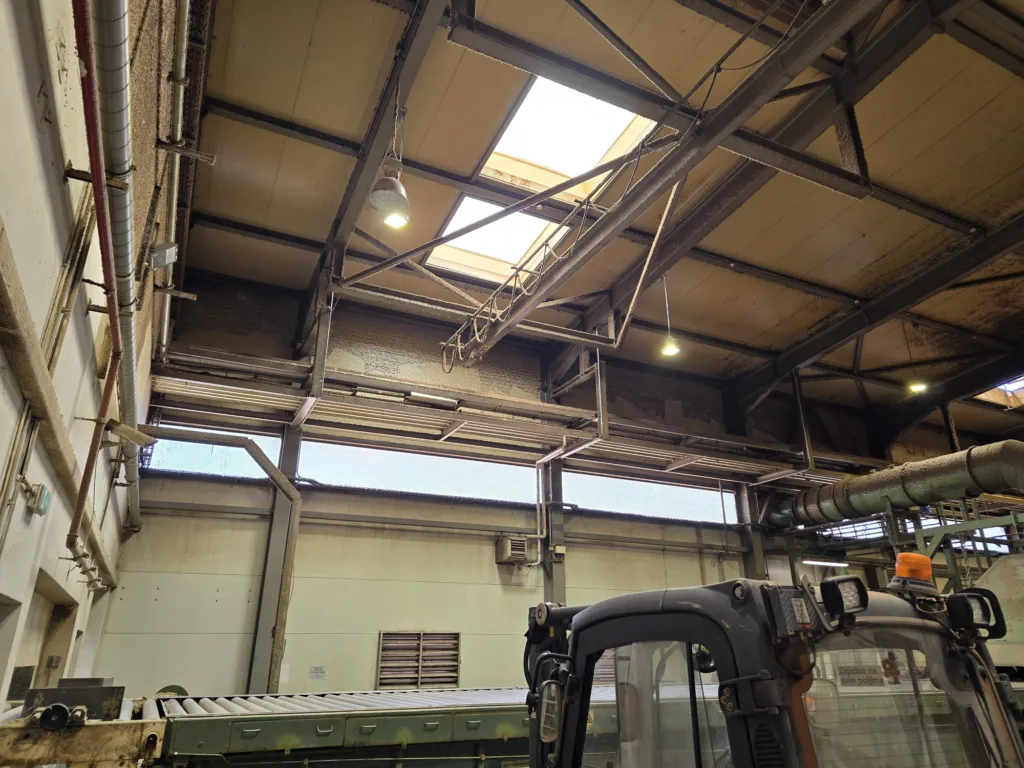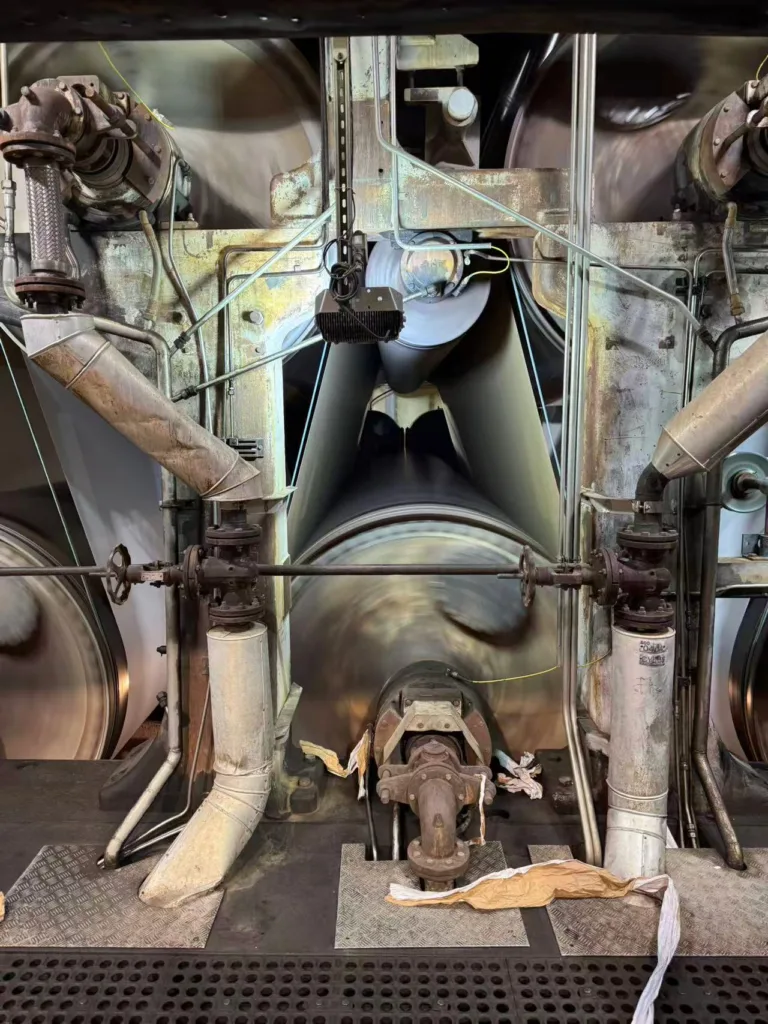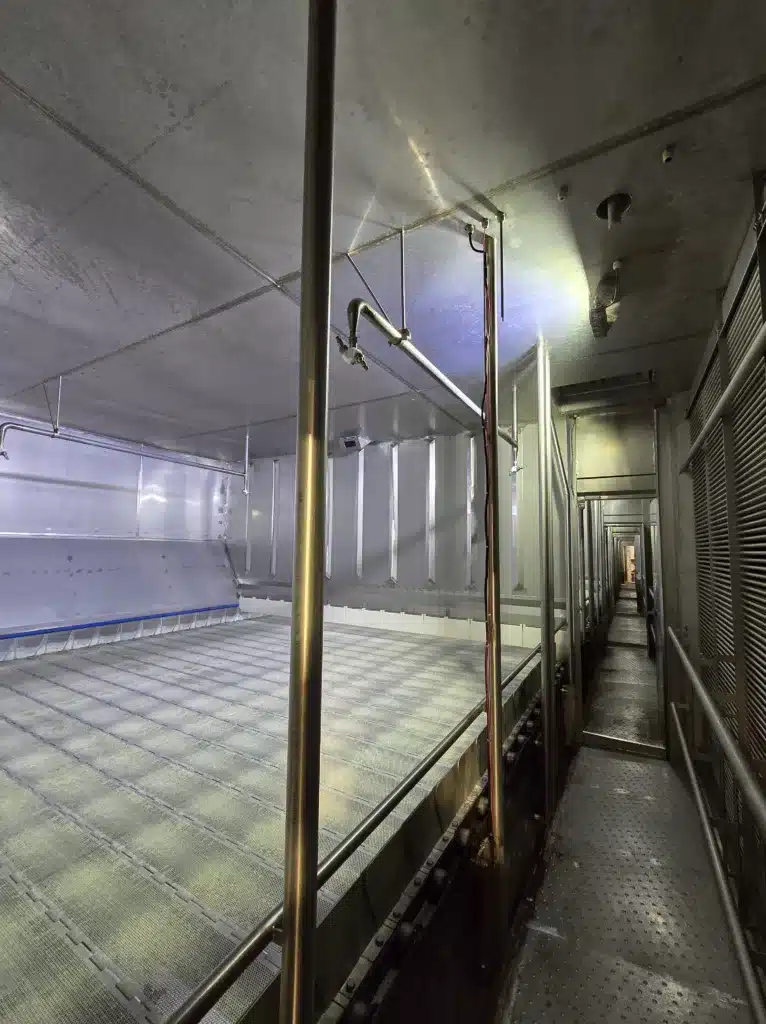

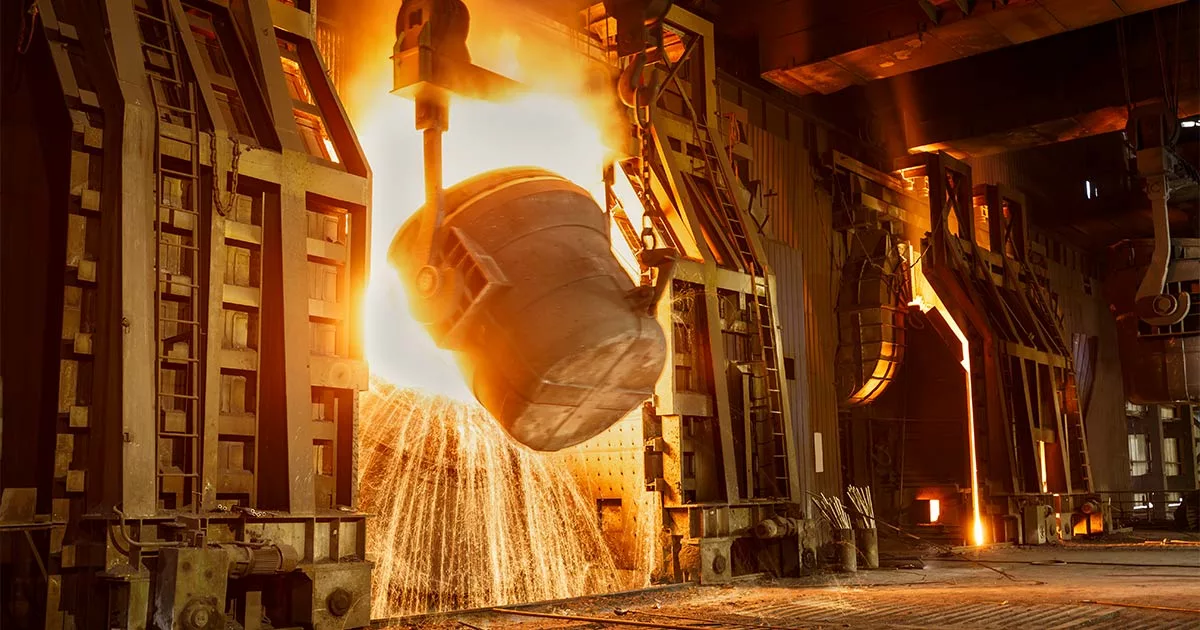
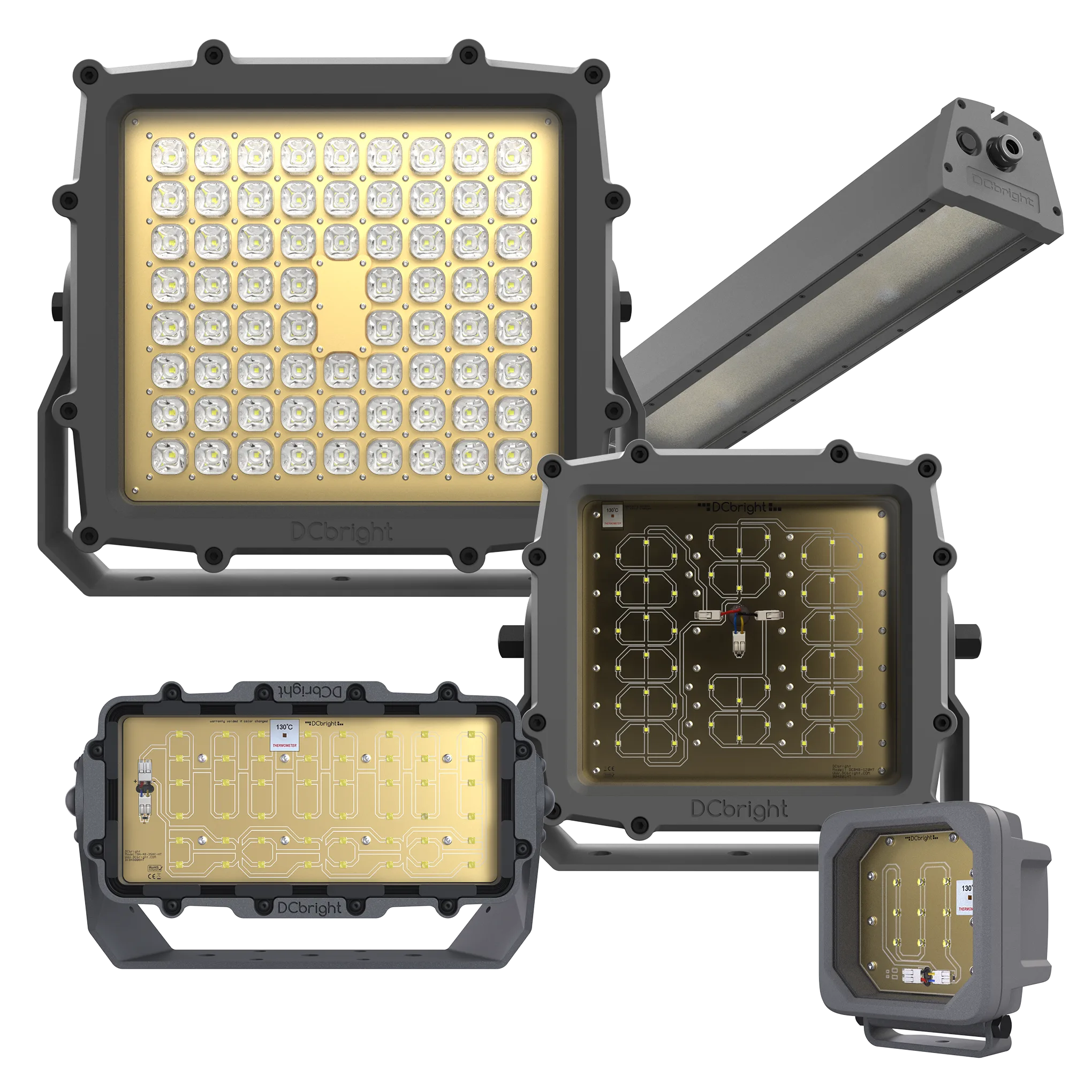
Six luminaires and two driver boxes for steel mills, foundries, glass production, furnaces, drying sections and process plants. From compact work light to 65,000-lumen floodlight.

Continuous operation, with 5-year warranty
L90B05 at +120 °C, almost six years of continuous operation
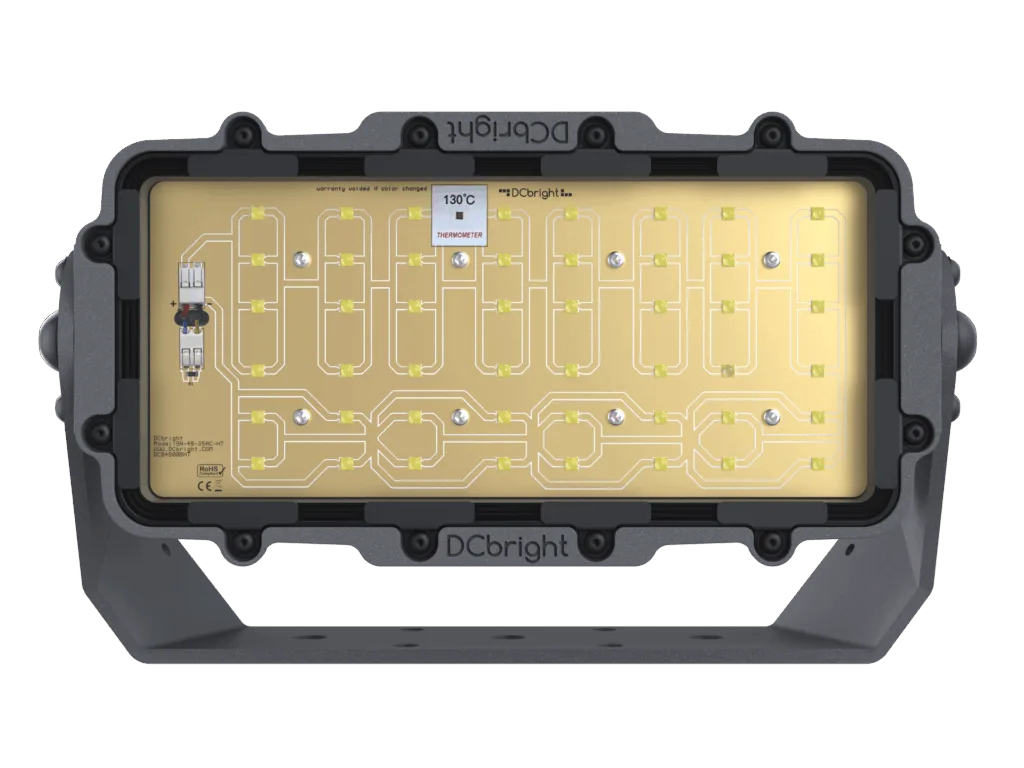
Most powerful luminaire of the line, Orca HT
Industrial LED luminaires are specified up to +50 °C ambient temperature. Above that, a standard luminaire ages at an accelerated rate: first the driver, then the plastic optics and the cable insulation. Above an oven, a rolling mill or a drying section, the temperature at mounting height easily exceeds that limit by tens of degrees. The HT line is designed for those positions and is the only European LED line that specifies continuous operation up to +120 °C and provides a warranty for it. Peaks up to +130 °C are permitted. The high temperature limit results from the thermal design of the complete system, from the housing to the driver which is located outside the hot zone.
The line is dead Tata Steel IJmuiden, VPK Paper, Farm Frites and Rockwool.
The first question we ask is not how much light is needed, but how hot it gets at the location where the luminaire is hung. That is rarely the temperature measured at work floor height. Beneath a hall roof above an oven, on a casting crane, or above the drying section of a paper machine, the ambient temperature is dozens of degrees higher, and with radiant heat from a glowing product, the air temperature is not even the decisive value. We therefore ask for a measurement at mounting height, or we come and do it ourselves. Based on that, the position falls into one of four zones.
Up to +50 °C at mounting height, the standard range, specified from -45 °C to +50 °C, is sufficient. An HT version adds nothing and costs more. If you doubt whether +50 °C will be exceeded in summer, a single measurement on a hot day in August says more than a generous margin in the specification.
The operating range of the HT line. All six luminaires can be used here in an AC version, continuously up to +120 °C and with a five-year warranty. DC versions (24 V) for machinery and installations with a low-voltage power supply can be used up to +110 °C.
Short-term temperature peaks of up to +130 °C are permitted without affecting the warranty: opening oven doors, batch changes, hot steam cleaning cycles. The luminaires are designed for this, provided that the average ambient temperature remains within +120 °C.
Above +130 °C, the standard warranty is void and it becomes custom work. Our engineers calculate per position what is possible with shielding, standoff mounting, and HT glass optics that bring the light to the spot from a cooler position.
An LED luminaire consists of a light source, an optic, a housing that dissipates heat, cabling, and a driver. Each of these five has its own temperature limit, and the lowest one determines the lifespan of the whole. In a standard luminaire, that is the driver: the electrolytic capacitors within it age the fastest. Next are the plastic lens, which deforms and becomes cloudy above infrared radiation, and the PVC cable insulation, which hardens and cracks.
The HT line raises every limit individually. The housing is thermally rated for an ambient temperature of +120 °C and features a gold-colored IR reflector on the process side. The optics are made of chemically tempered glass or borosilicate. The wiring is SiHF-OB silicone cable. And the driver is not located in the fixture but in a DRB driver box, IP67, in a location where the maximum temperature is +50 °C; there, it achieves a minimum of 100,000 hours at Tc 75 °C and 130,000 hours at Tc 50 °C.
The supplied cable between the driver box and fixture is 15 or 25 meters, depending on the version. Longer is possible. The driver output is 50 V DC and the limit is a maximum voltage drop of 2 V, so the achievable length follows from the cable cross-section: for a 120 W HT fixture, this is 60 meters at 2.5 mm² and 381 meters at 16 mm². The table per cross-section and power can be found in the manual.
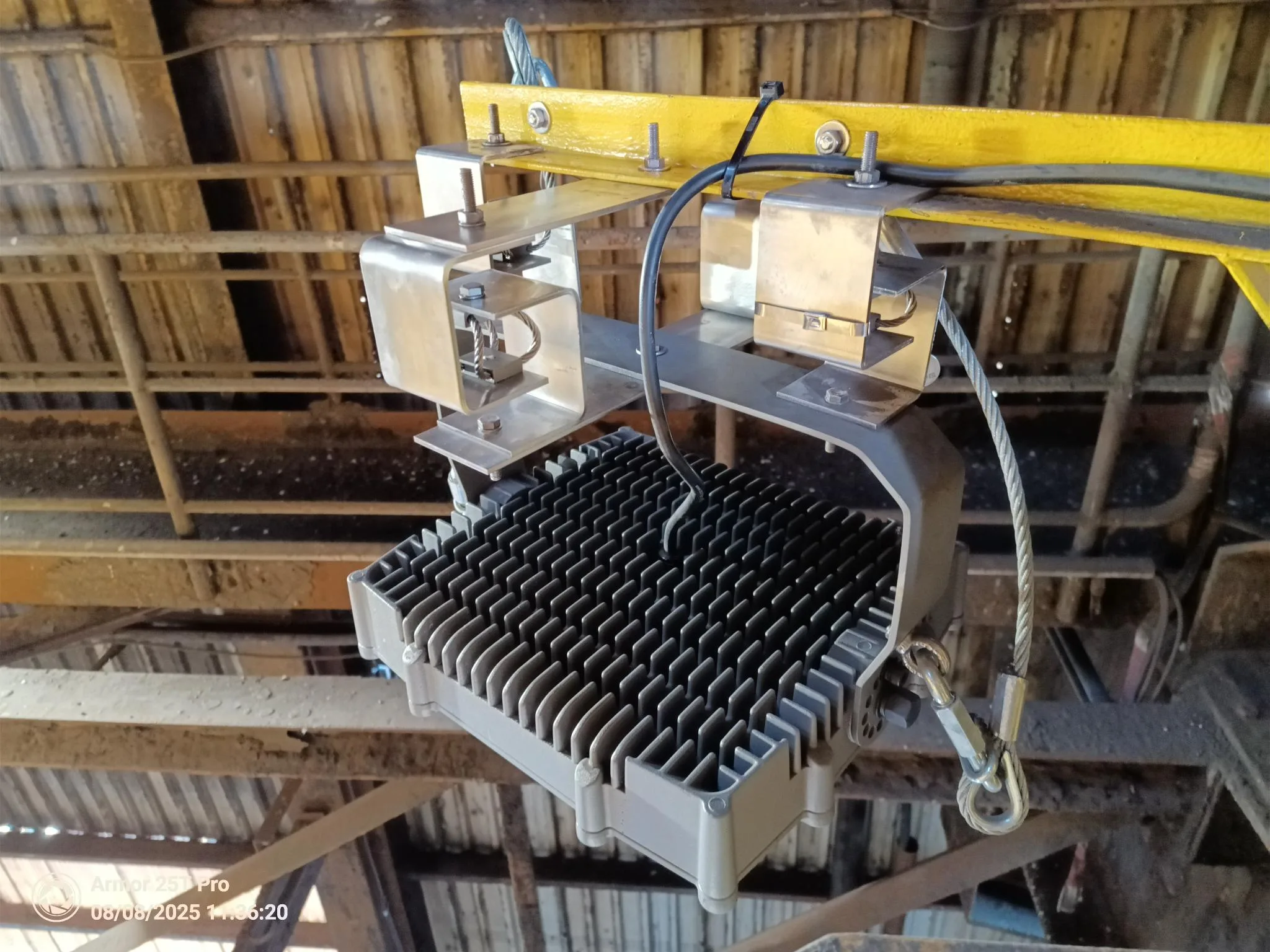
Orca HT on a steel grab crane. The driver is outside the hot zone.
The gold layer on the process side
Much of the infrared radiation between 800 and 2,500 nm is reflected by the gold layer of the IR reflector. What the glass transmits therefore goes back into the process and not into the housing. Calculated across the complete system, with the double passage through the glass, between 82 and 94 percent of the incident radiation between 800 and 1,200 nm is reflected back out; above 1,400 nm, the glass itself absorbs the majority.

The practical consequence: driver service takes place in the cool zone, during production. Whatever hangs in the hot zone requires no maintenance other than cleaning the glass and cooling fins during a scheduled stop.
The lifespan of an LED module decreases exponentially with the temperature at the LED junction. On the HT line, this roughly translates to a halving per 15 to 20 °C ambient temperature. A datasheet that lists only a single lifespan therefore means nothing without the temperature at which it was determined; usually, this is +25 °C. We provide the curve as L90B05, which is the number of operating hours after which at least 90 percent of the luminous flux remains with a failure rate of at most 5 percent.
In continuous operation, 51,400 hours is nearly six years; in a two-shift, twelve-hour system, it is almost twelve. In a position above a furnace or rolling mill, where a standard fixture is replaced within one to two years, that means three to five fewer replacement cycles per fixture. Every eliminated cycle is work at height above a hot process, usually during a shutdown, using a mobile elevating work platform and a work permit. That is where the premium price of an HT fixture earns itself back, not in energy consumption.
If you would like it calculated for your position, we will do so based on your stop frequency and hourly rate. An initial impression gives the Savings calculator.
Which fixture is suitable follows from the mounting position and the lighting requirement. Below is the line from compact to powerful; the core figures are listed below them side by side.
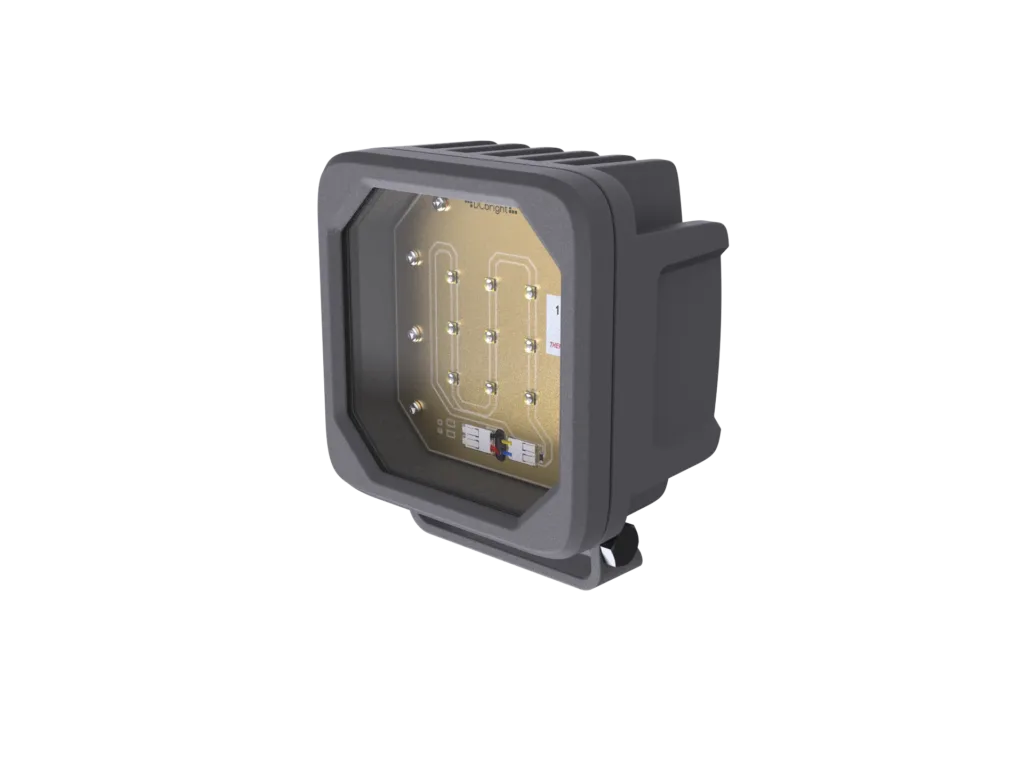
The compact heat-resistant work light for task and inspection lighting close to the process, and for small rooms such as climate chambers. From 2,600 lumens.
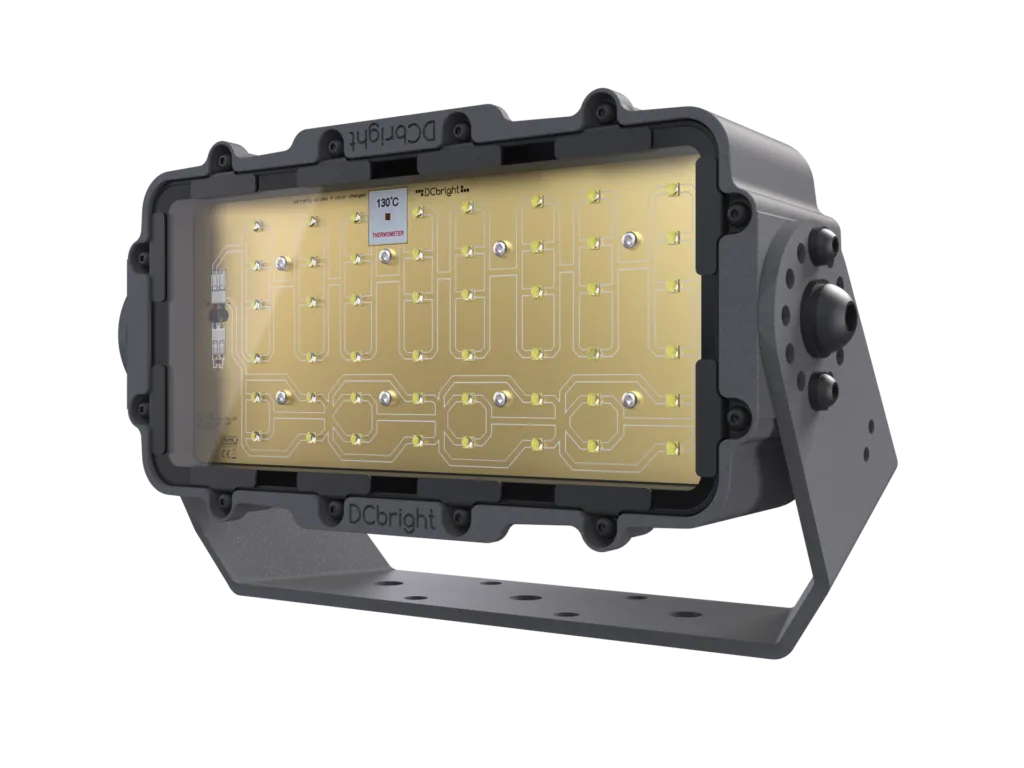
The proven all-rounder of the HT line, also available fully in 316L stainless steel for the food industry and corrosive environments. The CHEM version exists for chemically aggressive processes; it deliberately carries a 3-year warranty because of the aggressiveness of the environment.

The heat-resistant canopy light for drying tunnels and ceiling mounting in hot process areas.
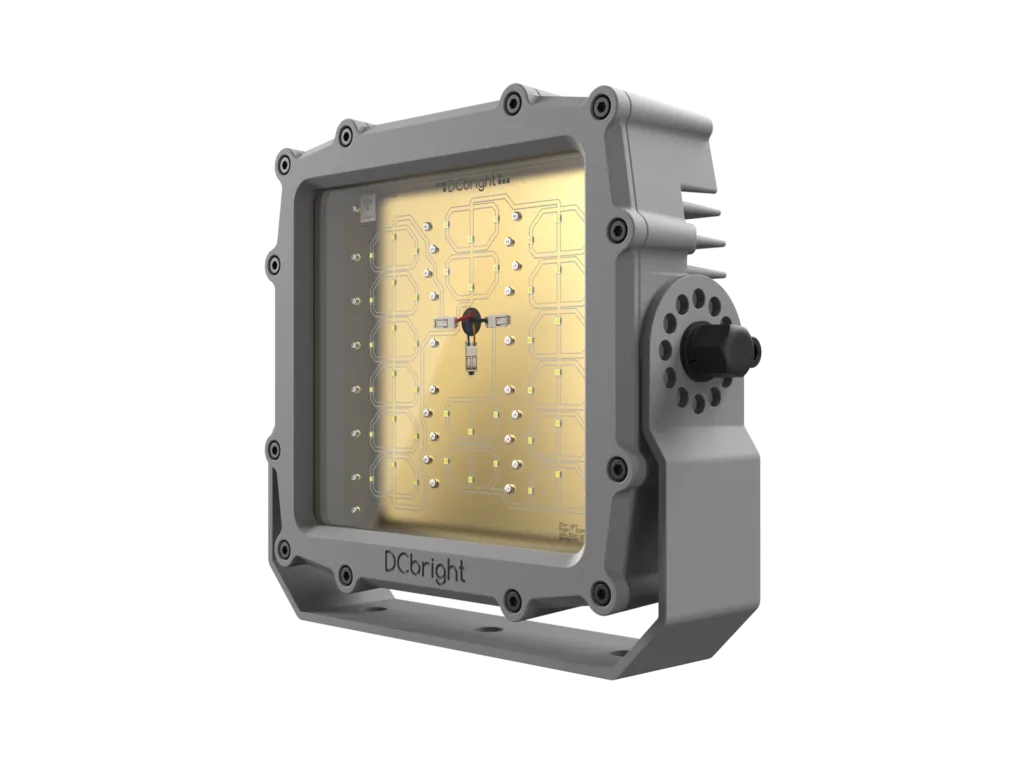
The robust mid-range floodlight for halls and process lines where heat and mechanical load come together.
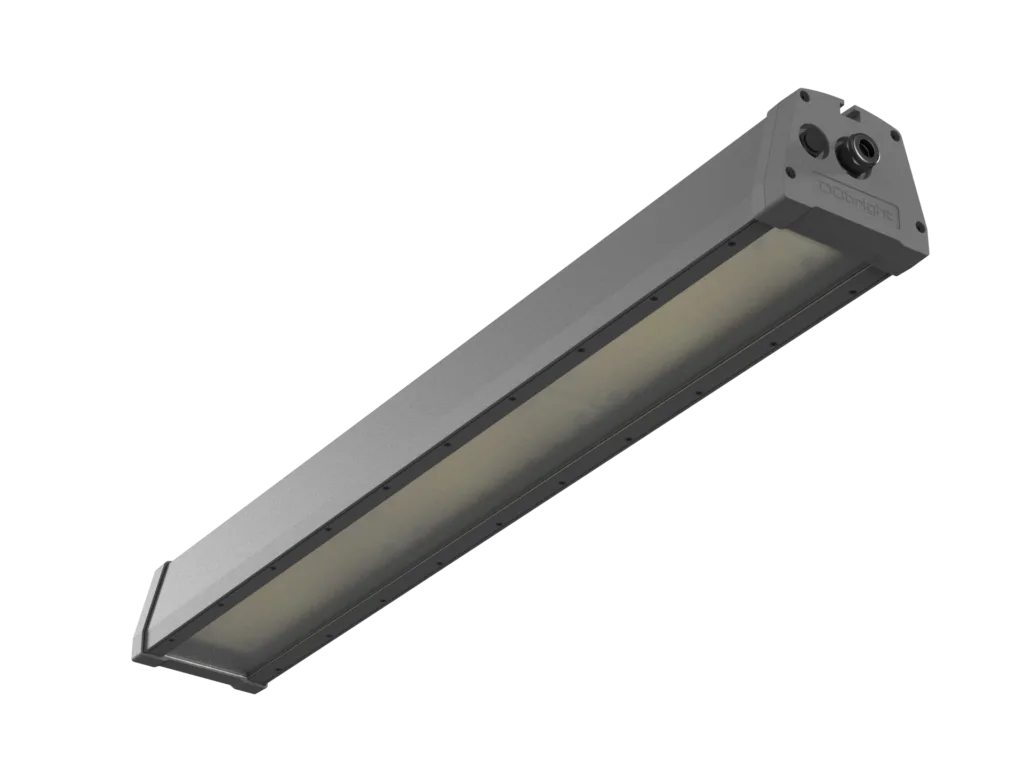
Linear light across the web width, from 300 to 1,200 mm. The standard above paper machines and dryer sections.

The most powerful of the line, up to 65,000 lumens, with HT glass optics of 20, 40 or 60 degrees for directed beams on high positions.
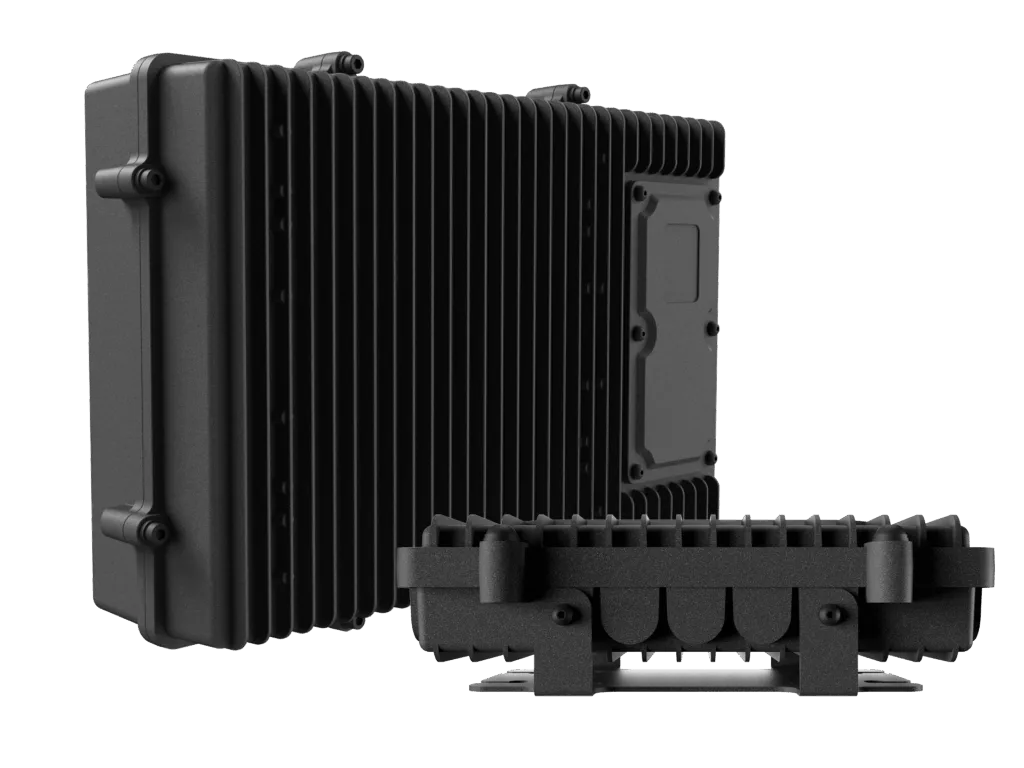
External driver boxes for a single driver up to 320 W (DRB-1) or systems up to 2,000 W (DRB-2), IP67, placed where the maximum temperature is +50 °C. Minimum of 100,000 hours at Tc 75 °C, 130,000 hours at Tc 50 °C.
| Product | Type | Power | Luminous flux | Max. Ta AC / DC | Versions |
|---|---|---|---|---|---|
| Goby HT | compact work lamp | 13 W | 2600 lm | +120 / +110 °C | AC and DC 24V |
| Snapper HT | all-round floodlight | 35 W | 7,000 lm | +120 / +110 °C | AC, DC, 316L SS and CHEM |
| Manta HT | canopy light | 75 W | 14,400 lm | +120 °C, AC | surface-mounted and recessed |
| Barracuda HT | mid-range floodlight | 120 W | 20,600 lm | +120 °C, AC | aluminium and 316L |
| Linear HT | linear, 300 to 1,200 mm | 30 to 120 W | 6,400 to 25,600 lm | +120 / +110 °C | AC and DC, optics 20/40/60/120° |
| Orca HT | high-output floodlight | 240 or 320 W | 51,000 to 65,000 lm | +120 °C, AC | HT glass optics 20/40/60° |
| DRB-1 / DRB-2 | external driver box | up to 320 / 2,000 W | n/a | cool zone, +50 °C | IP67, 15 or 25 m cable, extendable |
Values per version at Ta 25 °C, including driver consumption. DC versions (24V) can be used up to +110 °C; all AC versions up to +120 °C continuously, with peaks up to +130 °C without warranty consequences.
For every HT request, we record the same data, because faults in hot environments almost always occur in the same place. The ambient temperature at the mounting height, measured and not estimated, and in the case of a glowing product, also the distance to the radiation source. The position of the driver box and the cable length to it; a DRB box in a control cabinet that itself reaches +55 °C gains nothing. The cleaning method, because dust and grease on the cooling fins insulate and increase the temperature of the luminaire; in the case of heavy contamination, the AC version throttles itself to protect the LED. The mounting material and the thermal expansion of the structure the luminaire is attached to. And the warranty conditions for continuous operation above +85 °C, so you know in advance what applies.
The two estimation errors we encounter most often: a luminaire with a high IP rating considered heat-resistant, while IP says nothing about temperature, and applying a datasheet lifespan at +25 °C to a location of +90 °C.
Radiant heat from glowing steel is decisive here. Resistant to direct infrared radiation, driver outside the hot zone, chemically hardened glass, mounting above rolling lines and casting platforms. Proven at Tata Steel IJmuiden.
Also for rolling mills, continuous casting and mounting above casting platforms.
Heat, steam and dust combined above the dryer section. IP67 housing against condensation, replacement only during machine stops, linear light across the web width. Proven at VPK Paper.
From drying section to corrugated board line.
Resistant to heat and daily cleaning cycles. 316L stainless steel versions, glass instead of plastic, grease-vapour-resistant seals. Proven at Farm Frites.
Also for bakeries, sterilisation lines, laundries and frying lines.
Cyclic loading from extreme heat to frost. AC up to +120 °C and DC up to +110 °C, condensation-resistant, compact Goby HT for small chambers, dimmable for test protocols.
Also for burn-in rooms and cyclic test protocols.
Radiant heat from glowing product and high ambient temperatures. HT glass optics for directed beams on inspection positions, high colour rendering for quality control.
From glass furnaces and tempering to smelters.
Continuous use up to +120 °C around annealing furnaces, drying tunnels and process installations. Custom recessed and feed-through solutions, engineering calculated per position.
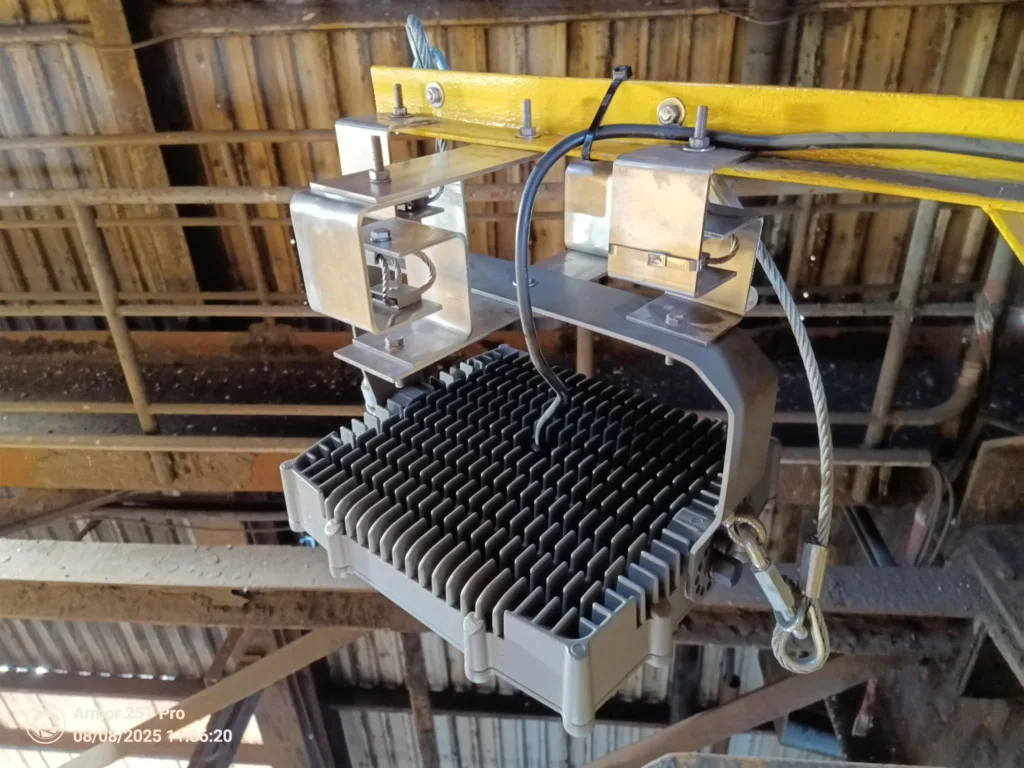
Steel process: positions where conventional lighting kept failing.


GOHT01 · GOHT02
| Luminous flux | 2600 lm |
| Power | 13 W, 200 lm/W |
| Beam | 120° extra-wide |
| Environment | AC +120 °C, DC 24V +110 °C, peaks +130 °C |
| Protection | IP66/67/68/69K, IK09 |
| Front | chemically hardened glass |
| Cable | silicone, to DRB driver box (AC) |
| Warranty | 5 years up to +120 °C |
SNHT01 to SNHT05
| Luminous flux | 7,000 lm |
| Power | 35 W, 200 lm/W |
| Beam | 120° extra-wide |
| Environment | AC +120 °C, DC 24V +110 °C, peaks +130 °C |
| Protection | IP66/67/68, SS and CHEM also IP69K, IK08 |
| Versions | AC, DC, 316L SS (AC and DC), CHEM |
| Warranty SS | 20 years on the 316L housing, 5 years on the rest |
| Warranty CHEM | 3 years, because of the aggressiveness of the environment |
MNHT01 · MNHT02
| Luminous flux | 14,400 lm |
| Power | 75 W, 192 lm/W |
| Beam | 120° extra-wide |
| Environment | AC +120 °C, peaks +130 °C |
| Protection | IP66/67/68/69K, IK08 |
| Mounting | surface-mounted (MNHT01) or recessed (MNHT02) |
| Application | drying tunnels, ceilings of warm process rooms |
| Warranty | 5 years up to +120 °C |
BAHT01 · BAHT03
| Luminous flux | 20,600 lm |
| Power | 120 W, 172 lm/W |
| Beam | 120°, HT optics 20/40/60° on request |
| Environment | AC +120 °C, peaks +130 °C |
| Protection | IP66/67/68/69K, IK09 |
| Versions | aluminium (BAHT01) or 316L (BAHT03) |
| Cable | SiHF-OB silicone, 15 m, to BLD320 in DRB-1 |
| Warranty | 5 years up to +120 °C |
LVHT01 to LVHT08
| Luminous flux AC | 6,400 to 25,600 lm, 300 to 1,200 mm |
| Luminous flux DC | 3,900 to 15,600 lm |
| Power | AC 30 to 120 W, DC 22 to 88 W |
| Beam | 20°, 40°, 60° or 120° |
| Environment | AC +120 °C, DC 24V +110 °C, peaks +130 °C |
| Protection | IP66/67/68/69K, IK09 |
| Application | linear light across the web width |
| Warranty | 5 years up to +120 °C |
ORHT01 · ORHT02
| Luminous flux | 51,000 lm (240 W) to 65,000 lm (320 W) |
| With HT optic | 39,000 to 52,000 lm |
| Power | 240 of 320 W, 203 to 213 lm/W |
| Beam | 120°, or HT glass optics 20/40/60° |
| Environment | AC +120 °C, peaks +130 °C, AC only |
| Protection | IP66/67/68/69K, IK09 |
| Front | chemically toughened glass or borosilicate |
| Warranty | 5 years up to +120 °C |
DRB-1 · DRB-2
| DRB-1 | one driver up to 320 W, 276 × 194 × 86.5 mm, 4.2 kg |
| DRB-2 | systems up to 2,000 W, 441 × 290 × 145 mm, 10.4 kg |
| Protection | IP67 |
| Placement | cooling zone, maximum +50°C; 15 or 25 m cable included, extendable up to a voltage drop of 2 V |
| Driver lifespan | minimum 100,000 hours at Tc 75 °C, 130,000 hours at Tc 50 °C |
| Control | mains, 0-10 V, DALI or LoRa Mesh |
| Maintenance | in the cool zone, without entering the hot zone |
For each product type, the datasheet and the photometric files are ready for direct download above: all versions and optics in EULUMDAT (.ldt), which DIALux and Relux read directly. 3D files and IES are available on request. View all datasheets and photometric files · Download the HT collection 2026 (pdf)
The questions that come up most often with HR applications, including the questions where the answer is no. If yours is not listed, please call 033 785 9809 or use the form.
Our AC luminaires operate continuously up to +120 °C ambient temperature, DC versions (24V) up to +110 °C. Brief peaks up to +130 °C are permitted without consequences for the warranty. Above +130 °C we offer custom solutions through engineering.
That depends on the ambient temperature, which is why we publish the full curve: L90B05 360,000 hours at +50 °C, 103,000 hours at +85 °C, 71,700 hours at +105 °C and 51,400 hours at +120 °C.
The driver is the weakest point: above its specified temperature it ages rapidly and fails, long before the LED itself wears out. Plastic lenses also deform and standard cables dry out.
IP says something about dust and water tightness, nothing about temperature. An IP69K luminaire can still fail within months at +80 °C if the driver and materials were not designed for it.
Yes. HT versions come with a 5-year warranty on the complete luminaire, subject to the additional HT conditions in Appendix A of the warranty statement. The Snapper CHEM-HT has a 3-year warranty due to the aggressive nature of chemical environments.
The full warranty statement can be downloaded on the page Product Quality and Warranty.
Because the driver is the most heat-sensitive component. In our system design, it is located outside the hot zone in a DRB driver box with a minimum lifespan of 100,000 hours at Tc 75 °C. The supplied cable is 15 or 25 meters long and can be extended as long as the voltage drop remains below 2 V. Maintenance on the driver is therefore performed in the cool zone.
Choose by mounting position and light requirement: Goby HT for compact and close-up, Snapper HT as the all-rounder, Linear HT above webs, Orca HT for high positions with high lumen output. Our lighting advisor calculates the positions.
Yes. The Barracuda HT and Orca HT are IP69K-classified: resistant to short-range high-pressure and steam cleaning. The Snapper HT is IP66, IP67 and IP68 in aluminum and IP69K in the 316L and CHEM version. Especially in the food industry, where daily cleaning cycles and heat come together, this is a decisive feature.
The AC luminaires have built-in temperature feedback that protects the luminaire against itself. If the internal temperature rises too high, for example due to heavy fouling on the cooling fins, the luminaire automatically dims down: with good airflow this is usually limited to around 50% of the luminous flux, in the most extreme case to 10%. In case of overheating the luminaire switches itself off completely. DC versions do not have this derating: they run at 100% up to +110 °C, with only a slight decrease in efficiency due to the high temperature. Regular cleaning of the cooling fins prevents derating from being needed.
Yes. The Snapper HT is available fully in 316L stainless steel, resistant to heat and daily high-pressure and steam cleaning. Fully 316L versions carry a 20-year warranty on the housing.
No. High temperature and explosion safety are different domains; our HT line is for hot, non-explosive zones. For ATEX zones we gladly refer you to specialised partners.
Yes. We deliver and support across the UK and Ireland, with CE and UKCA documentation, English datasheets and short lead times from the Netherlands.
Our fixtures are designed for industrial environments up to +120 °C, not for domestic fireplace surrounds. For compact industrial positions from +50 °C upwards, the Goby HT is the right choice.
In many cases, yes. Contact us to discuss a trial position in your process; we calculate the position in advance.
As a complete LED fixture, no: above approximately +130 °C, the electronics are the limitation, for us and for everyone. Offers that promise higher temperatures usually involve tubular fixtures with a porcelain socket and a traditional lamp, with corresponding efficiency and lifespan. Above +130 °C, the solution is engineering: mounting the fixture remotely, shielding it against radiation, and getting the light to the target location from a cooler position using targeted glass optics.
Standard industrial LED luminaires are specified from -45 °C to +50 °C. The HT series reaches +120 °C through a combination of measures: the driver sits outside the hot zone in a DRB driver box, the cabling is made of heat-resistant silicone, optics are glass instead of plastic, and the housing is made of specially selected and treated materials that withstand continuous heat.
Little. Maintenance is limited to cleaning the glass and cooling fins during planned stops: fouling insulates and raises the temperature of the luminaire. Because the driver sits outside the hot zone, driver service can even take place during production. So no line needs to be shut down for the lighting.
The AC versions are powered via the DRB driver box with a wide input range, suitable for common industrial mains voltages. In addition, 24V DC versions are available for mobile and machine-mounted applications. These are thermally limited to +110 °C ambient temperature.
Describe the position, process, and temperature at the mounting height, or send a photo if you do not know that temperature yet. An engineer will evaluate the position and indicate which version is suitable, or whether the position is above +130 °C and requires custom work.
We will respond within 1 business day.

You are speaking directly to an engineer
Free lighting design, trial position negotiable, 5-year warranty on HT
Prefer direct contact?
Photos of the position or the current luminaire help our engineers enormously. pdf, jpg or png · maximum 5 files · 15 MB
We use your data solely to assess your request.